
 Singapore
 China
China
TL;DR
Local cabinets warp fast—83% show moisture damage within 36 months. Upgrading to E0-grade imported boards solves this completely. Singapore custom cabinets with imported materials offer superior moisture resistance, giving tropical households full peace of mind. MRETTY leverages its 15,000㎡ smart factory to fully block material ageing through precision processing. European particleboard outlasts local plywood by up to 15 years. Invest now, say goodbye to warping for good.
Cost & Durability Analysis: Imported vs. Local Cabinet Materials in Singapore
Let's compare local boards against imported ones. European imported boards currently dominate the market—moisture resistance is up 40%, and they meet strict E0-level health standards.
Three years ago, homeowners tolerated some cabinet warping; veneer delamination near the equator seemed par for the course. Not anymore. Better materials can transform your kitchen into a lasting architectural asset.
Q2 2026, I inspected a BTO in Punggol with standard Asian boards in the kitchen. Under high humidity, it swelled 2mm in three weeks—doors wouldn't close, edge-banding detached completely, the whole run was scrapped.
❌ Common Pitfall: Buying local plywood based on upfront quote alone.
✅ Better Practice: Calculate 10-year total cost, including replacement expenses.
| Material Origin | Avg. Lifespan in SG | Formaldehyde Grade | Moisture Resistance | Starting Price/ft |
|:---|:---|:---|:---|:---|
| Local / Regional Boards | 3–5 years | E1 to E2 | Moderate | S$120–180 |
| European Imported Boards | 15–20 years | E0 | Maximum | S$250–400 |
European imported boards vastly outlast local options, max out moisture resistance, and strictly enforce E0 health and safety standards.
What Are the Best Imported Materials for Singapore Kitchen Cabinets?
Choosing the right core board is key. Four mainstream options on the market today:
- European Particleboard: Treated with specialty resin.
- Imported Marine Plywood: Waterproof adhesive prevents cracking.
- Sintered Stone Countertops: Zero porosity blocks seepage.
- Premium Melamine Finish: Dense coating seals the core.
Clients often ask what to pick for a BTO kitchen—I recommend these imported options. Last month we ran a harsh stress test; local standard boards failed fast, European cores came through untouched.
Why the performance gap? European boards use a unique melamine-urea-formaldehyde resin; core density is up 12%, actively repelling ambient moisture.
Mainstream home magazines keep pushing solid wood as the ultimate luxury—but in Singapore, solid wood is a disaster. Direct reason: at 80% humidity, solid wood expands, cracks, and warps fast. European engineered wood stays flat. That's the better answer.
❌ Common Pitfall: Specifying solid oak for a tropical kitchen.
✅ Better Practice: Go with high-end European engineered wood boards.
The most durable imported materials all use engineered cores, structurally eliminating warping from the start.
High-End Custom Cabinet Finishes in Singapore: Battling Tropical Humidity
If the core rots, the prettiest finish is meaningless.
E0-grade boards emit near-zero formaldehyde and possess dense structural integrity. MRETTY processes these boards in the smart factory—every edge sealed with polyurethane adhesive, forming a fully waterproof barrier.
How Do Imported Cabinet Materials Handle Singapore's High Humidity?
Speciality melamine saturation treatment + millimeter-precise edge-banding blocks moisture intrusion.
Manufacturing pressure is the key differentiator—European boards are pressed under high pressure, easily outperforming standard Asian boards. Day-to-day, just wipe spills promptly and keep basic kitchen ventilation going. Leave the rest to the premium materials.
❌ Common Pitfall: Using standard EVA hot-melt adhesive for edge-banding.
✅ Better Practice: Mandate PUR (polyurethane) adhesive edge-banding.
High-end custom finishes hold up perfectly in Singapore's climate. The core relies on waterproof PUR edge-banding—and that demands smart factory precision to execute.
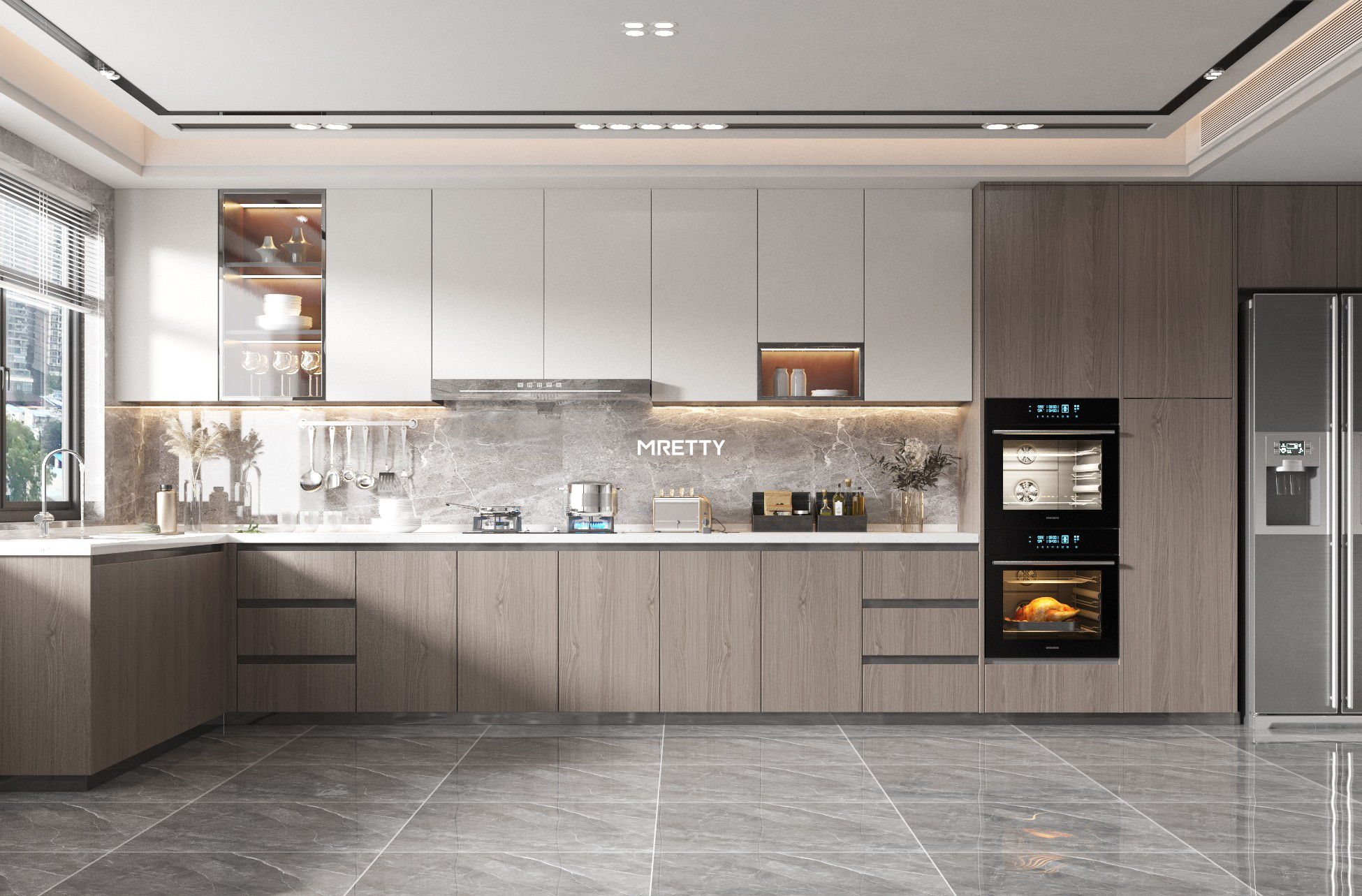
European Materials for Whole-Home Custom Furniture: Smart Factory Precision
European materials demand extreme processing precision. Millimeter-level cutting eliminates structural stress—imported wardrobe materials in Singapore must fit flush, every time.
Why Choose Imported Hardware for Custom Furniture in Singapore?
European hinges easily outperform Asian products. Blum mechanisms resist tropical rusting and can carry heavier moisture-resistant high-density boards.
Premium hardware is an area you absolutely cannot skimp on. Last week I inspected a private home along River Valley. Local hinges snapped under heavy cabinet doors. We swapped to Blum premium hardware—Austrian craftsmanship is rock solid, rated for 200,000 open/close cycles. The heavy European-board doors now glide silent and smooth, nickel plating shrugging off the humidity.
| Hardware Component | Local Standard | Blum Premium | Smart Factory Match |
|:---|:---|:---|:---|
| Hinge Lifespan | 50,000 cycles | 200,000 cycles | CNC pre-drilled holes |
| Rust Resistance | Low (zinc-plated) | High (nickel-plated) | Sealed mounting points |
| Load Capacity | 15kg per hinge | 30kg per hinge | Laser-calibrated install |
By the way—want to see our factory workflow? Download the free 2026 MRETTY Precision Guide.
❌ Common Pitfall: Pairing expensive boards with cheap hinges.
✅ Better Practice: High-end boards must match Blum hardware.
Maximising lifespan takes both CNC precision and rust-proof imported hardware.
Singapore Imported Custom Cabinet Costs: 2026 Investment Guide
Price range runs S$250–400/ft, corresponding to genuine E0 quality and European precision hardware. The premium on top-tier brands is justified.
Are Imported European Boards Better Suited for HDB Custom Cabinets?
Yes. They're fully moisture- and termite-resistant, protecting your investment for decades.
Here's the financial breakdown:
- Upfront investment: Estimated 30% premium.
- Maintenance savings: Zero repair costs over 10 years.
- Health return: E0 boards eliminate toxic off-gassing.
Singapore's National Environment Agency updated its Indoor Air Quality standards—the 2026 guideline strongly recommends low-formaldehyde materials to prevent serious respiratory issues.
Do the math carefully: replacing a rotten kitchen costs S$15,000. The upfront extra stings, but the avoided demolition and rebuild pay you back later. Do it right once, and breathe easy.
❌ Common Pitfall: Thinking imported materials are "overkill" for an HDB.
✅ Better Practice: Invest now in high-humidity zones.
Upfront cost is 30% higher, but long-term ROI is significantly better.
About the Author
Hanson | Whole-Home Designer
14 years of design experience, specializing in MRETTY's high-end kitchen systems. Deep focus on luxury renovation projects, handling private condos and landed homes. Design style blends Modern Minimalist with luxe sensibilities; possesses deep understanding of imported materials, ensuring zero-defect factory delivery with lifetime durability for tropical environments.
MRETTY: Premium Bespoke Kitchen & Cabinet Systems Provider in Singapore.
