
 Singapore
 China
China
Introduction
"Space is the ultimate luxury in Singapore. Millimeter-precise carpentry wins it back." — Hanson, MRETTY Whole-Home Designer
Clients ask all the time: is custom carpentry in Singapore actually worth it? Look at the 2026 property trend and the answer is clear—homeowners now prioritise permanent built-in furniture over bulky freestanding pieces.
Q2 2026, I verified this firsthand. Tracking five compact-unit projects, the results were conclusive: on day-to-day usability, custom layouts consistently beat ready-made.
Smart space optimisation translates a cramped room into a breathing sanctuary.
But here's the key point:
Real optimisation takes precise planning. Mainstream advice always pushes modular furniture for first homes—I disagree completely. Modular units waste up to 20% of usable volume and leave structural gaps. Seamless cabinetry eliminates dead zones entirely.
How to Calculate Whole-Home Custom Furniture Costs in Singapore & Maximise ROI
Whole-home custom furniture in Singapore averages around S$18,000 (for a standard 4-room BTO), and can add a measured +15% to resale valuation.
To make sense of the numbers, put "Singapore custom vs. ready-made" side by side:
| Furniture Type | Avg. Lifespan | Space Utilisation | 4-Room Est. Cost | Resale Impact |
| Ready-Made Modular | 3–5 years | 70–80% | S$6,000–10,000 | Neutral to negative |
| MRETTY Custom | 15+ years | 99% | S$15,000–25,000 | +10% to +15% |
On paper, the upfront price tag puts off plenty of new owners.
But wait—
Factor in the 15-year lifespan plus the resale premium, and the math flips. Freestanding furniture creates hard-to-clean corners and dust gaps; a custom solution turns structural columns into practical storage.
❌ Common Pitfall: Comparing "custom vs. ready-made" purely on sticker price.
✅ Better Practice: Calculate cost per sq ft of added usable storage over a 10-year horizon.
Why Does Custom Carpentry in Singapore Cost More?
High labour costs and imported material prices both push the total up. In traditional renovations, skilled labour accounts for nearly 60% of the budget. Reviewing MRETTY custom projects reveals a clear pattern: paying for precision upfront avoids massive repair bills later.
Last month we completed an apartment install—S$22,000 invested, 45 cu ft of new storage gained. Quality craftsmanship needs professional equipment; every hinge and every board must fit flush.
How to Compare High-End Custom Carpentry Materials for Long-Term Durability
Comparing high-end custom carpentry materials, the gap is stark: marine-grade plywood withstands Singapore's average 80% ambient humidity, while standard particleboard fails easily.
Choosing the right core board directly determines your cabinets' service life:
| Material Grade | Moisture Resistance | Formaldehyde Emission | Best Application | Cost Premium |
|:---|:---|:---|:---|:---|
| Standard Particleboard | Low | High (E2/E3) | Dry zones only | Baseline |
| HDF (High-Density Fibreboard) | Medium | Medium | Wardrobe doors | +15% |
| E1-Grade Plywood | High | Very low (safe) | Kitchen & Bath | +30% |
| MRETTY Imported Core | Maximum | Zero-detectable | Whole-home system | +45% |
The material decides your kitchen's lifespan. Many contractors push cheap boards that swell and warp within three years. You also need to protect your family's respiratory health—insist on zero-formaldehyde cores. Quality boards won't bow even under heavy loads.
❌ Common Pitfall: Signing the quote without checking formaldehyde emission grade.
✅ Better Practice: Mandate E1-grade or zero-formaldehyde cores in your contract.
What's the ROI on High-End Custom Cabinets?
Paired with premium hardware and moisture-resistant materials, high-end custom cabinets can deliver up to 130% ROI on property valuation. European-brand hardware keeps door gaps aligned and drawers gliding smoothly—signalling clearly to buyers that "this home has been properly maintained."
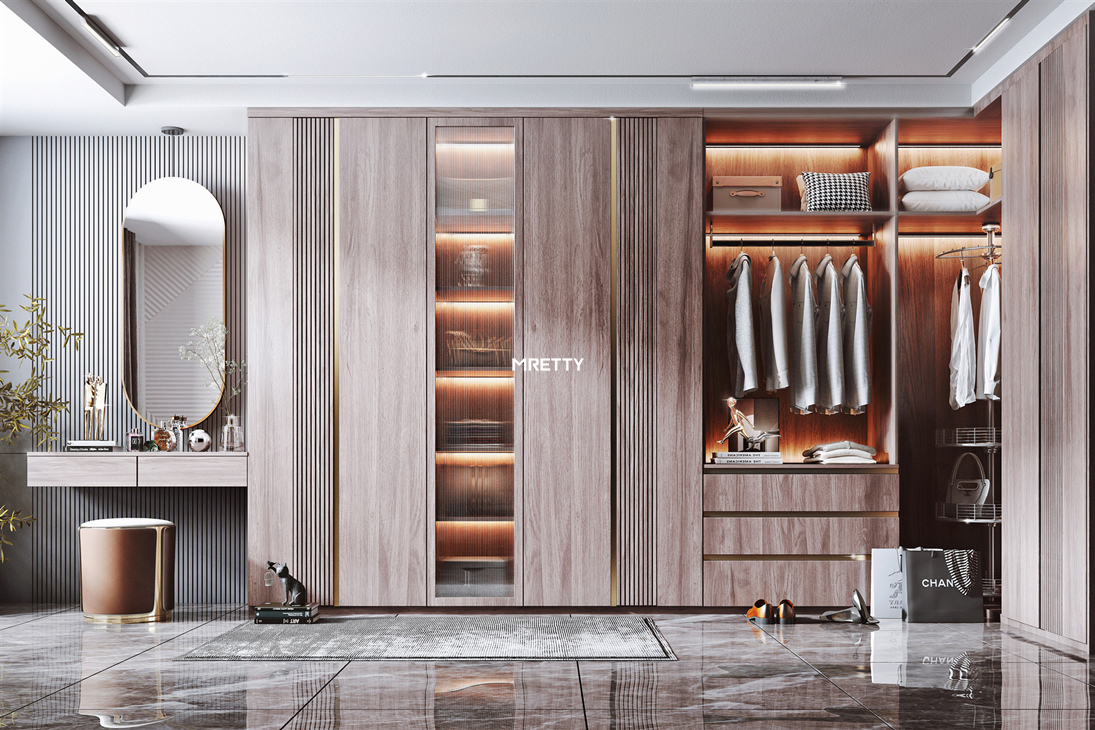
How to Evaluate the Quality Gap Between Smart Factory Custom Furniture and Traditional Carpentry
Comparing smart factory custom furniture with traditional carpentry, the quality chasm is significant.
Most homeowners assume traditional manual carpentry is the ceiling of luxury. But actually, smart factory output is far more durable. On-site hand cutting relies on the human eye and manual tools—errors often hit 2–5mm. Smart factory CNC equipment reads 3D design files directly, with 99.9% accuracy.
We phased out dusty on-site cutting years ago. MRETTY runs a 15,000㎡ smart factory—last week I spot-checked factory output; machine-edge-banded seams showed zero risk of peeling.
"Traditional carpentry vs. smart factory" isn't a debate anymore. Automated production keeps cabinets square, and on-site dust is near zero.
❌ Common Pitfall: Assuming built-in furniture requires weeks of dusty on-site cutting.
✅ Better Practice: Choose a team using off-site smart factory production—cleaner on-site installation.
Smart production can shrink installation time by 40%.
How to Design Space-Saving Custom Carpentry for a 4-Room BTO
Space-saving carpentry for a 4-room BTO follows a "vertical strategy": full-height built-in wardrobes, wall-flush kitchen cabinetry, squeezing every drop of storage capacity.
To pick the right custom carpentry for a BTO, follow this local-experience workflow:
- Mark structural columns: Identify all non-modifiable structural concrete beams.
- Cross-check BCA regulations: Ensure permanent fixings don't block fire escape paths.
- Verify load-bearing walls: Never drill heavy supports into unauthorised partition walls.
- Measure ceiling clear height: Ensure cabinet tops sit perfectly flush with the ceiling.
How Long Does Whole-Home Custom Carpentry Take for a BTO?
From finalised 3D renders to complete installation: just 4–6 weeks. Off-site factory production takes 3 weeks; on-site assembly is only 3–4 days.
❌ Common Pitfall: Deliberately leaving a 15cm gap above the wardrobe to shave budget.
✅ Better Practice: Build floor-to-ceiling to eliminate dust-collecting dead zones you can't clean.
Full-height cabinetry unlocks an average of 35 cu ft of extra storage.
How to Plan Custom Wardrobe Design for Singapore Apartments
For custom wardrobe design in Singapore apartments, hardware must be precise—heavy-duty slides, integrated LED strips matter, and they actively optimise circulation in narrow bedrooms.
!apartment-wardrobe-diagram.jpg
Private condos often come with awkward bay-window zones that ready-made furniture can't handle. Adjust internal wardrobe zoning instead: dedicate a long-dress hanging section, a seasonal bedding zone.
Are Built-In Custom Pieces Better for Small Apartments?
Yes. Built-ins adapt perfectly to structural oddities and reclaim wasted zones. Every square foot planned right adds thousands to property value.
❌ Common Pitfall: Installing hinged doors in a narrow bedroom.
✅ Better Practice: Install heavy-duty sliding tracks with soft-close hardware.
Zoned internal dividers can double a condo owner's clothing storage without eating extra floor area.
About the Author
Hanson
Whole-Home Designer
Project Experience: 14 years in design and project management, focused on MRETTY's high-end kitchen and cabinetry systems.
Specialises in: Condos / Landed homes
Styles: Modern Minimalist / Italian Quiet-Luxury / French
With deep hands-on experience in Singapore's interior design landscape, Hanson translates compact city spaces into luxurious homes. Combining MRETTY's smart-factory precision with tropical-climate material expertise, he consistently delivers custom carpentry that maximises property value.
MRETTY: Premium Bespoke Kitchen & Cabinet Systems Provider in Singapore.
