
 Singapore
 China
China
Executive Summary
- Qualified termite-resistant kitchen cabinets in Singapore must use aluminium or high-density engineered wood as the core substrate; standard "chemically treated" plywood alone is insufficient.
- Singapore's average 84% relative humidity makes moisture resistance and precision joinery the core vulnerabilities for termite intrusion.
- For complete protection, the termite-resistant strategy must extend to wardrobes and other built-in bespoke carpentry.
- Budget range typically S$8,000–25,000+, depending on material choice and kitchen size.
"In 14 years designing bespoke kitchens in Singapore, I've seen exquisite carpentry worth thousands eaten hollow by termites in a year. This silent threat is real, and it almost always traces back to the wrong material choice at the start."
— Hanson, Lead Designer, MRETTY Bespoke Cabinetry Systems
Termites cause ~S$5 billion in global property damage annually. For Singapore households, this problem is close to home. Choosing qualified termite-resistant kitchen cabinets in Singapore isn't a luxury option — it's a critical investment in your property.
This guide systematically breaks down how to build a truly termite-resistant kitchen — covering material selection, craftsmanship standards, and local cost calculations. Based on over a decade in the trade, I'll spell out differentiated solutions for HDBs, condos, and landed homes.
Want to build a kitchen that lasts?
Why Termites Are a Frequent Problem in Singapore Kitchens?
Termites are rife in Singapore kitchens for two core reasons: the tropical humid climate, and porous timber substrates commonly used that readily absorb moisture.
Singapore's tropical environment is an ideal breeding ground — average relative humidity stays above 84% year-round, letting moisture easily seep into the porous timber structure of standard kitchen cabinets. NEA (National Environment Agency) explicitly identifies the Formosan subterranean termite as the most destructive local species — they hollow out wood structures from the inside, almost silently.
Last month I inspected a 5-year-old condo in Marine Parade. The homeowner's kitchen looked expensive, but a slow leak behind the sink had soaked the standard plywood cabinet base into a dark, damp termite breeding ground — concealed and severe damage, completely avoidable with upfront material choice. By the time visible chew marks appear, irreversible loss has usually already occurred.
This is why I often find initial infestation points behind the sink or beside the dishwasher — slow leaks create the exact dark, damp conditions termites need to breed.
❌ Common Mistake: Assuming new BTOs or new condos won't get termites. Termites migrate from neighbouring units or surrounding soil — especially ground-floor HDBs and landed homes.
✅ Better Approach: Proactive prevention — choose substrates with built-in moisture and termite resistance at renovation stage. Don't wait for problems.
Best Termite-Resistant Kitchen Cabinet Materials 2026: Expert Comparison
The optimal core substrate for 2026 termite-resistant kitchen cabinets is premium powder-coated aluminium, followed by specialised high-density E0 engineered wood.
The core substrate is the single most important decision for termite-resistant cabinets in Singapore. No matter how beautiful the surface laminate, persistent termites can work through weak structural points.
Here's a counter-intuitive fact most contractors won't tell you:
Many homeowners think "chemically treated" timber is safe enough. But factually, this protection is often only surface-deep — easily compromised during installation. Termite-resistant coating only covers the board surface; any cut made on-site to route plumbing or wiring exposes the untreated core. Those fresh-cut edges become termite entry points, rendering the "protection" you paid for ineffective.
Are Aluminium Kitchen Cabinets Truly 100% Termite-Proof?
Yes — aluminium cabinets are completely termite-proof. Termites can't eat metal. It's the top pick for homeowners chasing ultimate protection. MRETTY uses premium powder-coated aluminium — rust-proof, scratch-resistant, won't warp or swell in Singapore's humidity; doors and drawers stay smooth long-term. Last quarter we installed a full MRETTY aluminium kitchen for a Serangoon client who'd been hit by termites twice — problem solved.
Aluminium vs Timber Kitchen Cabinets: Termite Resistance Compared
Aluminium substrate = absolute immunity. Timber substrate resistance varies wildly:
- Solid wood (e.g. teak): Natural oils offer some deterrence, but costly and needs regular maintenance.
- Standard plywood: Highly susceptible — wood layers and bonding adhesive are both termite food. Swells and delaminates when damp, making invasion easier.
This is why I advise against standard on-site carpentry for kitchens — even "chemically treated" timber loses protection over time, and every on-site cut creates a new unprotected gap.
MRETTY E0 Engineered Wood: Quality Timber Alternative
For homeowners who prefer the timber look, high-density engineered wood is the best pick. MRETTY's E0 boards aren't ordinary plywood — wood fibres compressed under high heat and pressure with specialty resin; dense core, moisture-resistant. Standard plywood acts like a sponge; our E0 board is dense, near-zero moisture uptake, and the high density makes it difficult for termites to chew through — offering protection far beyond conventional materials.
❌ Common Mistake: Focusing only on outer laminate, ignoring substrate properties — substrate directly decides durability and pest resistance.
✅ Better Approach: Request to see the raw board cross-section, not just the finished door appearance. Explicitly ask: "What is the substrate material?"
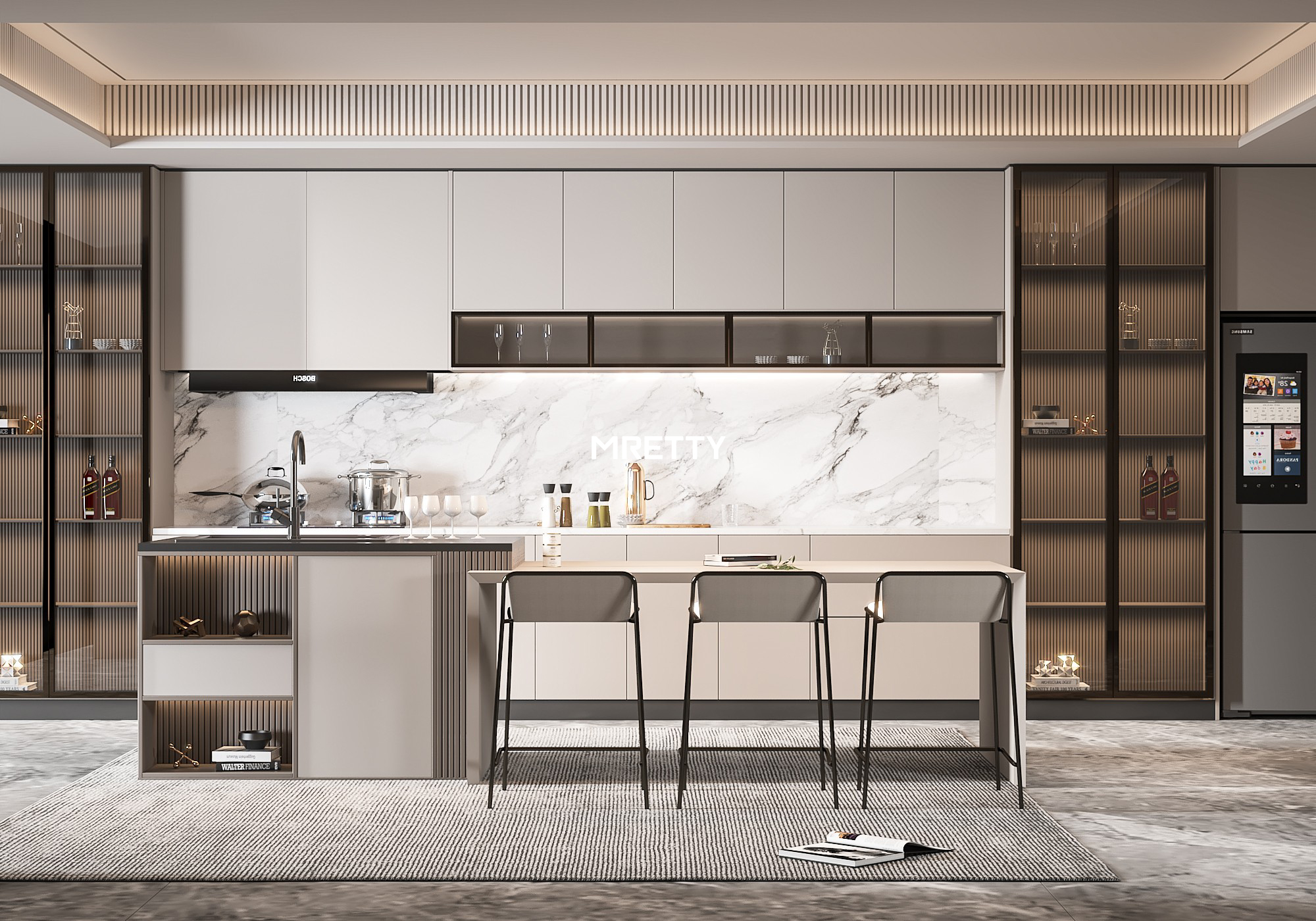
Step-by-Step Guide to Termite-Resistant Kitchen Carpentry Singapore
Effective termite-resistant carpentry in Singapore needs four core steps: choose inherently pest-resistant substrate, precision factory manufacturing, professional sealed installation, whole-home protection coordination.
Termite-resistant kitchens aren't just a material question — construction process matters equally. Tiny gaps are termite entry points. This is the standard flow I've verified across hundreds of projects.
How to Protect Kitchen Cabinets from Termites in Singapore's Humid Climate?
Goal: build a sealed, gap-free cabinetry system using materials termites can't eat:
- Choose inherently pest-resistant substrate: Foundational premise. Prioritise premium aluminium or high-density moisture-resistant engineered wood (like our E0 boards). No compromise.
- Insist on precision factory manufacturing: This is the core differentiator. Traditional on-site carpentry hand-cuts — low joint precision, gaps left behind. MRETTY's 15,000 sq m smart factory cuts at sub-millimetre CNC tolerance; every joint tight, leaving zero entry path for termites.
- Professional install + gap sealing: A perfect cabinet can fail from rough installation. Our install team levels and secures cabinets, then the key move — seal all gaps between cabinet and wall with quality waterproof sealant, cutting the main termite entry path.
- Whole-home coordinated protection strategy: Termites don't stay in the kitchen. Recent BTO project in Punggol — homeowner worried about pests, so kitchen went aluminium system, master wardrobe and TV console went E0 engineered wood. Creates a continuous "no-food-source zone" across the home, eliminating hidden risk. This holistic thinking matters even more for landed homes.
❌ Common Mistake: Only termite-proofing the kitchen, leaving adjacent bedrooms with standard plywood wardrobes — termites simply move to other timber furniture.
✅ Better Approach: Set a unified "material strategy" at renovation planning stage; all built-in carpentry to the same protection standard.
Termite-Resistant Kitchen Cabinet Pricing Singapore: Cost Breakdown
Termite-resistant kitchen cabinets in Singapore total S$8,000–25,000+, depending on material, size, design complexity, and hardware spec.
"How much?" is the most common client question. Higher upfront, yes — but far less than a full rebuild after termite destruction:
- Material choice: Biggest cost variable. Premium aluminium typically 15–25% above E0 engineered wood; both cost more than standard plywood but deliver far better long-term value.
- Kitchen size & layout: Large U-shape condo kitchen needs more material and labour than a 3-room BTO galley.
- Hardware & finish: Hinge and slide choice directly affects use and cost. We partner with premium brands like Blum — higher unit price, but lifetime warranty.
As a designer, I always advise clients to spec Blum-grade hardware — it's the most common failure point. Cheap hinges save a few hundred upfront, but rust and fail after 3 years, doors sag, gaps break the sealed system. Blum runs smooth for decades — tiny fraction of project cost, but defines daily experience.
Example 4-room BTO: full kitchen in MRETTY E0 engineered wood starts ~S$9,000; same config in aluminium ~S$12,000–18,000. Above are recent 2026 project references; final price per actual design.
❌ Common Mistake: Taking the lowest quote without checking substrate and hardware brand. Low price usually means inferior, short-lived material.
✅ Better Approach: Demand itemised quote — substrate type, hardware brand, warranty terms stated clearly for true comparability.
Higher upfront, yes — but a qualified termite-resistant kitchen is a value-driven decision, avoiding far larger financial loss and daily frustration later.
FAQ
Q: Will aluminium cabinets look too industrial / cold?
A: Older aluminium cabinets had that problem, but modern powder-coating delivers woodgrain, matte black, muted tones — MRETTY's aluminium system fits minimalist, Italian, French styles; no "clinical" feel.
Q: E0 engineered wood vs aluminium substrate — which?
A: Tighter budget or prefer timber look → E0 engineered wood (dense structure + low formaldehyde + good termite resistance). Want total peace of mind → aluminium (100% termite & rust proof). Ground-floor landed, wet zones → aluminium priority; dry-zone wardrobes can run E0 engineered wood for whole-home coordinated protection.
Q: How to retrofit an old kitchen for termite resistance?
A: First inspect for leaks and already-damaged substrate. Replace wet-zone standard plywood — sink base and hob area priority — with aluminium or E0 boards. Re-seal all gaps between cabinets and walls.
Protecting Your Home with MRETTY
Termites are an unavoidable reality in Singapore homes — termite-resistant kitchens are baseline, not optional upgrade. From substrate (aluminium / E0 engineered wood) → sub-mm smart-factory manufacturing → sealed installation → whole-home material strategy: a complete protection loop. MRETTY runs our own 15,000 sq m smart factory — design and production integrated, so the termite-protection budget isn't drained by middlemen or on-site errors.
About the Author
Hanson
Lead Designer, MRETTY Bespoke Cabinetry Systems
14 years in Singapore whole-home bespoke. Has seen plenty of "beautiful-at-first, failed-in-three-years" kitchens — termite damage, humidity warping, hardware failure are why he pushes clients to upgrade substrates and adopt factory-direct mode. Bakes tropical-climate adaptability into every BTO, condo, landed scheme.
MRETTY: Premium Bespoke Kitchen & Cabinet Systems Provider in Singapore.
