
 Singapore
 China
China
At-a-Glance: Your Singapore Interior Design Guide
TL;DR
Budget: For a full renovation of a new 4-room HDB BTO flat, prepare a baseline budget of S$50,000 – S$70,000.
Process: Follow a rigorous 7-step process from consultation to key handover to avoid costly pitfalls.
Durability: Prioritize "materials science" over "trends"—this is critical for Singapore’s high-humidity climate.
Partner: Opt for an integrated Design-and-Manufacture firm—one that handles both the design scheme and the production of custom furniture.
What Defines Good Home Design (in the Singapore Context)?
An awkward layout and insufficient storage don’t make a home; they create daily friction. Many Singaporeans endure these issues for years before finally deciding to renovate.
Truly excellent Singapore interior design solves precisely this problem. It’s not just about making a space look good; it’s about resolving the pain points you’ve "learned to ignore." Last month, a client had resigned themselves to a kitchen aisle too narrow to turn around in. When we proposed shifting a wall inward by just 30 centimeters, you could feel their "aha" moment—that simple change completely reshaped their daily cooking flow.
This transformation is what we aim for. Having helped over 500 families, we know: Good Design = Form × Function × Future-Proof Material Quality.
❌ Common Mistake: Focusing solely on social media "aesthetic trends" without considering your actual floor plan or your family's real lifestyle.
✅ Better Approach: Start with a deep dive analysis—what are your daily movement patterns? Where are the storage pain points? Will your family structure change in the next five to ten years? Use these answers to reverse-engineer the design so the space truly works for you.
How Much Does Interior Design Really Cost in Singapore?
Budget is every homeowner’s first question. The answer depends on three things: unit type, scope of work, and material grade. Low quotes today often lead to bankruptcy-level repairs tomorrow—a costly lesson many have learned in our humid climate.
Below are typical budget ranges based on our 14-year project database:
New | HDB BTO (4-Room): S$50,000 – S$70,000
This range covers foundational items after key collection: flooring replacement, basic rewiring, essential kitchen works, and custom carpentry like wardrobes and storage cabinets. For a 5-room BTO, budgets typically rise to S$60,000 – S$85,000.
Resale | HDB Resale Flat: 15%–25% Higher than BTO
Older flats involve more hidden works—hacking, rewiring, and comprehensive spatial reconfiguration to suit modern living—naturally driving up costs.
Private Condominium (3-Bedroom, approx. 90 sqm): S$70,000 – S$120,000
Costs are driven by higher-grade finishes, more complex lighting systems, and the increasing demand for smart home integration.
Landed Property (Terrace/House): S$250,000 – S$800,000+
These are large-scale projects involving significant structural works and multi-party coordination management.
🔑 An Industry Truth Rarely Stated Outright: Cheap Materials Are the Most Expensive Mistake
Last quarter, we inspected a home renovated only three years ago: the cabinet doors were already warping in the humidity. The root cause? Standard Medium-Density Fiberboard (MDF). We insist on using E0-grade moisture-resistant boards. While this may increase carpentry costs by 15%–20% for kitchen areas, it withstands Singapore’s humidity and lasts a decade instead of three.
❌ Common Mistake: Using an online "interior design quote calculator" to compare prices and simply picking the lowest bidder.
✅ Better Approach: Demand an itemized breakdown. Ask directly: What grade of plywood is used? Which brands of laminates and hardware (e.g., Blum or Hafele level)? How many years is the hardware warranty? Compare value, not just the total sum.
What Is the Standard Interior Design Process in Singapore?
A successful renovation always follows a structured path without skipping steps. Cutting corners almost always backfires. At MRETTY, we use a proven 7-Step Turnkey Process to control timelines, stress levels, and quality:
The Singapore Interior Design Process: Step-by-Step Breakdown
| Step | Phase | Specific Content |
| :--- | :--- | :--- |
| Step 1 | Initial Consultation · Needs Analysis | Deep-dive discussion on your lifestyle, aesthetic preferences, non-negotiable needs, and absolute budget ceiling. This is the foundation. |
| Step 2 | Concept Design · Space Planning | Translate needs into a full design concept: mood boards + 2D floor plans to optimize movement and space efficiency. |
| Step 3 | Detailed Design · Material Selection | Finalize the scheme—produce 3D visualizations and lock in finishes: Lamitak or Egger laminates, stone/quartz countertops, tiles, etc. |
| Step 4 | Quotation Confirmation · Contract Signing | Receive a transparent, itemized quote. Upon confirmation, sign a formal contract detailing scope, timeline milestones, and payment schedule. |
| Step 5 | Project Management · Site Coordination | Commencement of works. A dedicated Project Manager oversees the site to ensure all works comply with HDB renovation regulations. |
| Step 6 | Custom Furniture Manufacturing · Installation | Our core advantage—while site works progress, your custom cabinets are being produced in our own 15,000 sqm smart factory. Parallel workflows compress timelines and ensure quality. Recently, at a Bukit Timah project, an on-site measurement discrepancy was found; because we own the factory, the custom wardrobe dimensions were adjusted within hours—outsourcing would have delayed this by at least two weeks. |
| Step 7 | Handover · Defect Inspection | Conduct a final walkthrough inspection with you, checking every detail. All defects are rectified before official key handover. |
❌ Common Mistake: Making major changes mid-project—switching countertops, moving sockets, or推翻柜体格局 (changing cabinet layouts). Every change equals delays + extra costs.
✅ Better Approach: Lock in all selections by Steps 2 and 3. Use 3D renderings to confirm every detail before production begins.
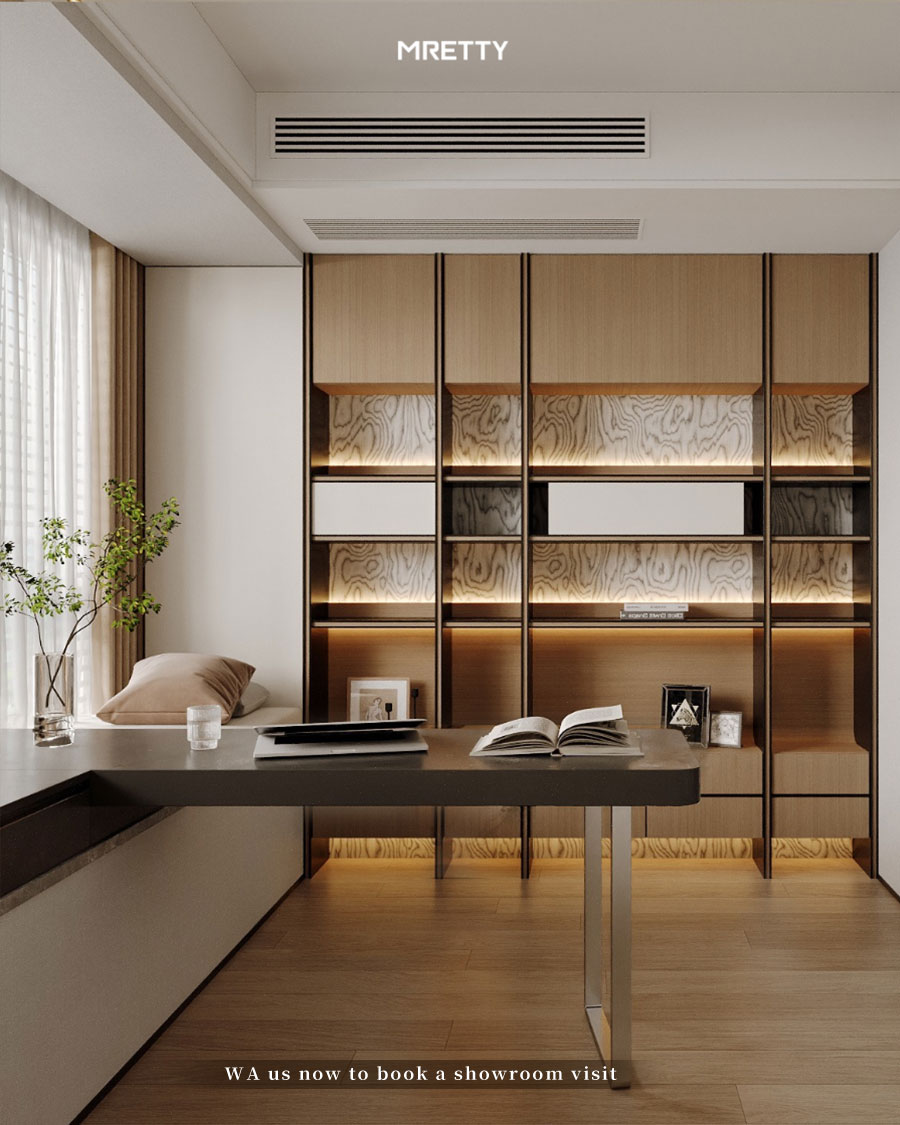
Which Interior Design Styles Are Most Popular in Singapore for 2026?
Timeless styles are rooted in "quietness" and "spatial efficiency." By 2026, Singapore’s design风向 (wind direction) has shifted from "photogenic" to "comfortable and authentic."
Minimalist Interior Design
Minimalism remains a favorite for small units—clean lines, neutral palettes, and multifunctional custom carpentry declutter the visual field and instantly amplify space.
Wabi-Sabi & Japandi
The fusion of Japanese aesthetics and Nordic functionality is gaining strength. Natural materials, imperfect textures, and warm wood tones create homes that feel like a place where you want to "stay and never leave."
Modern Italian Luxury
Another specialty of MRETTY: sintered stone surfaces, dark wood veneers, and layered lighting create hotel-grade sophistication—but it’s a "quiet luxury," not an ostentatious display.
☝️ But Here Is the "Brutal Reality" That Must Be Said
Many people talk about minimalism. But the true national style in Singapore is actually—"Storage Maximization."
What does this mean? It uses a minimalist shell to seamlessly hide the massive storage needs of a real family. It doesn’t mean "owning less"; it means "seeing nothing." Imagine floor-to-ceiling cabinets that look like a feature wall; platform beds with hidden storage compartments underneath. In a 90 sqm HDB flat, this isn't a trend—it's a survival strategy.
How to Choose the Right Interior Design Partner?
Choosing a firm is the most important decision in your entire renovation journey. Choose right, and they are your guide and gatekeeper; choose wrong, and the next few months mean budget blowouts and emotional breakdowns. To filter out the truly reliable options, you need to look beyond pretty pictures.
Selecting an Interior Designer: Your Checklist
| Check Item | How to Do It |
| :--- | :--- |
| Verify Credentials | Is the firm listed on the HDB Registered Renovation Contractors (RRC) list? For landed properties, ask about their familiarity with BCA approval processes. |
| Judge Real Works, Not Renders | Don’t just look at 3D renderings—ask for completed real-life photos and, ideally, visit an ongoing site. Craftsmanship precision doesn't lie. |
| Clarify Delivery Model | Do they offer a true turnkey solution? Is there a single point of contact managing everything end-to-end? Shorter responsibility chains are better. |
MRETTY’s Core Advantage: Design · Manufacture Integration
The vast majority of interior design firms in Singapore are essentially consultant intermediaries—after producing the design, the most critical part (your custom carpentry) is fully outsourced to external workshops. This handoff invites quality fluctuations, scheduling conflicts, and batch color variations.
MRETTY operates differently—we design it, and we manufacture it in our own facility. This gives you three hard advantages:
- Quality Control Loop: Every cut and assembly follows our standards; there is no "workshop cutting corners due to a rush order."
- Material Consistency: The laminate on your TV console and your kitchen cabinet doors come from the same batch, ensuring seamless texture and color matching.
- Budget Efficiency: Eliminating the middleman markup allows us to allocate more of your budget to higher-grade finishes and hardware.
Are "Package Deals" Worth It?
Packages offer fixed pricing but sacrifice flexibility—finishes, designs, and sizes are largely locked in. If you require bespoke storage solutions or have any irregular architectural features, the outcome value and long-term satisfaction of a fully customized route far outweigh what any package can offer.
❌ Common Mistake: Assuming "all interior design firms are basically the same."
✅ Better Approach: Ask every firm the same direct question: "Is your custom carpentry done in your own factory or outsourced?" Their answer will reveal their true control over quality and timelines.
About the Author
Hanson is the Lead Designer at MRETTY, bringing 14 years of high-end design and project management experience. He specializes in holistic residential transformations for private condominiums and landed properties, with expertise in Modern Minimalist, Italian Luxury, and French styles. To date, he has personally overseen the completion of 200+ residential projects across Singapore.
Frequently Asked Questions
Q: How soon after collecting keys for a BTO flat can I move in?
A: A standard 4-room BTO renovation takes approximately 8–12 weeks. If extensive custom carpentry and smart home systems are involved, setting aside 3–4 months is more realistic.
Q: What do HDB renovation regulations mainly restrict?
A: Key controls include: non-hacking of structural walls, floor protection requirements, noise control timings, and necessary approvals for certain plumbing/electrical modifications. Choosing a licensed registered contractor helps safeguard compliance.
Q: How much more does moisture-resistant board cost compared to regular board?
A: For cabinetry in kitchens and humid areas, E0-grade moisture-resistant core boards may increase carpentry costs by 15%–20%, but they minimize the risk of cabinet door deformation requiring repairs in three years—an investment that pays off in the long run.
Q: Why is owning a factory so important?
A: Outsourcing carpentry essentially hands the core quality of your home to a third party—you can’t track progress in real-time, can’t guarantee batch consistency, and finger-pointing ensues when issues arise. Owning a factory means scheduling is controllable, precision is assured, and accountability is absolute.
MRETTY: Premium Bespoke Kitchen & Cabinet Systems Provider in Singapore.
