
 Singapore
 China
China
TL;DR: This guide breaks down exactly how to choose residential glass cabinet doors for Singapore homes: core categories you need to know (reeded glass, vertical ribbed glass, tempered safety glass, etc.), why MRETTY’s custom solutions outperform off-the-shelf cabinets for HDB and condo layouts, transparent cost breakdowns, and application ideas tailored to local unit types. The goal? Strike the perfect balance between aesthetics, light flow, safety, and easy maintenance.
You’ve been staring at those solid cabinet doors in your home for ages—are you really sure they’re the optimal pick?
For decades, solid wood or melamine panels have been the default choice for cabinet doors. The logic is simple: safe, hides clutter.
But here’s the catch: This “play it safe” approach is quietly making your home feel smaller, darker, and more cookie-cutter than it needs to be.
I’ve been working in Singapore full-home customisation design for over 14 years, and I’ve seen this play out across hundreds of projects: one of the single biggest game-changers for HDB flats (Housing & Development Board flats, Singapore’s public housing) and standard condos is swapping in the right glass cabinet doors. It’s not about showing off your plates for guests—it’s about drawing light deeper into your space, adding layered visual depth, and giving your home a touch of personality that solid doors can never deliver. Let’s break it down properly.
1. 5 Essential Glass Types: 2026 Style Buying Guide
Your choice of glass makes or breaks the entire vibe and functionality of your cabinet. We’re long past the era of slapping a thin sheet of clear glass over a cabinet opening—today’s options are thicker, more refined, and far safer. Based on my hands-on experience working everywhere from Punggol BTO flats to Orchard area condos, these are the 5 categories most worth considering for 2026:
Reeded Glass (Fluted Arc Convex Grooves): Top Pick for Modern Homes
Reeded glass has parallel vertical arc-shaped convex grooves that create soft optical distortion: it hides interior clutter well enough, but still lets light pass through, creating a “layered, soft-focused depth” rather than harsh transparency. It works exceptionally well for modern reeded glass display cabinets in condo living rooms—the vertical lines draw the eye upward, making ceiling heights feel cleaner and more expansive.
Quick clarification people mix up constantly: The difference between “reeded glass” and “flat-channel ribbed glass” (sharper straight-line grooves): Reed glass has rounded, softer grooves with a gentle, diffused look. Flat-channel ribbed glass has rectangular-profile grooves, sharper, more architectural, and slightly more private than rounded reed glass.
Flat-Channel Vertical Ribbed Glass (Sharper Straight-Line Grooves): Cooler, More Architectural Look
It also follows a linear texture, but the grooves are flatter and harder-edged, with a subtle Art Deco or light industrial edge, and usually offers even better privacy than rounded reed glass. Last month we used this for a dry kitchen in a Bukit Timah landed home paired with dark aluminium frames, and the result was a crisp, graphic focal point that fit the minimalist scheme perfectly.
A condo client along the River Valley area initially balked at “textured glass” thinking it would look too busy. We sent her home with a physical sample to test in her own space—when the afternoon light hit it, the glass turned her dinnerware into soft-focused “installations”, while still hiding all the random mismatched mugs and plates. She signed off on the spot.
Frosted (Satin) Glass: The Privacy Workhorse
Frosted glass gets its uniform matte finish via sandblasting or acid etching: it transmits light but blocks visibility of details inside, and diffuses light beautifully. It’s the best low-risk pick for upper kitchen cabinets or bathroom storage: you want to hide clutter, but you don’t want the heavy, closed-in feel of a full solid door. It’s also the most timeless safe bet for glass-front cabinets for kitchens—add interior lighting and the glow comes out soft and warm, no harsh glare.
Clear Tempered Glass: Classic Display Route
If you want a true glass display cabinet door effect for collections (specialty mugs, books, decor objects), clear glass is the most straightforward option. Key non-negotiable: Tempered. Tempered safety glass goes through a heat treatment process that makes it 4–5x stronger than regular annealed glass. Even in the rare case of breakage, it shatters into small, blunt, pebble-like pieces rather than large, razor-sharp shards—critical for home safety, especially if you have kids or pets.
Laminated Glass: The Safety Gold Standard
If you have young children, or you’re extra risk-averse for edge cases, laminated glass is worth mentioning: it’s two sheets of glass bonded with a polymer interlayer, so even if it breaks, the entire sheet stays in place (similar to how car windshields work). Compared to tempered vs laminated glass for cabinet doors: Tempered is more than sufficient for 95% of residential use cases. Laminated glass adds extra anti-penetration protection, keeps fragments attached 100% of the time, and blocks almost all UV rays (helps prevent displayed items from fading over time).
Designer Pro Tip: What glass thickness should you go for?
For standard residential cabinet doors, the most common, balanced pick is 5mm–6mm thickness, which hits the sweet spot between slim profile and durability. If you have oversized door panels, or you want extra peace of mind, you can step up to 8mm tempered glass.
❌ Common Mistake: Picking glass solely based on filtered photos you see on Pinterest/Instagram or social mood boards, without accounting for how the texture looks in your home’s actual lighting.
✅ Safer Approach: Always take home a physical sample to test in situ. Every home’s sun orientation, window light, and indoor bulb colour temperature is different, and the haze level and premium feel of textured glass shifts completely depending on lighting. MRETTY always provides clients with physical samples to test in their own space before sign-off.
2. Why Choose Custom Glass Cabinets Over Off-The-Shelf Options in Singapore?
“Can’t I just buy a glass-front cabinet off the shelf at a store?” It’s the most common question we get—and while off-the-shelf can work, it almost always requires compromising on fit, finish, or function. Singapore homes are tiny, and packed with “non-standard” quirks: odd angles, protruding beams and columns, uneven skirting board depths, ceiling height variations. Off-the-shelf cabinets are built to generic standard sizes, which leaves you with unfillable gaps, wasted dead corners, and a finish that never feels truly high-end. That’s exactly why custom glass cabinet doors are worth the (often negligible) extra investment for most local homes.
Off-the-shelf is built for an “average house”. Custom is built for your house—every millimetre sized to fit your exact space. Case in point: a recent 4-room BTO project where we built a full floor-to-ceiling display cabinet that slotted perfectly into an irregular niche next to a structural column—no standard off-the-shelf cabinet would have fit that shape without ugly fill strips.
When you work with a specialised custom team like MRETTY, you’re not just getting “more size options”—you get:
Maxed-out space for HDB/BTO layouts: Singapore condos and HDB flats are packed with structural beams, pipe chases, and non-right-angle walls. We build the cabinet carcass to fit these quirks first, then integrate glass doors seamlessly, so every centimetre of available wall space becomes usable visual area—critical for small kitchen glass cabinet doors in compact units.
Unlimited aesthetic combos: Want reeded glass paired with champagne gold aluminium frames? Want premium Blum/Hettich soft-close hardware? Off-the-shelf stores give you fixed package options. Custom gives you hundreds of combinations to match your exact style.
Fully controlled quality chain: MRETTY’s cabinet carcasses are processed end-to-end in our own 15,000 sqm smart factory—from moisture-resistant board selection to edge banding precision to assembly sequencing. None of the “cut on-site by ad-hoc carpenters” sloppiness that leads to gaps, warping, or early failure in Singapore’s humidity.
❌ Common Mistake: Buying a slightly undersized off-the-shelf cabinet, then using foam gap fillers or trim strips to fake a custom fit.
✅ Safer Approach: Build one made-to-measure unit that fills the full available width of your wall. When you calculate cost per square metre of usable storage space, custom usually works out better value anyway, and delivers a seamless, built-in look instead of a patched-together mess.
Custom carpentry with integrated glass isn’t just furniture—it becomes an architectural element of your wall and circulation flow.
3. Transparent Cost Breakdown: Where Does the Price of Glass Cabinet Doors Come From?
Let’s skip the vague ranges: the price of “glass cabinet doors” in Singapore varies wildly because cost isn’t driven by the glass alone—it’s driven by the full system complexity.
Cost drivers break down to 5 core factors:
- Glass type: Clear tempered is your baseline cost. Reeded/ribbed textured glass is a tier up. Laminated safety glass is usually another notch higher.
- Frame material: Slim modern aluminium frames are durable, space-efficient, and mid-range cost. Solid wood frames read more “classic” but cost more and require more upkeep. Frameless/semi-frameless options add labour cost for proper edge polishing and mounting.
- Size & shape: Simple rectangles are the most cost-efficient. Odd shapes, oversized panels, or extra reinforcement requirements bump up material waste and labour time.
- Hardware: Do not skimp on hinges and runners. Blum/Hettich spec-grade hardware costs more than no-name generic imports, but delivers smooth, silent operation with no sagging for over a decade of daily use.
- Integrated lighting: Interior LED lighting for display cabinets is increasingly standard—LED strips, wiring routing, drivers, and safety certification all factor into total cost.
Quick example: For a standard HDB kitchen with ~10 upper cabinet doors, basic no-name hinges might add ~S$30–50 total to material costs. Upgrade to a full Blum soft-close system, and that jumps to ~S$300–450 for the full set. That’s not a “brand tax”—that’s paying for a mechanism tested for 200,000+ open/close cycles. Translating to daily use: that’s 10+ years of zero headaches vs hinges that start sagging and clanging after 2–3 years.
Reference Price Range Table (Supply + Install, Rough Estimate Per Square Metre)
| Tier | Est. Price (SGD / sq m, supply + install included) | Common Configuration | | :--- | :--- | :--- | | Entry Practical | S$180 – S$250 | Clear tempered glass + standard aluminium frame | | Mid-Range Mainstream | S$250 – S$380 | Reeded/ribbed glass + higher-grade frame + soft-close hinges | | Premium Refined | S$380 – S$480+ | Laminated safety glass + designer frame profile + integrated LED lighting |
Note: Figures based on MRETTY Q1 2026 project data, for budgeting reference only. Final price varies with panel size, custom profiles, hardware tier, lighting scope, and on-site conditions.
❌ Common Mistake: Comparing only the bottom-line total number, without checking what’s included.
✅ Safer Approach: Ask for an itemised quote: glass type + thickness, frame material specs, hardware brand/model, install scope, all listed explicitly. A quote that’s way below market average almost always means they’ve cut corners on hinge quality, edge banding, or moisture resistance somewhere—you’ll find out exactly where 2 years down the line when doors start sagging or boards swell.
4. Pro Design Tips: Glass Cabinet Strategies for HDBs / Condos / Landed Homes
The “best-looking glass cabinet” is always the one that solves your unit’s specific pain point. The logic for a 90sqm BTO flat is completely different from a Sentosa Cove landed home. Breakdown by unit type:
HDB / BTO Kitchens: Use Glass to “Brighten Up” Tight Spaces
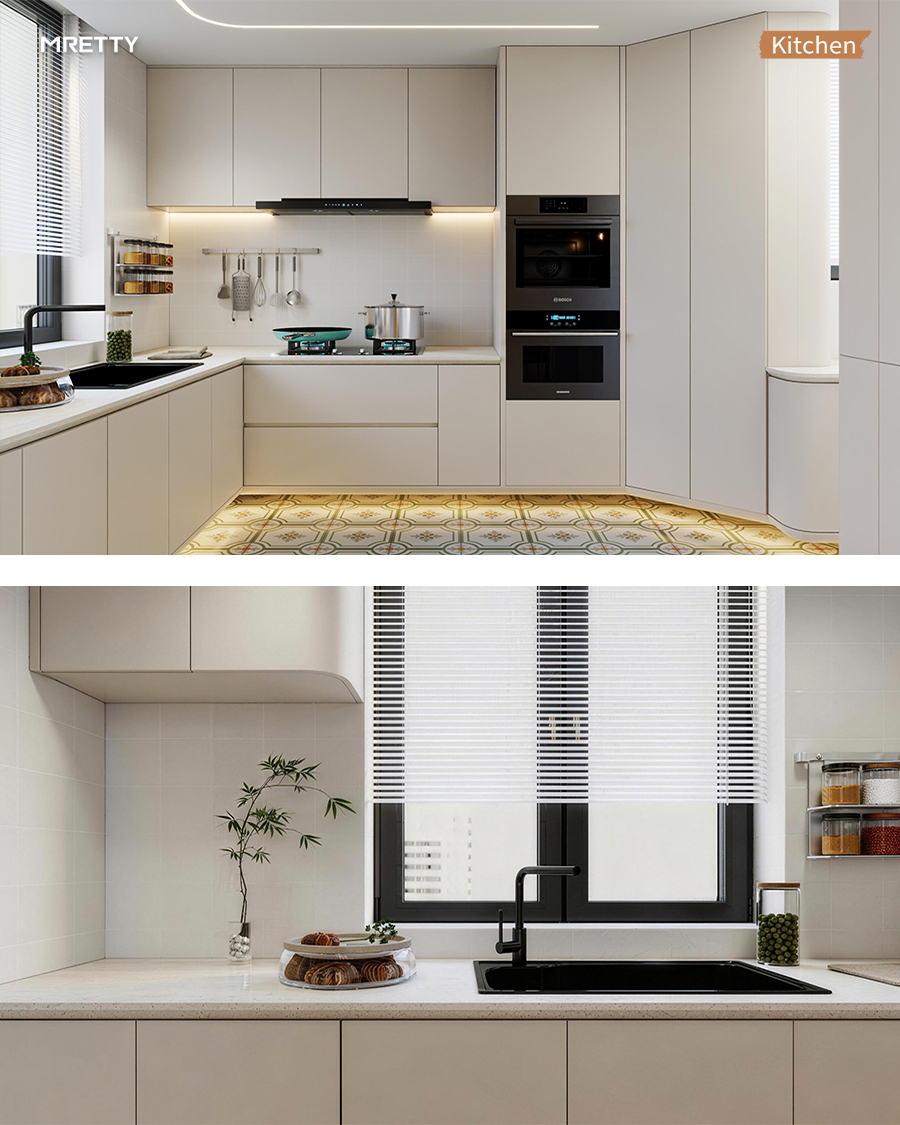
Small kitchens feel claustrophobic fast if you have a full row of solid upper cabinets blocking light. The fix? Swap upper cabinet fronts to frosted or reeded glass + slim light-coloured aluminium frames: it bounces window light deeper into the kitchen, making the space feel immediately larger, while the matte finish hides mismatched dinnerware and visual clutter.
Tampines 4-room BTO project example: Homeowner had tons of mismatched mugs and plates. We did upper cabinets in frosted glass with white thin frames—visual noise disappeared, and the kitchen felt a full size bigger instantly.
Condo Living Rooms: Make Glass Cabinets Your Lighting Focal Point
Condos live or die on cohesive, high-end flow. For these spaces, I lean toward clear glass or very lightly tea-tinted tempered glass for modern reeded/clear glass display cabinets, with the key focus on how light washes the interior: recessed LED strip lights along the inner frame make the contents glow softly. Daytime it reads as airy, breathable storage, nighttime it becomes a low-glare focal point that bumps up the entire unit’s perceived value.
5. Safety, Cleaning & Maintenance: Practical Pitfall Avoidance Guide
Always prioritise tempered or laminated safety glass (non-negotiable if you have kids, elderly residents, or pets). Never scrub textured glass grooves with rough scouring pads or abrasive sponges—microfiber cloth + mild neutral detergent is the only safe bet. For aluminium frames, don’t let harsh alkaline cleaning paste sit on the surface for extended periods. Singapore’s humidity is high: if you notice condensation beading on the interior side of glass panels, wipe it dry immediately. Don’t let water seep long-term into the rubber gasket seam and into the carcass edge banding (that’s what causes swelling over time).
- Check hinge tension once every 6 months: premium soft-close hinges are adjustable, but if installation screws have loosened due to slight wall unevenness or settlement, have your installer tighten them once to keep alignment perfect.
6. Custom Glass Cabinet Order Pre-Flight Checklist
- [ ] Glass type (clear / frosted / reeded / flat-ribbed / laminated) + thickness (5/6/8mm tempered) explicitly stated in writing
- [ ] Frame material & colour confirmed (aluminium frame profile width, wood frame paint/stain/veneer) with physical sample matched to your space
- [ ] Hardware brand & mechanism (Blum/Hettich model, full soft-close y/n) listed clearly
- [ ] Scope of integrated lighting, wiring routing, transformer location, and safety anchoring method confirmed
- [ ] Quote is itemised, not a single lump sum total
- [ ] On-site re-measurement completed for beams, skirting depth, ceiling slope (not just relying on floor plan dimensions alone)
Frequently Asked Questions
Are glass cabinet doors easy to break?
As long as you source through a legitimate supplier using tempered (or laminated, if specified) glass, sized to the correct thickness for the panel size, installed by pros who account for stress concentration points (to avoid impact damage), they’re perfectly safe for daily residential use. The only high-risk scenario is using thin, non-tempered “decorative glass” repurposed as a cabinet door.
How do I choose between reeded glass and flat-channel ribbed glass?
Go reeded if you want something softer, more versatile, and want to make ceilings feel taller and the space more airy. Go flat ribbed if you want a crisper, more architectural, cooler-toned edge with slightly higher privacy. Both hide clutter well—pick based on the “vibe” you want your home to project.
Can I use glass upper cabinets in HDB kitchens? Won’t they get gross with oil splatter?
Yes, you absolutely can—frosted/reeded semi-transparent options are the best pick here. The interior of the door can be finished with a wipe-clean surface, and glass itself is way easier to wipe down than textured wood/melamine. The real risk area is making sure your cabinet carcass base board and hardware are rated for moisture/high-heat use (proper edge banding + E0 moisture-resistant substrate, which MRETTY includes as standard).
MRETTY: Premium Bespoke Kitchen & Cabinet Systems Provider in Singapore.
