
 Singapore
 China
China
Core Questions at a Glance
What is Minimalist Customization?
A home solution focused on function, enhancing spatial texture and living efficiency through streamlined design.
Is it suitable for small Singapore homes?
Extremely suitable. Through built-in designs and multi-functional furniture, it maximizes limited space, making homes appear more spacious and orderly.
How to choose a customization company?
Evaluate their understanding of materials, craftsmanship precision, and real-world project portfolios, especially experience with Singapore-specific layouts (e.g., HDB bomb shelter integration).
Does Your Home Really Need That Much Stuff?
This is the first question I ask every new client.
We habitually fill our spaces, believing that owning more equates to wealth, only to harvest chaos and anxiety. True luxury is having a clear, serene home that exists solely for you. This is the core value of minimalist whole-home customization.
Quick Answers to Key Questions (FAQ)
Before diving deeper, let’s address the most common doubts.
What does Minimalist Whole-Home Customization mean?
It is a home design and manufacturing approach centered on "Less is More." The focus is not simply reducing items, but emphasizing three points through rigorous design logic:
- Function First: Every cubic centimeter of design must serve a clear functional purpose.
- Clean Lines: Prioritizing planes and straight lines, reducing unnecessary decoration to create a fluid visual experience.
- Spatial Negative Space: Using intentional "negative space" to highlight the structural beauty of the space itself and the texture of materials.
At MRETTY, we utilize our 15,000 sqm smart factory to translate this philosophy into seamlessly joined cabinetry, hidden storage, and tactile surfaces.
How to prevent Minimalism from becoming "Stark and Empty"?
This is clients' most common concern. Based on my experience handling hundreds of Singaporean households, the key lies in distinguishing between "empty" and "minimal."
"Stark and empty" is unplanned void; minimalism is deliberate simplicity. True minimalism creates warmth through material texture, lighting application, and the accent of a few personalized decor pieces. We advise clients to choose one or two designer furniture pieces or artworks as focal points rather than leaving the space blank. MRETTY’s Italian-imported Fenix/Cleaf boards, with their unique matte texture and delicate touch, are themselves a form of understated decoration.
Minimalist Whole-Home Customization: Beyond Style, Building a Lifestyle
Many view minimalism merely as a visual style. But in my view, it is a mindset for solving modern living problems. The core of modern minimalist style whole-home customization is simplifying life through design, liberating you from tedious chores and endless searching.
Effective simple-style whole-home customization begins with a deep analysis of your living habits. In Q2 this year, we designed a 5-room HDB flat for a young couple in Bishan. Both worked from home, and their previous clutter hindered their focus. Our solution did not reduce furniture; instead, we designed a "feature wall" integrating a double workstation, bookshelves, and a hidden bed. During the day, it was a high-efficiency work zone; at night, folding down the bed transformed it into a rest area, increasing the living room's utility by nearly 40%.
What does this illustrate? True minimalism invests in order and efficiency.
The common perception is that minimalism is about "throwing away" — discarding old items and buying less. But the reality is quite the opposite; high-level minimalism is about "investment" and "integration." You aren't simply buying less furniture; you are investing in a well-designed, multi-functional integrated system. A cleverly designed "feature wall" can consolidate storage, work, display, and even rest functions, replacing five or six independent, scattered furniture pieces. This fundamentally solves chaos rather than merely creating emptiness.
❌ Common Mistake: Believing minimalism means buying less furniture or choosing the cheapest white boards.
>
✅ Better Approach: Invest in high-quality, multi-functional custom furniture. A well-designed storage system is worth far more than ten scattered storage boxes. Choose high-end boards with anti-fingerprint and scratch-resistant properties, like those used by MRETTY, to significantly reduce daily maintenance effort.
Minimalist Customization Strategies for Singapore BTO Flats & Condos
Singapore's living environment is unique. HDB flats and condos have different structural constraints and renovation rules; thus, best practices for Singapore HDB whole-home customization differ from condo strategies.
| Property Type | Key Characteristics & Challenges | Core Minimalist Strategy |
| :--- | :--- | :--- |
| HDB BTO (Built-To-Order) | Compact space, often with structural beams and mandatory bomb shelters. | Unify and Integrate. Use custom cabinets to flatten fragmented walls, "hiding" beams, pipes, and bomb shelter doors to form a unified visual plane. |
| Condominium | Better ceiling height and lighting, stronger sense of space. Challenge is maintaining openness while meeting storage needs and showcasing taste. | Lightness and Transparency. Use glass, mirrors, and floating cabinet designs. Reduce the cabinet-to-space ratio, defining areas with large "negative space" and high-quality loose furniture. |
HDB BTO Case Study:
In a recent 4-room BTO project in Punggol, the client's bomb shelter door faced the living room, creating an eyesore. Our designer treated the entire wall as a storage system stretching from the foyer to the living area, using a seamless door matching the cabinetry to conceal the bomb shelter entrance, while integrating the shoe cabinet, miscellaneous storage, and TV feature wall. This is the essence of a minimalist renovation plan for Singapore BTO flats: turning constraints into features.
❌ Common Mistake: Copying the "empty" design of a large condo into a small HDB flat, leading to severe storage shortages.
>
✅ Better Approach: Tailor the solution. In HDBs, resolve 80% of storage needs via "invisible" custom cabinets; in condos, reduce the cabinet ratio to 60%, utilizing vertical space and modular furniture more.
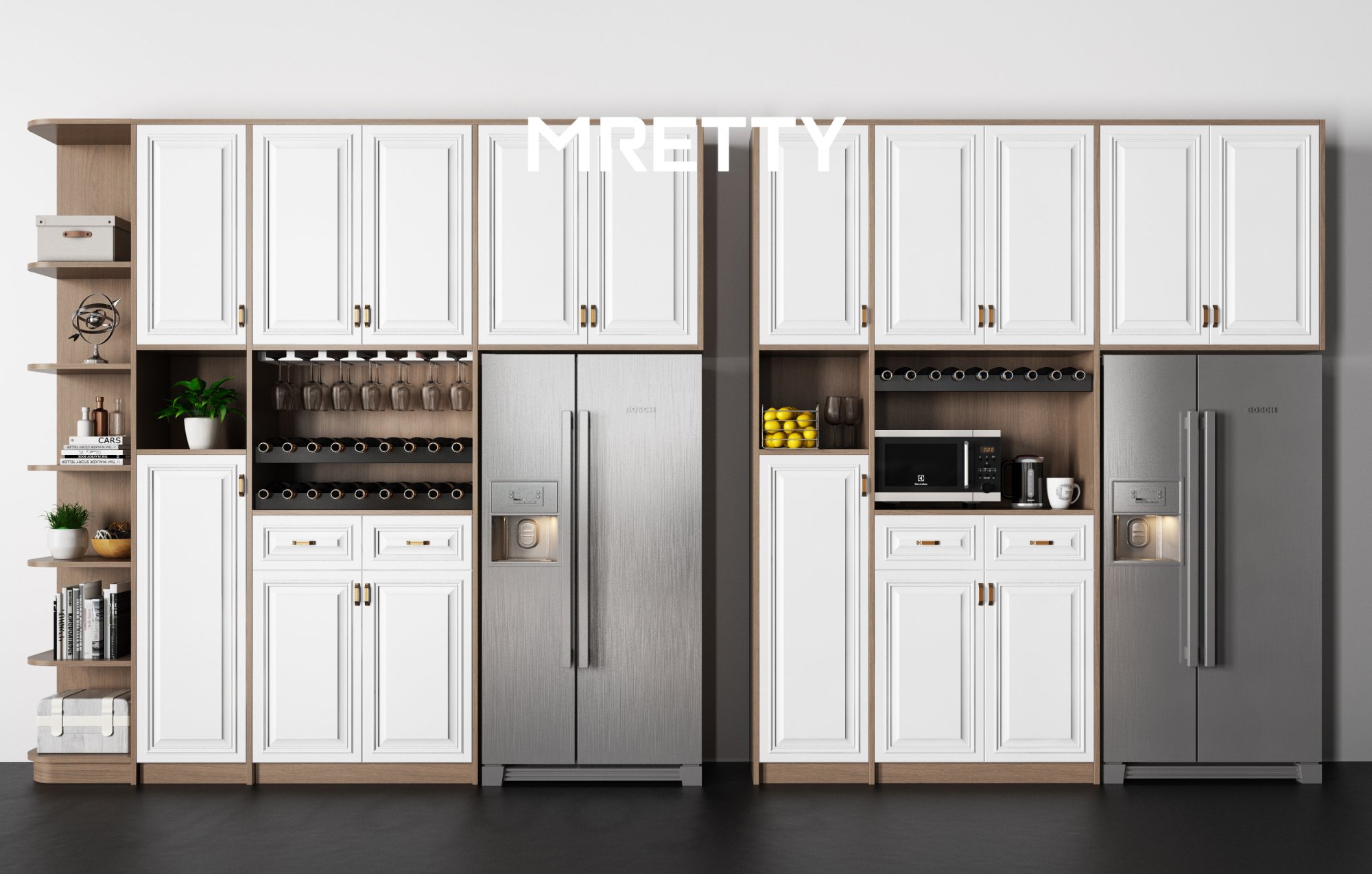
How to Achieve True Minimalist Living in Singapore: MRETTY's 10-Year Expert Guide
Achieving a minimalist home with texture—rather than one that feels "stark and empty"—requires precise control over design elements. It is not about throwing things away, but choosing the "right" things. Below are four key points summarizing the core of the MRETTY minimalist customization service process in Singapore.
1. Color & Material: The Source of Texture
Minimalism does not equal a "white box." We typically advise clients to choose a low-saturation neutral palette (e.g., off-white, light grey, oat) as a base, then layer different materials for depth. For example, sleek lacquer boards, finely textured eco-boards, warm wood elements, and cool metals. In MRETTY minimalist design cases, we frequently use Italian Fenix NTM® boards. Their nano-tech surface achieves an ultra-low light reflectance rate of below 1.5%, offering a warm touch and pure visual clarity, perfectly embodying "quiet luxury."
2. Line Design: The Skeleton of Space
Line design is the soul of minimalism. We pursue straight, clean lines. This manifests in: Handle-less Design: Using chamfered edges, push-to-open mechanisms, or recessed handles to maintain a seamless cabinet face. Built-in Design: Perfectly embedding refrigerators, ovens, and other appliances into cabinetry to form a unified facade. Slim Profiles: Using minimal metal frames for cabinet doors or glass partitions to outline refined contours.
3. Lighting Layout: The Shaper of Atmosphere
Abandoning complex ceiling lights for a recessed lighting design is a hallmark of minimalism. Combining downlights, spotlights, magnetic track lights, and hidden LED strips allows us to precisely control light zones, intensity, and color temperature. This not only provides more uniform, comfortable illumination but also adds layers to simple spaces through light and shadow play. For instance, using 3000K warm light for a tranquil bedroom ambiance, and 4000K neutral light for focused study lighting.
4. Ultimate Storage: Hidden Order
This is the core of minimalist storage techniques for small apartments. A successful minimalist home is backed by a robust storage system. We design 80% of storage space to be "hidden." For example, floor-to-ceiling cabinets along an entire wall with interiors precisely divided by item size; massive storage beneath tatami platforms; or multi-functional furniture that folds or retracts. This ensures public areas remain tidy while everything stays within reach.
❌ Common Mistake: Focusing only on cabinet appearance while ignoring internal hardware and structure. Sticking doors or wobbly drawers are "devilish details" that ruin the minimalist experience.
>
✅ Better Approach: Invest in high-quality hardware, such as the full range of solutions from Austrian Blum. MRETTY insists on top-tier hardware, ensuring every opening and closing is quiet and smooth. This pursuit of extreme detail is where the true value of high-end customization lies.
2026 Minimalist Design Trends: From "Decluttering" to "Functional Fusion"
As a designer, I follow the home furnishing exhibitions in Milan and Cologne annually. 2026 minimalist design trends show a clear shift: moving away from "discarding" (decluttering) towards "integrating" (functional fusion).
This means design is no longer about mere removal, but about combining elements more intelligently. For instance, a minimalist living room TV wall solution is no longer just a blank wall with a TV, but a composite functional unit integrating AV equipment, display shelves, storage cabinets, and even a compact workstation. The future home will be a seamless whole composed of multiple high-efficiency "functional modules."
In my view, "functional fusion" suits Singapore's high-density living environment better than pure "decluttering." Within a limited footprint, every surface must serve multiple roles. Rather than pursuing emptiness, clever design allows a space to serve different scenarios at different times—this is the true maximization of space.
Another major trend is deep integration with Smart Home technology. Through pre-planning, we can perfectly conceal control panels for systems like Google Home, sensors, and wiring within custom cabinetry, achieving true "technological minimalism."
❌ Common Mistake: Chasing isolated trendy elements, like micro-cement last year or arched doors this year.
>
✅ Better Approach: Focus on the underlying lifestyle changes behind the trends. Understand the logic of "functional fusion" and "smart integration," combining it with your own life needs to create a home that is both stylish and truly practical.
Investing in Your Quality of Life for the Next Decade
Singapore minimalist whole-home customization is not just about aesthetics; it is a wise investment in your future quality of life. Through scientific spatial planning, robust storage systems, and high-quality material craftsmanship, it saves you time, reduces mental exhaustion, and creates an environment where you can fully relax and focus.
Choosing MRETTY means choosing a professional team that deeply understands Singapore's local living environment, possesses top-tier manufacturing capabilities, and has ten years of senior design experience. We build for you not just a "beautiful house," but a "home that works perfectly for ten years."
Download our
Beginner’s Guide to Minimalist Home Design in Singapore e-book for more inspiration and practical tips.
Frequently Asked Questions (FAQ)
What is the approximate budget for minimalist customization?
Whole-home customization pricing depends on various factors: property size, scope of customization, material selection, and hardware grade. In Singapore, for a standard 4-room HDB (approx. 90 sqm), the budget range for minimalist whole-home customization typically falls between S$30,000 and S$80,000. Using basic eco-boards might be at the lower end, while opting for Italian-imported Fenix boards and full Blum hardware (as provided by MRETTY) will approach the upper limit. We recommend allocating 40%-60% of your total renovation budget to custom furniture, as it is the key determinant of long-term living experience.
Is minimalism suitable for small HDB flats or condos in Singapore?
Absolutely suitable—arguably the optimal choice. The core of minimalism is functionality and spatial efficiency, which is precisely what small units need most. Through floor-to-ceiling storage, multi-functional furniture, and a unified color palette, minimalist design makes small spaces appear visually larger, tidier, and more open. The key lies in precise measurement and ingenious design.
What is the difference between Minimalism and Modern Simplicity?
The two are often confused. Here is the distinction: Modern Simplicity: Focuses more on stylistic form, emphasizing clean lines and geometric shapes, but can still incorporate more decorative elements and color contrasts. Minimalism: A more extreme philosophy. It demands not only formal simplicity but also functionality as the starting point, stripping away all unnecessary elements. Colors are more restrained, and materials prioritize pure texture. Minimalism is the further refinement and distillation of Modern Simplicity.
What projects are included in Minimalist Whole-Home Customization?
It typically covers all fixed furniture and storage systems in the home, including: Entryway: Shoe cabinets, storage cabinets Living Room: TV consoles, display cabinets, feature wall systems Dining Room: Sideboards, banquettes Bedroom: Wardrobes, bedside tables, vanity tables, study desks Kitchen: Kitchen cabinets, islands Bathroom: Vanity cabinets Others: Storage racks for utility rooms/bomb shelters, balcony cabinets, etc.
MRETTY provides end-to-end full-project services from spatial planning to furniture design, production, and installation.
About the Author
Aida, Senior Lead Designer, MRETTY
With over ten years of experience in high-end residential design, I firmly believe that space is the physical manifestation of the dweller's inner spirit, and exceptional design is the journey that guides clients toward self-realization. Throughout my career, I have provided full-project customization services for hundreds of HDB and condo households in Singapore, specializing in creating infinite living possibilities within finite spaces through exquisite design.
I am passionate about blending diverse design styles—whether the calm of Modern, the elegance of Italian and French, or the tranquility of Japanese and retro Mid-Century—capturing their essence and integrating them with the client's unique persona. At MRETTY, I combine this passion with the company's top-tier craftsmanship, dedicated to creating a timeless home for every client that is both beautiful and supremely functional.
MRETTY: Premium Bespoke Kitchen & Cabinet Systems Provider in Singapore
