
 Singapore
 China
China
TL;DR
- True "luxury" in Singapore comes from a unified and coherent design vision, not from stacking expensive furniture together.
- Whole-home integrated customization (where the same entity handles both design and execution) offers better control over quality and consistency than the fragmented model of "separate designer + multiple contractors."
- Material selection must be adapted to the Singapore climate; choosing durable, moisture-resistant materials prevents cracking, peeling, and costly rework down the line.
Quick Answer Snapshot
To achieve Singapore-style luxury interior design, the core is to create a stylistically unified, highly personalized space supported by superior materials and craftsmanship. It is far more than just "buying expensive"; it relies on professional spatial planning and custom solutions that ensure every element—from cabinetry to trim, from circulation to lighting—fits seamlessly into a cohesive whole. Adopting a "whole-home integrated customization" approach ensures that every piece of millwork, finish, and hardware complements each other and is executed with precision.
Can you tell the difference between a home that simply looks "expensive" and one that is truly "luxurious"? Many cannot.
The secret lies not in the price tag of the sofa, but in whether the entire home feels seamless and harmonious. I have been a whole-home designer at MRETTY for over 14 years, guiding hundreds of Singaporean homeowners through this exact journey.
This guide does not chase short-term trends. Instead, it focuses on foundational principles of luxury homes that work in Singapore: built to last, yet comfortable to live in every single day.
How to Define "True Luxury" and Avoid Costly Pitfalls
In Singapore, "luxury" must be grounded in an understanding of our living environment—whether it is a Good Class Bungalow (GCB), a high-end condominium in the Orchard Road area, or a more spacious HDB Executive Apartment.
Luxury ≠ Extravagance; it is intelligent design: balancing unity, execution precision, and personalization.
Over the years, I have observed three common traps homeowners fall into—mistaking them for luxury while they actually burn money:
3 Common "Luxury Decor" Mistakes Singaporeans Make
1) Fragmented Shopping: Turning Your Home into a "High-End Showroom"
❌ The Mistake: Without a master plan, homeowners buy "statement pieces" from various high-end stores. The result often feels disjointed—more like a museum than a livable home.
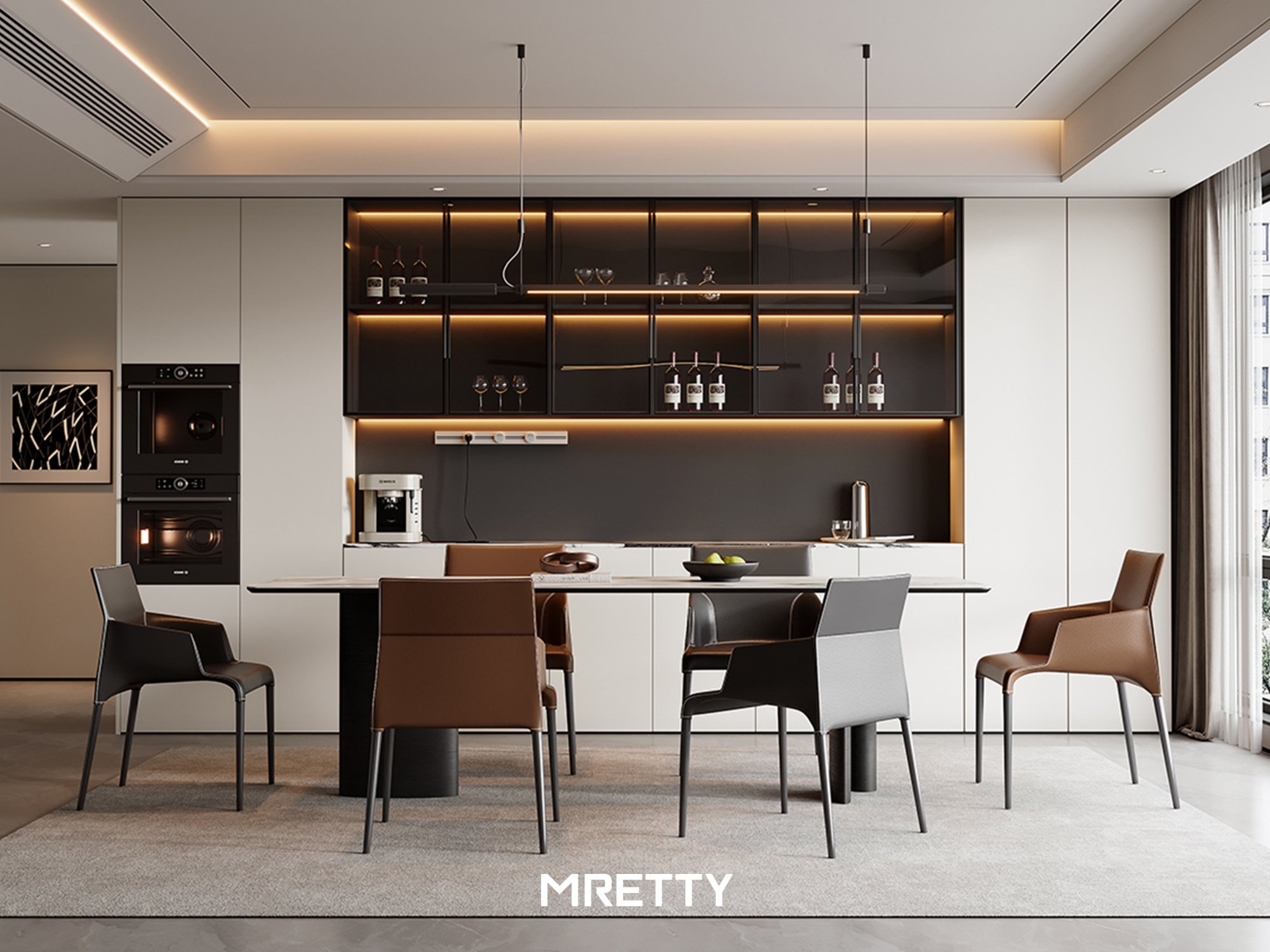
✅ The Better Approach: Establish a unified whole-home concept first: consistent material palettes and design language that connect every room. The tones and textures of your kitchen cabinets should "talk" to your living room feature wall; only then will circulation and sightlines feel fluid and premium.
2) Ignoring the Singapore Climate: Copying European Magazine Materials
❌ The Mistake: Selecting certain solid woods or finishes based solely on aesthetics, without considering the long-term relative humidity (Singapore’s annual average relative humidity is approximately 84%, according to the National Environment Agency, NEA). This leads to wood warping, veneer lifting, and metal oxidation, resulting in expensive do-overs.
✅ The Better Approach: Prioritize weather resistance and stability: low-moisture engineered wood systems, higher-grade finish systems, and corrosion-resistant hardware (such as Blum / Hettich product lines, which perform more reliably in humid environments). At MRETTY, we lean towards solutions proven in tropical Southeast Asian conditions.
3) Fear of Empty Space: Overcrowding Every Square Foot
❌ The Mistake: Especially in condos, the urge to "maximize utility" often leads to visual noise and clutter—which is the opposite of luxury. Crowding = Cheapness.
✅ The Better Approach: Master the use of negative space (breathing room): emptiness highlights key elements, allows light and air to flow, and makes circulation feel generous. Luxury is about "the right furniture in the right place," not "filling every corner."
Last year, during a consultation at a condominium in Ardmore Park, a homeowner had purchased a very large, beautiful Italian sofa. However, it "swallowed" the living room and created awkward walkways. We replaced it with a custom-sized, cleaner-lined sofa with slender legs, preserving clear circulation. The space immediately felt larger and more sophisticated. Get the scale right, and the luxury follows.
Prioritizing "unity, climate adaptability, and spatial proportion" upfront turns your budget into a long-term asset rather than a one-time expense.
How to Achieve Highly Unified Spatial Results with "Whole-Home Integrated Customization"
How do you guarantee uniformity? It comes down to process.
Many struggle with the choice: Whole-Home Integrated Customization vs. Traditional "Interior Designer + Dispersed Contractors." The difference is significant.
The traditional route usually involves: Designer creates drawings → Carpentry, tiling, and installation are subcontracted out. With more handovers, material batches, finishing methods, and communication channels easily diverge.
In contrast, the "Whole-Home Integrated Customization" model we practice at MRETTY consolidates design—production—installation within the same system: one chain of responsibility, one set of standards, delivering results closer to the original intent.
Comparison: MRETTY Whole-Home Integrated Customization vs. Traditional ID + Multiple Contractors
| Dimension | MRETTY Whole-Home Integrated Customization | Traditional ID + Multiple Contractors |
|---|---|---|
| Material Consistency | Higher: All custom cabinetry (kitchen systems, wardrobes, storage systems) come from controlled batches and a unified craftsmanship system, minimizing color/texture mismatch risks. | Higher Risk: Different carpenters/suppliers use varied batches, leading to "close-but-not-quite" visual clashes. |
| Precision & Finishing | Near factory-grade: Leveraging smart manufacturing and CNC logic (tolerances managed to precise millimeter levels), resulting in cleaner surfaces and tighter joints. | Variable: Higher reliance on on-site manual work; different workers' skill levels directly impact finishing quality. |
| Accountability Chain | Single point of contact: The designer is responsible for the overall delivery from concept to installation. | High coordination cost: You (or the ID) must manage multiple parties regarding schedules and defect responsibilities. |
| Outcome Predictability | More controllable process; easier to achieve a look where everything feels "grown from the same system." | More prone to errors, rework, and a visual sense of "patchwork." |
A recent project in a new condominium presented a typical scenario: the homeowner worried that the wooden textures in the open-plan living-dining-kitchen zone would look mismatched. Because all related components were completed within the same system using unified batch finishes and processes, continuity was assured—something分散外包 (dispersed outsourcing) struggles to guarantee. This is the tangible difference MRETTY’s approach delivers.
Integrated customization eliminates "handover gaps"—where errors and deviations love to hide.
Ready to see how a unified design process creates a truly luxurious home?
Visit the MRETTY showroom to experience our material library and completed projects firsthand. We translate the principles of "unity, refinement, and durability" into tangible details.
[Book a Free Showroom Tour]
How to Select Materials and Soft Furnishings for Timeless Luxury
A frequent question: To achieve a luxury feel, do I need to buy branded furniture like Poliform or Molteni&C?
They are indeed beautiful, but they cannot solve your specific dimensions, plumbing, beams, columns, or dead spaces—nor can they become "one" with your architecture.
Many misunderstand luxury as importing famous brands.
But I often say: True luxury frequently resides in what you cannot "buy off the shelf"—
- It is the built-in wardrobe that reaches the ceiling without leaving an awkward 15cm gap;
- It is the custom storage wall that perfectly fits a recess and hides away network cables and routers;
Off-the-shelf furniture is made for "generic layouts"; customization is made for your layout.
The Material Palette is the Foundation
❌ The Mistake: Using cheap plywood or low-density boards for the hidden structural framework of cabinets. Singapore’s humidity will slowly cause them to swell and deform: doors misalign, drawers stick, and repairs begin within three to five years.
✅ The Better Approach: Be equally rigorous with the structural materials—using higher-density, moisture-resistant internal core systems ensures your "custom system" remains silent, stable, and functional for over a decade. Part of luxury is the layer of structure you never see but interact with daily.
My personal rule of thumb is 80/20:
- 80% of your budget should prioritize high-quality customization that defines the spatial skeleton (kitchen systems, wardrobe systems, major storage)—they dictate fit, durability, and overall character;
- 20% can be allocated to a few characterful statement pieces (a classic armchair, a signature light fixture)—to inject your personal aesthetic.
Tailoring Strategies for Different Property Types: Condos, Large HDBs, and Good Class Bungalows (GCBs)
Luxury is not a "one-size-fits-all template." Strategy depends on property type.
Luxury Home Approach for Singapore Condominiums (Especially Large Units in Core Areas like Orchard)
The keywords here are: Amplifying Space and Light.
- Use floor-to-ceiling custom wardrobes/storage walls to draw the eye upward;
- Thoughtfully incorporate mirrors/glass elements to create depth and extension (but exercise restraint to avoid a cold feel);
- Favor multi-functional integrated designs (e.g., the relationship between dining tables and islands, balancing storage with display) to keep circulation clean and sophisticated.
Creating "Luxury Feel" in Large HDB Executive Apartments
The challenge is elevating a standard layout to a higher tier. Here, a more comprehensive renovation strategy is key: reconfigure zoning (within non-structural limits) using holistic cabinetry systems to create dry-wet zones or walk-in wardrobe logic, and apply a consistent, premium material palette throughout—once the visuals unify, the perceived quality transcends typical HDB associations.
Luxury Interior Design for Good Class Bungalows (GCBs)
GCBs are about scale, flow, and integration: the advantages of whole-home integrated customization shine brightest here. A real-scale example: We once executed a feature wall approximately 6 meters high in a GCB, using book-matched marble slabs. At this scale, even a 0.5mm misalignment would be jarring—achieving that "single sheet of silk" alignment requires processes closer to factory-level cutting and positioning control (pure on-site manual work struggles with such consistency). Additionally, GCBs are ideal for integrating smart home systems invisibly within luxury decor: convenience should be available, but wires, boxes, and controls should remain hidden.
Frequently Asked Questions About Luxury Home Decor
What are the key elements of luxury home decor?
True luxury typically involves several elements working in concert:
- Unified Vision: A consistent material palette and design language that tells one coherent story throughout the home;
- Craftsmanship Precision: Flawless seams, finishes, paintwork, and hardware tactile feel;
- Material Honesty & Durability: Preference for natural/high-performance finishes, stable substrates, and reliable hardware;
- Personalized Customization: Layouts and components genuinely tailored to your lifestyle (making spatial planning incredibly valuable);
- Layered Lighting: Beyond mere brightness, incorporating ambient, accent, and task lighting to sculpt atmosphere;
- Hidden Quality: Moisture-resistant structures, stable framing, and silent, smooth drawer slides and hinges—this is the confidence that comes from a home that stays "new" for years.
About the Author
The author of this article has served as a Lead Designer at MRETTY for 14 years, completing over 200 high-end residential projects across Singapore—from Sentosa Cove bungalows to Orchard Road penthouses. The design philosophy emphasizes "timelessness, livability, and alignment with the homeowner's lifestyle."
References
- National Environment Agency (NEA), Singapore – Public data on "Singapore Climate" (humidity metrics, etc.).
MRETTY: Premium Bespoke Kitchen & Cabinet Systems Provider in Singapore.
