
 Singapore
 China
China
True luxury home design is the art of creating a personalized sanctuary. It reflects the inner spirit of its inhabitants through masterful spatial planning, refined material language, and bespoke craftsmanship—rather than merely accumulating expensive objects. In Singapore, this means a design system that both withstands the tropical humidity and achieves seamless, flawless integration in every detail.
TL;DR: Authentic luxury home design in Singapore must follow an integrated approach: bridging interior architectural logic with whole-home custom furniture manufacturing. The core pillars are: master-level spatial planning, climate-adapted materials (such as Italian marble), and invisible smart home ecosystems. The most successful projects—whether Good Class Bungalows (GCBs) or high-end condominiums—reject fragmented outsourcing. Instead, they choose a single point of accountability to orchestrate everything from concept to execution, ensuring zero dilution of the design vision.
"Space is the physical manifestation of the inhabitant's inner spirit. Design is the journey guiding them toward self-realization."
— Aida, Senior Whole-Home Customization Designer at MRETTY
Over more than a decade of walking alongside homeowners in Singapore, I have witnessed too many projects that began with beautiful inspiration but faltered due to disconnected details and poor coordination. True luxury is never about "buying expensive things"; it is a daily lived experience: the reassuring glide of a drawer, the softness of dusk light on a wall, the comfort of a space scaled perfectly for you.
Drawing on our team's experience across hundreds of high-end residences, this guide helps you bypass common pitfalls and create a home that stands the test of time.
1. Defining Your Vision: Deconstructing "True Luxury"
Luxury home design is not a fixed style; it is a set of core principles that elevate the living experience: the deep integration of form, function, and personal narrative.
Many assume luxury means "expensive materials and branded furniture."
The truth is: the highest luxury is often 'invisible.'
It resides in structural intelligence, the calibration of spatial proportions, and restrained negative space—addressing the architectural "shell" first: circulation, daylight, and scale relationships, before considering any decoration.
In a 2025 Sentosa Cove project I was involved in, we subtly adjusted the layout to create a 12-meter通透轴线 (transparent axis) from the entrance straight through to the sea view. The construction cost increase was limited, yet the daily experience of returning home was fundamentally transformed.
Last month, a client came to me with reference images of a "five-star hotel lobby." As we talked deeper, it emerged that they truly loved sailing, vintage family maps, and quiet reading time. The final scheme became: a custom navigation chart storage console and a series of soft, enveloping curved forms reminiscent of a yacht's interior—still luxurious, but more importantly, it was their home.
❌ Common Mistake: Selecting furniture and decor first, then retrofitting the space.
✅ Better Approach: Prioritize refining the "architectural shell"—space, flow, light. A well-planned empty house already possesses inherent sophistication.
❌ Common Mistake: Equating luxury with filling every space.
✅ Better Approach: Skillfully use negative space. Allow key pieces and architectural features room to breathe.
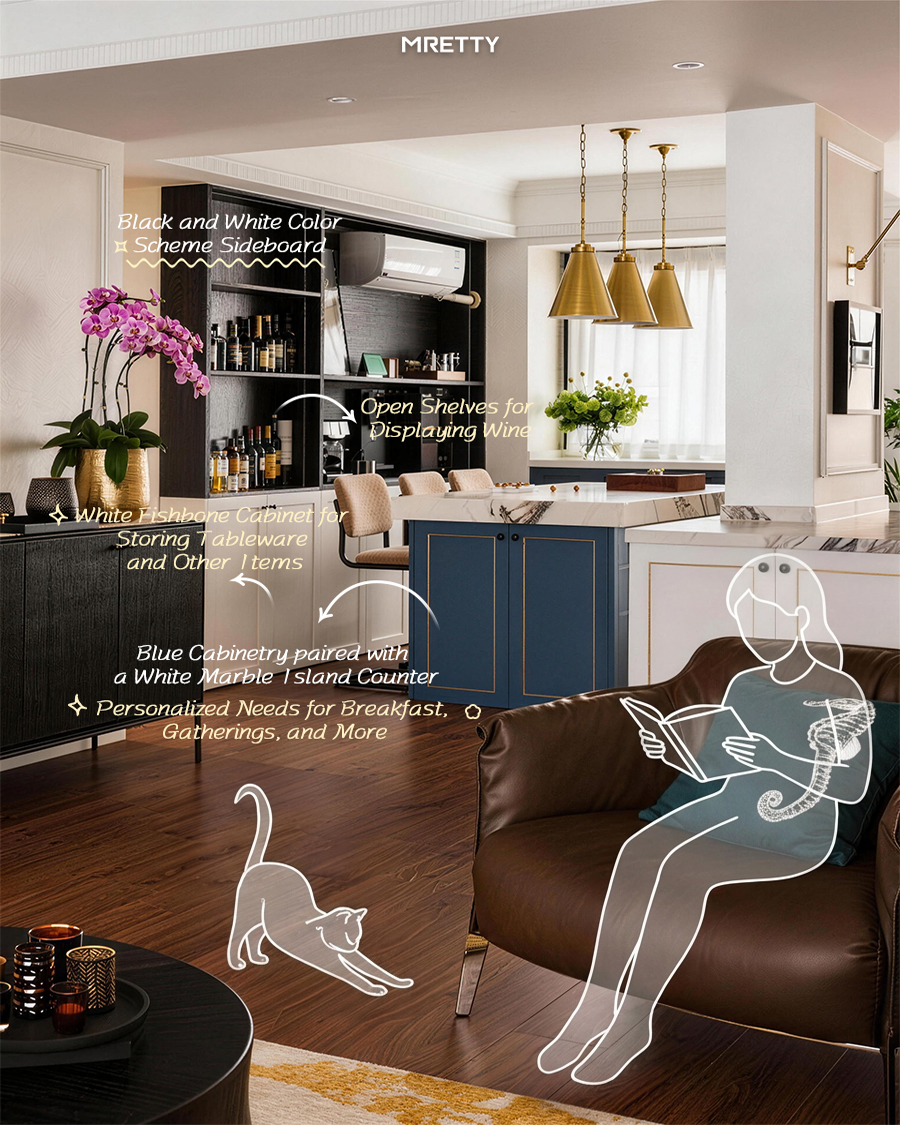
2. Unifying Space: The Power of Integrated Whole-Home Customization
The most frequent and costly pitfall I observe is the "fragmented approach":
Homeowners hire a designer → the designer outsources carpentry → the carpenter sources materials elsewhere → furniture is bought from various showrooms. Result: communication breakdowns, compromised quality, and clashing styles.
The integrated model is the correct solution.
A true turnkey solution means one team, one vision, one accountable window.
At MRETTY, designers interface directly with the production team in our 15,000 m² smart factory—when a designer specifies "specific wood veneer + 0.8mm edge-banding tolerance," they are communicating with colleagues, not an unknown external vendor. This direct line is the key to "zero-deviation execution." Even prestigious brands like Poliform offer excellent off-the-shelf pieces, but for whole-home material uniformity and perfectly aligned joints, an integrated system is far harder for fragmented outsourcing to replicate.
In a recent Ardmore Park condominium project, we needed a curved integrated feature wall where the wall surface and shelving shared identical color and curvature. With a fragmented approach, the wall contractor and millwork factory would almost certainly fail to match every curve and finish.
Because our design and production ends were connected, the wall's CAD curves directly drove the CNC milling of the shelves—seamless joints, consistent color. This is the power of a unified system.
Data Point: Design-Build integrated projects can deliver up to 33% faster than traditional fragmented models.
❌ Common Mistake: Hiring designers, contractors, and furniture suppliers separately, hoping they coordinate automatically.
✅ Better Approach: Choose an integrated firm capable of orchestrating the entire whole-home customization design process, ensuring a "single source of truth + single chain of accountability."
3. Contextual Strategies: Tailoring Design to Property Types
Luxury is not "one template applied everywhere." Singapore's property types vary drastically; strategy must adapt accordingly.
High-End Condominiums & HDB Penthouses
Core Challenge: Amplifying the sense of space. We favor multi-functional custom furniture combined with floor-to-ceiling storage to lift sightlines, supplemented by mirrors or light-toned finishes to expand light. In one 1,200 sq ft condominium, we integrated the dining table directly into a marble-clad kitchen island, reclaiming valuable floor area without sacrificing dining ritual.
Good Class Bungalows (GCBs)
Core Challenge: Commanding scale without hollowness. The focus is not "making things big," but "defining them with layered detail." In a Nassim Road GCB project, the double-volume living room generated noticeable echoes. Rather than relying solely on rugs, we designed large-scale custom acoustic art panels (wrapped in Kvadrat fabric) and incorporated towering bookshelf systems to break up flat wall surfaces—solving acoustics while giving the vast space warmth and intimacy.
❌ Common Mistake: Applying large-property design logic directly to small-footprint apartments.
✅ Better Approach: Adjust strategy by scale—apartments prioritize "spatial optimization," GCBs prioritize "zoning and atmospheric definition."
4. Selecting Materials: Technical Specification for Singapore's Humid Climate
In the tropics, material selection is first a technical issue, second an aesthetic one.
Singapore's average humidity exceeds 80%, acting as a relentless enemy to inferior materials. I have witnessed too many projects where wood warps, finishes peel, and metal corrodes—often within just two to three years.
Deep material judgment is essential.
For instance, I once saw a walk-in wardrobe built with standard MDF; within 18 months, it began swelling and delaminating near the floor. This is why we insist on High Moisture Resistance (HMR) plywood cores for all millwork: the upfront cost may be ~15% higher, but it prevents total cabinet failure years later.
For countertops, natural stones like Italian marble perform superbly but require proper sealing. Hardware is uniformly specified from brands like Blum—their opening/closing systems are tested to 200,000 cycles (equivalent to 20+ years of use) and offer superior corrosion resistance for our local environment.
❌ Common Mistake: Choosing based only on "how it looks," ignoring performance in humidity.
✅ Better Approach: Prioritize systems proven against humidity: HMR cores, properly sealed natural stone, corrosion-resistant hardware.
5. Integrating Life: Weaving Smart Homes into the Luxury Experience
Smart home technology is no longer just "adding a few switches later."
True luxury is invisible technology: intuitive, seamlessly embedded in the design, not cluttering the walls.
We plan smart systems from a "Scenes" perspective, rather than controlling lights, curtains, and AC individually:
- "Good Morning Scene": Curtains open gradually, lights rise to 70%, AC adjusts to 24°C.
- "Movie Scene": Lights dim, projector screen descends, curtains close.
This requires pre-routing conduits from Day 1, concealing control modules within walls and custom furniture. The goal: you experience convenience, yet barely see the devices.
❌ Common Mistake: Adding smart devices after renovation, leading to exposed wires and disjointed experiences.
✅ Better Approach: Plan the smart system during the initial design phase, hiding all wiring and hubs within the architectural and furniture structures.
6. Common Questions About Luxury Home Design
Q: How much does luxury interior design typically cost in Singapore?
High-end residential renovations generally start from S$150 per square foot (psf) and scale upwards; with extensive customization and imported materials, costs commonly exceed S$250/psf.
- A high-end condominium full-scale project: commonly S$250,000+
- A GCB: often S$1,000,000+
We provide itemized quotations post-initial consultation, making every dollar traceable.
Q: Why is custom furniture so critical to luxury design?
Three reasons:
- Perfect Scale: Fits your home's exact dimensions, leaving no awkward gaps.
- Material Unity: Can share the same batch of finishes as built-in millwork for superior cohesion.
- Function Tailored to You: Internal layouts arranged precisely around your lifestyle.
This is the core value of whole-home customization design.
7. Begin Your Bespoke Home Journey
Translating vision into reality requires expertise and a clear roadmap. We have compiled a checklist based on our most successful projects to help you start on the right footing.
MRETTY: Premium Bespoke Kitchen & Cabinet Systems Provider in Singapore.
