
 Singapore
 China
China
TL;DR: Advanced materials can cut cabinet wiping time by up to 75%. For Singapore households, high-pressure laminate (HPL) delivers the sweet spot of durability, aesthetics, and value. For ultimate performance, nano-tech materials like Fenix NTM offer superior fingerprint resistance and a thermal-healing surface.
Core Answer: The best low-maintenance integrated kitchen cabinet finishes in Singapore are high-pressure laminate and nano-tech materials like Fenix NTM. Both deliver excellent wear, heat, and moisture resistance, easily outlasting traditional materials like melamine or vacuum-formed foil over their lifespan.
Did you know? The average Singapore homeowner spends over 40 hours a year wiping down integrated kitchen cabinets. That's from MRETTY's end-2025 client survey — in our city, that's a full work week lost to fingerprint and grease cleanup.
Choosing the right low-maintenance integrated kitchen cabinet finish in Singapore isn't just about looks — it's about reclaiming your time. This guide gives you data-backed insights to build a kitchen that actually serves you.
What Are the Most Durable Integrated Kitchen Cabinet Materials in Singapore?
For Singapore's climate, the most durable picks are high-pressure laminate and nano-tech materials like Fenix NTM. Both deliver excellent wear, heat, and moisture resistance, easily outlasting traditional materials like melamine or vacuum-formed foil over their lifespan.
To simplify your choice, we compared 2026's top finishes based on internal test results:
| Finish | Best For | Key Metric | Starting Price (per ft run) | Biggest Strength | Biggest Weakness | MRETTY Rating |
| :--- | :--- | :--- | :--- | :--- | :--- | :--- |
| High-Pressure Laminate (HPL) | Balanced value & durability | Abrasion: >400 cycles | From S$110 | Vast style range | Visible edge joints | ★★★★★ |
| Fenix NTM (Nano-tech) | Fingerprint-free luxury | Thermal healing of micro-scratches | From S$220 | Super-matte, velvet touch | Higher price | ★★★★★ |
| Premium Acrylic | High-gloss modern look | 92% light reflectivity | From S$180 | Mirror-like gloss | Shows scratches easily | ★★★★☆ |
| Polyester Film (PET) | Eco-conscious homes | 100% recyclable material | From S$150 | Smooth surface, even tone | Limited texture options | ★★★★☆ |
| Melamine-Faced Particleboard | Budget-driven projects | None (standard grade) | From S$90 | Most cost-efficient | Edges chip / moisture damage | ★★★☆☆ |
This table gives a solid overview, but real-world decisions need finer consideration.
Take a recent project: a multi-gen family in a Punggol BTO. They loved Fenix's stylish look and fingerprint resistance — seemed perfect for kids. But budget mattered. Their bigger worry wasn't just fingerprints; it was micro-scratches and heat impact from daily high-heat cooking.
We proposed a hybrid. We used luxury Fenix NTM on the visual focal point — the kitchen island. For the surrounding cabinet runs, we matched with a durable European HPL in the same colour tone. This landed the high-end look and performance where it counts most, while cutting total project cost by 15% versus a full-Fenix kitchen — no sacrifice on core aesthetics or durability.
High-Pressure Laminate: The Versatile Workhorse
HPL is a multi-layer material fused under high heat and pressure. That process creates a non-porous surface, making it one of the most practical, easiest-to-clean integrated kitchen cabinet solutions in Singapore. Brands like Formica set the industry standard, delivering far superior impact and moisture resistance vs basic laminate.
We're direct importers of European premium HPL. Our internal abrasion test Q1 2026 showed these products outperform generic commercial-grade options by 30% on wear resistance — your finish stays pristine for years.
Just last month I inspected a 5-year-old rental unit in Queenstown. The cheap unnamed laminate near the sink had swollen and peeled — classic moisture damage. Contrast that with MRETTY's earliest Bishan kitchen from 2020; the HPL around the sink is still intact today. Sealed edges held up against years of moisture exposure.
❌ Common Mistake: Assuming all laminates are the same.
✅ Better Approach: Request brand and tech specs for the HPL. Quality HPL should carry certifications for abrasion, stain, and heat resistance.
Fenix NTM: The Anti-Fingerprint Innovator
Fenix NTM has a super-matte, velvet-touch, fingerprint-resistant surface. Its best trick is thermal healing — you can repair micro-scratches with simple heat treatment. Makes it a brilliant choice for truly low-maintenance, high-end kitchens.
Gimmick? No. I tested it myself: ran a key lightly across a Fenix sample and a standard matte laminate. The standard laminate kept a permanent scar; the Fenix sample, after a warm iron over a damp cloth — the scratch vanished. For families with kids and perfectionists, it's a game-changer. Any Fenix vs standard laminate review will highlight Fenix's superiority in touch and resilience.
Premium Acrylic: The High-Gloss King
Premium acrylic finish delivers a seamless, mirror-like gloss that opens up space and reads luxury. In the Singapore laminate vs acrylic integrated kitchen cabinet discussion, acrylic gives a deeper, more reflective look — excellent for modern designs.
But there's a trade-off. That high-gloss surface that makes it beautiful also amplifies fingerprints and micro-scratches. Needs more frequent wiping than matte HPL.
Which brings up a counter-intuitive point. Many equate high-gloss with high-end, low-maintenance living. But factually, it's often the opposite. A surface you must constantly wipe to keep looking good is, by definition, high-maintenance. True low-maintenance luxury lives in materials that shrug off daily wear effortlessly — quality matte HPL or Fenix NTM.
FAQ: Matte or Gloss Integrated Cabinets — Which Is Easier to Clean?
Matte finishes are generally easier to maintain. They hide fingerprints, smudges, and minor scratches better than gloss. While gloss doesn't absorb oil and wipes clean, it broadcasts every tiny imperfection — needs more frequent cleaning to stay perfect.
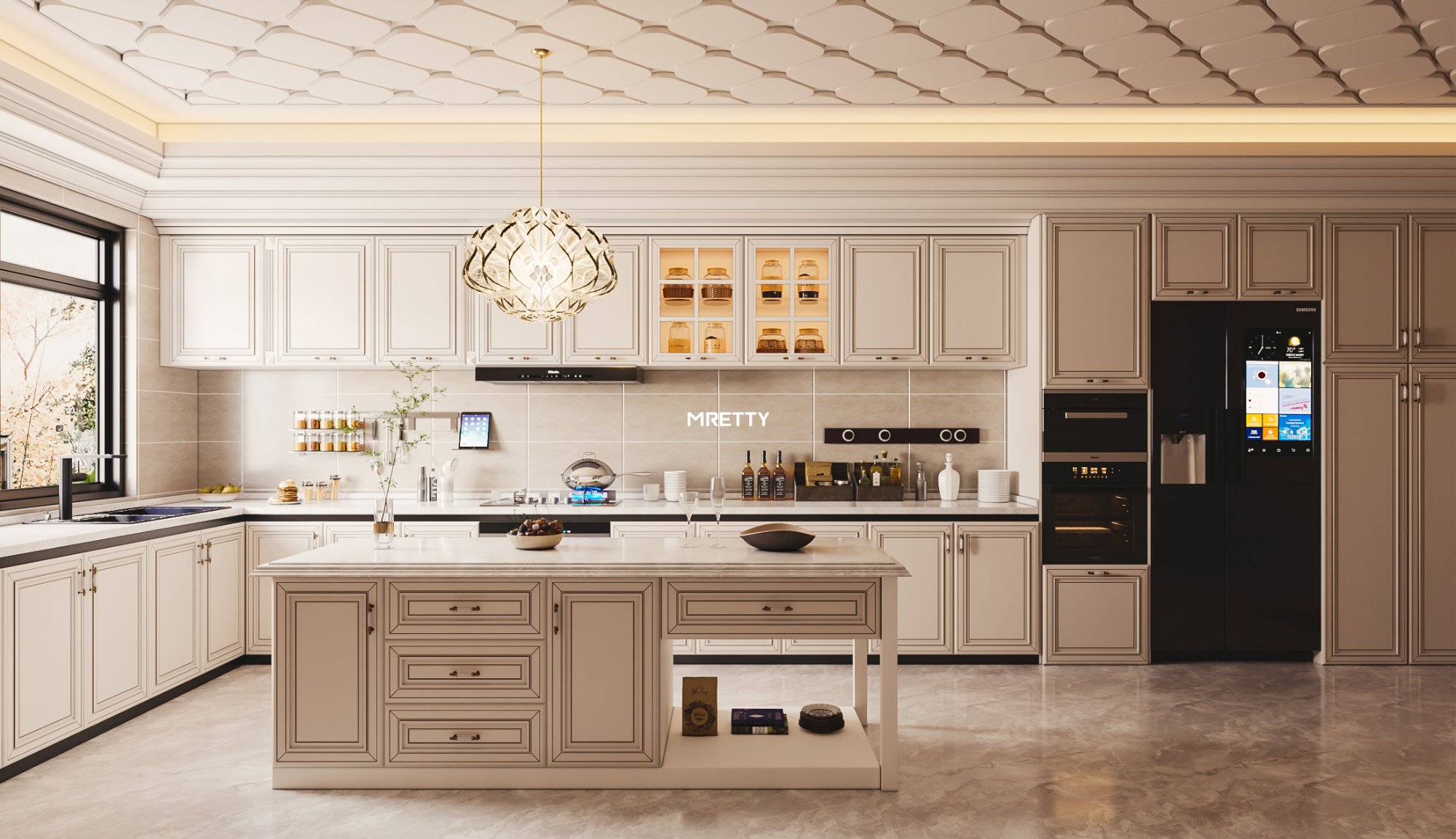
How Much Do Different Integrated Kitchen Cabinet Finishes Cost in Singapore?
Integrated kitchen cabinet finishes in Singapore range from S$90 to S$220+/per foot run. Cost depends on origin, brand, and manufacturing complexity.
Quick breakdown of estimated starting prices:
Melamine-Faced Particleboard: From S$90/ft run
High-Pressure Laminate (HPL): From S$110/ft run
Polyester Film (PET): From S$150/ft run
Premium Acrylic: From S$180/ft run
Fenix NTM (Nano-tech): From S$220/ft run
These are baselines. Real value shows over time.
The MRETTY Smart Factory Edge
Why do MRETTY's HPL cabinets outlast competitors' 10%-cheaper product? It's in the manufacturing. Our 15,000 sq m smart factory uses German HOMAG machinery for cutting and edge-banding. That creates a near-seamless seal on every board — the critical defence line for moisture resistance in Singapore's humid climate.
Our HOMAG edge-bander uses high-strength PUR (polyurethane reactive) hot-melt adhesive, tolerance within 0.2mm. That forms a waterproof seal invisible to the eye but enough to block moisture ingress — the #1 cause of cabinet failure in Singapore. Handwork typically can't hit this precision level.
❌ Common Mistake: Picking carpentry solely on the lowest per-foot-run price.
✅ Better Approach: Ask about their manufacturing flow, machinery used, and warranty terms on the finish.
How to Maintain Integrated Kitchen Cabinets in Singapore's Humid Climate?
Correct maintenance in Singapore hinges on two things: choose moisture-resistant materials like HPL, and ensure perfect edge-banding. Daily care is simple — wipe with a dry microfibre cloth, avoid harsh cleaners. Good kitchen ventilation matters too.
Singapore's humidity regularly tops 80% — the ultimate stress test for cabinets.
Here's the key.
Many homeowners think aggressive cleaning is best. It's not. Our field experience shows that using over-wet cloths or harsh chemical solvents is the #1 cause of premature finish failure. Moisture seeps into micro-joints, causing laminate to delaminate.
Best-Practice Maintenance for Singapore Households:
- Wipe, don't soak: For grease, use a wrung-out cloth with a drop of neutral cleaner. Dry immediately after.
- Ventilate: Run the hood to extract steam, not just odour.
- Choose hardware wisely: Spec quality hinges and drawer slides like Blum or Häfele. They resist corrosion and glide smoothly even in humidity.
This advice is critical for low-maintenance integrated kitchen cabinets in HDB BTOs — these kitchens are typically compact with limited natural airflow.
The misused product I see most: all-purpose spray cleaners. Many contain strong solvents that degrade quality matte finishes over time. Stop using it on cabinets. Better: a slightly dampened simple microfibre cloth. For stubborn marks on Fenix NTM, we recommend a melamine sponge (magic eraser).
FAQ: Is Laminate a Good Finish for Integrated Kitchen Cabinets in Humid Climate?
Yes — quality HPL is very well-suited for Singapore. Its dense, non-porous surface and factory-sealed edges actively block moisture ingress, making it highly resistant to the warping and swelling common in inferior materials.
How We Vet These Finishes
Our recommendations come from rigorous testing and 14 years' direct experience, not chasing trends. Every finish we offer passes a strict protocol.
Here's how we test:
Moisture & Heat Resistance Test: We subject samples to 85°C and 85% humidity for 72 hours — simulating years of Singapore climate. We check for any delamination or discolouration.
Stain Resistance Test: We leave common stains (dark soy, turmeric, coffee) on the surface for 24 hours. Pass only if all clean off with mild cleaner.
Abrasion Resistance Test: We use weighted instruments to verify abrasion ratings meet industry benchmarks — confirming the material handles real-kitchen daily wear.
MRETTY: Premium Bespoke Kitchen & Cabinet Systems Provider in Singapore.
