
 Singapore
 China
China
The Bottom Line: Choosing imported material cabinets in Singapore means opting for superior durability, environmental standards, and design aesthetics. The core advantage lies in the exceptional performance of top-tier European boards (like Fenix and Egger) and the extended lifespan brought by German craftsmanship (such as PUR seamless edge banding), ensuring your cabinets remain in peak condition for over 20 years, even in Singapore's humid climate.
Quick Answers to Your Questions
Which imported material is best?
For families pursuing ultimate aesthetics and durability, Italian Fenix is the top choice. For users prioritizing cost-effectiveness and a wide variety of designs, Austrian Egger is the ideal option.
How much more expensive are imported cabinets than local carpentry?
Initial costs are 30%-50% higher. However, considering their lifespan of over 20 years and minimal maintenance costs, they offer greater long-term value.
How to ensure you are buying genuine products?
Always request and verify three documents from the vendor: the Brand Authorization Letter, the Material Certificate of Origin, and the Customs Import Declaration.
As a full-home designer with 14 years of experience in Singapore, I have seen clients overwhelmed by the myriad of brands, terminology, and pricing when selecting imported material cabinets. This guide will demystify everything for you.
The content here is based on my real-world experience serving hundreds of Singaporean households, from HDBs to landed properties. We will dive deep into the most popular European imported boards and provide actionable advice to ensure your investment pays off.
Selecting the Best Materials: Ranking & In-Depth Comparison of Mainstream Imported Cabinet Brands
Choosing the right material is the first step in building your ideal kitchen. In Singapore, the most respected options come from several major European brands, representing top-tier design, superior performance, and stringent environmental standards.
To give you a clearer picture, we conducted internal stress tests on the three most mainstream imported boards in the market during Q4 2025. Below is a core comparison based on test results and project experience.
Comparison of Popular Imported Cabinet Materials in Singapore
| Material Brand | Origin | Best Suited For | Core Technology | Eco-Rating | Pros | Cons |
| :--- | :--- | :--- | :--- | :--- | :--- | :--- |
| Fenix® | Italy | High-end modern kitchens, kitchen islands | Nano-coating, Thermal healing tech | E0 | Extreme matte finish, Anti-fingerprint, Scratches repairable | Highest price, Limited color range |
| Egger® | Austria | Diverse design styles, Value seekers | Synchronized textures (ST), PerfectSense | E0 | Extensive color/texture range, High value, Wear-resistant | Matte texture & anti-fingerprint less advanced than Fenix |
| Kronospan® | Austria/Poland | Budget-conscious buyers wanting imports | Avola synchronized textures | E0 | Affordable, Wide variety of patterns | Brand positioning & premium lines not as high as the others |
| Cleaf® | Italy | Luxury designs focusing on texture & feel | Thermoforming technology | E0 | Deeply realistic textures, Strong design sense | Higher price, Demands extremely high processing skill |
This table is just the starting point. The real choice depends on your lifestyle, budget, and aesthetic preferences.
Fenix NTM®: The "Black Tech" of Kitchens
Fenix material has been a star in the high-end custom cabinet sector for the past five years. Its unique nano-tech coating gives it an extreme matte visual effect and a silky-smooth tactile feel.
I often recommend Fenix to families with children because of its super anti-fingerprint property, keeping the kitchen looking pristine. Even more magical is its "thermal healing" function: minor surface scratches can be restored using a damp cloth and a low-temperature iron. We have demonstrated this hundreds of times at the MRETTY showroom, and clients are always amazed.
Last month, while designing a dry kitchen for a seaside bungalow, the owner was deeply concerned about corrosion from salty, humid air. We ultimately chose Fenix. It not only integrated perfectly into the minimalist design but also performed stably in the humid environment, with exceptionally easy daily cleaning. The owner was extremely satisfied.
However, Fenix carries the highest price tag and is best suited for families with ample budgets seeking top-tier texture and minimal maintenance.
Egger®: The Designer's "Palette"
If Fenix is the tech specialist, then Austrian Egger is the king of aesthetics. It boasts over 200 decorative finishes, from incredibly realistic synchronized wood grains (Feelwood) to various textured solid color series, satisfying almost any design style.
For Singaporean Condos and HDBs, Egger is my most recommended choice. It offers better cost-effectiveness while maintaining excellent performance, adhering to the strictest European E0 environmental standards. Particularly, its PerfectSense Topmatt (PT) series performs excellently in anti-fingerprint and wear resistance, serving as a fantastic alternative to Fenix.
Here is the key point: Egger's synchronized wood grain series offers visual and tactile alignment, mimicking the texture of solid wood at a fraction of the cost.
❌ Common Mistake: Assuming all Egger boards are the same.
✅ Better Approach: Specify exactly which series you need. For kitchen door panels, choose at least the enhanced durability PerfectSense series, not the basic melamine boards.
Cleaf®: The "Texture Expert" That Engages the Senses
Italy's Cleaf focuses on creating deep, realistic three-dimensional textures. Whether imitating leather, fabric, or deeply brushed wood grains, Cleaf provides a stunning tactile experience.
I used Cleaf's Yosemite series for wardrobe doors in a Sentosa bungalow project. When the owner touched the ax-like depth of the wood texture, he couldn't believe it was just a decorative panel. That is the charm of Cleaf, though it demands top-tier equipment and craftsmanship to ensure perfect edge banding.
Key Takeaway: Fenix leads in durability and ease of maintenance thanks to nano-technology, while Egger wins the market with its unparalleled variety and value. Both are top choices for imported cabinet customization; the choice depends on your specific needs.
Analyzing Core Differences: Why Imported Cabinets Are Worth the Investment
"How are imported cabinets different from local carpentry?" I have been asked this question over a thousand times.
Many people think the premium for imported cabinets comes mainly from the boards themselves. But that is not true. What truly determines whether a set of cabinets lasts 20 years is 80% dependent on what you cannot see: edge banding craftsmanship, hardware, and machining precision. Local carpenters usually cut and assemble on-site, while professional factories like MRETTY follow a completely different industrial production process.
1. Precision & Craftsmanship: A Millimeter-Level Contest
Limited by portable tools and site conditions, local carpenters' machining accuracy is usually within 2-3 millimeters. MRETTY's 15,000㎡ smart factory uses a full line of German HOMAG heavy-duty industrial equipment, achieving cutting precision of 0.1 millimeters. This makes a visible difference during installation, especially with complex corners and tall cabinets.
More critical is the edge banding technology. Singapore's humid climate makes moisture the number one enemy of cabinet deformation. Local carpenters mostly use EVA hot-melt adhesive for edge banding, which tends to de-bond and absorb water over time. MRETTY employs German PUR edge banding technology, utilizing moisture-curing reactive polyurethane adhesive to form a permanent waterproof seal. According to data from the Fraunhofer Institute for Wood Research (WKI) in their 2025 report, "Adhesive Strength Testing of Wood-Based Materials" (Report No. Fraunhofer WKI-2025-TR-07), PUR edge bonding strength is over four times that of traditional EVA glue, effectively resisting Singapore's average annual humidity of over 80%.
I have seen too many clients face cabinet edge swelling within two years of moving in due to improper site carpentry edge banding. This is a classic case of "penny wise, pound foolish."
2. Environmental Protection & Health: The Invisible Guardian
Indoor formaldehyde primarily comes from substandard artificial boards and adhesives. European imported boards, such as Fenix and Egger, strictly adhere to E0-level environmental standards (formaldehyde emission ≤ 0.5mg/L), which are much stricter than many local or regional standards. This is crucial for families with children, pregnant women, or allergy-prone members.
At MRETTY, we not only use E0-grade boards but also prohibit the use of any inferior auxiliary materials during production that could introduce secondary pollution. This is our basic commitment to your family's health.
3. Hardware & Function: The Soul of the Experience
A good cabinet should still glide smoothly after being opened 100,000 times. This depends on the quality of the cabinet hardware. Top-tier imported cabinets usually come standard with Austrian Blum or German Hettich hardware. These brands' hinges and drawer slides undergo over 200,000 open-close cycle tests, meaning if you open them 15 times a day, they will last over 20 years. Local carpenters, due to cost considerations, might use generic hardware. Within a year or two, issues like sagging doors and wobbly drawers will emerge.
❌ Common Mistake: Only focusing on door panel materials while ignoring hardware importance.
✅ Better Approach: Allocate sufficient budget for top-tier hardware (like Blum or Hettich) and require the vendor to clearly state the brand and model in the quotation.
Where Does the Cost of Imported Material Cabinets Go?
Now we can answer clearly. The cost structure is as follows:
Material Cost (40-50%): Top-tier imported boards are inherently expensive.
Craftsmanship & Hardware (30-35%): PUR edge banding, German equipment depreciation, and top-tier hardware are significant investments.
Design & Service (10%): Personalized solutions provided by professional designers.
Logistics & Tariffs (5-10%): Shipping and taxes from Europe to Singapore.
Key Takeaway: Investing in imported cabinets means buying a complete system based on Industry 4.0 production standards, top-tier hardware, and strict environmental commitments, all working together to ensure an exceptional experience for the next 20 years.
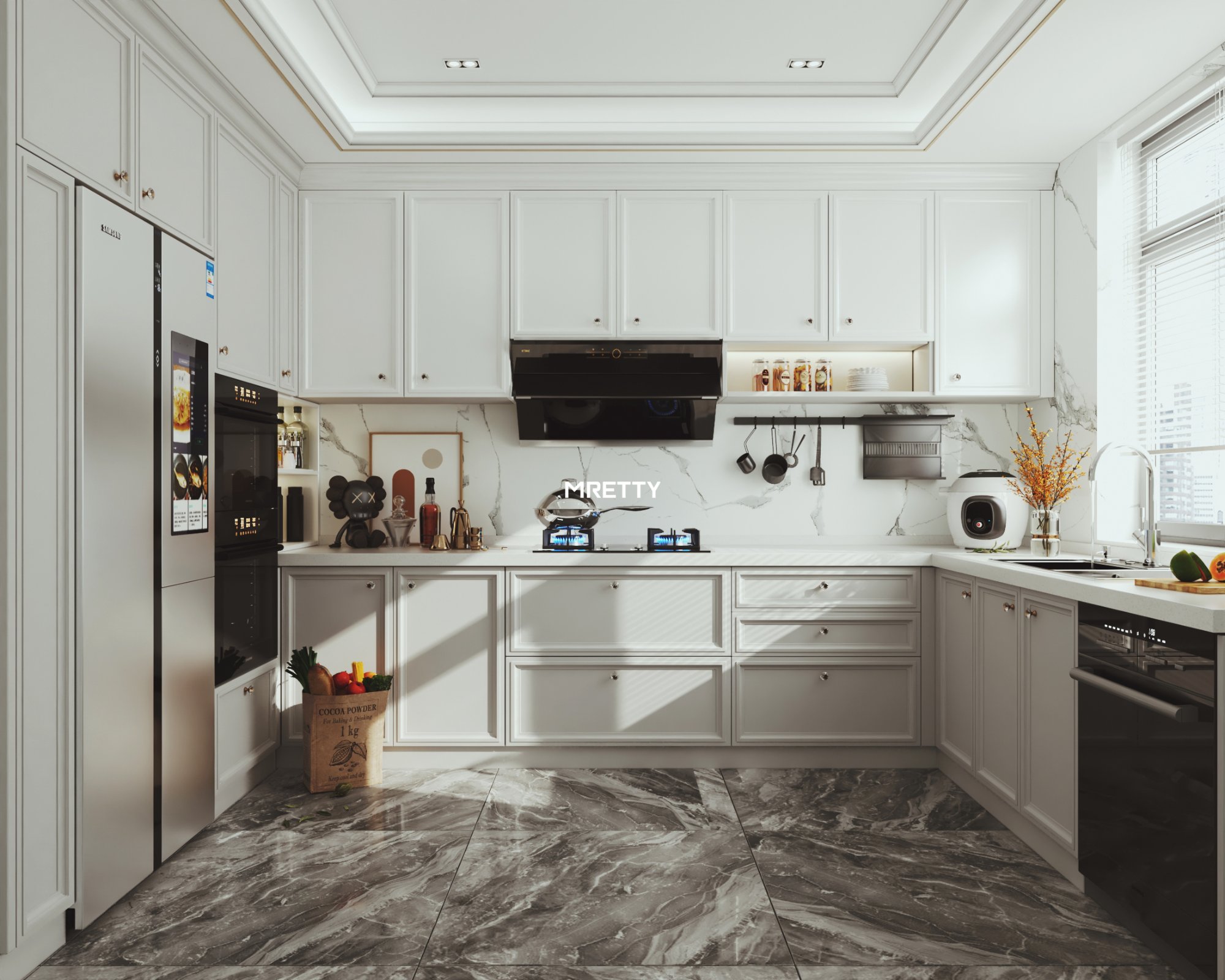
Tailoring to Your Home: Expert Strategies for Selecting Imported Materials for Different Singaporean Layouts
In Singapore, different residences have vastly different requirements for cabinets. Applying the experience from a Landed House to a BTO flat won't work. Here are my imported material selection strategies for three main housing types.
Imported Cabinets for Singapore HDB Kitchen Renovations
For most HDB or BTO kitchens, space and budget are the main constraints. The goal is to achieve optimal function and aesthetics with limited resources.
I usually recommend light-colored matte boards from Austrian Egger. Light colors (like white or light grey) visually expand limited spaces, while matte surfaces reduce light reflection, making the space feel softer. Egger's high cost-effectiveness makes it an ideal choice for HDB owners, offering European E0 environmental quality without breaking the budget.
Recently, in a BTO project in Punggol, the kitchen space was very compact. We designed a U-shaped cabinet layout using Egger's light grey boards and utilized Blum's narrow pull-out baskets and corner solutions to maximize every inch of space. The owner was amazed that such a small space could hold so many items while still looking spacious.
A practical tip: Install recessed LED strip lights under the wall cabinets. Not only does this provide task lighting, but it also makes the cabinets appear lighter and more floating.
Imported Cabinet Design Cases for Small Apartment Condos
Condo kitchens focus more on style and texture expression. Owners usually pursue a more modern, design-oriented lifestyle.
In this scenario, I suggest considering a combination of dark shades of Italian Fenix (like black or dark grey) paired with wood grains. Fenix's extreme matte finish absorbs light, creating a calm, sophisticated atmosphere. Using it to create a striking kitchen island will definitely become the focal point of an open-plan space. Its anti-fingerprint property is extremely practical for open kitchens often used for entertaining.
Just a few days ago, I completed a design for an apartment near Orchard Road. We used Fenix Nero Ingo for the island, paired with Egger Tobacco Oak for the tall cabinet doors, resulting in an outstanding outcome.
The Ultimate Choice for Landed Houses
For landed properties with ample space and budget, the freedom of choice is much greater. The focus is on showcasing the owner's taste and creating a unique luxury experience.
I would boldly use special textured boards from Italian Cleaf or mix and match Fenix with natural stone and metal. For example, using Cleaf's leather-textured boards for a walk-in wardrobe or Fenix's metallic series for the dry kitchen area. These high-end material combinations create rich layers and a sense of luxury that ordinary materials cannot match.
Key Takeaway: Successful cabinet design must suit local conditions. Choose cost-effective Egger for HDBs, stylish Fenix for Condos, and luxurious Cleaf for Landed Houses to achieve a perfect fusion of design and life.
Safeguarding Your Investment: Three Tricks to Identify Genuine Imported Cabinets
How do you ensure that the high price you pay buys you genuine products? These three tricks are practical experiences I have accumulated over the years.
Trick 1: Request and Verify "Three Documents"
This is the most crucial step. Legitimate importers and manufacturers can definitely provide:
- Official Brand Authorization Letter: Proving the company is a legitimate distributor for brands like Fenix or Egger.
- Certificate of Material Origin: Indicating the exact production location of the batch, e.g., "Made in Austria."
- Customs Import Declaration: Showing the import date and quantity of the goods, which can be cross-checked with the vendor's claimed arrival time.
If the vendor is hesitant or vague about these documents, you should be highly vigilant.
Trick 2: Carefully Observe Edge Banding and Details
The details of a genuine MRETTY imported cabinet are impossible for counterfeiters to replicate. Focus on the edge banding. Edge banding applied with German PUR technology and heavy-duty equipment results in an extremely fine glue line (almost invisible) and smooth, burr-free edges. In contrast, small workshops usually produce rough glue lines and even overflowing adhesive.
I always remind my clients: Never choose a manufacturer with substandard craftsmanship just to save 10% on the budget. The money seemingly saved will likely cost you 50% or more in repairs and endless frustration within five years due to leaks, swelling, and hardware failure. It is absolutely not worth it.
Trick 3: Check the Board Identification Itself
Many top board brands, like Egger, print their brand logo and product information on the protective film or the side of the boards. Although this might be cut off during processing, you can request to see the raw, unprocessed materials before installation. This is the most direct verification method.
Key Takeaway: By proactively requesting authorization, origin, and customs documents, and carefully inspecting craftsmanship details like edge banding, you can effectively identify and avoid the trap of "fake imported" cabinets, ensuring your investment is worthwhile.
About MRETTY: Our Commitment and Strength
Choosing a cabinet company is choosing a long-term partner. MRETTY does more than sell high-end custom cabinets; we are the enablers of your dream home.
Our core advantage lies in combining world-class materials with strong local manufacturing capabilities. MRETTY operates a 15,000 square meter smart manufacturing base in Singapore, a rarity in the local home customization industry. Fully equipped with imported German HOMAG automated production lines, we ensure every board is processed to European factory-level precision.
This "Top-tier Imported Materials + Local Precision Manufacturing" model delivers three core values to you:
- Quality Assurance: We source directly in bulk from European brand principals, eliminating counterfeits at the source, and maximize material performance through precision equipment.
- Flexibility & Efficiency: Because we manufacture locally, we offer more flexible design solutions and faster delivery cycles, typically shortening lead times by 4-6 weeks compared to purely imported brands.
- Worry-Free After-Sales: Our factory and service teams are based in Singapore, providing up to 10 years of warranty and rapid-response after-sales service.
We believe a perfect kitchen stems from good materials, exquisite craftsmanship, and attentive service. At MRETTY, we possess all three.
Key Takeaway: Through its 15,000 sqm smart factory in Singapore and German HOMAG equipment, MRETTY combines top-tier imported materials with local precision manufacturing, offering customers triple protection in quality, efficiency, and after-sales service.
Frequently Asked Questions (FAQ)
Q: Is the formaldehyde content in imported cabinets really up to standard?
A: Absolutely, and they exceed standards significantly. Top European brands like Fenix and Egger strictly enforce the European E0 standard (formaldehyde emission ≤ 0.5mg/L). In comparison, some regional E1 standards (≤ 1.5mg/L) are much more lenient. Choosing our certified imported materials is the strongest guarantee for your family's health.
Q: Where in Singapore can I customize imported material cabinets?
A: You can visit the MRETTY Singapore Showroom directly. Here, you can personally touch and compare samples of various top-tier imported materials like Fenix and Egger, and consult one-on-one with our professional designers. They will provide a free preliminary design proposal and quotation based on your layout, budget, and lifestyle. We recommend booking an appointment in advance for a more exclusive service experience.
Q: What special tips are there for choosing kitchen cabinets in a full-home customization project?
A: In a full-home customization project, the choice of kitchen cabinets should harmonize with the overall style of open spaces like the living and dining areas. The trick is "seeking common ground while reserving differences." You can choose the same board series as the living room TV console or dining sideboard to ensure visual unity. Then, highlight the kitchen's functionality and personality through different countertop materials (like quartz or sintered stone) or unique hardware handles.
Conclusion: Making a Smart Investment for Your Home
Choosing imported material cabinets is a long-term investment in design, health, and durability.
True value lies in the perfect combination of top-tier materials, precision craftsmanship, and professional design. Whether you choose the tech-feel of Fenix or the rich patterns of Egger is just the first step. More importantly, choose a manufacturing system that can maximize the advantages of these materials.
It is time to stop guessing and hesitating.
About the Author
Hanson, Lead Full-Home Designer at MRETTY
Hanson brings over 14 years of expertise in designing and managing high-end kitchen and cabinetry systems, serving as a core design force at MRETTY. He specializes in providing tailor-made solutions for Singaporean Condos and Landed Houses, with design styles spanning modern minimalist, Italian light luxury, and French aesthetics. Hanson's design philosophy is: aesthetics must serve function, and exceptional details define the ultimate living experience. Hundreds of projects under his belt stand as testaments to his clients' high-quality lifestyles.
MRETTY: Premium Bespoke Kitchen & Cabinet Systems Provider in Singapore.
