
 Singapore
 China
China
One-Line Summary
>
For Singapore homes, whole-house customization using imported boards centers on choosing European/Japanese boards with F★★★★ eco-certification and superior moisture resistance built for our 80%+ average humidity. This is not just an aesthetic splurge — it is a long-term investment in your family’s health and your furniture’s 10+ year lifespan.
Quick Answers
Why are imported boards better? They hit F★★★★ eco standards (near-zero formaldehyde, on par with natural wood), use denser, more moisture-resistant cores, and their surface finishes/texture options lead the global market. What matters most when picking boards in Singapore? Moisture resistance and formaldehyde emission levels. These two factors dictate how long your furniture lasts, and whether your indoor air is safe. What’s the budget for high-end custom using imported boards? Expect S$350 – S$700+ per foot run (PFR, the standard Singapore cabinetry quote metric) for European imported board setups.
Five years ago, whole-house customization in Singapore was all about "filling empty space". By 2026, the market has matured completely. Clients now want a seamless blend of health safety, functionality, and personal style — which is exactly why imported board whole-house customization is the consensus choice for high-end Singapore projects. It’s not "better" just because it’s imported: it’s material science, precision manufacturing, and specialized design expertise combined.
As a designer with 14+ years of project experience at MRETTY, I’ve sat across from hundreds of Singaporean families making these choices. This guide breaks down exactly why your board choice is the single most important decision for your custom home, based on real-world lessons from HDB flats, condos, and landed homes across the island.
Why prioritize imported boards for whole-house customization?
When clients ask this, my answer isn’t about the prestige of the word "imported" — it comes down to four measurable performance metrics that directly affect your daily life:
Top-tier eco safety for your family: European and Japanese board standards are the strictest in the world. Japan’s F★★★★ certification caps formaldehyde emissions at ≤0.3mg/L — almost identical to untreated natural wood. This is non-negotiable for homes with young kids, allergy sufferers, or anyone sensitive to chemical off-gassing.
Moisture resistance built for Singapore: Our average annual humidity sits above 80%, which is the ultimate stress test for all wood products. Imported European boards use high-density, uniformly pressed cores with professional anti-moisture treatments. Paired with proper PUR edge-banding, they block humid air from seeping into the board core and causing swelling or warping.
Global-leading aesthetics: Brands like Italy’s FENIX and Cleaf set the worldwide benchmark for surfacing tech. You get super-matte, anti-fingerprint, synchronized woodgrain textures and specialty finishes that standard regional boards cannot replicate.
Precision hardware pairing: Top boards need top hardware to perform. Pairing imported boards with Austrian Blum or German Hettich soft-close hinges and drawer slides means your cabinets will glide smoothly even after 200,000+ open-close cycles (50+ years of daily use). The full value of the premium board is only realized with equivalently premium fittings.
A real-world cautionary tale
>
Last year we had a client come to us after going with a cheaper, visually similar non-imported board for their kitchen to save on upfront costs. Less than 12 months later, the base of their sink cabinet had swollen from water vapour, the edge-banding was peeling at the corners, and there was a persistent chemical smell in the closed drawers. They ended up spending 2x the amount they saved just to replace the damaged sections. Short-term savings almost always cost more in the long run here.
What’s the core difference between imported vs. local/regional boards?
The most common question I get: "They look the same, why is the price so different?" The difference is in the parts you
can’t see, which dictate 5–10 years of use:
Eco standards are not even in the same league: Most regional boards cap at E0 (≤0.5mg/L formaldehyde). F★★★★ limits are ~40% lower than that — a massive difference for indoor air quality.
Core density and structural stability: Europe’s regulated forestry and centuries of board manufacturing expertise produce wood fibers that are longer, more uniform, and press into denser particleboard/HDF cores. This means better screw-holding strength, less bowing on long shelves, and better resistance to impact damage — critical for 2m+ tall wardrobe doors or heavy loaded shelves.
Surfacing tech and durability: High-end imported boards use thicker, electron-beam-cured laminate layers that are far more scratch-resistant, UV-stable (no fading in sunny Singapore HDB/condo units), and wear-resistant than standard thin melamine finishes. For a Sentosa seafront condo project we did in Q1 2026, we specified Italian FENIX NTM®: its nanotech surface doesn’t show fingerprints, and minor scratches can even be heat-polished out. No standard melamine board can do that.
The gap between imported and non-imported boards is a full-chain difference, from eco safety to 10-year durability.
How to pick from mainstream imported board brands in the Singapore market
Brand overload is normal. I match brands to your style and functional needs, not just what’s "most expensive". These are the three top-tier options for SG high-end custom:
| Feature | FENIX NTM® (Italy) | Cleaf (Italy) | Egger (Austria) |
| :--- | :--- | :--- | :--- |
| Core advantage | Nanotech super-matte surface, anti-fingerprint, minor scratch heat-repairable | World-leading synchronized wood/textile/stone textures, hyper-realistic tactile feel | Ultra-reliable, massive color/pattern range, best balance of performance and cost |
| Eco grade | F★★★★ | F★★★★ | F★★★★ |
| Best for styles | Modern minimalist, Italian luxury-lite | Japandi, wabi-sabi, industrial, nature-forward schemes | All styles (most flexible option) |
| Origin | Italy | Italy | Austria/Germany |
| Price tier | Highest | Mid-high | Mid (best value for full-home projects) |
| Ideal use cases | Kitchen cabinet fronts, island cladding, desks (high-touch zones) | Wardrobe fronts, feature walls, decorative panels | Full-home carcasses, shelves, base cabinets |
There is no "best" brand overall — only what fits your design and budget. Professional guided selection saves you from overspending on features you don’t need.
Local case study: Cleaf in a Punggol 5-room HDB
>
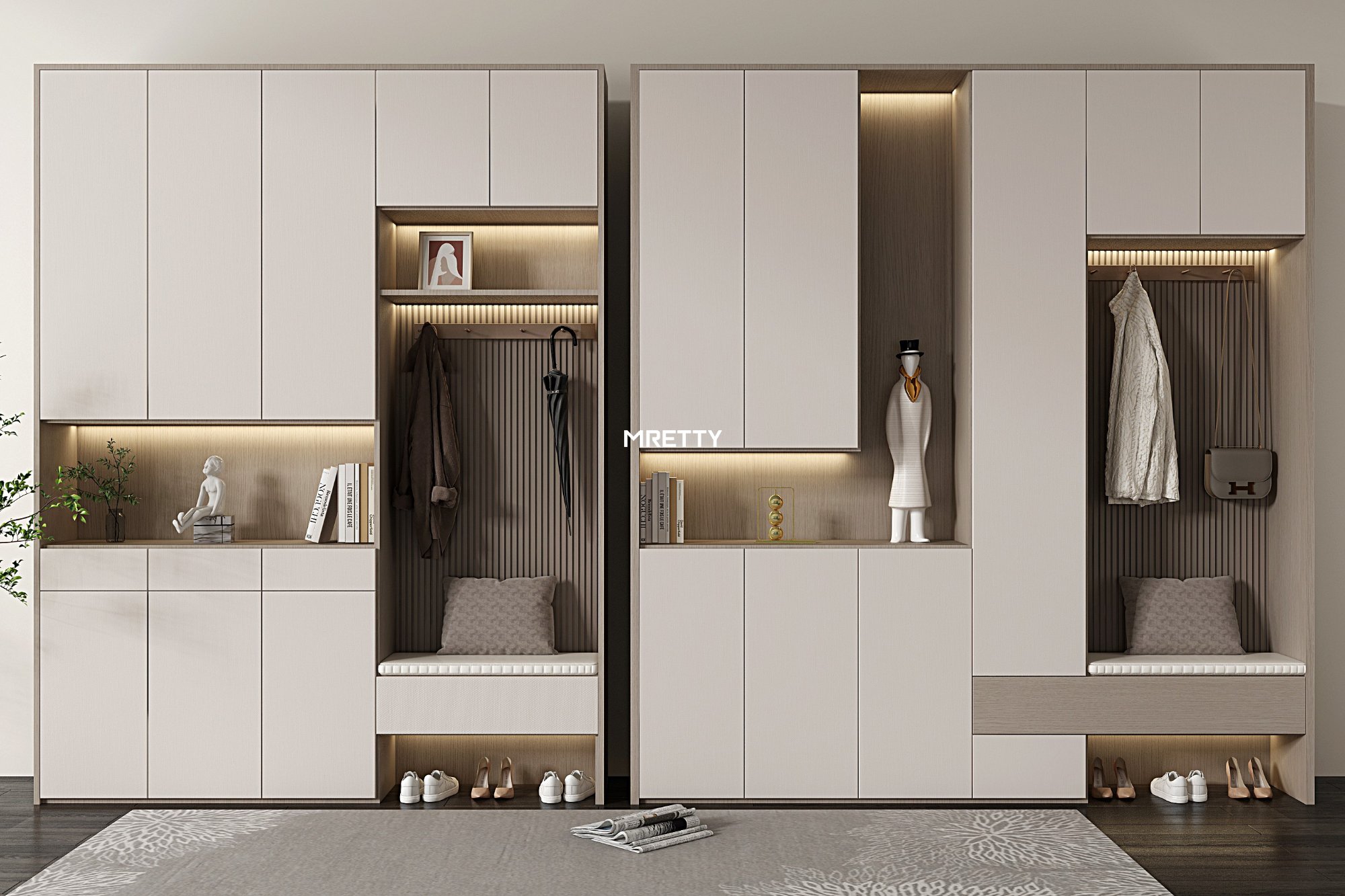
For a recent Punggol 5-room flat project, the owners wanted a warm, unique TV feature wall that didn’t feel like a generic laminate job. We used Cleaf’s Yosemite series synchronized woodgrain board: the deep embossed texture catches natural light beautifully, and we used its seamless patterning to hide full-height storage cabinets flush against the wall. The owners said the result felt "expensive but lived-in" — exactly what we aimed for.
Expert take: How to choose boards for Singapore’s ultra-humid climate
This is the #1 question I get after 14 years working here. 80%+ year-round humidity is brutal on wood products.
There’s a massive misconception here: people think buying the most expensive waterproof board is enough. But edge-banding tech matters just as much as the board itself. A poorly sealed edge is like a crack in a dam — even the best core will rot from the inside out if humid air gets in.
My rule is zone-based selection, never one-size-fits-all:
High-moisture zones (kitchens, bathrooms): Use imported laminate faced onto hardwood plywood substrates (far more moisture-resistant than particleboard) for sink/base cabinets. Non-negotiable: use PUR (polyurethane reactive) edge-banding, which forms a permanent, 360-degree waterproof seal around all exposed edges. Standard EVA hotmelt glue will soften and peel within 2–3 years in Singapore humidity.
General living zones (wardrobes, living cabinets): Use high-moisture-resistance (HMR) particleboard cores (e.g. Egger’s HMR series), and design ventilation into the cabinet: slotted back panels or raised kickboards to let air circulate so moisture doesn’t get trapped inside.
Coastal homes (East Coast, Sentosa): Add salt air corrosion to the mix. Pair top-tier moisture-resistant boards with 304 stainless steel upgrade hinges/hardware so your fittings don’t seize up.
The right strategy is a "whole-home material map", not just throwing the most expensive board at every surface.
[Button: Book a free, no-obligation material consultation with MRETTY’s team]
How to budget for imported board whole-house customization
"High-end" doesn’t mean unlimited. In Singapore, imported board custom work is quoted by per foot run (PFR) — the standard local metric for cabinetry length, far more transparent than square meter estimates.
2026 market range: S$350 – S$700+ per foot run, depending on four factors:
- Board brand/series: FENIX commands the highest price, Cleaf mid-high, Egger the most flexible range.
- Complexity: A wardrobe with 8 soft-close drawers and internal dividers costs far more than one with just two hanging rails and basic shelves. Angled cuts, curved fronts, or built-in lighting add cost too.
- Hardware grade: Basic Blum soft-close hinges vs. top-tier electric openers or glass drawer systems can double hardware costs — but it’s the part you touch every day, so it’s worth prioritizing.
- Service overhead: You’re paying for MRETTY’s 15,000 sqm smart factory precision, in-house experienced installers, and 5-year+ warranty — not just the board itself.
Never just compare the PFR base rate. Always ask for a line-item quote that lists exact board series, hardware model numbers, dimensions, and all included services. No hidden costs, no surprise add-ons later.
How MRETTY guarantees end-to-end quality from design to installation
Good boards are the starting point. Perfect execution is what matters. We run a closed-loop system so there’s no finger-pointing between contractors:
- Deep discovery first, not drawing first: I spend the first meeting listening to how you live — your morning routine, how many people use the wardrobe, whether you work from home — before putting a single line on paper. For small condo units we use the thinnest possible high-strength imported board carcases to steal back 2–3 inches of floor space per cabinet.
- German-made precision manufacturing: All confirmed designs go to our Johor-based 15,000 sqm smart factory, running full HOMAG Industry 4.0 lines. Cutting and edge-banding tolerance is <0.1mm, so every door fits flush, every seam is invisible.
> Quick tech note: PUR vs EVA edge-banding
> Standard EVA glue softens at ~80°C — risky for cabinets near ovens or in hot kitchens. PUR cures into an irreversible chemical bond, rated to 150°C+, with 60%+ higher waterproof bond strength. It’s the only way to permanently block humidity from seeping into board edges.
- In-house installation team, no outsourcing: All our installers are full-time staff with 8+ years of experience on average. They know how to handle imported boards (no chipping edges, no messy caulking) and tweak for on-site wall/floor unevenness so the final result matches the 3D render exactly.
Frequently Asked Questions (FAQ)
Q1: How do I verify an imported board is genuine?
A: Three steps: 1) Ask for the supplier’s official brand authorized distributor certificate; 2) Check for the brand’s laser-etched security mark or ink stamp on the board back/edge; 3) Request original bill of lading and certificate of origin. Legitimate suppliers will provide all three upfront.
Q2: Should I use different boards for wardrobes vs. kitchen cabinets?
A: Absolutely. Kitchen sink cabinets must use hardwood plywood substrate with PUR-sealed edges, full stop. Wardrobes can use high-moisture-resistance particleboard, but need ventilated backs and raised kickboards to prevent trapped moisture buildup.
Q3: What’s included in full-home imported board customization?
A: All built-in fixed carpentry: entryway shoe cabinets, TV consoles, wardrobes, built-in desks, kitchen cabinets, bathroom vanity carcasses. Process covers site measurement, 3D design, factory production, professional installation, and post-install warranty.
Q4: What boards should I pick for a kids’ room?
A: Non-negotiable F★★★★ certification first (lowest formaldehyde). Pick durable, non-toxic matte finishes that don’t show fingerprints/scratches, and insist all exposed edges are rounded over (no sharp corners) for safety.
Q5: What should I double check before signing a contract?
A: 1) Is every board and hardware brand/model written explicitly in the quote, no vague "premium board" labels? 2) Are all final dimensions, internal configurations, and lead times listed? 3) Is total price, payment schedule, and warranty period (min 2 years for carcasses, 5 for hardware) clearly stated?
About the Author
Hanson is MRETTY’s Director of Whole-House Customization Projects, with 14+ years of experience delivering high-end cabinetry and kitchen systems for 500+ Singapore homes, from mass-market HDBs to luxury condos and landed properties. He specializes in translating modern minimalist, Italian luxury-lite, and French-classic aesthetics into practical, humidity-proof designs that fit Singapore’s unique spatial constraints. He believes great design isn’t just about how a room looks — it’s about anticipating how you live in it, every day.
MRETTY: Premium Bespoke Kitchen & Cabinet Systems Provider in Singapore.
