
 Singapore
 China
China
TL;DR: Replacing kitchen cabinets in a resale HDB is a major undertaking, with budgets typically falling between S$6,000 – S$20,000+, covering materials, labour, and potential "wet works" (plumbing/masonry). The full process spans planning, HDB applications, demolition, factory prefabrication, and installation. To last in Singapore's climate, insist on moisture-resistant plywood cores and pro-grade hardware like Blum. A factory-based system like MRETTY's delivers tighter tolerances and cleaner finishes than traditional on-site carpentry.
The Bottom Line: Replacing resale HDB kitchen cabinets is a multi-step engineering project — from design and permits to prefab and installation. Costs start around S$6,000 and climb based on scope and materials. Partnering with a specialist team like MRETTY ensures full compliance with HDB regulations and delivers a truly durable, made-to-measure kitchen system.
Here's a sobering stat: in Singapore, over 45% of resale HDB buyers rank the kitchen as their #1 renovation priority.
But industry data reveals a brutal flipside: 60% of homeowners end up spending at least 30% more than expected. That gap is exactly what makes resale HDB kitchen cabinet replacement such a pressure point — it turns an exciting upgrade into a financial headache.
This guide strips away the fog. I'm Hanson, with MRETTY for 14 years specializing in high-end kitchens and whole-home custom systems, overseeing hundreds of projects just like yours. I'll walk you through real costs, official procedures, and material logic so you can dodge the traps — and build a kitchen that lasts twenty years, not five.
1. Real Cost Breakdown: What Does HDB Kitchen Cabinet Replacement Actually Cost?
Let's talk money first. For a standard 4-room HDB, the investment in kitchen cabinetry and countertops alone commonly lands between S$6,000 – S$20,000+. What drives the price comes down to these core variables:
- Total cabinet length (linear feet): Longer runs = higher cost. This is the single biggest lever.
- Material grade: Standard laminate finishes cost far less than premium options like Fenix NTM.
- Countertop choice: Basic engineered stone is affordable; higher-grade quartz or sintered stone climbs fast.
- Hardware system: Damping systems from Blum / Häfele push cost up, but make every single day feel smoother.
- Scope of works: Swapping cabinets only vs. "hack walls + reroute plumbing + masonry + waterproofing" — completely different budget universes.
MRETTY 2026 HDB Kitchen Cabinet Package Reference (based on ~20 ft of cabinetry)
- Essential Tier (S$6,000 – S$9,000): Moisture-resistant plywood core + durable laminate finish, standard quartz countertop, basic soft-close hinges.
- Performance Tier (S$10,000 – S$16,000): Premium finishes (Fenix, wood veneer, etc.), branded quartz or entry-level sintered stone, full Blum hinge and drawer system.
- Quiet-Luxury Tier (S$17,000+): Fully bespoke specification, imported finishes, high-end sintered stone countertop, integrated lighting and internal organisers.
The Most Common — and Most Expensive — Mistake: Chasing the Lowest Quote
Many homeowners equate "saving money" with "pick the cheapest bid."
The truth? That's usually the most expensive trap of all.
A client showed me a kitchen they'd done two years prior with a low-cost contractor: the cabinet door beside the sink had already swollen and delaminated. Every dollar "saved" upfront was paid back in full — and now they were redoing the entire thing.
Cheap quotes typically hide these compromises:
- Ordinary MDF as the core (which soaks up moisture and deforms fast in Singapore's humidity)
- No-name hardware (starts rusting and sticking within 2–3 years)
- "Warranty" that's verbal — or where the contractor's number no longer connects
❌ Common Mistake: Looking only at the grand total without asking what's inside it.
✅ Better Approach: Demand an itemized quotation that spells out core material grade (moisture-resistant ply? E0?), finish brand, and hardware brand. MRETTY documents all of this transparently, so you know exactly where every dollar goes.
2. Zero-Error Process: The 5 Critical Stages
A smoothly-run HDB kitchen replacement follows these 5 stages. Skip any one, and you risk dragging timelines and blowing budgets.
Stage 1: Deep Planning & Design (The Most Underrated Step)
This isn't just picking colours — it's circulation and ergonomics design. We map the "kitchen work triangle" (sink → cooktop → fridge) to match your cooking habits so movement feels natural.
As of early 2026, MRETTY uses 3D modelling for over 95% of clients to lock the scheme in — proportions, socket positions, lighting points, and trim details all visible before a single tool touches the wall, eliminating costly mid-job revisions.
Stage 2: HDB Applications & Compliance
This step is non-negotiable. Simply "swapping cabinets" on their own usually doesn't trigger a permit — but the moment any of the following enter the picture, you must go through the HDB Renovation Permit process:
- Hacking walls or floor tiles
- Relocating or adding a sink (plumbing/water supply changes)
- Modifying electrical wiring/routing
Your contractor must be a HDB-registered renovation contractor. MRETTY handles the entire submission on your behalf, ensuring full alignment with Singapore HDB kitchen renovation guidelines.
Stage 3: Demolition & Site Preparation
Once permits clear, the old kitchen exits. If "wet works" are in scope, this phase runs hacking, masonry, waterproofing, retiling, and shifts plumbing/electrical points to their new positions.
This is also where surprises surface: older flats often hide issues like severely corroded pipes once walls open up — problems that need immediate fixing and weren't in the original quote. Budget psychologically for this.
Stage 4: Factory Precision Prefabrication (MRETTY's Core Advantage)
Traditional carpentry means sawing, edge-banding, and gluing in your living space — dust everywhere.
MRETTY's method: once drawings are confirmed, everything goes into our 15,000 m² smart factory, cut and edge-banded on CNC and automated lines at sub-millimetre precision.
The upside:
- Drastically less on-site dust and time (timeline can shrink by roughly 40%)
- Tighter edge seals, consistent batches, and better moisture defence
Stage 5: Installation & Handover
Prefabricated modules arrive on-site for assembly, levelling, and trim work. Countertops, backsplash panels, appliances, and hardware go in. Final walkthrough covers: door alignment, drawer glide smoothness, and lighting stability.
❌ Common Mistake: Assuming demo + install takes just a few days.
✅ Better Approach: Pad your schedule with 1 extra week buffer. Full kitchen replacements with wet works typically need 4–6 weeks; cabinet-swap-only jobs run about 2–3 weeks.
Ready to Launch Your HDB Kitchen Replacement?
Don't leave your renovation to chance. Let a specialist team shape an executable plan around your budget and floor plan.
[Book a No-Obligation MRETTY Design Consultation]
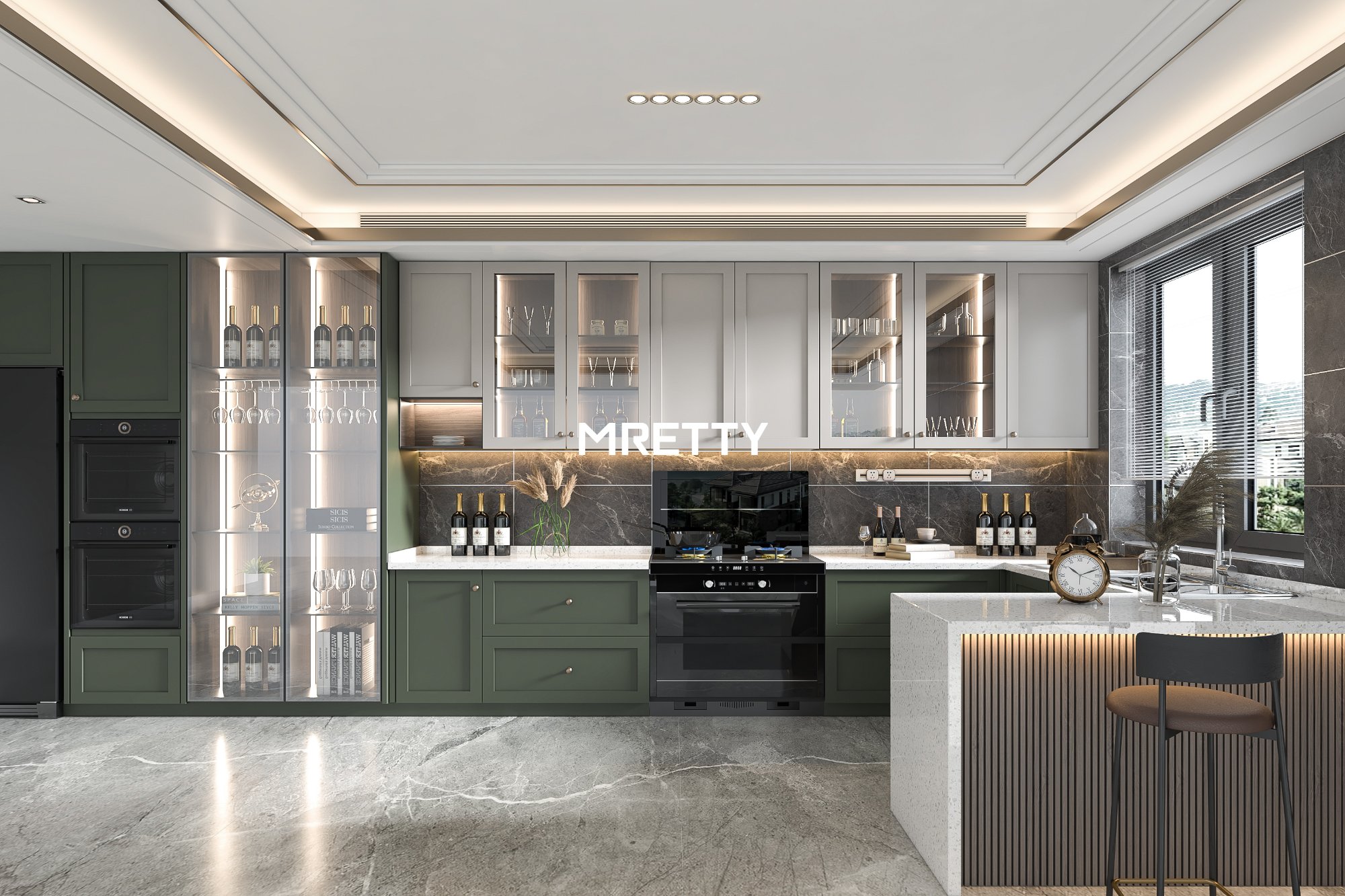
3. Choosing Materials: Fighting Singapore's Heat & Humidity with the Right Boards & Countertops
Pick the wrong material and even the prettiest kitchen won't last. Singapore's year-round humidity is a slow, grinding stress test on board cores and edge seals.
Core Board: Moisture-Resistant Plywood Beats Standard MDF — Period
This is my non-negotiable: cabinet carcass cores must be high-quality moisture-resistant plywood.
Standard MDF is cheaper, but it behaves like a sponge. Within arm's reach of the sink, it can swell and delaminate in a year or two. Even when suppliers claim "high-grade MDF is fine," field experience tells us plywood outperforms on screw-hold strength and long-term moisture resistance by a wide margin — conservatively 50%+ better on real-world durability.
Countertops: Quartz vs. Sintered Stone
Your countertop takes the hardest hits in the kitchen.
| | Quartz | Sintered Stone |
|---|---|---|
| What It Is | Engineered stone (resin-bound) | Natural minerals, sintered at extreme heat/pressure |
| Pros | Non-porous, stain-resistant, wide style range (Caesarstone, Silestone, etc.) | Near-indestructible; UV-stable, heat-resistant, highly scratch-resistant |
| 2026 Est. Rate | ~S$90 – S$150/ft run | ~S$160 – S$280/ft run |
| Best For | Proven everyday performance at reasonable cost | Long-term buy-once-buy-right luxury |
Finishes & Hardware: What You Touch Every Day
- Finishes: The workhorse remains High-Pressure Laminate (HPL). Want a quiet upscale touch? Fenix NTM gives you ultra-matte, anti-fingerprint, thermally healable micro-mar surfaces.
- Hardware: A system like Blum TANDEMBOX — solid glide feel, whisper-close, built for the long haul — is one of those details that separates "acceptable" from "genuinely satisfying."
❌ Common Mistake: Fixating on door panel aesthetics while ignoring core board and hardware.
✅ Better Approach: Spend your budget rationally — lock in the moisture-resistant ply core + reliable hardware first (that's your skeleton), then upgrade door finishes and countertops with whatever's left.
4. Expert Debate: Traditional Carpentry vs. MRETTY's Factory Modular System
A lot of people assume "custom = a carpenter on-site bit by bit." But "custom" only means made to your home's exact dimensions — it does not mean it must be hand-built in your kitchen.
The real comparison worth making is: traditional on-site carpentry vs. MRETTY's factory modular system.
| Dimension | Traditional On-Site Carpentry | MRETTY Factory Modular System |
|---|---|---|
| Precision | Depends on individual craftsman's hand; variable | Computer-guided CNC equipment; sub-mm repeatability |
| Finish Quality | On-site veneer/applying; dust contamination risk, bubbling risk | Clean factory environment; consistent surface quality |
| Batch Consistency | Each purchase order different batches; colour-match risk | Unified imported materials; same-batch production |
| Timeline | Many sequential on-site steps; weather/manpower affects pace | Factory prefab + on-site assembly; faster overall |
| On-Site Disruption | Heavy dust, noise, adhesives indoors | Mostly assembly work on-site; minimal disruption |
| Warranty | Often verbal / ~1 year | Documented warranty coverage on materials & hardware |
MRETTY's Edge: Precision, Speed, and Import-Grade Materials
A slightly counterintuitive fact: premium finishes and flawless trim work are often better achieved in a factory than by even a skilled hand on-site.
CNC-guided cutting and thermally bonded edge-banding deliver the level of "door faces perfectly flush, gaps perfectly even, edges perfectly sealed" that human hands struggle to repeat consistently — and that precision determines how the kitchen wears over years of daily use.
5. Your Top Questions: HDB Kitchen Renovation FAQ
Q: Can I just replace the cabinet doors and keep the old carcasses?
Technically yes — if the existing cabinet boxes are still structurally sound and the core hasn't swollen or warped. But if the carcass is already compromised, new doors are just putting lipstick on the problem. The underlying issue will resurface soon enough.
Q: How long does an HDB kitchen renovation take?
Cabinet-swap-only: about 2–3 weeks. With wet works (hacking, masonry, waterproofing, tiling): typically 4–6 weeks, plus whatever time HDB permit processing requires beforehand.
Q: Do I need to buy my appliances through the contractor?
Usually not. We plan the spacing and power points during the design phase to fit your chosen appliances. You typically purchase the appliances yourself; we handle the surrounding cabinetry and integration so everything sits flush and finished.
6. Beyond the Kitchen: Think Whole-Home, Not Standalone Cabinets
The kitchen shouldn't be an island. A truly polished home carries a unified design language — so the kitchen's material palette, tones, and detailing flow into the living/dining zone, the TV feature wall, the foyer cabinet, the wardrobes.
At MRETTY, we often extend the kitchen's finish story into the adjoining carpentry so the entire public zone reads like one coherent whole — grown, not glued together.
7. Your New Kitchen Is Already Waiting
A good HDB kitchen isn't about "more expensive = better." It's about every step — from planning and materials to execution — earning its keep against your daily usage frequency.
If what you care about is HDB compliance, factory-grade precision, and a system built to perform for 15+ years — our approach will feel like the right fit.
8. About the Author
Hanson is a Senior Designer at MRETTY, specializing in high-end kitchen systems for Singapore HDB flats and condominiums for 14 years. He has led hundreds of kitchen retrofits and whole-home custom projects, with a focus on translating complex regulations, material choices, and circulation logic into complete, livable, and visually cohesive solutions.
MRETTY: Premium Bespoke Kitchen & Cabinet Systems Provider in Singapore.
