
 Singapore
 China
China
TL;DR: What You Will Learn
- Style Definitions: Master the core traits of mainstream interior design styles in Singapore, such as Modern Luxury, Minimalism, and Japandi.
- Practical Application: Understand how to adapt these home aesthetics for HDB flats, Condos, and Landed Properties.
- Smart Choices: Get a framework for selecting the right style, complete with checklists and insights into how materials affect look, feel, and cost.
What Are the Main Interior Design Styles and How to Choose?
Finding a clear definition of home design style is the first step in any renovation. Style is the philosophy that guides every decision. It dictates colors, materials, furniture, and lighting. Without it, a home feels chaotic. A unified style creates harmony.
Most people think choosing a style is about scrolling through photos. But actually, it starts with defining function and feeling. Aesthetics should serve your lifestyle, not the other way around. This is especially critical for renovation design in Singapore, where space is a luxury. The process goes far beyond visuals; it requires an examination of form and function.
Start with this homeowner checklist:
Assess Your Lifestyle: Are you a homebody who craves coziness? Or a social butterfly needing flexible spaces for entertaining?
Analyze Your Space: Note the natural light, ceiling height, and layout of your HDB or Condo.
Gather Inspiration: Collect images, then look for patterns. Do you prefer clean lines or ornate details? Warm or cool tones?
Prioritize Feeling: How do you want your home to make you feel? Calm and peaceful? Or vibrant and energetic?
Key Data Point
A 2025 study by the Renovation Contractors and Material Suppliers Association (RCMA) Singapore found that over 75% of dissatisfied homeowners blamed "lack of a clear, unified style."
This data highlights a crucial point. Defining your aesthetics early prevents costly mistakes. It is the blueprint for all decisions, from space planning to finish selection.
❌ Common Mistake: Choosing a trend that doesn't suit your life. For example, opting for a stark Industrial style when you have young children and crave a soft, comfortable home.
✅ Smarter Approach: Start with your needs and desired feelings. Then find the style that aligns with this core requirement. Your home should serve you for years.
A clear design style acts as a filter. It ensures your final space is a functional reflection of you.
What Is Minimalism Defined in the Singapore Context?
Minimalism is about "intentionality." It is not about emptiness. It is about removing the non-essential to highlight form, material, and function. The core principle is simple: "Less is more." This style uses clean lines, a controlled color palette, and zero clutter.
In Singapore, this means clutter-free countertops and smart storage. It means focusing on high-quality materials that speak for themselves. We see minimalism executed beautifully in landed properties, where generous open spaces can showcase architectural simplicity.
Last month, we worked on a 2-bedroom apartment in Punggol. The client wanted a minimalist living room that didn't feel cold. Our solution was a full-height, handleless storage wall using fingerprint-resistant Fenix NTM®. It blended seamlessly into the wall, hiding clutter and making the room feel larger and more serene.
MRETTY Expert Insight on Materials
True minimalism demands precision. Off-the-shelf furniture often cannot deliver this precision. This is where custom millwork becomes vital. We create seamless, handleless cabinets using advanced materials like matte Fenix NTM®. This innovative surface resists fingerprints and has low light reflectivity, creating a tranquil, unified look. We can build storage that integrates into the wall—a key part of minimalist space planning. This is the MRETTY custom design process. We design for purity and function.
❌ Common Mistake: Buying cheap, sparse furniture. This makes the space look empty and cheap, not intentionally minimalist.
✅ Smarter Approach: Invest in fewer, higher-quality pieces. Focus on perfect craftsmanship and integrated storage to hide clutter and maintain clean lines.
Minimalism is achieved when every item has a purpose. It creates an atmosphere of calm and order.
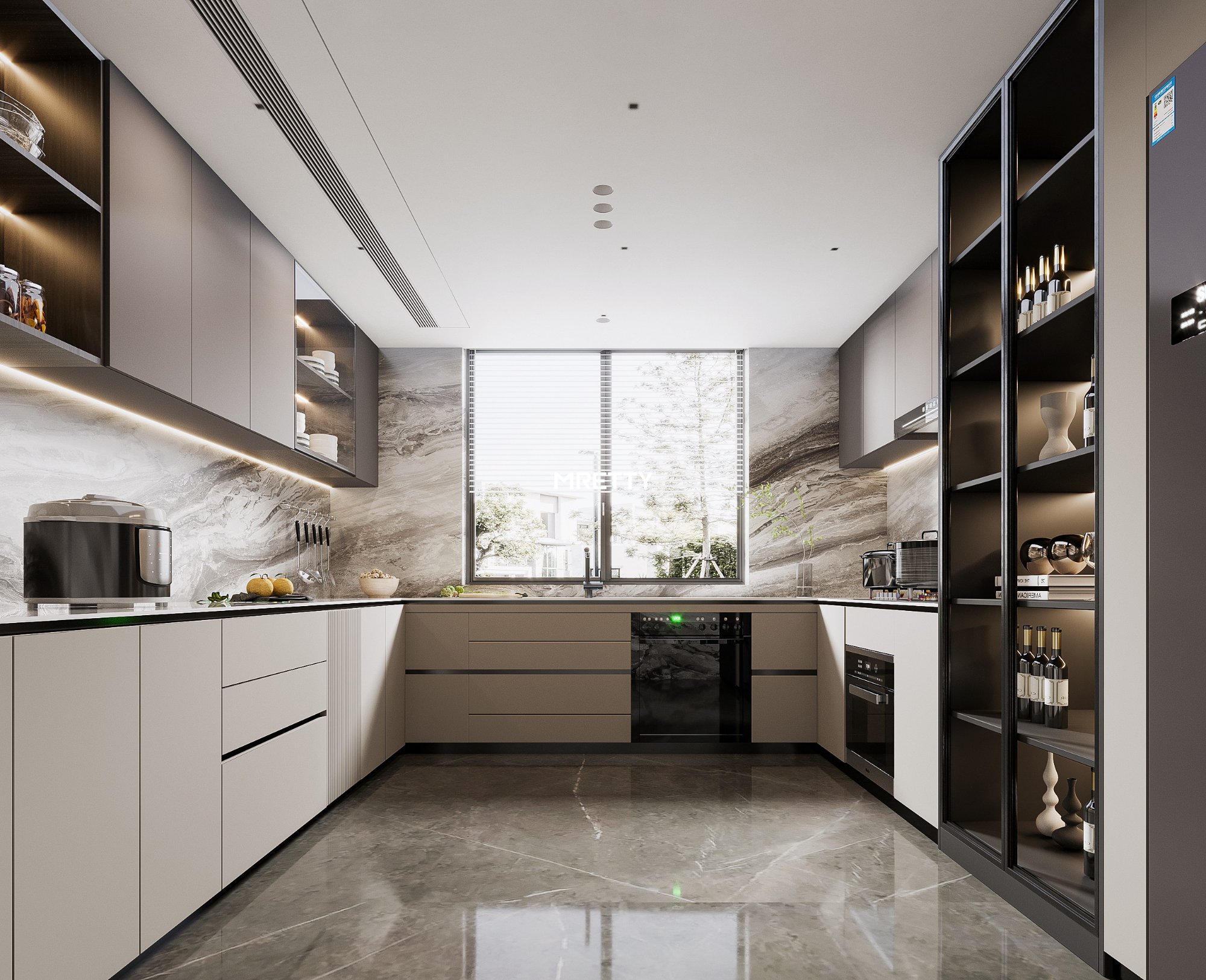
How to Achieve Modern Luxury Interior Design in Singapore?
Modern luxury interior design in Singapore is not about ostentatious extravagance. It is a refined look defined by superior materials, impeccable craftsmanship, and thoughtful details. This style fuses clean modern lines with rich textures and understated elegance. It is about the sensory experience. The tactile feel of a solid wood surface. The soft-close sound of a well-made drawer. The sophisticated ambiance created by layered lighting.
Defining Modern Luxury in the Singapore Context
For luxury condo design, the goal is to maximize the sense of space and quality. Key elements include:
Rich Material Palette: Italian marble, dark wood veneers, brushed bronze or matte black metal, and tactile fabrics like velvet or Bouclé.
Custom Millwork: Tailor-made TV consoles, display shelves, and wardrobes that integrate perfectly into the architectural structure.
Layered Lighting: A mix of ambient, task, and accent lighting to create mood and highlight features.
For a recent landed property in Bukit Timah, our team paired large-format Italian marble flooring with a dark walnut feature wall. Brushed bronze inlays provided subtle visual interest. The true luxury lay in details only the homeowner would notice daily: Blum hinges ensuring every cabinet door closed silently.
From the MRETTY 15,000㎡ Smart Factory
To achieve the precision luxury demands, MRETTY uses German CNC machinery for perfect cuts. Our custom kitchens feature premium hardware from brands like Blum, ensuring every hinge operates with silent, smooth perfection for decades. This "manufacturing-first" approach delivers tangible quality.
This focus on machinery and materials is what distinguishes true luxury from mere decoration. It communicates quality in a way pure visual elements cannot.
❌ Common Mistake: Equating luxury with branded logos and gold finishes. This makes a home feel like a public showroom, not a private sanctuary.
✅ Smarter Approach: Focus on the quality of materials and craftsmanship. True luxury is in the details—perfect cabinet alignment, the feel of a handle, seamless tech integration.
Modern luxury is the intersection of design, material science, and expert craftsmanship, creating refined comfort.
Why Are Japandi and Scandinavian So Popular in Singapore?
Japandi and Scandinavian are incredibly popular interior design styles in Singapore for 2026. Why? They are arguably the best interior design styles for small homes in Singapore. Both celebrate simplicity, natural materials, and a connection to nature. This creates calm, breathable interiors for city living. While often grouped together, they are distinct.
Scandinavian originates from the Nordic regions. It emphasizes light, coziness (Hygge), and function. Its palette includes light woods like white oak and pine, white walls, and comfortable textiles.
Japandi is a hybrid. It blends the rustic minimalism of Japanese design (Wabi-sabi) with Nordic functionality. It employs deeper hues, a mix of light and dark woods, and an appreciation for handcrafted objects.
As a designer, I find Japandi more forward-looking for Singaporean families. Its embrace of darker tones and natural imperfections is more forgiving of daily wear than the pure brightness of Scandinavian. It feels more grounded and ages gracefully with changing trends.
Japandi vs Scandinavian: Comparison for Singapore Homes
| Feature | Scandinavian | Japandi |
| :--- | :--- | :--- |
| Philosophy | Hygge (Comforting contentment) | Wabi-sabi (Finding beauty in imperfection) |
| Color Palette | Bright, airy. White, grey, pastels. | Muted, earthy. Beige, cream, terracotta, charcoal. |
| Wood Tones | Light woods (Beech, Ash, Pine). | Mix of light and dark woods (Oak, Walnut, Bamboo). |
| Furniture | Soft, rounded, comfortable. | Low profiles, clean lines, highly functional. |
| Clutter Level | Minimal and organized. | Ultra-minimal and curated. |
We completed a 4-room HDB project in early 2026 where the client was torn between the two. Leveraging MRETTY's custom capabilities, we created a Japandi-style kitchen with dark walnut cabinets. We paired it with a Scandinavian-style living room featuring light oak flooring and a soft sofa. This created distinct zones while maintaining a unified, nature-inspired feel.
❌ Common Mistake: Using only light wood tones in a Japandi theme. This looks more Scandinavian. Contrast is key.
✅ Smarter Approach: Intentionally mix wood tones. Pair light oak flooring with dark walnut TV consoles or kitchen cabinets. This creates the signature depth of Japandi design.
Both styles offer an escape from city life. But Japandi offers a more contemplative palette, while Scandinavian leans towards bright, family-friendly comfort.
What Is the Difference Between Modern and Contemporary Design?
This is a common point of confusion. People often use the terms interchangeably, but they are two distinct concepts.
Modern Design refers to a specific, static historical period: the early-to-mid 20th century. It originated from the Bauhaus movement in Germany and the Nordic design movement. Its characteristics are fixed.
Natural materials (wood, leather)
Clean, straight lines
Neutral colors
Lack of ornamentation
The Eames Chair is a perfect symbol of Modern Design.
Contemporary Design is dynamic. It means "of the moment" and is always evolving. What is contemporary in 2026 will not be contemporary in 2046. Today, contemporary style might include curved furniture, large-scale art, and integrated technology. It borrows elements from many eras, including Modernism, but is not confined to one.
Analytical Insight
In our Q4 2025 client consultations, we found nearly 60% of people requesting "modern" design actually wanted "contemporary." They described curved sofas and bold trends, not mid-century classics. A key difference lies in form. Modern design favors straight lines. Contemporary design embraces curves and fluid shapes, like a kitchen waterfall island.
Understanding this difference is crucial. It helps you communicate your vision clearly. If you ask for "Modern," a designer should think mid-century aesthetics. If you ask for "Contemporary," it opens a conversation about current trends.
Frequently Asked Questions (FAQ)
(FAQs addressing various styles can be added here, e.g., Which style is most timeless? Which style makes a space look biggest? etc.)*
From Definition to Dream Home
Understanding these styles is the first step. The next is partnering with experts like MRETTY to translate definition into reality. We combine design intelligence with factory precision to create spaces that are both beautiful and functional.
[Book a Free Design Consultation]
MRETTY: Premium Bespoke Kitchen & Cabinet Systems Provider in Singapore.
