
 Singapore
 China
China
TL;DR: Inherited Property Renovation Quick Guide
What Should You Do First?
Engage professionals to clarify the legal ownership transfer status and structural health of the property.
How to Blend Old-School Style with Modern Aesthetics?
Rely on bespoke custom joinery. It skillfully integrates heirloom pieces you wish to keep, creating a coherent design where "modernity forms the bone, and classicism the soul."
What Is the Deadliest Mistake to Avoid?
Ignoring specific regulations. The renovation rules for HDB flats, condominiums, and URA-conserved buildings exist in three completely different worlds.
Planning Your Transformation: Inheritance HDB Renovation Checklist
The moment you receive the keys to an ancestral home, emotions run deep. Memories are sealed within those walls, yet the outdated layout often stifles your current lifestyle. This is all too common—just last month, a client inherited a 40-year-old 3-room HDB flat in Queenstown. They loved the location but were suffocating in its stuffy, enclosed old layout.
But here is a reality check:
An excellent renovation begins long before you pick paint swatches. It starts with a sober blueprint. This checklist ensures your inspiration for renovating an inherited property is grounded in every key foundational point.
"When we inherit a house, we inherit its stories. My job is to help clients discern: which stories should be etched into the architecture to stay, and which should continue in a brand-new form. It is a delicate balance—honoring the past does not mean freezing it in time; it means allowing it to breathe and live happily in the present." The most successful projects are those where practicality is treated as the perfect partner to sentimentality.
Step 1: Settle the Legal and Financial "Family Affairs"
Before design, lay the groundwork. First, confirm the property title is officially transferred to your name. If there are multiple inheritors, all parties must agree on the renovation plan and budget. Second, arrange financing in advance. Hidden costs in old home renovations are inevitable. According to local renovation platforms, the renovation loan cap in Singapore is typically S$30,000, or six times your monthly salary.
Step 2: Commission a Structural Safety Assessment (Non-Negotiable!)
For older homes, this step is non-negotiable. Hire a Building and Construction Authority (BCA)-recognized Professional Engineer to inspect invisible pathologies—foundation settlement, load-bearing wall conditions, water seepage, rot, and aging wiring. Late last year, a structural assessment we conducted for an old walk-up apartment in Kallang uncovered severe pipe corrosion, saving the homeowner over S$20,000 in future burst-pipe repair costs.
Step 3: Define Your Life Vision and Bottom-Line Needs
What do you actually want life here to look like? Working from home? Frequent large gatherings? List your "non-negotiable needs." This list is the core of your design brief. Think deeply about circulation, daylight, and especially storage space—this defines what a "successful transformation" looks like to you.
Step 4: Find a Design Specialist for Old Homes
Don't go it alone, and don't hire just any general contractor who only knows how to lay bricks. Singapore's old homes have unique temperaments. An experienced interior designer can see the potential behind thick walls and plan ahead spatially. The essence of a design-and-build team like MRETTY lies in this: every line drawn in the design studio is precision-cut in the factory and perfectly realized on-site—especially for complex custom joinery.
Step 5: Finalize Design Drawings and Secure Permits
The designer translates your vision into floor plans and photo-realistic renderings. Once finalized, the contractor runs the permits: HDB flats require Housing & Development Board (HDB) renovation permits (for hacking, plumbing relocation); conserved shophouses require the strict approval of the Urban Redevelopment Authority (URA). This step is the prerequisite for any inherited old home to become beautiful; do not rush it.
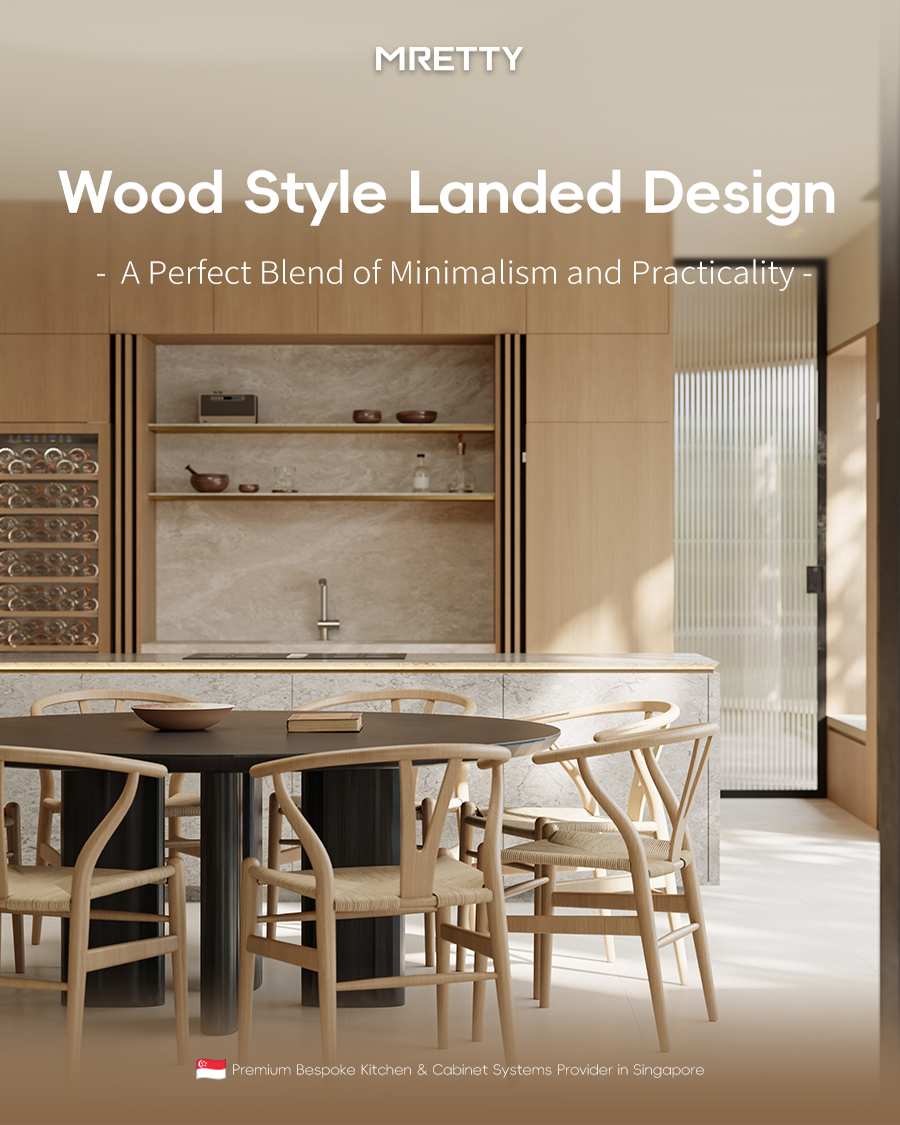
Creating Seamless Aesthetics: Why Whole-Home Custom Furniture Is the Only Solution
With the project framework set, how do you mold the space to be both beautiful and functional? The biggest aesthetic challenge is reconciling modern living needs with the "quirks" of an old structure—those un-square corners, slanted ceilings, and protruding columns that standard retail furniture simply cannot fit.
This is where whole-home custom furniture delivers a knockout blow. Instead of forcing in off-the-shelf items, custom furniture adapts to the house. The flaws of an old home become opportunities for custom design.
Many mistakenly believe new furniture must mimic antiques to suit an old house. But actually, the highest form of heritage renovation plays with "intentional contrast." Placing a minimalist, clean-lined modern built-in cabinet next to an authentic old teak wood door does not clash; it makes the carved patterns of that old door feel more dignified. This dialogue across eras is where vibrant, high-end sophistication lives. Supported by MRETTY's 15,000 sqm smart factory with sub-millimeter precision, this fusion of "old bones, new skin" lands steadily.
How to Blend Modern Design with Old-Home Features?
Use Materials as Bridges: Connect past and present with a unified material palette. For instance, the warm brown hue of an old staircase can be echoed in the finish of a new modern media console. Turn Dead Space into Assets: Old niches, sloped ceilings, and odd corners are fully utilized by custom joinery—creating a window-side banquette or a floor-to-ceiling book wall that wraps around structural columns. Integrate, Don't Just Place: Don't just drop a modern desk into a nostalgic room. Build it as a built-in workstation that follows the wall's contours, making it look like it grew organically from the architecture.
In a Joo Chiat shophouse project, the homeowner wanted to keep his grandfather's intricately carved Peranakan screen. Instead of pairing it with a tacky TV console, we created a minimalist matte finish feature wall with a recess precisely sized to "frame" the screen. The clean modern lines elevated the old piece into the undisputed artistic centerpiece of the home.
Expert Tip: Using Custom Joinery to "Settle" Heirlooms
Heirlooms shouldn't be cumbersome obstacles; they are the soul anchors of the design. Grandma's Old Sewing Table? We transformed it into a unique bathroom vanity—keeping the carved legs but pairing them with a modern stone top and a hidden-frame sink. Old Cast Iron Window Grilles? In a Katong home, we inlaid these grilles into the paneling of a new custom wardrobe as decorative accents. Father's Old Bookshelves? We deconstructed the aged timber and reincorporated it into a larger new library wall—giving it new life in a contemporary form.
❌ Common Mistake: Treating heirlooms as obstacles to be stuffed into a storeroom to gather dust.
✅ Better Approach: Treat them as the heart of the design. Use custom joinery to give them new functions, turning them into spatial focal points that carry both emotional weight and practical utility.
This strategy maximizes both the emotional value and the resale value of the asset—the correct solution for modernizing an old home without stripping away its soul.
Knowing the Rules: Renovating Singapore Old Ancestral Homes with Confidence
In Singapore, you cannot simply swing a sledgehammer. Different property types are governed by vastly different regulations. Mastering this logic prevents your project from being halted mid-way.
Here is a hard comparison of the rules between the Housing & Development Board (HDB) and the Urban Redevelopment Authority (URA):
| Comparison Dimension | HDB (Flat) Renovation Guidelines | URA (Conserved/Protected Building) Guidelines |
| :--- | :--- | :--- |
| Governing Body | Housing & Development Board (HDB) | Urban Redevelopment Authority (URA) |
| Core Principle | Ensuring structural safety and community uniformity | Preserving the original architectural character and historical fabric |
| Wall Hacking | Non-load-bearing walls can be hacked after permit approval | Strictly restricted (especially street-facing facades); internal alterations require rigorous approval |
| Window Specifications | Must comply with HDB-approved uniform styles | Original window types, materials, and colors must be retained or restored identically |
| Facade Alterations | Absolutely prohibited (color/external fixtures are restricted) | Prohibited. The building's "envelope" is protected by law |
| Approved Contractors | Must hire from the official "Registered Renovation Contractor List" | Must engage specialized teams with proven experience in conserved works |
| Approval Timeline | Typically 1 to 3 weeks | Often several months; requires highly detailed architectural drawings and material plans |
I recall a conserved bungalow in Blair Plain where the owner wanted to rip out all the cracked original floor tiles to lay modern vinyl. We stopped them immediately—URA would never have approved it. Later, we helped them source a specialty supplier for period-accurate replica tiles. The restoration passed with flying colors, preserving both the home's history and its market value. Experience is your pass when dealing with these authorities.
❌ Common Mistake: Assuming designers automatically know the nuances of your specific conserved zone (e.g., rules for Joo Chiat differ from Blair Plain).
✅ Better Approach: Check your property's status on the URA website and partner with a firm that has a proven track record of cleared conserved projects.
Estimating Your Investment: Singapore Inherited Condo Renovation Cost Breakdown
Budgeting for an old home cannot use the same formula as a new one. You must allocate sufficient buffer for "hidden works." We recommend setting aside at least 15% to 20% of the total budget for contingencies—old wiring and hidden cracks can bite at any moment.
Below are the estimated ranges for full renovations in Singapore for 2026 (including design, labor, and basic materials, but excluding loose furniture and high-end appliances):
Inherited 3-Room HDB Flat (~65 sqm): S$40,000 – S$70,000
Inherited 5-Room HDB Flat (~110 sqm): S$65,000 – S$110,000
Inherited Condominium (~120 sqm): S$80,000 – S$150,000+
Inherited Landed Home/Shophouse (~250 sqm+): Starting from S$300,000 – S$800,000+
For landed/conserved properties, the bulk of the budget often burns on foundational and structural works—reinforcing weak foundations, fully replacing decaying roof beams/tiles, or rewiring the entire house for smart home systems. Meanwhile, addition and alteration works can drastically inflate costs due to the need to navigate both URA and BCA regulations.
Where Does the Money Go in an Old HDB Renovation?
A huge chunk of the budget goes into the "hidden injuries" behind the walls: Whole-home rewiring (Approx. S$4,000 – S$7,000) Whole-home replumbing (Approx. S$3,000 – S$5,000) Demolition of old walls and replastering (Approx. S$5,000 – S$10,000) This is why renovating an old home is often more expensive than fitting out a new one.
But with the right quality standard, a renovation executed with MRETTY's whole-home customization will elevate the property's market value to a completely different tier—a heritage home that understands modern living is always worth more than a cold, cookie-cutter new launch.
Ready to Reshape Your Family Ancestral Home?
Renovating an inherited home is a dual journey of craftsmanship and intention. It is about nurturing your generation's life within the bones of an old house. With clear planning and the right partners, the past and the future can coexist under the same roof.
If you are strategizing for an inherited property in Singapore, we can provide a clear roadmap. We have distilled over ten years of hands-on experience into this resource:
Download our free guide —
The Complete Step-by-Step Checklist for Heritage Home Renovation — breaking down every stage for you:
[Download Your Free Checklist Now]
Frequently Asked Questions
1. Can I use CPF (Central Provident Fund) to pay for inherited property renovation fees?
No. CPF can only be used for purchasing property-related fees/down payments/loans; it cannot be used for renovation. Renovations must be paid in cash or via a specialized renovation loan from a bank.
2. How long does a typical inherited property renovation take?
The span varies greatly. For standard HDB flats, actual works take about 8 to 12 weeks after permits are secured. For landed homes involving structural changes or conserved shophouses, it takes at least half a year smoothly, potentially stretching over a year for complex cases.
3. Is it better to renovate and live in an inherited house, or sell it directly?
Purely depends on your family situation—emotional attachment, cash flow, and the location's appreciation potential. But if the location is decent, a thoughtfully modernized heritage home offers far greater rewards, whether kept for the next generation or held as a scarce asset, than a blind fire sale.
**
Sources: Housing & Development Board (HDB), Urban Redevelopment Authority (URA), Building and Construction Authority (BCA), Qanvast Singapore Platform.
MRETTY: Premium Bespoke Kitchen & Cabinet Systems Provider in Singapore
