
 Singapore
 China
China
In a Nutshell: Smart home system integration with furniture design is an advanced methodology that deeply fuses smart technology with whole-home custom furniture during the design phase itself. In Singapore, over 60% of new homeowners are considering smart home solutions. This integrated approach creates seamless, aesthetically pleasing, and highly human-centric living spaces, making the furniture the protagonist of smart living rather than a mere backdrop for devices.
Quick Overview
| Question | Core Answer |
| :--- | :--- |
| What is Smart Home Integrated Design? | Proactively planning the location, wiring, and functionality of smart devices from the very first stroke of the furniture design. |
| Why is it crucial in Singapore? | It maximizes the utility of limited space in HDBs and Condos while significantly boosting the long-term value and aesthetics of the property. |
| What is the biggest misconception? | Believing wireless solutions solve everything. The truth is, pre-installed wiring still holds absolute advantages in stability and aesthetics. |
Imagine a world-class symphony orchestra. If the lights, acoustics, and instruments all acted independently, the result would be chaos. Only under the unified coordination of a conductor can harmonious music be produced.
True Smart Home System Integration with Furniture Design works the same way. It is not about placing a smart speaker on a TV console, nor is it about stuffing a motion sensor into an already-built wardrobe. It means treating the smart system (IoT) as a "building material" equal in importance to the boards and hardware from the very first line drawn on the blueprint, orchestrated by the designer.
As a Whole-Home Designer with over 14 years of experience at MRETTY, I will walk you through how true integrated design works, especially within the unique residential context of Singapore.
1. Why Integrated Design is the Future, Not an Option
Many view smart homes as a luxury add-on. But in land-scarce Singapore, integrated design is the key solution to the three core challenges of space, aesthetics, and long-term living experience.
When smart modules are "embedded" into the furniture, what you get is a clean, uninterrupted surface. No messy wires, no obtrusive devices. A custom bedside cabinet integrated with smart technology can automatically trigger soft floor lighting via hidden sensors the moment you step out of bed at night. This elegance is impossible to replicate with aftermarket devices.
According to the Building and Construction Authority (BCA), green and smart buildings can reduce energy consumption by 15% to 25%. Through preset scene modes, integrated design can automatically shut off lights and air conditioning in unoccupied rooms, achieving energy savings alongside convenience.
❌ Common Mistake: "I can add smart devices later; let's just finish the cabinets now."
✅ Better Approach: Communicate your future smart needs during the design phase. Just last month, we met a client in Bishan. He thought reserving power points was an unnecessary expense three years ago. Now, wanting to install motorized curtains, he discovered there was no power source near the curtain box. To avoid damaging the walls, he had to settle for unsightly exposed wiring. The cost to retrofit that single power point was nearly five times the cost of pre-wiring. This small oversight became a permanent regret in his new home.
Forward-thinking integrated design fundamentally enhances the aesthetic unity of your home and avoids costly renovations down the road.
2. Singapore Housing Strategies: HDB vs. Condo vs. Landed
In Singapore, no single solution fits all housing types. Based on my experience serving hundreds of local households, the structure and regulations of each property type dictate the starting point of the design.
HDB Flats (BTO & Resale)
For Singapore HDB smart home renovation, the biggest challenges are wall structures and electrical load. Many prefabricated walls cannot be hacked for wiring, making wireless protocols (like Zigbee) the mainstream choice. However, "wireless" does not mean "no planning."Focus: Utilizing furniture as conduits. Take a recent BTO project we completed in Tengah New Town as an example. The homeowner wanted a minimalist living room despite having numerous devices. We designed the TV console with hidden wiring channels between the back panel and the plinth, routing all cables neatly inside. The TV wall remained pristine, showing only the screen. This is a prime example of a hybrid model using furniture to achieve a "wireless" visual effect.
❌ Common Mistake: Relying solely on wireless signals, leading to instability in older HDBs with thick load-bearing walls.
✅ Better Approach: Adopt a "Hybrid Model." Pre-wire through custom furniture in device-heavy zones like the TV wall and study; use wireless sensors in bedrooms and corridors. This ensures 100% stability in core areas.
Condominiums
The core of small-space condo smart home and storage furniture solutions is "multi-functionality" and "building upwards."Focus: Leveraging vertical space. We designed a floor-to-ceiling storage cabinet for a client in Novena. It integrated a motorized lift hanging rod, internal感应 lighting, a hidden safe, and a built-in air purifier—all controlled via a central panel or smartphone app—maximizing the value of every square meter.
Landed Houses
Landed property whole-home smart system and high-end custom furniture integration offers the most freedom, but system complexity increases exponentially. Multiple floors and large spaces demand robust network coverage and granular zone control.Focus: Establishing a strong wired network backbone. During the design phase, we collaborate with low-voltage engineers to plan network points, AP (Wireless Access Point) locations, and server racks. MRETTY designers coordinate with your tech team to ensure our high-end custom furniture (like media console cabinets) have adequate ventilation and access panels.
Successful integrated design begins with a deep understanding of the physical limitations of the building.
Download Your Free Design Checklist
Ready to start your smart home journey? Download our Singapore Smart Home Integrated Design Planning Checklist, containing 50 critical checkpoints to help you communicate effectively with your designer.
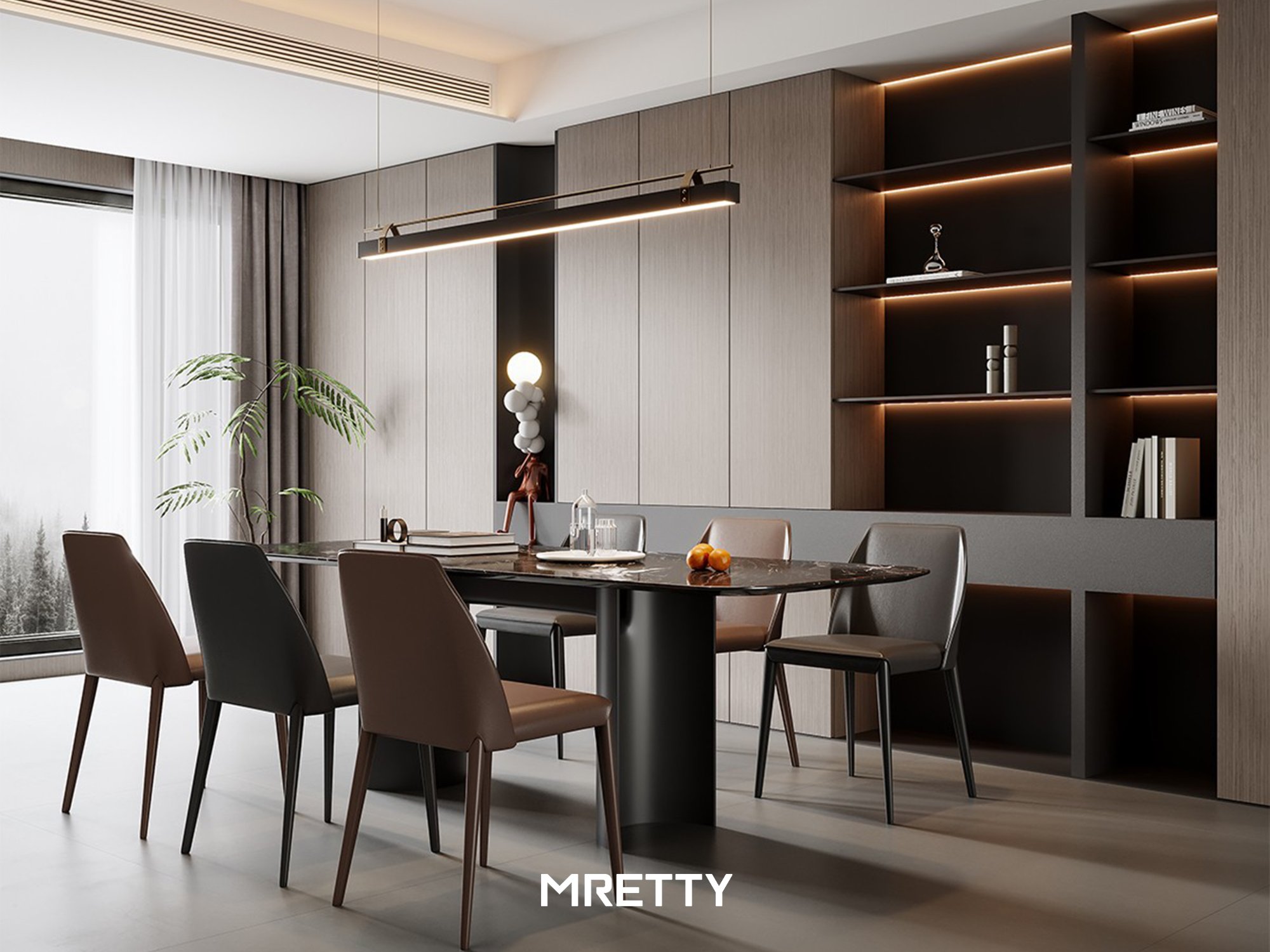
3. How MRETTY Achieves Seamless Integration Between Furniture and Smart Systems
"The render looks great, but the execution is a mess" is a nightmare for many homeowners. True integration relies on precision manufacturing at the factory level—this is the core distinction between MRETTY and ordinary design firms.
Our process is "Integrated Design – Modular Production – Unified Installation." Every smart module model and dimension finalized during design is fed directly into the production system of our 15,000㎡ smart factory located in Johor Bahru.
Pre-cut Openings: Cutouts for smart switches, sockets, and sensors are executed with sub-0.5mm precision on CNC machines. Your cabinet arrives perfect, requiring no "butchering" by installers on-site.
Pre-grooved Wire Channels: Wherever wiring needs hiding, grooves are pressed into the boards during production. This means the wiring for smart wardrobe LED strips or under-cabinet kitchen lights is completely invisible.
Structural Reinforcement: Areas requiring motorized lifts or heavy smart appliances are reinforced with internal framing and specialized hardware. For instance, a kitchen island with an integrated lift-up worktop has a completely different internal structure from a standard island.
❌ Common Mistake: Assuming any custom furniture maker can handle "smart integration."
✅ Better Approach: Choose a brand with end-to-end design-to-production capabilities. Ask them how they handle wiring预留 at the factory level, not just during on-site installation. This directly reflects the professionalism of a premium smart furniture solution.
Through this "Design-as-Production" model, MRETTY ensures over 99% accuracy from concept to reality.
4. The Smart Heart: How to Choose the Right Ecosystem?
Choosing a smart home system is like choosing between Apple iOS or Android. Once chosen, your future devices and experience will largely be defined by it.
Many believe that when choosing a smart ecosystem, the more compatible devices, the better.
But this is not true. For high-end integrated design seeking a seamless experience, the quality of integration matters far more than the quantity of supported devices. An ecosystem with a slightly shorter list of supported devices but stringent quality control (like Apple HomeKit), when its core devices are deeply "embedded" into the furniture, often provides a "native" and stable experience. In contrast, a vast but fragmented system with inconsistent response speeds across brands can cause daily frustration.
Comparison of Mainstream Smart Home Ecosystems
| Ecosystem | Core Advantage | Ideal User |
| :--- | :--- | :--- |
| Google Home | Powerful AI and voice recognition; excellent third-party device compatibility. | Tech enthusiasts who love experimenting with various smart gadgets. |
| Amazon Alexa | Widest device support (Skills); currently the most common choice. | Users who want to maximize the range of device choices. |
| Apple HomeKit | Extremely high security and stability; seamless integration with Apple devices. | Apple ecosystem users with high demands for privacy and premium experience. |
An important 2026 Smart Home Design Trend in Singapore is the adoption of the Matter protocol. The proliferation of Matter is especially critical for Singaporean households. Why? Because users here rarely stick to a single brand. Your phone might be Apple, your TV Samsung, and your air purifier Xiaomi. The Matter protocol acts as a "universal translator," ensuring these devices from different brands can understand each other's commands. When shopping for new devices in 2026, seeing the "Works with Matter" logo is like buying insurance for your smart system's future compatibility.
❌ Common Mistake: Focusing only on a device's features while ignoring its ecosystem.
✅ Better Approach: Decide on your preferred core ecosystem first, then select compatible devices around it. At MRETTY, we discuss this with you early in the design phase to ensure all integrated devices coexist harmoniously within a single App.
5. Expert Pitfall Guide: 5 Most Common Integration Traps
Over years of project experience, I have seen too many cases where poor planning turned a "smart home" into a "frustrating home." Here are five fatal traps I have identified.
Avoiding these common traps is a prerequisite for project success.
6. Frequently Asked Questions (FAQ)
How does a smart home system integrate with custom furniture?
Integration centers on "pre-planning." During the furniture design phase, the dimensions, wiring routes, and ventilation needs of smart devices (sensors, motors, controllers) are factored in. By pre-cutting openings and embedding wire channels at the factory, seamless unification between devices and furniture is achieved.
Is smart home integration suitable for Singapore HDBs or Condos?
Absolutely. For space-constrained HDBs and Condos, integrated design embeds smart functions (like motorized lifts, smart lighting) into storage cabinets, maximizing spatial utility. The key is adopting a hybrid model—"wired for core, wireless for periphery"—tailored to the building structure.
What is the budget for a whole-home smart custom setup?
Budgets vary widely. A basic entry-level smart system (lighting, curtains, a few sensors) integrated into custom furniture might start around S$15,000. A high-end premium smart furniture solution covering security, AV, and environmental controls could exceed S$50,000. Costs depend primarily on the number of automation points and the complexity of the furniture design.
What are the must-have features for smart wardrobes and smart kitchen cabinets?
For smart wardrobes, essentials include: motion-sensor LED strips (lighting on door open), motorized lift hanging rods (easy access to high storage), and electronic dehumidifier rods. For smart kitchens, MRETTY recommends: under-cabinet task lighting (eliminating shadows while chopping), motorized lift-up doors/drawers (touch-to-open), and integrated smart track power sockets.
7. About the Author
Hanson, Whole-Home Designer at MRETTY
Hanson possesses over 14 years of experience in high-end kitchen and cabinetry system design and project management at MRETTY. Deeply rooted in the Singapore market, he has personally completed whole-home customization projects for hundreds of families, from Condominiums to Landed Houses, giving him profound insight into local residential structures and homeowner needs. Hanson specializes in seamlessly blending the design aesthetics of Modern Minimalist, Italian Luxury, and French styles with complex smart home technologies, dedicated to creating living spaces that combine top-tier beauty with cutting-edge functionality.
MRETTY: Premium Bespoke Kitchen & Cabinet Systems Provider in Singapore
