
 Singapore
 China
China
Professional Singapore kitchen cabinet design must strike a balance between aesthetics, ergonomics, and climate adaptability—with functionality always coming first. Research by Qanvast confirms this: data shows that 65% of Singapore homeowners rank storage and practicality as their top kitchen priority. The secret to a kitchen that truly lasts lies in material selection. Moisture-resistant plywood and premium hardware are the two non-negotiable baselines for resisting the local hot and humid environment.
TL;DR: Crafting the Perfect Kitchen Cabinet Design
- Material First: Prioritize high-moisture-resistant plywood to avoid the common pitfall of solid wood warping and twisting in high humidity.
- Smart Storage: Utilize hardware systems from brands like Blum and Häfele to maximize every inch of compact HDB/condo kitchens.
- Realistic Budgeting: Custom cabinetry projects typically range from S$8,000–S$25,000+, depending on length, core board grade, countertop, and hardware configuration.
- Holistic Thinking: Collaborate with a whole-home customization team like MRETTY to ensure your kitchen style flows seamlessly with the rest of your home, rather than being an isolated "pretty box."
"Space is the physical expression of the occupant's inner spirit. Design is the journey that guides them to complete their self-awareness."
—— Aida, Senior Whole-Home Design Lead at MRETTY
Priority Answers to Core Questions
Before diving into the details, let’s answer the two questions most frequently asked by Singapore homeowners.
How Much Does a Kitchen Cabinet Set Cost in Singapore?
In 2026, custom kitchen costs vary widely. A complete cabinetry system for a standard 4-room HDB commonly falls between S$8,000–S$15,000. For larger condominiums or landed properties featuring premium countertops like sintered stone, budgets can easily exceed S$25,000. Pricing is driven by four variables: total cabinet length, core board grade, countertop selection, and hardware quality. A reliable quote itemizes these clearly rather than providing a vague lump sum.
What Are the Best Materials for Kitchen Cabinets in Singapore’s Climate?
Many instinctively believe "solid wood is the most premium," but this is often a costly misconception. Singapore’s year-round humidity causes solid wood to constantly expand and contract, potentially leading to door warping and joint cracks within 3–5 years. A far more reliable core material is high-moisture-resistant plywood—it offers significantly greater stability. For surface treatments, high-grade laminates are waterproof, scratch-resistant, easy to wipe clean, and offer vast style options, making them the gold standard for local durability.
Ready to turn your vision into a precise, executable plan? MRETTY offers a no-obligation initial design consultation to help bring your ideal kitchen from sketches to site.
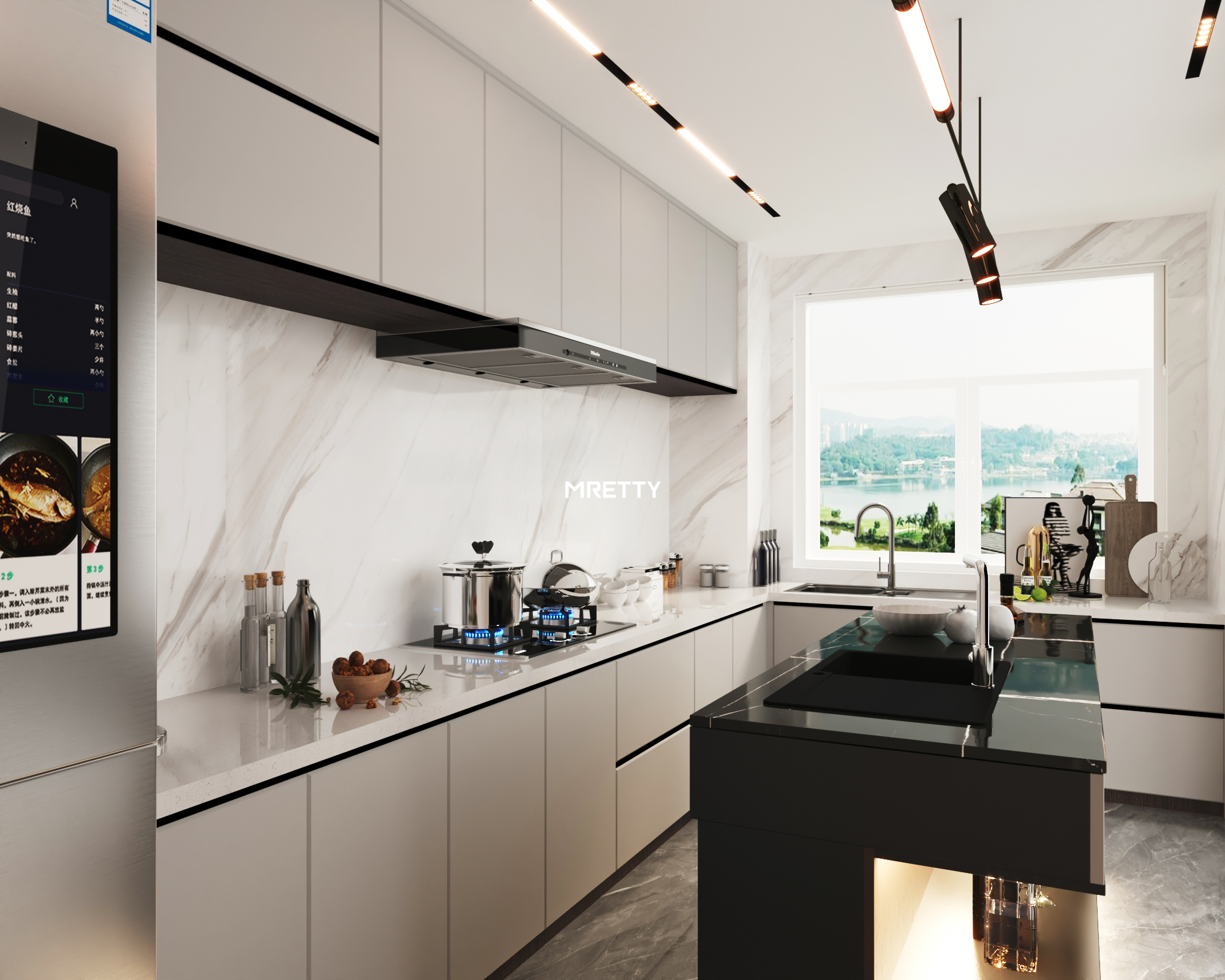
Step 1: 5 Key Stages of Kitchen Space Planning
Excellent kitchen design never starts with "choosing door colors"; it begins with rigorous space planning. Regardless of kitchen size, smart layout doubles efficiency—centered around the work triangle (the flow between sink → stove → refrigerator). Referencing data from the U.S. National Kitchen & Bath Association (NKBA): an optimized work triangle layout can improve user operational efficiency by approximately 15%.
Last month, I applied this logic to a 93 sqm BTO in Tampines: the kitchen had a narrow, corridor-like layout. We implemented a double-row layout with floor-to-ceiling cabinets, fitting in a full-sized fridge, dishwasher, and ample counter space without feeling oppressive—proving once again that smart design beats square footage limitations.
Here is the 5-step process I follow for every project:
- Precise Measurement & Mapping: Not just length and width, but locking in window sill heights, water inlets/outlets, gas points, electrical risers, and beam positions—this step is non-negotiable.
- Defining Work Zones: Establish the primary path (fridge → sink → stove) first, ensuring short distances and minimal crossing.
- Selecting Layout Form: Single-row / Double-row / L-shape / U-shape / Island, chosen to suit the layout. For most new BTO kitchens, the L-shape best balances storage volume with continuous countertop space.
- Developing Vertical Storage: When space is tight, "borrowing space upwards" is the only correct answer—cabinets go to the ceiling, storing less-used items at the top.
- Pre-planning Appliance Integration: Exact dimensions for built-in ovens, fridges, and dishwashers must be finalized early in the design phase to ensure seamless cabinet openings, ventilation, and visual uniformity.
❌ Common Mistake: Directly copying a beautiful layout from Pinterest without comparing it to your actual home dimensions and daily cooking flow.
✅ Better Approach: Map out the work triangle and high-frequency zones first, then fit the appropriate layout into your HDB/condo’s real floor plan.
This structured process ensures your kitchen isn’t just "beautiful in photos," but beautiful in everyday use.
Step 2: Analyzing the 4 Most Common Kitchen Cabinet Materials in Singapore
Material selection is where professionalism is most evident. For kitchens, Singapore’s humidity is the ultimate test—no matter how beautiful the surface, if the core material swells, doors warp, drawers stick, and edges peel, everything fails.
The "premium filter" of solid wood requires caution here: it has a high expansion/contraction rate, and large door panels are especially prone to warping in our local environment. The superior solution is almost always the stability king among engineered materials. At MRETTY, our cabinet cores utilize imported E0-grade multi-ply plywood, with formaldehyde emissions below 0.5mg/L, far exceeding local health standards; its cross-laminated structure performs more stably against moisture and bending.
| Component | Professional's Choice | Why It Works in SG |
|---|---|---|
| Cabinet Core | High-Moisture-Resistant Plywood | Resists swelling, far superior to standard MDF/particleboard |
| Surface Finish | High-Pressure Laminate / Durable Melamine | Waterproof, scratch-resistant, wipes clean of kitchen grease |
| Countertop | Quartz or Sintered Stone | Non-porous, stain-resistant, heat-resistant, durable |
| Hardware System | Blum / Häfele | Tested for hundreds of thousands of cycles, corrosion-resistant, stable feel |
❌ Common Mistake: Spending the bulk of the budget on a "stunning countertop" while using the cheapest options for the cabinet core and internal hardware.
✅ Better Approach: Apply the 40–30–30 Budget Allocation Rule—
- 40% to the cabinet structure and hardware (what truly determines lifespan)
- 30% to the countertop
- 30% to appliances and miscellaneous installation costs
Investing in climate-adapted materials and European-quality hardware is the smartest long-term decision you can make for your kitchen.
Step 3: Decoding 2026 Singapore Kitchen Design Trends
Classic principles always outweigh trends, but understanding trends keeps a space feeling "current." The 2026 Singapore kitchen trend is shifting away from the cold, sterile "all-white clinical look" toward: emphasizing texture, warmth, and invisible technology, with kitchens increasingly functioning as "living hubs" with social attributes.
But here is a key reminder—
Many homeowners think they "must chase every new trend to be modern." But chasing trends is precisely what makes a kitchen look dated fastest within five years. Features like open shelving, in Singapore’s context of heavy stir-frying and oily steam, often turn into greasy display racks and cleaning nightmares.
A smarter approach is to: select only 1–2 trends that genuinely align with your lifestyle and whole-home style, prioritizing functional benefits. The following three are worth serious consideration:
- Curved Soft Lines: Sharp right angles are replaced by curves and soft transitions—rounded island ends, curved cabinet corners. Visually gentler, physically safer, reflecting high-end Italian design language.
- The "Hidden" Invisible Kitchen: Concealing refrigerators, dishwashers, and even small appliance zones behind seamless cabinetry. We implemented this in a condo project at The Reef at King's Dock—all appliances vanished into one continuous facade, instantly elevating the open-plan space.
- Full Statement Stone: Moving beyond a small backsplash, allowing quartz/sintered stone to run from the countertop all the way up to the base of the wall cabinets (or even full wall cladding), creating a strong visual anchor.
❌ Common Mistake: Forcing a niche, bold color scheme just to "keep up with trends," resulting in a clash with the home's architectural language.
✅ Better Approach: Choose enduring directions—like appliance concealment, which is both trendy and a time-tested space-saving solution.
The best design always tells a functional story that won’t go out of style, using contemporary language.
Step 4: MRETTY’s Core Advantage: Whole-Home Integrated Customization
Why treat the kitchen as an "isolated project"? A truly great home emphasizes coherence—the kitchen’s design vocabulary (materials, tones, textures, handle systems) should naturally flow into the living room, dining area, wardrobes, and foyer.
Imagine: the wood grain finish and matte black metal accents of your kitchen cabinets perfectly echoing the same material palette on your living room TV feature wall; the sintered stone on your kitchen island extending to your master bathroom countertop—this level of unity is only achievable when one system manages everything from start to finish. MRETTY’s 15,000㎡ smart factory ensures every board leaving the facility is under the same color calibration and batch process control, solving the perennial headache of "different suppliers, different batches, mismatched whites and woods"—a pain point many clients originally came to us to fix.
❌ Common Mistake: Hiring one team for the kitchen, another for wardrobes, and a third for the TV wall—ending up with clashing styles, mismatched materials, and finger-pointing after-sales.
✅ Better Approach: Engage a whole-home customization partner like MRETTY from the start, unifying design intent, material quality, and having a single point of contact and accountability.
Placing the kitchen back into the "whole-home narrative" creates that seamlessly integrated sense of sophistication.
Frequently Asked Questions
How Do I Choose a Kitchen Cabinet Designer in Singapore?
Prioritize those with extensive local HDB/condo completed project portfolios and a genuine understanding of material trade-offs in humid environments. A good designer asks about your circulation and storage habits first, not just making the renderings look good. Ask one key question: Where is your manufacturing done? Those with in-house/controlled factories deliver far more stable edge-banding, batch consistency, and precision than outsourced carpenters.
Custom Kitchen Cabinets vs. IKEA Singapore: What’s the Verdict?
If you seek precision fit and long-term durability, custom is superior. IKEA wins on entry-level pricing and aesthetic options, but its standard sizes inevitably leave awkward filler gaps. Its core materials are primarily particleboard-based, inherently weaker against kitchen moisture. The core value of customization is a bespoke system tailored to your walls, your pipes, and your cooking style—a long-term investment in daily quality.
How Long Does Custom Kitchen Cabinetry Take in Singapore?
From design confirmation to final installation, the typical timeline is 6–8 weeks: with factory manufacturing taking approximately 4–5 weeks, and on-site installation 1–2 weeks (subject to minor adjustments based on material arrival and site conditions).
About the Author
Aida is the Senior Whole-Home Design Lead at MRETTY, with over a decade of deep expertise in Singapore’s high-end residential sector. She has led hundreds of kitchen and whole-home customization projects across HDBs, condominiums, and landed properties. Her design methodology emphasizes: Material Science × Ergonomics × Whole-Home Narrative = True Durable Luxury.
Begin Your MRETTY Design Journey
Ready to Start Your Kitchen Project?
MRETTY provides kitchen and cabinetry customization centered on "whole-home consistency"—from moisture-resistant core grades and hardware tactile feel, to material alignment with living room wardrobes/TV walls, all completed under one unified standard.
Book a No-Obligation Design Consultation →
MRETTY: Premium Bespoke Kitchen & Cabinet Systems Provider in Singapore.
