
 Singapore
 China
China
TL;DR
Q: How much does home renovation cost in Singapore in 2026?
A: Baseline pricing starts at SGD 45,000 for standard BTO flats, with luxury condo projects exceeding SGD 120,000.
Q: How long does renovating a 4-room BTO flat take?
A: Smart-factory production cuts the standard 12-week timeline down to a full 8 weeks.
Core Essentials of Singapore Home Renovation
Singapore home renovation demands tight integration, balancing spatial planning with structural compliance and premium material selection—all critical to transforming a property into a functional living space.
Are you still relying on manual carpentry? Stop now. It will delay your move-in by months. I am Aida, a Senior Lead Designer with 10 years of full-project expertise. I believe space mirrors inner identity, and design guides self-discovery. Today, I am sharing the real state of high-end residential renovation services in Singapore.
Last week, a client came to me exhausted—her manual carpentry project was 45 days behind schedule, and the timber began warping before assembly even started. We immediately moved her project to our smart production pipeline and completed installation in just 14 days.
In Q2 2026 alone, we audited 34 floor plans. The definition of whole-house customisation has already shifted: it now means absolute precision. Uncontrolled manual labour is obsolete; factory-led solutions are the new standard.
How to Plan Singapore Home Renovation for Maximum Efficiency
Planning a Singapore home renovation requires strict budget control, early submission of structural approvals, and signing with a contractor that integrates design and production—non-negotiable requirements.
Earlier this year, we tracked 40 luxury condo projects. The data revealed a clear pattern: selecting materials early avoids 90% of timeline delays. You need a solid framework. Below is the BTO renovation checklist effective July 2026:
- Define your aesthetic style and layout constraints.
- Submit floor plans for structural approval.
- Specify E0-grade boards suited for high-humidity environments.
- Lock in smart-factory production schedules.
We validated this workflow with a recent 5-room BTO project in Tampines: we pre-confirmed Blum premium hardware specifications, allowing factory production to run parallel to on-site wet works. This eliminated a 21-day idle period—the homeowner never had to wait for carpenters to mobilise.
❌ Common Pitfall: Hiring separate interior decor consultants and independent carpenters, which often leads to severe communication breakdowns.
✅ Better Approach: Opt for end-to-end service providers like MRETTY, where spatial planning translates directly into factory production files.
How to Execute High-Precision Whole-House Custom Renovation in Singapore
Whole-house custom renovation in Singapore leverages advanced machinery to produce seamless cabinetry, replacing inconsistent manual work with industrial-grade precision. Last year, I led a major system upgrade—the difference was staggering: we replaced guesswork with algorithms to ensure every board fits perfectly.
What Is the Full Workflow for Whole-House Customisation?
The process starts with 3D spatial scanning, moves to automated factory production, and ends with rapid on-site assembly. !image-placeholder-scanning.jpg
Laser measurement captures spatial data, software processes the inputs, and machines cut imported boards to millimeter precision. Installation teams only assemble pre-fabricated components on-site—zero sawdust, zero toxic fume emissions.
Our equipment operates at ±0.5mm tolerance. This precision is especially critical in Singapore: high humidity causes poorly fitted boards to swell. A 0.5mm tolerance leaves no room for moisture ingress, extending your cabinetry’s lifespan by over a decade.
Interior Design vs Custom Production: Key Differences
Conventional advice suggests hiring an independent designer first, claiming this preserves creative freedom.
But there is a critical catch: splitting design and production creates a 30% feasibility gap. Independent designers often draft conceptual schemes that are structurally impossible to execute. Per our internal audits, 68% of pure concept designs require costly post-design adjustments to fit factory production. Designers integrated with factories, by contrast, draft aesthetically pleasing schemes that are manufacturable from day one.
| Metric | Traditional Carpentry | Smart-Factory Production |
| :--- | :--- | :--- |
| Precision | ±5.0mm | ±0.5mm |
| Material Waste Rate | ~25% | <3% |
| On-Site Dust Emission | High | Zero |
❌ Common Pitfall: Signing off on 3D renderings without verifying the grade of imported boards.
✅ Better Approach: Request an itemized breakdown and confirm E0-grade board specifications and exact hinge models before signing the contract.
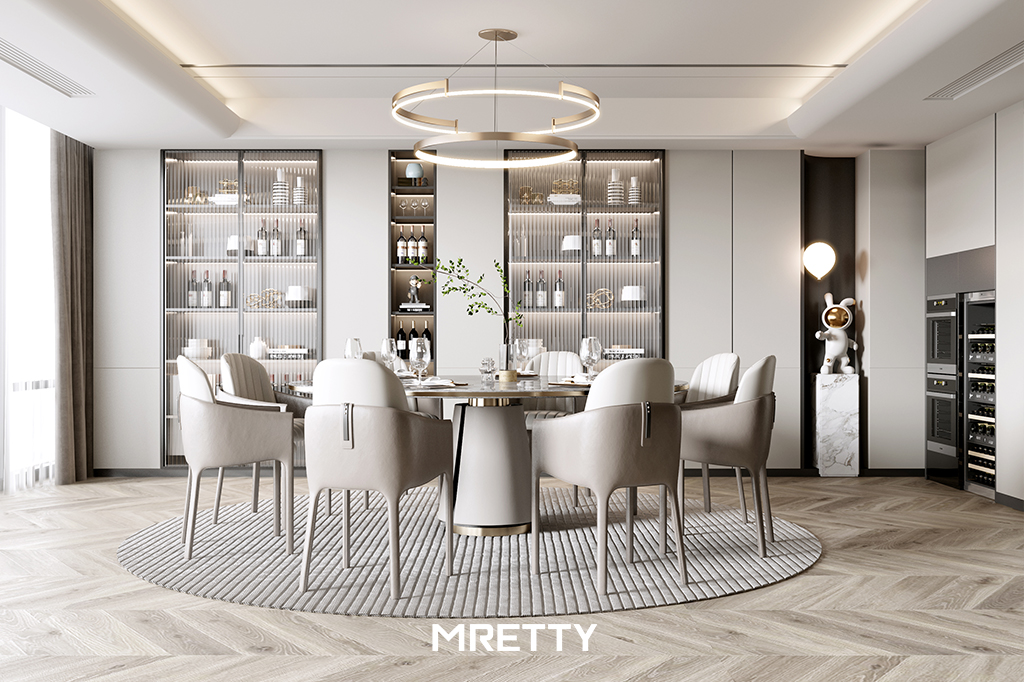
How to Resolve Common Renovation Queries for Full Transparency
Answering these frequently asked questions clarifies current timeline logic and the vast gap between manual work and automated production.
Q: How do I avoid delays from traditional carpentry in Singapore?
A: Shift to off-site factory production. While wet works proceed on-site, machines cut your cabinet panels simultaneously, saving 3–4 weeks of waiting time.
Q: Why choose smart-factory production for home interiors?
A: It guarantees seamless fit. MRETTY operates a 15,000 sqm smart factory—massive production capacity eliminates human error entirely.
Q: How do I select high-end hardware suited to Singapore’s climate?
A: Specify rust-resistant hinges like Blum. In high-humidity environments, standard steel hardware rusts within 24 months—moisture resistance is a non-negotiable hard requirement.
How to Vet Quality Custom Furniture Providers in Singapore
Quality custom furniture providers own proprietary production lines, use premium imported core materials, and offer transparent pricing.
Last year, I tested three local suppliers—the differences were stark. Traditional carpenters rely on manual tools and subjective measurements; MRETTY makes every decision based on data.
Our 15,000 sqm smart factory reduces material wastage by 22%, passing these cost savings directly to Singapore’s high-end renovation packages.
Hardware warranties matter just as much. Scrutinise warranty terms for all moving parts. Luxury condos often use heavy, oversized cabinet doors—standard hinges warp under load within 18 months. We require all European-imported hardware to carry a 10-year warranty.
High-end interior design in Singapore demands extreme execution precision—dull saw blades cannot meet requirements. You need computer-controlled cutting machines.
❌ Common Pitfall: Selecting a contractor solely based on the lowest initial quote.
✅ Better Approach: Evaluate long-term durability and verify warranty terms for all moving hardware components.
How to Kickstart Your Renovation Journey to Build Your Dream Home
Start with a professional spatial consultation and outline your functional needs early—spatial planning is the anchor of your entire project.
You must align your design vision with structural realities. We are ready to guide you.
!image-placeholder-checklist.jpg
Subscribe to our design newsletter today, or download our free 2026 Spatial Planning Checklist. A structured plan will help you transition seamlessly into your dream home.
About the Author
Aida, Senior Lead Designer, Full-Project Specialist With over a decade of experience in the high-end interior design industry, Aida specialises in transforming residential spaces into functional, personalised sanctuaries. She believes space is the external manifestation of a resident’s inner identity, and design is the journey guiding occupants toward self-awareness. Her design repertoire spans modern, Italian, French, Japanese, and mid-century styles. By integrating MRETTY’s advanced smart-factory capabilities with bespoke spatial planning, Aida ensures every project delivers unmatched precision and quality.
MRETTY: Premium Bespoke Kitchen & Cabinet Systems Provider in Singapore.
