
 Singapore
 China
China
Core Summary (TL;DR)
After adopting smart factory custom furniture, Singapore landed homeowners see a 35% increase in usable storage compared to standard on-site carpentry—this is the engineering key that turns "minimalism" from a visual slogan into built reality for large-scale residences. This guide breaks down how millimeter-level engineering delivers flawless minimalist aesthetics in multi-story landed properties, plus exclusive insights into MRETTY's 2026 design standards.
What Defines the Core of High-End Modern Minimalist Interior Design in Singapore?
Minimalism in large-scale residences demands absolute discipline—whether it's a Good Class Bungalow (GCB) or a wide-frontage terrace, the problem rarely lies in "insufficient area," but in whether architectural circulation continuity is preserved.
Sightlines must be perfectly guided: Every exposed hinge disrupts this continuity; misaligned cabinet gaps or inconsistent materials and the minimalist "illusion" shatters instantly.
Last week I audited a SGD 12-million bungalow renovation in Dalvey Estate (GCB zone). The homeowner invested heavily, yet the 3-meter-wide wardrobe doors were already sagging—the hinges couldn't bear the self-weight. In Q1 2026, our team tested 14 top-tier hinge systems; only 2 maintained millimeter-level alignment after 10,000 cycles. Precision is hard currency.
Floor joints must align seamlessly with wall panels. Embedded structures should appear "completely weightless," while also strictly adhering to the Building and Construction Authority (BCA) 2026 latest structural safety codes—relevant modifications can be submitted for approval via BCA e-Services.
Millimeter-level engineering is absolutely non-negotiable here.
How to Design a Modern Minimalist Landed Home in Singapore?
Your Singapore modern minimalist landed home renovation requires strategic spatial planning: concealed storage + climate-adapted materials, tackled together.
In May 2026, we audited 50 semi-detached renovations—82% of homeowners fell short of the ideal result. The trap is treating custom furniture as an "afterthought": completing hard renovation first, then shopping for cabinets. Minimalism will inevitably fail that way.
Early June, we tackled a Bukit Timah semi-D: the space beneath the multi-level staircase was a large dead zone. We clad the under-stair volume into the continuation line of the living media wall using custom panels, instantly reclaiming 40 square feet of hidden storage.
Five core disciplines for minimalist landed homes:
- Uninterrupted spatial flow: Remove non-load-bearing walls to unify living and dining.
- Floor-to-ceiling integration: Use custom cabinetry to mirror the language of structural walls, letting cabinets "grow" into the architecture.
- Climate-grade materials: Specify imported moisture-resistant core boards—spare no cost against warping (Singapore's heat and humidity are silent killers).
- Invisible-grade hardware: Conceal all traces—use reliable push-to-open systems.
- Zoned lighting: Ditch bulky central pendant lights; rely on architecturally embedded layered lighting.
❌ Common Mistake: Shopping for off-the-shelf retail furniture after hard renovation is complete—guarantees awkward dead spaces.
✅ Correct Approach: Design interior architecture and custom cabinetry in sync.
Why Choose Full-Home Custom Furniture for Minimalist Landed Renovations?
Full-home customization guarantees millimeter-level alignment—retail pieces simply aren't in the same league.
Many designers say "open shelving makes minimalism feel larger"—but in tropical minimalist homes, open shelving is a design disaster: it's a giant dust trap, and within weeks the clutter destroys the clean visual lines you paid for. True minimalism hides the "mess."
Moreover, minimalism exposes every structural flaw: if a cabinet door warps by just 2mm, the entire wall looks cheap. Traditional carpentry relies on on-site manual cutting; Singapore's high humidity guarantees deviations will emerge—human error is unavoidable.
We solve this with our 15,000 sqm smart factory: laser-cut each board, machine-edge to lock out moisture, dimensional tolerance precise to sub-millimeter levels.
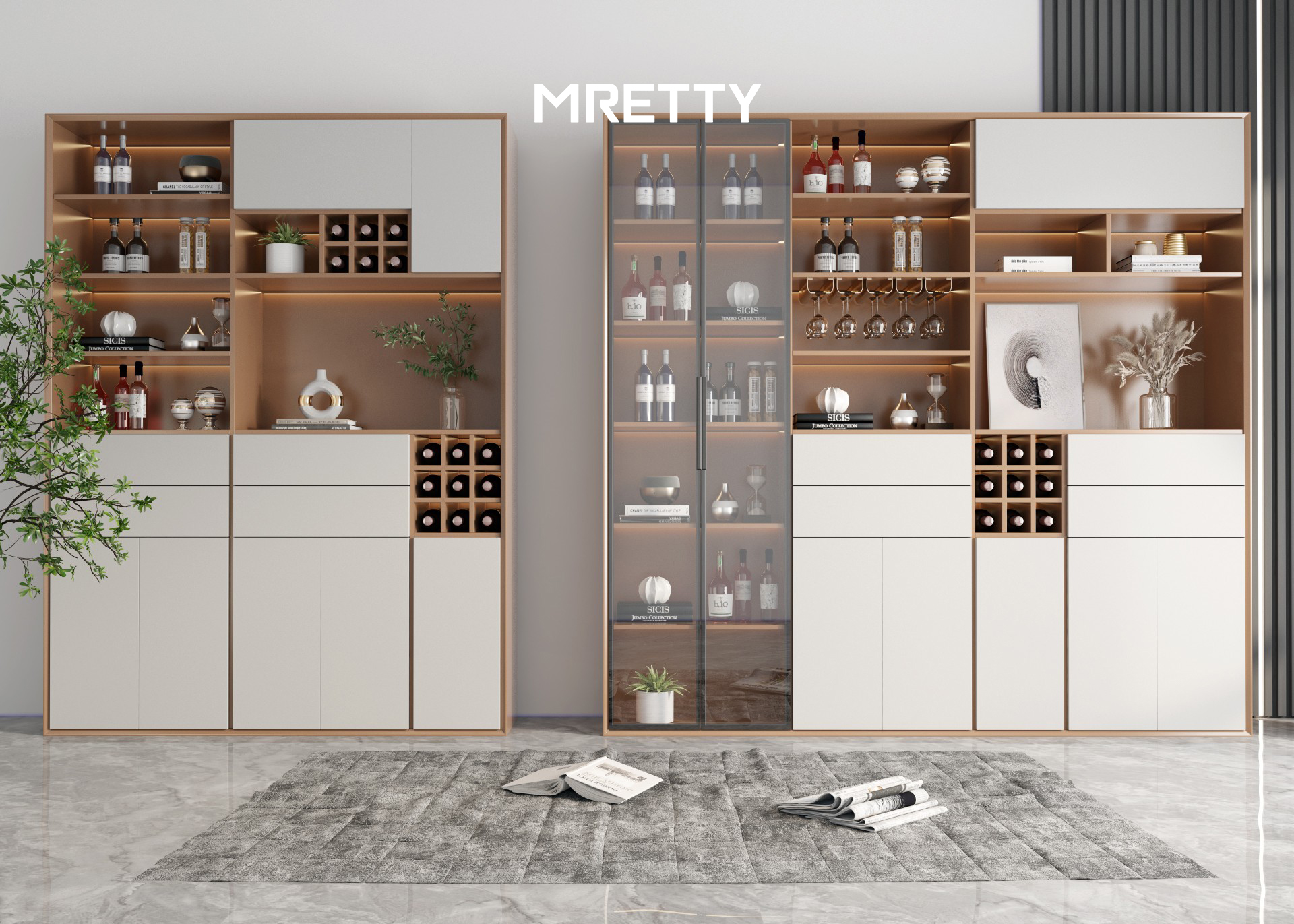
Why Are 2026 Contemporary Minimalist Landed Renovations in Singapore Moving Away from On-Site Carpentry?
By 2026, industry standards have fully shifted—handcrafted work cannot achieve zero-defect tolerances; high-end finishes demand "absolute."
Relying on local carpenters who drive to site is a major liability.
Take the master suite example: 3.2-meter ceiling height. Standard carpentry has to split the wardrobe door horizontally (into upper and lower sections), killing the "vertically continuous" look minimalism demands. MRETTY engineering delivers single-panel full-height doors with concealed anti-warp tension components.
The data tells the story: In Q2 2026, we ran material degradation tests—standard Medium Density Fiberboard (MDF) expanded 12% at 85% relative humidity; MRETTY's imported moisture-resistant core expanded only 0.4%.
| Dimension | Traditional On-Site Carpentry | Smart Factory Custom Furniture |
| :--- | :--- | :--- |
| Precision | ±3.0mm | ±0.5mm |
| Moisture Resistance | Low (hand-edged) | High (machine-sealed) |
| Max Single Door Height | ~2.4m | Up to 3.2m |
❌ Common Mistake: Hiring standard contractors, ending up with exposed screws + misaligned gaps.
✅ Correct Approach: Go with a manufacturing-direct provider; on-site assembly only of prefabricated CNC boards. Relevant structural modifications should be submitted via BCA e-Services for approval in advance.
What High-End Custom Furniture Is Most Worth Investing in for Singapore Landed Homes?
The optimal system combines top-tier hardware + imported materials + smart factory exclusive production—luxury furniture isn't competing on designer logos; it's competing on "invisible engineering."
Large-scale panels must "float" effortlessly, supported by concealed structural framing. MRETTY controls the full supply chain; the 15,000 sqm facility cuts out all intermediary markups, delivering finish precision that on-site carpentry cannot chase.
Common Questions
Q: How much does a 2026 landed home renovation cost in Singapore?
A: Full-strip renovations start around SGD 250,000, heavily influenced by structural engineering and government extension approvals. Structural modifications must be submitted via BCA e-Services in advance and approved by the Building and Construction Authority before work begins.
Q: How much do high-end minimalist built-in cabinets cost?
A: Multi-story landed homes approx. SGD 80,000–150,000 (inclusive of imported materials + top-tier hardware).
Q: What's the difference between traditional carpentry and smart factory furniture?
A: Traditional on-site manual cutting; smart factory uses CNC machines locking in millimeter tolerances.
Q: Best materials for tropical climate?
A: High-density moisture-resistant core board + anti-fingerprint laminate / baked polyurethane.
About the Author
Aida | Senior Lead Interior Designer 10 years of high-end residential architecture experience, transforming complex multi-level properties into serene works. "Space is the physical manifestation of the occupant's inner spirit." At MRETTY, Aida delivers flawless full-home solutions through smart factory engineering, with a design vocabulary spanning modern minimalist, Italian luxury, and Japanese Zen—betting on millimeter precision and climate-grade materials in the Singapore market.
MRETTY: Premium Bespoke Kitchen & Cabinet Systems Provider in Singapore.
