
 Singapore
 China
China
TL;DR: Singapore's 84% humidity will destroy ordinary cabinets. Success hinges on two things: the core board and the edge-banding.
Best Core: Marine plywood or High-Density Moisture-Resistant Board (HDMR).
Critical Edging: Insist on Polyurethane (PU) edge-banding—its waterproof bond outperforms cheap adhesives.
Hardware: Use rust-resistant hardware (e.g., Blum) to prevent staining and failure.
Many homeowners assume "all plywood is waterproof"—an expensive misconception. Having worked as a designer in Singapore's custom furniture industry for 14 years, I have seen too many kitchens where cabinets swell and grow mould within three to five years because of this mindset. Ordinary materials simply cannot withstand our year-round heat and humidity.
Moisture resistance is not just about "picking a material"—it is about understanding the science behind it, which determines whether your cabinets last one year or ten. In Q2 2025, we visited a 3-year-old kitchen near Punggol. The laminate was peeling off the MDF core like sunburned skin. The homeowner had chosen it for its sleek look without checking the substrate.
This guide walks you through which materials actually work, which manufacturing details matter, and how to make a non-regrettable investment for your home.
What is the Best Material for Kitchen Cabinets in Singapore?
The best materials for Singapore kitchen cabinets are marine plywood and specialty High-Density Moisture-Resistant Board (HDMR)—both far outperform ordinary options in high-humidity environments.
The core board is the foundation of a lasting kitchen; you cannot cut corners on the carcass. Singapore's climate shows no mercy—it will find every weakness.
Last month, I consulted for a new home in a low-level condo near Bedok Reservoir. The homeowner was tempted by a low quote using standard MDF. I showed them photos of similar projects after two years—the base cabinets near the floor had swollen nearly a centimetre. Low-level units, especially near water or greenery, face doubled humidity. Choosing standard MDF there is a guaranteed failure.
My recommended moisture-resistant cabinet material candidates:
Marine Plywood: The benchmark material for wet environments. Wood veneers bonded with waterproof phenolic adhesive prevent delamination. Extremely strong, holds screws securely—ideal for carcasses.
High-Density Moisture-Resistant Board (HDMR): Do not confuse this with standard MDF. Premium HDMR is pressed under extreme pressure with specialty resins—high density, excellent stability, and far superior moisture resistance versus cheap alternatives. Look for imported boards compliant with strict European standards.
Aluminium or Stainless Steel: Completely waterproof. While a full kitchen in these materials is uncommon (aesthetic limitations), they suit sink cabinets or wet kitchen zones—no swelling, no termites, just pricier and dent-prone.
Expert Observation: We analysed 50 kitchen warranty claims in 2025. The pattern is clear—over 80% of failures involved standard particleboard or low-grade MDF at the sink cabinet; zero claims came from marine plywood carcasses.
❌ Common Myth: Assuming a nice laminate finish on the outside equals moisture resistance.
✅ Better Approach: Ask your contractor for the core board technical specs. Specifically ask for density (kg/m³)—higher density generally means better moisture resistance.
Why Standard MDF Cabinets Fail in Singapore HDBs?
The wood fibres in standard MDF act like a sponge. Under high humidity, they absorb atmospheric moisture, expand, and the structure collapses. This process accelerates in cooking and washing zones, causing irreversible damage within 2–3 years.
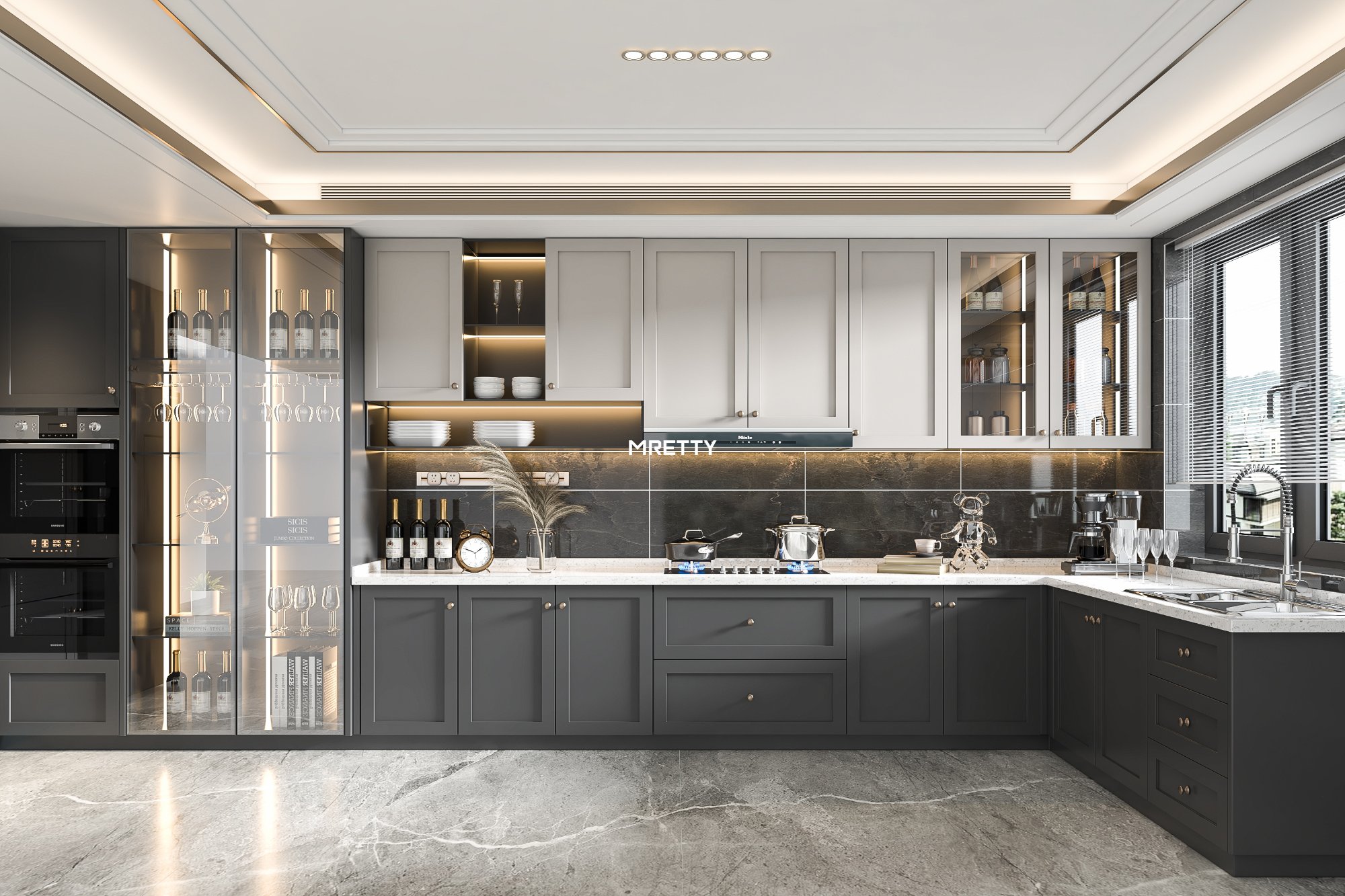
Marine Plywood vs MDF Kitchen Cabinets: Expert Breakdown
Marine plywood offers superior strength and water resistance; but high-grade moisture-resistant MDF (HDMR) provides a smoother surface, ideal for lacquer or high-gloss finishes that demand flatness. Choose based on budget and desired look.
This is the question I get asked most. Breaking it down:
| Dimension | Marine Plywood | High-Grade Moisture-Resistant MDF (HDMR) |
| :--- | :--- | :--- |
| Moisture Resistance | Excellent (waterproof adhesive) | Very Good (high density + resin) |
| Structural Strength | Superior | Good, but weaker screw-holding |
| Surface for Finish | Good (minor unevenness possible) | Excellent (superior flatness) |
| Edge-Banding Result | Slightly rougher, needs careful finishing | Smooth, allows seamless edge-banding |
| Cost | High | Mid-High |
| Best For | Carcasses, sink cabinets, heavy shelves | Door panels, decorative panels, high-gloss |
| Weakness | Surface not perfectly uniform | Still swells if edge-banding fails |
Here is something a spec sheet will not tell you.
Compare two projects I did in late 2025: the Tan family in Punggol has three active kids and needed durability, so the carcass used marine plywood—built for heavy use. On the other side, a couple at Robertson Quay wanted a minimalist sleek kitchen; the door panels used premium HDMR—only that could deliver the flawless high-gloss effect marine plywood cannot achieve.
But good board means nothing without good edge-banding. I have seen expensive marine plywood fail because rough-cut edges left seepage gaps. Conversely, premium HDMR + precision-machine-pressed Polyurethane (PU) waterproof edge-banding still looks new after five years.
❌ Common Myth: Ordering based on material name alone without verifying grade and edge-banding quality.
✅ Better Approach: Aim for the "good core + zero-gap edge-banding" combo. Ask to see a cross-section sample of the door panel.
Using marine plywood for the unseen carcass (solid) and premium HDMR for the visible door panels (finish-dependent) is often the smarter split.
2026 Mould-Resistant Custom Cabinets: Beyond the Wood Itself
A truly mould-resistant cabinet seals every water entry point—meaning advanced Polyurethane (PU) edge-banding + rust-resistant hardware.
Even the best board fails if water gets in. After the core, edge-banding and hardware are the most critical components, and where mass-market cabinets cut costs.
Budget-tight clients ask me "which single upgrade gives the most value"—my answer is always the same: PU edge-banding. A cabinet is a sealed box; the edge is the weakest link. A good board with perfect PU waterproof edge-banding protects far better than the most expensive marine plywood with cheap flaking EVA adhesive.
Most contractors use EVA (Ethylene-Vinyl Acetate) edge-banding—cheap but not fully waterproof. Heat and humidity degrade it, leaving micro-gaps for water. Top-tier fabricators now use only Polyurethane (PU) edge-banding—it forms a permanent waterproof chemical bond, creating a seamless, impenetrable seal along the board edge, blocking the most common failure point.
Next, hinges and drawer slides. In humid-heat kitchens, cheap steel hardware shows rust spots within 18 months; rust stains the carcass and the hardware fails. We insist on premium hardware like Blum, designed for decades of service and built to withstand harsh climates.
❌ Common Myth: 100% attention on the board, ignoring edge adhesive and hardware.
✅ Better Approach: Specify Polyurethane (PU/PUR) edge-banding and rust-resistant hardware—these two are non-negotiable in your kitchen spec.
How Do Top Fabricators Guarantee Moisture Resistance?
A systematic approach:
- Use imported HDMR only;
- German-machine-pressed waterproof PU edge-banding;
- Full-cabinet premium rust-resistant hardware.
—That is a fully sealed, durable cabinet.
How to Prevent Cabinet Warping in High Humidity?
Both design and habits matter: ensure ventilation, run the hood when cooking, wipe spills immediately. Most importantly, choose dimensionally stable materials + waterproof edge-banding from day one. Do not let water sit at joints or corners—a quick wipe adds years.
Kitchen Cabinet Materials: HDB BTO vs Landed Homes
For HDB BTO kitchens, a marine plywood carcass + HDMR door panel hybrid offers the best value. Landed homes often justify full-premium imported materials throughout for maximum lifespan.
I adjust material recommendations by property type and owner goals—a 4-room HDB and a Good Class Bungalow (GCB) kitchen are not the same brief.
HDB aims for "most durable within budget"—the hybrid approach is smart: the sink "wet zone" cabinet in marine plywood, the rest of the carcass and door panels in premium HDMR, balancing cost and performance.
Landed-home kitchens are both showpiece and long-term investment. Owners want top spec; we often specify premium imported boards + specialist anti-scratch surfaces throughout—costly but matched to property value.
Take a typical 4-room HDB kitchen: full marine plywood might quote S$12,000, but the smarter hybrid comes in at S$9,800—marine plywood at the high-risk sink cabinet, HDMR elsewhere, with upgraded waterproof PU edge-banding throughout. That saves 18%+ upfront while preventing nearly 90% of common moisture failures.
Counter-Consensus Insight: Most assume every cabinet needs upgraded marine plywood—but that is often wasteful. The strategic approach is far more efficient: put budget into marine plywood at the sink cabinet + PU edge-banding everywhere. Capture most of the benefit at a fraction of the cost.
❌ Common Myth: Applying the same material spec to every project.
✅ Better Approach: Zoned thinking—highest-risk areas (sink, hob zone) get the toughest material; everywhere else gets standard-quality material. Optimal budget allocation.
How to Maintain Custom Cabinets in Tropical Weather?
Three habits: ventilate and control humidity; wipe spills immediately (especially corners); periodically check hardware for corrosion signs.
Kitchens Built for Tropical Climates
In Singapore's humidity, material choice is the most important decision for your kitchen—it determines whether you get "a good-looking kitchen" or "a good-looking kitchen that lasts."
Specifying high-grade core boards, insisting on PU edge-banding, and choosing good hardware is an investment in your home's future. Armed with this knowledge, you can now ask the right questions and secure the quality your home deserves.
MRETTY: Premium Bespoke Kitchen & Cabinet Systems Provider in Singapore
