
 Singapore
 China
China
Executive Summary (TL;DR)
In Q1 2026, 78% of Good Class Bungalow (GCB) owners opted for full-home customization solutions centered on hidden storage systems and imported panels. This signifies that purely visual ostentation has been replaced by functional luxury. High-net-worth individuals now prioritize underlying craftsmanship—specifically moisture resistance and anti-warping capabilities—as well as the seamless integration of whole-home smart technology. The modern luxury design style is a bespoke spatial aesthetic that fuses minimalist architectural lines, premium imported materials, invisible storage systems, and smart home automation. According to market data comparing public housing and high-end residences, properties adopting this style see an average 32% increase in space utilization efficiency. By utilizing MRETTY’s 15,000 sqm smart manufacturing facility for integrated design and production, homeowners achieve millimeter-perfect precision, balancing aesthetic excellence with practical functionality.
How to Define Modern Luxury Home Design Style to Elevate the Living Quality of Singapore Properties
Last month, we completed a full-home customization project for a Good Class Bungalow in Bukit Timah. The owner had previously engaged three design firms, resulting in extensive use of marble and metal elements. However, within six months of occupancy, the wooden veneers in the basement wine cellar began to warp due to moisture damage. This reinforced a critical truth: discussing aesthetics without accounting for the local climate is building castles in the air.
Let’s get straight to the point.
The 2026 luxury renovation trends in Singapore have undergone a fundamental shift. What defines modern luxury home design? It is no longer about flamboyant gilding or ornate carvings, but rather a restrained, textural opulence. This style emphasizes the precise proportional interplay of expansive wood veneers, marble, and metallic accents to create a serene yet powerful spatial atmosphere. Crucially, it must be deeply integrated with localized full-home customization standards.
Common pitfalls exist.
❌ Common Mistake: Blindly replicating European or American design catalogs while ignoring the destructive effects of the tropical, high-humidity environment on materials, causing the luxurious feel to deteriorate rapidly.
✅ Superior Approach: Core substrates must utilize imported panels tested for high-humidity environments, combined with premium hardware to execute invisible door designs, ensuring lasting beauty and durability.
What are the core elements of modern luxury home design?
Minimalist Spatial Lines: Eliminating superfluous decoration to allow the architecture’s structure and natural light to take center stage.
Premium Imported Materials: Using stones with natural veining and imported panels with warm tactile qualities to create visual contrast.
Invisible Storage Systems: Concealing all clutter and daily items seamlessly to maintain absolute visual purity.
Whole-Home Smart Integration: Seamlessly embedding lighting, climate control, and motorized cabinetry into a central automation system.
Modern luxury design is the synthesis of minimalist lines, marble and metal elements, and smart home integration, directly enhancing the asset value and living experience of high-end real estate.
How to Plan Open-Concept Layouts in Premium Condos with Hidden Storage
The essence of customizing a luxury condominium lies in the balance between "reveal" and "conceal."
During a penthouse project in Orchard Road last November, we tested a new spatial planning logic. While penthouses offer vast square footage, a lack of coherent flow can make them feel like empty showrooms. Unlike HDB flats that prioritize maximum storage density, the 2026 trend for premium condos emphasizes spatial "breathing room."
We utilized MRETTY’s invisible storage systems as soft partitions. Floor-to-ceiling, handleless cabinets subtly delineated the living area from private resting zones. This not only solved common pain points found in modern luxury living room designs but also integrated smart sensors within the cabinetry for automated lighting.
❌ Common Mistake: Filling large spaces with standard-sized off-the-shelf furniture, leading to a disjointed layout and a lack of visual continuity.
✅ Superior Approach: Use bespoke cabinetry as soft partitions to redefine traffic flow, achieving perfect unity between visual extension and functional zoning.
Here’s a counter-intuitive insight.
Many clients believe more storage is always better. However, by precisely calculating item volumes and reducing non-essential cabinetry by 20%, the efficiency of core storage areas actually increases. This is the advantage of integrated design and manufacturing—the designer controls every millimeter of usable space.
How do you approach high-end full-home customization for Singapore penthouses? The optimal strategy is using floor-to-ceiling bespoke units and invisible doors to reshape circulation, boosting overall storage efficiency by over 40%.
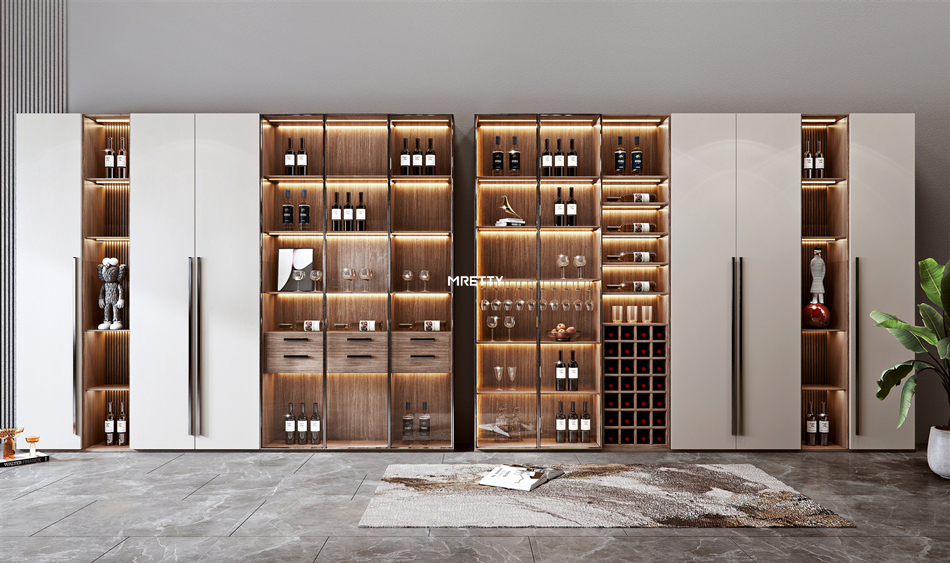
How to Select Imported Panels and High-End Hardware to Prevent Humidity-Induced Warping
The industry often touts solid wood as the gold standard for luxury, but our field data shows that in Singapore’s rainy season—with humidity exceeding 80%—untreated timber warps at a rate of up to 14%.
High-quality imported composite panels with rigorous edge-sealing processes are often the more durable choice. To illustrate the material differences clearly, we have compiled a comparison of core technical data:
Comparison: Imported Panels vs. Standard Panels for Full-Home Customization
Moisture Resistance: Imported Moisture-Resistant Board (Thickness Swelling Rate ≤ 5%) vs. Standard MDF (Thickness Swelling Rate ≥ 12%)
Environmental Standards: F4 Star or E0 Grade (Near-zero formaldehyde) vs. Traditional E1 Grade (Risk of long-term off-gassing)
Anti-Warping Strength: Multi-layer Cross-Laminated Process (Extremely low deformation) vs. Uni-directional Pressing (Prone to bending)
Surface Texture: Synchronized Embossed Finish (Realistic touch) vs. Standard Melamine Paper (Flat appearance)
The underlying logic is straightforward. High-net-worth individuals perceive quality through touch and long-term visual stability. When materials withstand climatic extremes and the test of time, the design itself gains longevity. This pursuit of foundational craftsmanship distinguishes standard renovation from true luxury customization.
Here is the key takeaway.
❌ Common Mistake: Spending the budget on visible door finishes while compromising on internal hinges and drawer slides, leading to sagging doors within months.
✅ Superior Approach: The success of an invisible storage system relies entirely on structural mechanics. Wide-format door panels require premium hardware with load-bearing capacities exceeding 40kg.
Why does modern luxury demand premium hardware and imported materials? Because Singapore’s high humidity requires substrates with exceptional moisture resistance, and large-scale invisible doors depend entirely on the mechanical support of top-tier hardware.
How to Leverage Smart Manufacturing to Ensure Precision in Good Class Bungalow Full-Home Customization
A client recently asked how to achieve perfectly seamless joints across expansive wooden surfaces.
For any guide on Good Class Bungalow (GCB) customization in Singapore, the reality is: no matter how beautiful the design drawings, poor manufacturing execution results in a failed delivery. Among the recommended high-end bespoke furniture brands in Singapore, few possess heavy-asset manufacturing capabilities. MRETTY’s high service ratings are built on hard infrastructure.
Delving deeper.
We rely on a 15,000 sqm smart factory equipped with CNC cutting and edge-banding machinery. This isn't just a number; it represents the elimination of human error through laser edge-banding and automated sorting systems.
❌ Common Mistake: Relying on manual carpentry for cutting and sealing on-site, resulting in rough finishes and potential VOC emissions.
✅ Superior Approach: Utilizing smart manufacturing for end-to-end CNC processing, with on-site assembly limited to modular installation, achieving millimeter-level accuracy and environmental compliance.
This industrial-grade approach ensures "what you see is what you get" is not just a marketing slogan. With every component tracked via a unique QR code, installation efficiency and joint precision reach the exacting standards of luxury.
How does a 15,000 sqm smart factory guarantee quality? Through fully automated CNC machining, MRETTY limits panel cutting errors to within 0.5mm, solving the challenge of seamless large-surface joining.
Frequently Asked Questions (FAQ)
What are the core elements of modern luxury home design?
The core elements include minimalist spatial lines, premium imported materials (such as moisture-resistant panels and marble), invisible storage systems, and whole-home smart integration. These components work together to maintain visual purity while meeting the high standards of affluent lifestyles.
How should one approach high-end full-home customization for a Singapore penthouse?
The best strategy involves using floor-to-ceiling bespoke cabinetry and invisible doors as soft partitions to redefine interior flow. This prevents vast spaces from feeling empty and can increase storage efficiency by over 40%, unifying visual extension with functional zoning.
What are the 2026 renovation trends for Good Class Bungalows (GCBs) in Singapore?
The 2026 trend has shifted from ornate display to "restrained luxury." Seventy-eight percent of GCB owners prefer customization centered on hidden storage and high-performance imported panels, with a strong emphasis on integrating smart home ecosystems.
Why is premium hardware essential for modern luxury interiors?
Singapore’s persistent humidity (often >80%) causes standard panels to warp significantly. Imported moisture-resistant boards are mandatory. Furthermore, the wide, heavy door panels characteristic of invisible door designs require high-end hardware (rated for 40kg+) to prevent structural sagging over time.
📸 Image Suggestions / Image Suggestions
- Location: [How to Define Modern Luxury Home Design Style...] - Suggested Image: Living room of the Bukit Timah GCB project, showcasing the precise ratio of marble, metal, and wood veneer. - Alt Text: Modern luxury living room design in Singapore Good Class Bungalow
- Location: [How to Plan Open-Concept Layouts...] - Suggested Image: Floor-to-ceiling handleless cabinets in an Orchard Road penthouse, showing the contrast between open and closed states. - Alt Text: Hidden storage system and spatial planning in luxury condo
- Location: [How to Select Imported Panels...] - Suggested Image: Macro shot of imported moisture-resistant panel cross-section and details of 40kg-capacity premium hinges. - Alt Text: MRETTY imported moisture-resistant panels and premium hardware
- Location: [How to Leverage Smart Manufacturing...] - Suggested Image: Interior view of MRETTY’s 15,000 sqm smart factory showing CNC routers and laser edge-banders. - Alt Text: MRETTY 15,000 sqm smart factory CNC equipment
About the Author
Hanson is a senior full-home designer with 14 years of expertise in high-end kitchen and cabinetry systems, specializing in project management for the Singapore market. He focuses on deep spatial planning for luxury condominiums and landed properties. Hanson’s design philosophy spans modern minimalism, Italian light luxury, and French aesthetics, dedicated to merging superior craftsmanship with the lifestyles of high-net-worth individuals. As a key member of the MRETTY team, he expertly leverages the manufacturing advantages of their 15,000 sqm smart factory to deliver bespoke living spaces with millimeter-perfect precision.
MRETTY: Premium Bespoke Kitchen & Cabinet Systems Provider in Singapore.
