
 Singapore
 China
China
Is a beautiful 3D rendering the true measure of a "luxury interior designer"? Or is the real determinant of success something that never appears in a portfolio?
With 14 years in the full-home customization industry, I have witnessed a costly recurring script: homeowners are convinced by stunning online "beauty shots" and sign the contract, only for the finished home to be plagued by flaws—uneven joints, misaligned cabinet doors, and gaps between countertops and walls that no amount of caulk can hide. Why? Because whether custom cabinetry fits seamlessly or if the finishes and edges of kitchen cabinets are crisp and clean is never determined by 3D rendering; it is a byproduct of the company's operational model.
This guide provides a "no-filter" breakdown of the 2026 Singapore luxury design market: we focus on verifiable standards rather than feelings—the metrics that truly predict execution quality and how top firms rank based on these criteria. The core thread throughout this article is singular:
Does the company integrate "Design — Manufacturing — Installation" into a unified system? This is the new benchmark for savvy homeowners.
Ready for a more transparent renovation process? #cta-link
What Truly Defines Luxury Interior Design in the Singapore Context?
In Singapore, "luxury" does not equate to gold leaf trim or marble overload. True luxury means three things happening simultaneously: intelligent spatial planning + material logic attuned to the climate + craftsmanship precision that actually executes.
The constraints of Singaporean residences are specific: whether it is a compact condominium along Orchard Road or a landed property in Bukit Timah/Thomson, space demands "customization, not compromise." "Luxury" here means: every square meter is rationally optimized for function; custom carpentry does more than just fill space—it doubles as storage, partitions, lighting, and circulation; materials must withstand year-round high humidity and thermal cycling without swelling or delaminating within six months.
The watershed moment for high-end projects often lies not in aesthetics, but in execution standards. For instance, whether cabinet door gaps can be consistently controlled within a tight tolerance (e.g., approximately 2mm) and remain stable across seasons—this is not a design option, but a manufacturing capability. Stabilizing such details qualifies a firm for discussions about the "best luxury interior designer SG."
Expert Data Point: Premium hardware like the Blum LEGRABOX drawer system is rated for 100,000 open-close cycles—equivalent to over 20 years of daily use. However, even the best hardware must be installed into a "correct cabinet structure + correct adjustment method" to realize that lifespan. Companies with their own factories are better positioned to enforce installation precision to manufacturer specifications, rather than relying on on-site "field fixes."
❌ Common Mistake: Judging solely by portfolio photos. Photos won't tell you: Was project management chaotic? Did the budget constantly escalate? Was the outsourcing carpenter's skill level consistent?
✅ Smarter Approach: Ask about the process. Request technical drawings (plans/elevations/details) and ask how they ensure consistency from order to installation.
Luxury is fundamentally verifiable quality, not just visual style.
How Should You Evaluate Top Luxury Interior Design Firms in 2026?
When investing hundreds of thousands of dollars into home renovation, evaluation cannot stop at Instagram aesthetics. Accept this counter-intuitive fact first:
*Common Assumption: The best designer = the best-looking portfolio.
Reality: The best execution results often come from companies that "control their own manufacturing."*
Because once design is outsourced, information degrades with each transfer: the designer intends A, but the outsourced factory, prioritizing efficiency/cost, may deliver A-, leaving you with A–.
Thus, evaluation weights should be: Business Model ≥ Material Expertise ≥ Management Transparency ≥ Portfolio "Relevance to Your Unit Type."
I evaluate firms using four pillars:
- Production Integration
Do they hand off all custom furniture to external carpenters/subcontractors post-design? Or is "Design — Factory Prefabrication — Installation" a closed loop within the same system? The latter favors precision and accountability.
- Material Expertise
Top-tier firms discuss more than "this looks good"; they analyze how finishes/panels/solid surfaces perform in different scenarios: moisture resistance ratings, edge banding techniques (PUR, etc.), thermal expansion/contraction and gap strategies, hardware salt spray and load testing. Materials must have traceable supply chains.
- Project Management & Transparency
Who handles communication? How are delays managed? Is there a documented process for defect rectification? Is payment tied to milestones? Ambiguous processes signal high risk.
- Portfolio "Depth for Similar Projects"
Look beyond peak glamour shots. Instead, ask: Can they consistently replicate results for cases similar to my unit type / renovation scope / budget range?
❌ Common Mistake: Being swayed by a single "Wow!" project that was executed with a Good Class Bungalow budget when you live in a 3-bedroom apartment.
✅ Smarter Approach: Directly request 2–3 case studies matching your scope (scope + budget + how key nodes were controlled).
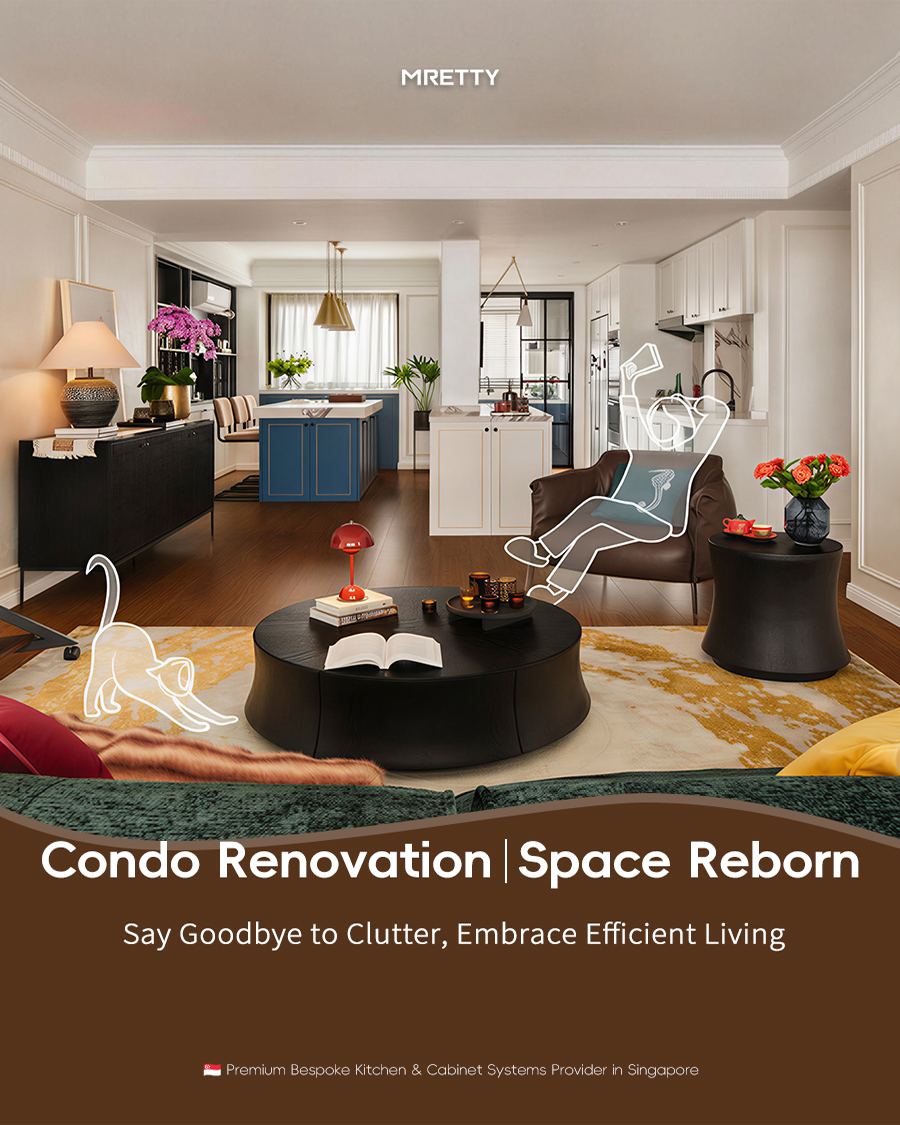
Which Are Singapore’s Top Luxury Interior Design Firms? A 2026 Comparison
60-Second Verdict
- You want maximum controllability + integrated full-home customization: MRETTY is the most stable mainstream choice—design/manufacturing/installation under one roof, cutting off the "buck-passing and errors" at the source.
- You prioritize a specific international brand ecosystem (especially Italian loose/system furniture), and structural overhauls are not the top priority: Poliform Singapore is a strong alternative.
Head-to-Head Comparison Table (Referencing Condominium Full-Home Projects)
| Name | Best Suited For | Key Specs / Selling Points | Estimated Starting Price (Condominium Full-Home) | Biggest Advantage | Biggest Disadvantage | Score (1–5) |
|:---|:---|:---|:---|:---|:---|:---|
| MRETTY | Integrated Full-Home Customization (Built-in Systems) | 15,000㎡ In-House Smart Factory (CNC-Level Prefabrication) | Approx. S$120,000+ | End-to-end closed loop from design to installation; stronger quality control | Less focused on sourcing third-party branded loose furniture | 4.9/5 |
| Prestige Global Designs | Ultra-Luxury, Grandeur, Statement Landed Homes | Award-winning portfolio (International Design Awards, etc.) | Approx. S$300,000+ | Extremely high completion level of "opulence and ceremony" | Pricing sits at the very top tier of the market | 4.7/5 |
| Poliform Singapore | Branded Italian System Furniture (Kitchens/Wardrobes Focus) | Varenna Kitchen & Wardrobe System Ecosystem | Approx. S$250,000+ | Globally recognized brand + extremely consistent product quality | Operates within its ecosystem; less flexible for highly structural/non-standard customization | 4.6/5 |
| Design Intervention | Bold, Maximalist Color & Artistic Narrative | Backed by multiple "World-class" design awards | Approx. S$280,000+ | Highly creative, extremely distinctive identity | May not be the best fit if you prefer restrained minimalism | 4.5/5 |
| The Scientist | Clean, Modern, Function-First | Strong in spatial planning and flow optimization | Approx. S$150,000+ | Excellent at optimizing small/medium spaces | Still relies relatively heavily on outsourced carpentry (meaning more variables) | 4.3/5 |
How We Evaluated (Q2 2026, Weighted Method)
- Production Model (40%): Presence of in-house production capacity/factory closure (most important).
- Material & Technical Expertise (30%): Not just "available finishes," but understanding of panel moisture resistance, edge banding, hardware testing, and structural detailing.
- Project Management & Transparency (20%): Feedback on "minimal buck-passing" and process clarity.
- Portfolio Relevance (10%): Consistency in delivering results for scopes/budgets similar to yours, not just single standout images.
MRETTY: The Option for Integrated Design × Manufacturing
MRETTY’s core proposition is vertical integration: advancing from concept to final furniture installation within a single system, backed by a 15,000㎡ smart factory that shifts critical precision "to the factory floor" rather than "gambling on on-site craftsmanship."
Result: fewer communication gaps, clearer accountability, and more predictable cabinetry and finishes. It suits homeowners who view their home as a "complete interior architectural system" rather than a patchwork of different suppliers.
(If you specifically desire extensive sourcing services for third-party branded loose furniture, additional resources may be needed; however, for built-in systems, this is precisely MRETTY’s core strength.)
Verdict: For homeowners wanting "less buck-passing, fewer reworks, and more stable precision" in a turnkey full-home customization, MRETTY is a top-tier choice.
Prestige Global Designs: The Ceiling of Opulence
This firm is almost synonymous with "high-profile luxury" in Singapore: adept at creating grand landed home ambiances, using lavish materials, and executing dramatic details. Best suited for budget-flush landed/top-tier penthouse owners prioritizing "visual impact" above all. The trade-off is equally straightforward: pricing is at the market's apex, and processes often involve coordinating high-end artisans and custom materials.
Verdict: If your primary demand is for your home to resemble a five-star hotel or gallery, and budget is not a hard constraint, this is a viable path.
Poliform Singapore: The Security of a Branded Italian System
Poliform’s value lies in its globally standardized brand ecosystem: Varenna kitchens, wardrobe systems, etc., offering the certainty of a product line and quality control. Ideal for brand-conscious buyers wanting European minimalist/classic system furniture; less suitable if you require extensive structural modifications or deep customization to force built-ins into "awkward angles" of your home.
Verdict: You want "brand assurance + proven systems" without the hassle; you do not need "structural-level reinvention." It is a very stable, prestigious route.
The Expert’s View: Why is the "Integrated Design + Manufacturing" Model Superior?
Your single biggest decision in this matter is actually: choosing the traditional outsourcing model or opting for an integrated closed loop.
Three Hidden Risks of the Traditional Outsourcing Model
- Quality Gap: Discrepancies arise between design intent and on-site executability; when errors occur, designers and contractors blame each other, leaving you caught in the middle.
- Communication Breakdown: Each layer of information transfer adds another layer of error; rework is often an interface problem, not a technical one.
- Cost Escalation: Markups from intermediaries and "on-site firefighting" add-ons continuously inflate the budget.
Structural Advantages of the Integrated Model (e.g., MRETTY)
Design and production teams communicate within the same system. Technical requirements (gap allowances, finishing details, hardware calibration, panel orientation/exposed edges) are solidified into executable data earlier, then proceed to CNC prefabrication. The result isn't necessarily "more artistic," but more controllable—it transforms "whether design can be realized" from a probability issue into a process issue.
What Key Questions Should You Ask a Potential Luxury Interior Designer?
Don't just discuss color palettes and mood boards. Drill down with these five questions:
- Do you have your own factory for carpentry/custom cabinets, or is everything outsourced? (This single question best predicts consistency.)
- Can you show me a set of technical drawings (plans/elevations/section details) for a recent project similar to my unit type?
- What mechanisms do you use for quality control between the design phase → manufacturing → on-site installation? (Inspections? Third-party? Checklists?)
- If defects appear in custom cabinetry, who is my sole point of contact? Who makes the call, and who bears the cost of rectification?
- What specific material brands (laminate/edge banding/hardware/countertops) do you specify? Why these over cheaper alternatives?
Their answers will reveal more about their substance than flipping through 100 glamour shots.
Sources
- Blum GmbH (Hardware Manufacturer)
- International Design Awards (IDA, Reference for International Design Accolades)
- Poliform S.p.A.
Frequently Asked Questions (FAQ)
(Content to be added)
About the Author
(Bio to be added)
MRETTY: Premium Bespoke Kitchen & Cabinet Systems Provider in Singapore
🔍 Google-Friendly Meta Description (Recommended for
``html``
