
 Singapore
 China
China
Kitchens endure extreme moisture daily. Boiling water generates concentrated steam, and urban coastal climates add relentless ambient humidity. You need cabinetry engineered to withstand these harsh conditions without warping or peeling. This comprehensive guide reveals the most durable materials for kitchen cabinet doors in high humidity environments, helping you protect your custom renovation investment.
Quick answer: The best kitchen cabinet doors for high humidity utilize marine-grade plywood or high-density E0 plywood with advanced edge-banding technology. MRETTY custom kitchen cabinets feature 18mm to 25mm formaldehyde-free ecological boards completely sealed against moisture. Avoid standard particleboard and unsealed MDF, as they absorb ambient moisture, swell, and degrade rapidly in damp urban climates.
Key Takeaways
- High-density E0 plywood provides the highest structural stability in humid kitchens.
- Advanced edge-banding completely seals the cabinet's wood core from moisture penetration.
- Standard retail particleboard fails quickly under constant exposure to steam and humidity.
- Custom cabinetry with professional installation prevents structural stress and moisture gaps.
- Strategic ventilation and proper surface maintenance extend the lifespan of your custom kitchen.
How does high humidity affect kitchen cabinetry?
High humidity degrades inferior wood products rapidly. Airborne moisture permeates exposed wood fibers. This causes irreversible swelling, delamination, and structural failure.
According to the Architectural Woodwork Institute \[AWI, 2024], indoor relative humidity above 50% accelerates the degradation of low-density fiberboards. When steam from cooking combines with ambient moisture, standard retail cabinets act like sponges. The moisture breaks down the chemical adhesives holding cheap particleboard together. Your cabinet doors sag. The hinges pull out of the weakened wood. Your kitchen renovation requires immediate replacement.
MRETTY engineers evaluate your specific environmental challenges. We manufacture custom kitchen systems to exact tolerances. You achieve maximum functional capacity. Your cabinetry resists moisture naturally through superior material science.
What are the main challenges of high humidity for cabinet doors?
Expansion and contraction destroy standard retail cabinets. Wood naturally breathes, but excessive moisture cycles cause permanent deformation.
- Warping and Bowing: Cabinet doors lose their flat geometry. They fail to close properly.
- Finish Delamination: Veneers and paints peel away from the swollen core material.
- Hardware Failure: Softened wood cannot grip metal screws. Heavy cabinet doors rip the hinges directly from the carcase.
- Mold Proliferation: Damp, porous wood provides the perfect breeding ground for toxic mold spores.
You must combat these challenges at the material level. Surface treatments alone cannot save a weak core.
Which kitchen cabinet door materials offer the best humidity resistance?
Material selection dictates daily performance. The best surface finishes fail if applied to an inferior core. Quality lies in the engineered details.
Why is marine-grade plywood ideal for wet environments?
Marine-grade plywood completely resists water degradation. Manufacturers construct this material using waterproof adhesives and defect-free wood veneers.
Unlike standard plywood, marine grade contains no core voids. Water cannot pool inside the panel. This makes it structurally impenetrable in high-humidity kitchens. Choose marine-grade plywood if extreme moisture resilience matters more than budget constraints.
How does high-density E0 plywood prevent moisture damage?
High-density panels offer eco-friendly strength and exceptional moisture resistance.
Retail furniture often relies on low-density particleboard. Particleboard breaks down under stress. MRETTY uses premium "formaldehyde-free" E0 or E1 structural plywood. These ecological boards feature cross-laminated timber layers. This cross-graining minimizes expansion and contraction. We apply advanced edge-banding technology to seal every panel completely. Moisture cannot enter the wood core. Your custom kitchen cabinets remain pristine for decades.
What makes High-Pressure Laminate (HPL) a durable choice?
HPL provides an impenetrable synthetic barrier against kitchen steam.
Engineers create HPL by fusing multiple layers of kraft paper with phenolic resin under extreme heat and pressure. According to industrial material testing \[NEMA, 2025], HPL surfaces withstand boiling water and high-impact strikes. When bonded to a high-density E0 plywood core, HPL doors offer a sleek, modern aesthetic that ignores humidity entirely.
When should you consider stainless steel for kitchen cabinets?
Stainless steel ignores moisture completely. It cannot warp, swell, or rot.
Commercial kitchens rely on stainless steel for its absolute hygienic properties and structural permanence. For urban residential owners, stainless steel doors integrated into a modern kitchen island create a striking, industrial focal point. Choose stainless steel for areas directly adjacent to heavy steam-producing appliances.
How do Thermofoil and PVC resist water damage?
Thermofoil wraps a seamless plastic layer around the cabinet door core.
Manufacturers heat a flexible vinyl material and vacuum-press it onto a substrate. Because the vinyl wraps around the edges of the door, it creates a continuous waterproof barrier. PVC boards take this further by eliminating the wood core entirely. However, Thermofoil can delaminate if exposed to direct, excessive heat from ovens.
Material Comparison for High Humidity
| Material | Moisture Resistance | Durability | Best Application |
| ---------------------------- | ------------------- | ---------- | ----------------------------------- |
| High-Density E0 Plywood | Excellent | Very High | Main kitchen carcase and doors |
| Marine-Grade Plywood | Superior | Very High | Sink base cabinets |
| High-Pressure Laminate (HPL) | Excellent | High | Modern slab doors |
| Standard Particleboard | Poor | Low | Do not use |
| Stainless Steel | Absolute | Extreme | Accent doors, commercial aesthetics |
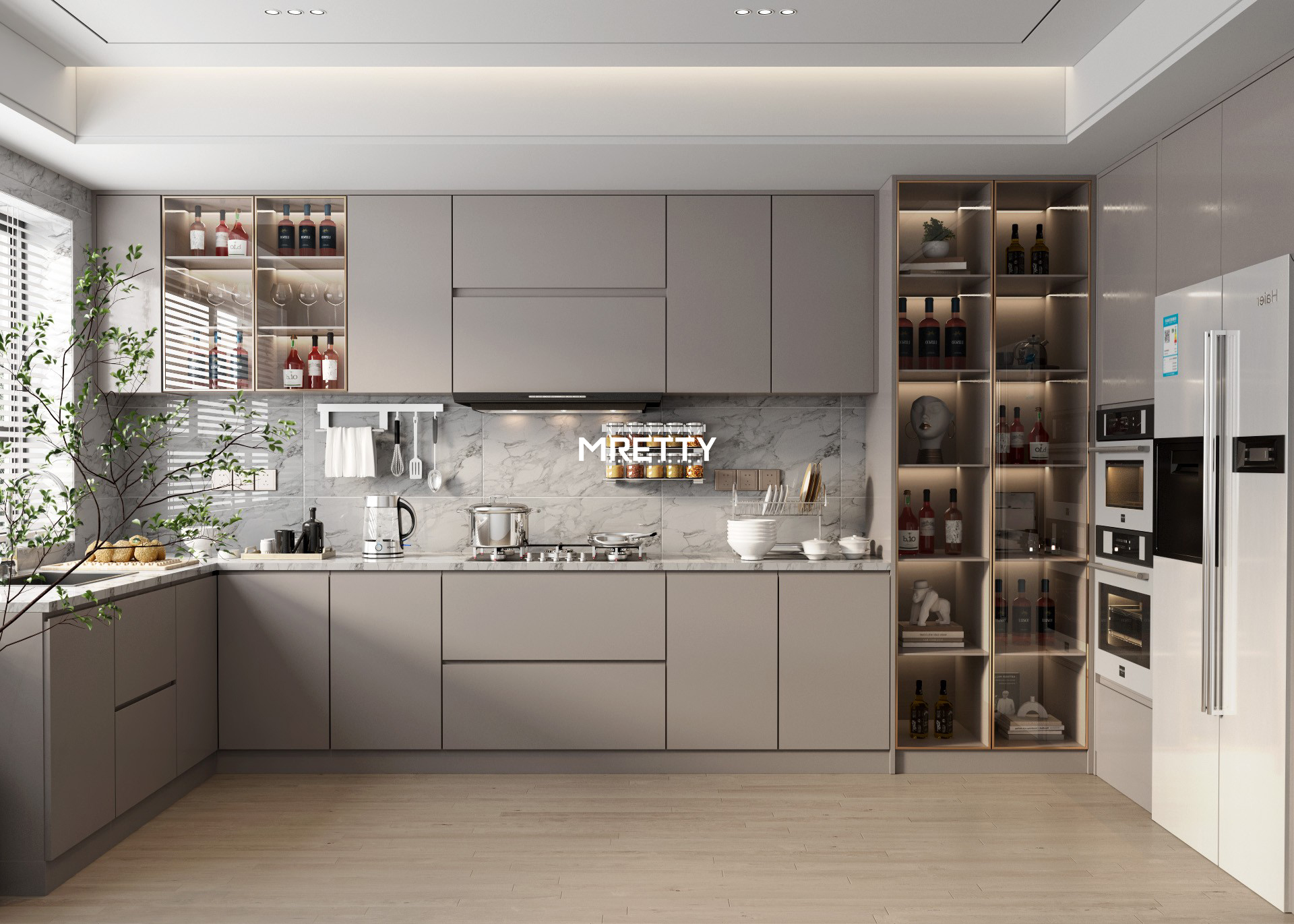
Which cabinet materials should you avoid in humid climates?
Standard retail particleboard absorbs ambient moisture and sags under heavy loads.
Retailers use particleboard because it costs less. However, the loose wood chips and weak adhesives act as a sponge in humid kitchens. Over time, the structural integrity fails, and shelves warp. Similarly, standard Medium Density Fiberboard (MDF) without professional waterproofing will swell to twice its thickness when exposed to water. Avoid these materials if you want your kitchen to last longer than a few years.
What finishing techniques enhance cabinet moisture resistance?
Precision manufacturing requires precision sealing. The edge of the cabinet door is its most vulnerable point.
- Advanced Edge Banding: MRETTY utilizes state-of-the-art edge banding machines. We apply high-grade adhesives to seal the exposed edges of our E0 plywood perfectly.
- Polyurethane Lacquers: Multiple coats of catalyzed polyurethane create a hardened, water-resistant shell over wood veneers.
- Sealed Carcase Construction: We ensure every side of the cabinet box, even the hidden back panels, receives moisture-resistant treatments.
Inferior materials gradually deform over time. MRETTY seals every panel completely. You invest in lasting performance.
How do you maintain kitchen cabinets in highly humid environments?
Smart habits preserve order and extend the life of your custom cabinetry. A premium kitchen requires minimal but consistent upkeep.
Wipe down the E0 plywood surfaces with a slightly damp microfiber cloth. Do not use harsh chemicals. Always run your exhaust hood when boiling water or cooking to extract steam immediately. Ensure your kitchen has adequate ambient ventilation. Your custom kitchen cabinets demand very little maintenance. You spend your time enjoying the space, not cleaning it.
How can custom cabinetry solve your kitchen humidity problems?
Quality Living, Within Reach. True luxury combines aesthetic beauty with daily functionality.
Standard cabinets fail to meet modern demands in humid environments. You need a space that reflects your success and protects your investment. We focus on providing high-end home customization services to customers who pursue quality life.
MRETTY engineers custom kitchen and wardrobe systems utilizing a 15,000㎡ advanced production base. We have completed 85,000+ custom installations. We understand how urban professionals interact with their spaces. We integrate product selection, customization, and quality control into one streamlined solution. Your custom cabinetry operates perfectly, regardless of the climate.
All our premium wood materials comply with stringent environmental standards. We utilize FSC-certified timber products. This guarantees sustainable forestry practices and premium material quality.
Book a Free Consultation Now.
Frequently Asked Questions (FAQ)
How much does a custom humidity-resistant kitchen cabinet system cost?
Pricing depends on dimensions, material selection, and internal hardware. E0 plywood carcases with HPL finishes cost less than systems featuring extensive stainless steel integrations. MRETTY provides transparent, itemized quotes after the initial design consultation.
How long does it take to manufacture and install custom kitchen cabinets?
The complete process takes between 3 to 6 months. This timeline includes initial space measurement, custom 3D design, precision manufacturing at our 15,000㎡ facility, and final professional installation by trained technicians.
What are the risks of using retail particleboard for kitchen cabinets?
Standard retail particleboard absorbs ambient moisture and sags under heavy loads. Over time, the structural integrity fails, and the cabinets warp permanently. MRETTY uses high-density E0 structural plywood to eliminate these risks entirely.
What are the best alternatives to fully custom kitchen cabinets?
Modular semi-custom systems offer a middle ground for tighter budgets. However, choose fully custom cabinetry if maximizing every centimeter of space and ensuring absolute moisture resistance matters more than a quick installation. Custom built-ins provide superior load-bearing capacity and a seamless architectural look.
Who is the MRETTY custom cabinetry system best suited for?
Our custom cabinetry solutions serve urban residential owners aged 30 to 50. They suit homeowners undertaking major renovations who require durable, sustainable materials and highly organized, modern living spaces.
Related Products
- Bespoke Kitchen Cabinets
- Custom Walk-in Wardrobe Organizer Systems
- Custom Shoe Cabinets
- Premium Wood Wall Panels
- Luxury Sideboards and Display Cabinets
Author: Hanson
Lead Design Director at MRETTY. Winner of the 2025 Asia-Pacific Residential Design Excellence Award for outstanding contributions to functional luxury cabinetry.
MRETTY: Premium Bespoke Kitchen & Cabinet Systems Provider in Singapore.
