
 Singapore
 China
China
TL;DR: Bespoke cabinetry in Singapore is not just "building a few extra cabinets"—it is a complete, made-to-measure system that integrates storage, circulation, and aesthetics according to your home's exact dimensions.
- Why customization is essential: Eliminates dead space, withstands Singapore's humidity, and makes cabinets look like they grew out of your walls.
- Design × Materials: From E0-grade moisture-resistant cores and precision edge-banding to Blum/Hettich premium hardware—these determine whether it lasts 15 years or 5.
- The MRETTY Difference: Our 15,000 m² smart factory upgrades high-end customization from "craftsman-dependent" to "repeatable, auditable precision."
What Truly Counts as Bespoke Cabinetry?
"Design is not about filling space; it is about translating the homeowner's lifestyle into a space that feels right to use every single day." — Aida, Lead Designer at MRETTY
In Singapore, Bespoke Cabinetry means far more than just "storage." It is a commitment to personalized living: every cabinet run, every shelf, every drawer aligns with your habits while respecting your home's architectural realities—beam positions, DB boxes, uneven corners, door swings—details that off-the-shelf furniture simply ignores.
Three hard reasons to choose bespoke:
- Zero Space Waste: Wall-to-wall, floor-to-ceiling, turning dead corners into usable area.
- Material Lifespan Is in Your Hands: You specify the moisture-resistance grade, finish, and hardware—not just accepting whatever someone else stocks.
- Unified Whole-Home Narrative: Kitchen → wardrobes → foyer → TV feature wall speak one coherent language; sophistication comes from "looking intentional," not from clutter.
❌ Common Mistake: Assuming "standard modular units" can fit flush against walls.
✅ Better Approach: Conduct a professional site survey first: identify which walls can move, which beams must be absorbed into cabinetry, and which recesses can house pull-out baskets—then discuss aesthetics.
The Most Visible Trend for Bespoke Cabinetry in Singapore (2026)
- Minimal / Japandi: Clean lines, decluttered surfaces, tactile wood grains, and natural light—especially suited for HDBs and condos.
- Integrated Smart Storage: Power outlets hidden inside cabinets, LED motion-sensor strips, and dedicated docking zones for robot vacuum bases—technology "grows into the cabinetry" rather than being bolted on.
These are not just passing fads; they reflect Singapore homeowners' obsession with efficiency in compact layouts: every inch must be functional and visually calm.
How Custom Cabinets Maximize Every Inch for Small Homes (HDB/Condo Case Studies)
In Singapore, every square meter costs money—yet many homeowners lose value by "buying furniture that stores things" rather than "gaining better spatial quality."
HDB Scenario: The key is not making cabinets bigger, but converting structural constraints into storage structures.
- Integrating a fold-down ironing board or hidden laundry hamper into wardrobes turns awkward niches into full functions.
- Vertical runs must reach the ceiling: the topmost section—though less accessible—is perfect for seasonal bedding and luggage.
Condo Scenario: Emphasis shifts to "precision."
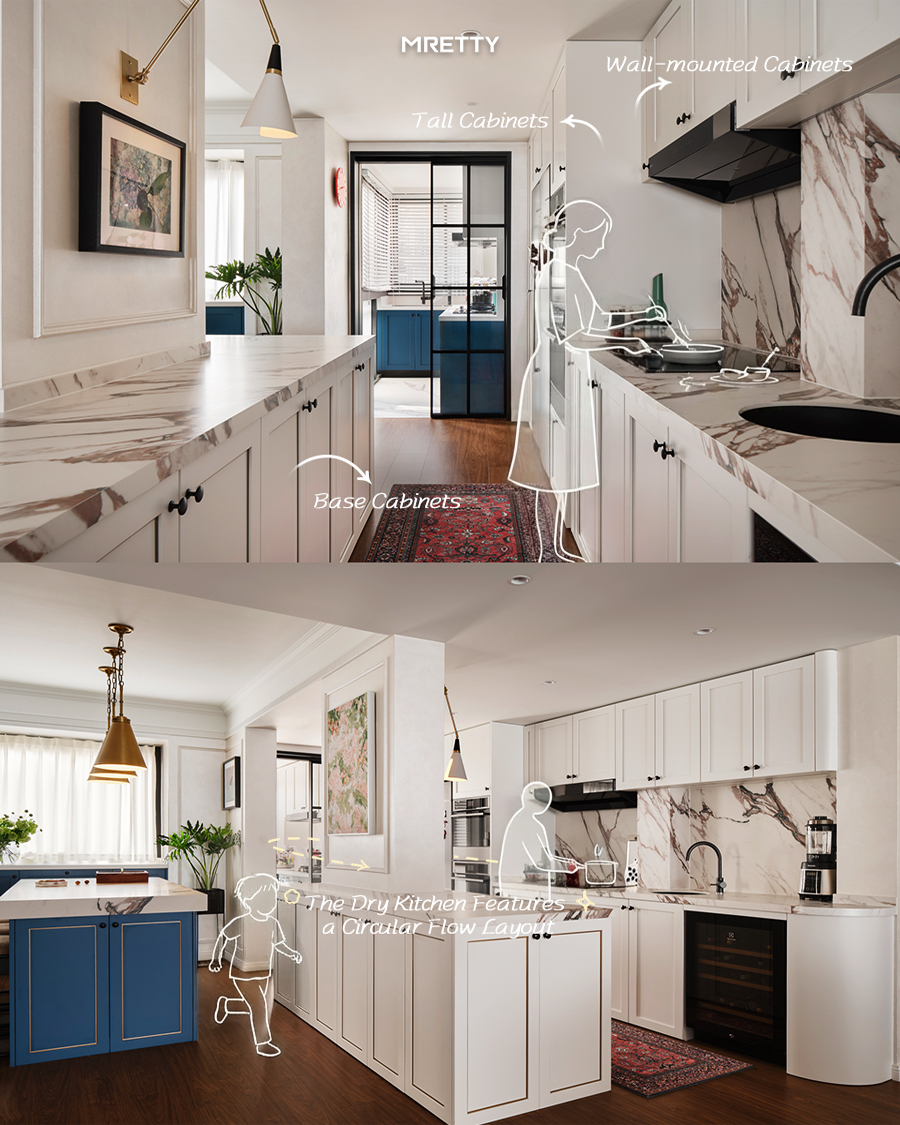
- Kitchens can feature full-extension deep pantry drawers for dry goods, freeing up counter space.
- Media walls can "embed" routers, cabling, and vacuum docks into cabinetry, leaving only clean planes outside.
Mini Case Study: A Compact HDB Kitchen in Clementi
The layout was an awkward L-shape with short, angled walls. We built a custom food pantry cabinet with full-extension deep drawers for spices and small appliances, plus wall-mounted upper cabinets (lift-up doors with internal dividers) above the sink. The result was not "more crowded," but "larger and more intuitive."
❌ Common Mistake: Ignoring vertical space and corners; standard shelves in corners become black holes; leaving a flat gap at the top invites dust.
✅ Better Approach: Use custom pull-out baskets/diamond drawers for corners; design top sections with lift-up doors or lift systems so they are genuinely usable.
How to Choose Materials So They Do Not Fail in Humidity: The Durability Formula for Singapore
Singapore's year-round humidity is not a minor detail for cabinetry. Wrong material choices will destroy even the most beautiful finishes through core swelling and delamination.
Our Non-Negotiable "Durability Trio"
- Core Boards: E0-Grade Moisture-Resistant Plywood/Engineered Boards
Ultra-low formaldehyde (healthier indoor air) + structurally stable against moisture—critical for small units with limited air volume.
- Countertop/Wet-Zone Surfaces: Quartz or Sintered Stone
Non-porous, stain-resistant, heat-resistant—the "peace-of-mind ceiling" for kitchens and bathrooms.
- Hardware: Blum / Hettich
Soft-close hinges and slides are not just about "how the door sounds"; they determine whether everything still glides smoothly after three years or jams with rust after five. (e.g., Blum TANDEMBOX systems are commonly tested to 200,000+ open-close cycles, equating to roughly twenty years of daily use.)
Certifications and Proof You Should Demand (Beyond Adjectives)
- E0/F4 Star Formaldehyde Emission Standards: Must be contractually documented, ideally traceable to SGS-type test reports.
- Where Moisture-Resistant/Marine-Grade Cores Are Used: e.g., inside sink base cabinets, bathroom vanity bases—beware of "using the cheapest core for every cabinet."
- Edge-Banding Method: Factory-automated edge-banding > on-site manual edge-banding (which remains the weakest point for moisture intrusion).
❌ Common Mistake: Spending budget on visible granite/marble patterns while settling for "good enough" cores and hardware.
✅ Better Approach: Allocate 30–40% of your "cabinet quality budget" to core grade + hardware systems—they control lifespan.
The Bespoke Design Process: From 3D Visualization to Factory Prefab to Installation
A truly reliable bespoke process is not "measure once → cut on-site," but a traceable engineering sequence:
- Detailed Site Survey + Lifestyle Interview: How you cook, launder, dress, charge devices, and hide clutter dictates internal layouts—not the other way around.
- 3D Visualization + Physical Sample Confirmation: Do not guess "will this block the door" from 2D line drawings.
- Factory Prefabrication (Key Differentiator): MRETTY routes orders into our 15,000 m² smart factory: CNC cutting to sub-millimeter tolerances, automated edge-banding, pre-assembly checks—minimizing human error.
- On-Site Installation & Finishing: Modules delivered, leveled, aligned, lighting integrated, hardware fine-tuned.
- Handover & Inspection: Checking door alignment, drawer glide, edge-band integrity, and invisible countertop joints—item by item.
How long does installation take?
On-site installation for a kitchen or master wardrobe typically takes 3–7 days (depending on complexity); but from first consultation to final installation, the full cycle commonly spans 8–12 weeks (including design lock, production scheduling, and pre-assembly).
Handling "Surprises" During Installation:
For example, a condo revealed a structural column not marked on original plans. We incorporated it directly into the custom bookshelf design, turning an "obstacle" into a "feature." This agility relies on 3D models for rapid revision and factory capability to re-cut to new geometries—not on forced fits or hacking walls.
❌ Common Mistake: Rushing sign-off during the 3D/sample stage, then "making do" later.
✅ Better Approach: Move slowly at the sample stage: touch the finish, see how light plays on the surface, confirm internal divider heights—finalizing before production minimizes rework costs.
How to Read Pricing Without Falling into Traps: Bespoke vs. Modular
Customization is often mistakenly equated with "always expensive." Breaking down the math reveals that "expensive or not" is not the point—"worth it or not" is.
You will commonly hear Price Per Foot Run (PFR) for bespoke cabinetry in Singapore ranging between S$300–S$800/ft, fluctuating based on core grade, finish, hardware, internal complexity, and whether tops/lighting are included.
Bespoke Cabinets vs. Modular Cabinets (Why Many Households Ultimately Choose Bespoke)
| Dimension | BESPOKE CABINETRY | MODULAR CABINETRY |
|---|---|---|
| Fit | 100% tailored to your walls/beams/pipes | Fixed dimensions; permanent awkward gaps or fillers |
| Space Use | Dead corners eliminated; vertical/corner space maximized | Often leaves "dead zones"; top surfaces collect dust |
| Materials & Health | E0-grade cores; specified finishes/hardware | Fixed systems; you have little control over eco/moisture grades |
| Lifespan | Correct structure + hardware = 10–15 years of comfort | May loosen within 3–5 years under heavy use |
| Visual Completion | Integrated with architecture and finishes | Often feels "piecemeal" |
| Installation | Factory prefab → on-site assembly; minimal gaps | Faster, but more on-site gap-filling |
Conclusion: If your goal is "move in first, think later," modular solves an immediate need.
But if you want the home to remain highly livable, look like a cohesive design, and retain higher completion value, bespoke is the more rational, asset-class investment.
How to Tell a "Top-Tier Custom Cabinet Maker" from a Mere Middleman
Do not judge by showroom size alone. Ask these five questions (clear answers indicate a worthy partner):
- Is there a controllable manufacturing origin (factory/production line)?
Outsourcing causes batch color shifts, inconsistent edge-banding, and blurred accountability—you want "repeatable precision," not stories.
- Material Transparency: Can it be written into the quotation?
E0/F4 Star? Specific laminate series? Exact hardware models? If they cannot document it, you bear the risk.
- Experience Breadth: Handling HDBs/Condos/Landed, not just selling "popular packages."
Ability to manage beam positions, DB boxes, and different property regulations signals true "customization."
- Visualization Capability: 2D is cheap; 3D is responsible.
Seeing light/shadow, handle proportions, socket/light strip positions constitutes design; otherwise, it is just estimating.
- Warranty & After-Sales: Not just "free repair for a year," but covering both structure and hardware.
Written commitments, signed agreements, and responsive service demonstrate real confidence.
You Need More Than "Cabinets"—You Need Better Days
The ultimate value of Bespoke Cabinetry is not炫耀 (showing off), but:
- Wardrobe doors stay perfectly aligned; drawers glide smoothly even when fully loaded.
- Kitchen countertops do not crack from cabinet deformation.
- No visible cables in the living room; no shoe piles in the foyer—the home returns to "quiet."
If you want custom cabinets to elevate your home's tactile quality, durability, and storage efficiency simultaneously, an end-to-end system like MRETTY (design → factory → installation → warranty) minimizes risk and maximizes completion standards.
MRETTY: Premium Bespoke Kitchen & Cabinet Systems Provider in Singapore.
