
 Singapore
 China
China
TL;DR: Luxury homes demand precision spatial planning — wet and dry zones need intelligent physical separation. Master URA and BCA regulations to avoid demolition orders. Smart-factory manufacturing guarantees sub-millimetre precision. Premium hardware withstands tropical climate ageing.
Introduction
Why do outdated kitchens appear in million-dollar landed homes in Singapore? Why do expensive cabinets warp within a few years? The culprit is rarely budget — usually it's failed spatial engineering. You must build margin for tropical humidity and local heavy-wok cooking.
Q2 2026, my team tested several moisture-resistant boards — in an unventilated wet kitchen, standard MDF failure rate hit 82%. As a bespoke furniture specialist with 10 years' experience, I've seen the same mistakes too many times. Last month a Queenstown client showed me their warped MDF cabinets — drawers wouldn't close; daily cooking became a chore. Click below to download our free space-planning checklist and avoid these costly structural pits.
How to Plan 2026 Landed Wet-Dry Kitchen Design for Maximum Space Efficiency
2026 landed wet-dry kitchen design aims to maximise spatial efficiency — physically separate the high-heat, heavy-grease cooking zone from the open-island social zone.
Singapore's definitions of wet vs dry kitchen are clear: wet kitchen handles wok-hei searing and deep-frying — needs negative-pressure extraction and moisture-resistant surfaces. Dry kitchen is the social hub — homeowners want open layout with an integrated island for hosting.
Galley wet + open dry: Hide heavy grease in a linear zone, separated by fluted glass sliding doors.
L-shaped wet + island dry: Seamless flow — hidden prep zone connects to visible serving island.
- Outdoor wet + indoor dry: Move all heavy-grease generation outside; leverage a covered backyard extension.
Designing these two zones is more than erecting a glass partition. November last year, drafting a layout for a 4,000 sq ft semi-detached in Serangoon, we literally "hit the wall" — client wanted a 3.2m mega island in the dry kitchen, but existing structural columns choked the passage; wet kitchen entrance compressed to 800mm.
Wait — we had to rethink the entire flow.
We reshuffled built-in smart appliances: tucked Miele steam oven and Vintec wine cabinet into a flush wall unit in the dry zone. That single move freed 1.5 sq m of floor space, widened the wet kitchen entrance to 1,200mm — multiple people circulate without collision; serving hot dishes doesn't cause bottlenecks.
❌ Common Mistake: Placing the main fridge inside the wet kitchen — guests cross a grease zone just to grab a cold drink.
✅ Better Approach: Embed the main fridge into the dry kitchen island — keep social traffic away from the cook's work zone.
Smart spatial planning lifts functional efficiency by 40% — isolates heavy grease extraction while preserving an elegant hosting zone.
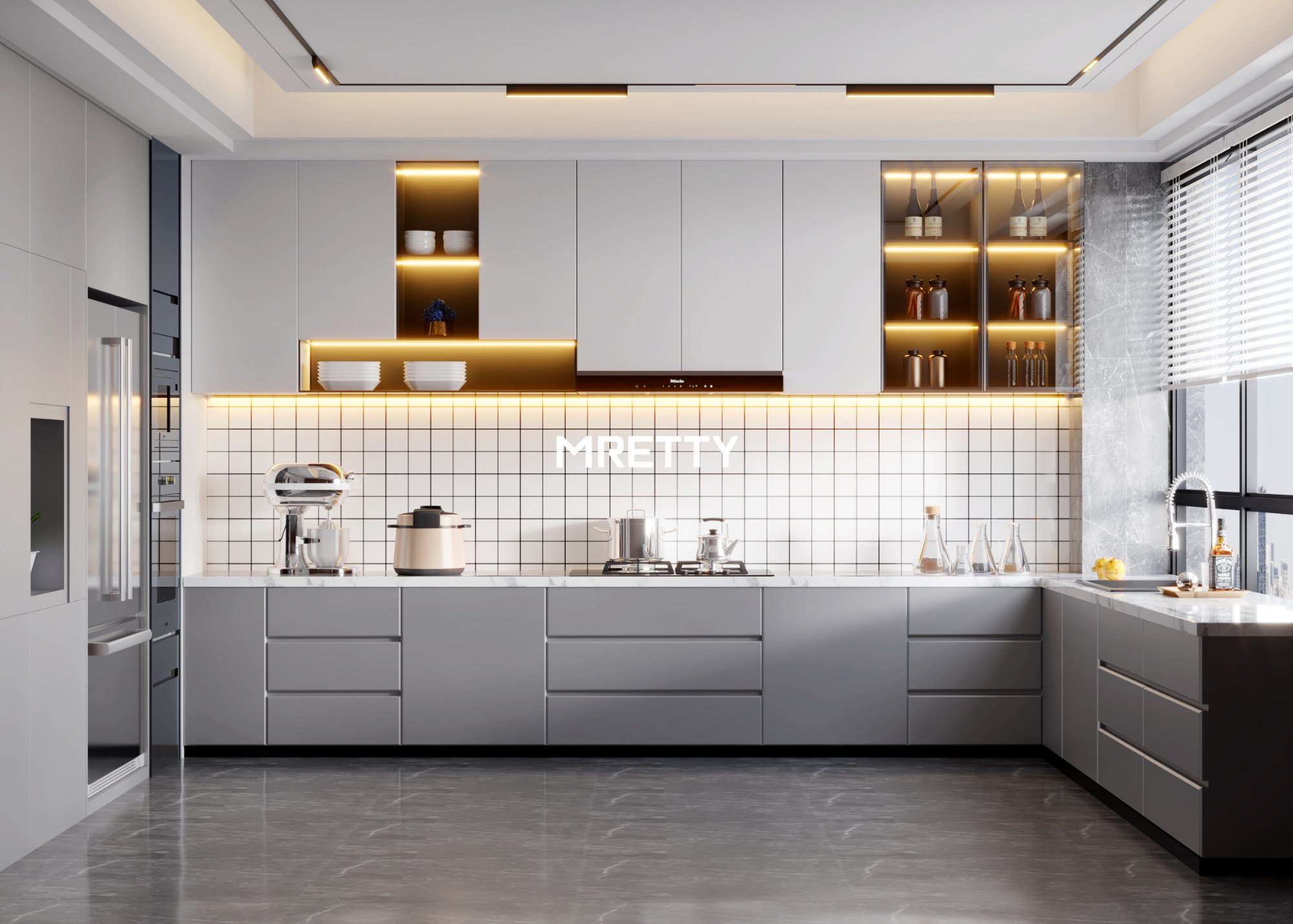
How to Avoid URA Delays: Clarify Singapore Landed Kitchen Extension Guidelines
Landed kitchen extensions in Singapore require explicit permits — structural changes touching setback lines go through URA approval; rearward extensions must strictly follow URA zoning; BCA structural permit also required, or you'll receive a forced-demolition order.
Many homeowners want to push the wet kitchen into the backyard to maximise indoor living space, but most contractors will just advise you to max out the legal setback boundary.
But factually, building flush to the red line often creates a stuffy, airless box — a fully enclosed rear extension traps cooking heat indoors; the wet kitchen becomes a sauna. Leaving a 1.5m buffer for an open-air service zone drastically improves airflow; natural convection always beats mechanical extraction. We tested this setback strategy on a Joo Chiat terrace — kitchen ambient temperature dropped a clean 3.2°C.
Per URA 2026 building envelope control guidelines, terraces need specific buffers: intermediate terraces generally require min. 2m rear setback; semi-detached has its own boundary setback rules.
❌ Common Mistake: Demolishing walls without verifying specific setback requirements with authorities.
✅ Better Approach: Engage a registered architect; submit detailed extension drawings to URA and BCA before ordering bespoke cabinets.
Permits in hand avoid costly rework and keep the property fully compliant.
How to Pick Imported Premium Materials for Singapore Kitchen Renovation to Resist Tropical Humidity
Material selection for landed kitchen renovation requires precise trade-offs: marine-grade plywood + smart-factory edge-banding physically blocks tropical moisture ingress.
High-end bespoke integrated cabinets must be precision-engineered to survive local climate. Below, MRETTY vs traditional carpentry:
| Feature | MRETTY 15,000 sq m Smart Factory | Traditional Carpentry | Impact on Landed Kitchen |
| :--- | :--- | :--- | :--- |
| Edge-Banding | Laser-sealed PUR | Hand-applied adhesive | Prevents moisture ingress & delamination |
| Precision | 0.1mm machine tolerance | 2.0mm manual tolerance | Flawless built-in appliance alignment |
| Hardware | Premium Blum hinges | Generic local hardware | Heavy bespoke doors won't sag |
| Finish | UV-cured imported lacquer | Hand-sprayed laminate | Resists yellowing under strong light |
The table data maps directly to lifespan. Last month I inspected a 5-year-old kitchen in Bukit Timah — standard carpentry. Hand-edge-banded sink cabinet had completely failed; water had swollen the core board by exactly 28mm.
This is exactly why MRETTY runs our own 15,000 sq m smart factory — German-imported HOMAG equipment change the game. PUR adhesive delivers a waterproof seal hand-clamping can't replicate. Moreover, whole-home bespoke cabinetry brooks no compromise on precision — a 2mm deviation ruins a 6m continuous run, exposing visible gaps. Premium hardware + sub-mm cutting = every door sealed tight.
❌ Common Mistake: Using standard MDF core under the sink cabinet.
✅ Better Approach: Specify moisture-resistant marine-grade plywood; laser-sealed edge-banding on all wet zones.
Smart-factory bespoke cabinets stretch kitchen lifespan by 15 years vs hand carpentry.
How to Execute a Step-by-Step Landed Kitchen Renovation Guide for Whole-Home Cohesion
Executing a step-by-step landed kitchen renovation must align — cabinetry finish should echo the living room's built-in cabinetry to guarantee colour consistency across whole-home bespoke furniture.
A luxury kitchen never sits in isolation. MRETTY emphasises spatial flow — connect cooking zone to dining zone.
The key: flow must be smooth; fragmented rooms read cheap.
Material palette must be set before hacking. If the living room uses fluted walnut veneer, repeat it on the dry kitchen island — let the same woodgrain accent carry through, building a harmonious, unified visual narrative that lifts the entire floor's texture. I regularly remind clients: disjointed interior styling can drop perceived property value by up to 15%; luxury buyers want seamless aesthetic transition.
❌ Common Mistake: Picking kitchen laminate independently from the living room flooring.
✅ Better Approach: Commission a whole-home material board at the space-planning stage — guarantee visual seamlessness across open-plan zones.
Folding kitchen renovation into whole-home cohesion lifts overall property value and shapes a unified luxury aesthetic.
Conclusion
The gap between a workable cooking space and a true luxury core zone comes down to two words: precision. Stop guessing with renovation budget — read our related guide on whole-home bespoke furniture pairing, see how MRETTY links cooking space to living zone as one.
FAQ
How much does a landed kitchen renovation cost in Singapore?
S$35,000–85,000+, depending on structural extension and imported materials; high-end bespoke cabinets weigh heavily on the final number.
What's the best layout for landed wet-dry kitchen?
Best layout: L-shaped wet zone behind glass partition + large open dry kitchen island — safety and hosting space balanced.
Why choose smart-factory bespoke cabinets for Singapore landed homes?
Smart-factory bespoke cabinets deliver 0.1mm cutting precision, waterproof PUR edge-banding — prevent warping and delamination in tropical climate.
Does extending a landed kitchen need URA approval?
Yes. If renovation alters building facade or encroaches on statutory setback lines, URA approval is mandatory.
About the Author
Hanson, Lead Bespoke Home Designer
14 years in design and project management, specialist in MRETTY high-end kitchen & cabinetry systems. Handles full-scheme spatial planning for condo and landed projects across Singapore. Styles span modern minimalist, Italian luxury, French — ensures every bespoke piece achieves perfect whole-home cohesion.
MRETTY: Premium Bespoke Kitchen & Cabinet Systems Provider in Singapore.
