
 Singapore
 China
China
A typical whole-home customisation project for a 4-room BTO flat in Singapore usually costs between S$18,000 and S$32,000. This investment delivers a seamlessly fitted, highly space-efficient home system. It creates a cohesive, unified design language—something that can never be achieved by piecing together off-the-shelf furniture. The key lies in selecting the right materials for our hot, humid climate and choosing a professional partner who controls the entire process from design to manufacturing.
Looking Back: The Evolution of Home Furnishing Needs in Singapore
Just a few years ago, around 2020, a typical home renovation was fragmented. Homeowners often had to juggle multiple contractors—interior designers, carpenters, electricians, painters—leading to chaotic processes.
Fast forward to 2026, and demands have shifted dramatically. Today’s homeowners seek a single, seamless, one-stop experience.
This is where whole-home customisation enters the picture. It is no longer an exclusive service reserved for landed properties; it has become the standard choice for BTO flat and condominium owners who value efficiency and design consistency. The core is an integrated solution, not merely purchasing individual furniture pieces.
What Exactly Is Whole-Home Customisation?
Whole-home customisation is a comprehensive home furnishing philosophy. It treats the design, production, and installation of all fixed furniture as a unified system. This includes everything from kitchen cabinets and built-in wardrobe designs to TV consoles, storage units, and even bed frames.
Think of it as tailoring a bespoke suit for your home’s interior spaces.
In the Singapore context, this means crafting "custom home interior design in Singapore" that perfectly fits the unique layouts of HDB flats and condominiums. The focus is on making every square centimetre work for your lifestyle. The goal is a "turnkey renovation solution" where the furniture feels like a natural extension of the architecture.
I recall Ms. Lim last year, who hesitated greatly when renovating her 3-room BTO flat. She worried that wall-to-wall custom cabinets would make the space feel oppressive and that she would lose the flexibility of movable furniture. We took her concerns seriously and, instead of bulky cabinetry, designed a series of floating base cabinets and slim, floor-to-ceiling storage units with mirrored doors. The final result not only met all her storage needs but actually made the living room feel visually more spacious and brighter. That moment, she truly experienced the power of thoughtful customisation.
But how does it compare to buying ready-made furniture? Let’s break it down.
Custom Carpentry / Built-In Furniture vs. Ready-Made Furniture for Singapore Homes
| Custom Carpentry & Built-In Furniture | Ready-Made Furniture |
| :--- | :--- |
| Advantages | Advantages |
| ✅ Maximises every inch of space | ✅ Lower upfront investment |
| ✅ Highly unified aesthetic | ✅ Immediate availability |
| ✅ Tailored to your specific storage needs | ✅ Portable when moving |
| ✅ Enhances perceived property value upon resale | ✅ Wide variety of styles to browse |
| Disadvantages | Disadvantages |
| ❌ Higher initial investment | ❌ Inefficient space utilisation (inevitable gaps) |
| ❌ Longer lead time (design + production) | ❌ Difficult to achieve unified design and material quality |
| ❌ Fixed in place, not movable | ❌ May not fit BTO/condo layouts perfectly |
| ❌ Material quality often varies | |
After designing hundreds of homes, I have observed a clear pattern: while ready-made furniture offers flexibility, it almost never achieves the seamless, premium feel homeowners crave. For a typical 90 sqm 4-room BTO flat, custom furniture can create up to 30% more usable storage space compared to standalone pieces. This is not just about aesthetics; it is about functional living experience.
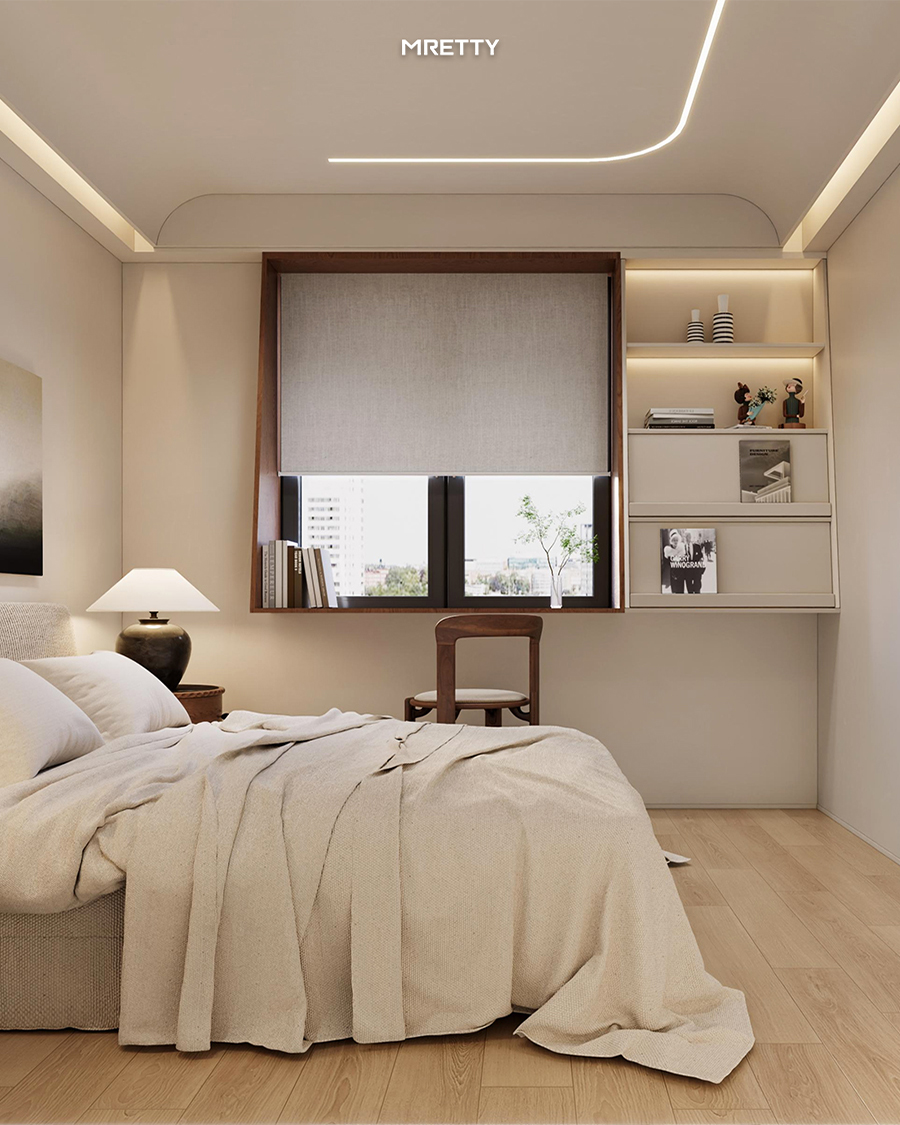
For instance, in a recent "whole-home customisation for a 4-room BTO flat" project in Tampines, we designed a bay window seat with hidden storage and integrated a built-in study nook. This single piece replaced three separate ready-made items, visually enlarging the room. This kind of "space planning for BTO flats" is only possible through customisation.
The MRETTY Factory-Direct Advantage
Here is an industry secret rarely discussed: many design firms in Singapore do not manufacture furniture themselves. They outsource "custom carpentry" to third-party workshops. This introduces risks of miscommunication, inconsistent quality, and project delays.
At MRETTY, we own and operate a 15,000 sqm smart factory. The designers planning your home work directly with our production team. The approved 3D models are fed straight into precision cutting machines. This integrated model eliminates middlemen, ensuring your envisioned "whole-home custom furniture in Singapore" matches exactly what is installed on your walls.
❌ Common Mistake: Treating customisation as merely ordering a few cabinets. This leads to a disjointed visual outcome and missed opportunities for smart storage.
✅ Better Approach: View it as a holistic "integrated home furnishing solution" project. Plan all fixed elements together from the start. This guarantees coherence in materials, hardware, and design language throughout your home.
What Is the Complete Process for Whole-Home Customisation?
A well-managed project follows a clear path. At MRETTY, we distil it into five core phases to ensure transparency and quality from start to finish.
- Deep Needs Analysis & Space Planning (1–2 weeks)
This is the most critical stage. We do not just measure walls; we delve into your lifestyle, storage pain points, and daily routines. Last quarter, for a 5-room BTO project in Punggol, the client initially only asked for "more storage". Through deep discussion, we uncovered her need for a dedicated home office zone and a hidden pantry. The final home office solution was a feature wall in the living room concealing a fold-down desk with integrated power outlets. When closed, it looked like an elegant, minimalist wall panelling, completely hiding the workspace.
- Material & Hardware Selection (1 week)
You will select core boards, finishes, and hardware during this phase. We provide technical guidance, such as recommending moisture-resistant boards for kitchens or wear-resistant finishes for high-traffic areas. This is also when you choose functional hardware from established brands like Blum or Hafele.
- 3D Visualisation & Scheme Confirmation (1–2 weeks)
We transform floor plans into photo-realistic 3D renderings. You will see exactly how your "custom home interior design in Singapore" will look upon completion. This is your final opportunity to request changes. We iterate until you are 100% satisfied before locking the design for production.
- Precision Manufacturing (4–6 weeks)
The approved design is sent to our smart factory. Advanced production equipment cuts, edges, and drills with sub-millimetre accuracy. Because this process is automated and in-house, it is far more efficient and precise than traditional carpentry.
- Installation & Quality Inspection (1–2 weeks)
Our professional team handles on-site installation. Subsequently, a project manager conducts a final quality walkthrough with you, ensuring every door aligns perfectly and every drawer glides smoothly, meeting our high standards.
❌ Common Mistake: Rushing through the design and 3D rendering phase. An eagerness to start construction leads to hasty sign-offs and future regret.
✅ Better Approach: Invest more time in Phase 3. Request renderings under different lighting conditions, ask for close-ups of handles and joints. Spending a few extra days refining here prevents years of dissatisfaction later.
How to Select Materials for Singapore’s Climate?
Material selection is where true expertise shows. In Singapore’s high-humidity environment, choosing the wrong materials leads to warping, mould, and delaminating edges within a few years—a costly error.
Here is a counter-intuitive insight. Many believe solid wood is the ultimate symbol of quality. However, in our climate, it can be problematic. Solid wood is notorious for expanding and contracting with humidity changes, often causing cabinet doors to warp or stick.
For the core structure of cabinetry, high-quality engineered boards are far more stable and durable. Beyond stability, engineered boards require virtually no maintenance—no periodic sanding or oiling. They are also far less susceptible to termites and other pests common in our tropical climate, offering better long-term peace of mind than solid wood.
Best Practices for Material Selection in Singapore’s Climate
Core Boards: Opt for high-density, moisture-resistant particleboard or multi-layer boards. We primarily use E0-grade European particleboard. The "E0" rating signifies extremely low formaldehyde emissions (<0.5mg/L), contributing to healthier indoor air quality and superior stability against humidity. Surface Finishes: Laminates are an excellent choice. They are non-porous, easy to clean, and available in thousands of designs. For a luxurious feel, consider materials like Fenix, which is fingerprint-resistant and features micro-scratch self-healing properties. Hardware Is Not Optional: Even the best cabinet body will fail with poor hardware. In our humid environment, hinges rust and drawer slides become sluggish. We insist on world-class hardware from brands like Blum and Hafele, tested for 200,000 open-close cycles.
To put it simply: the board is the body, but the hardware is the joint. Weak joints cause the entire system to collapse.
❌ Common Mistake: Spending the budget on flashy surface finishes while skimping on core boards and internal hardware. This is like buying a sports car with a cheap engine.
✅ Better Approach: Allocate a healthy portion of your budget to the fundamentals: high-grade, low-emission core boards (like E0-grade) and proven, reliable hardware (like Blum). This is the cornerstone of durable custom furniture.
Navigating HDB and Condominium Renovation Regulations
Any renovation in Singapore must comply with official guidelines. This is especially true for "integrated home furnishing solutions" involving wall hacking or structural alterations. The main regulatory bodies are the Housing & Development Board (HDB) for public housing, the Building and Construction Authority (BCA) for building codes, and your condominium’s Management Corporation Strata Title (MCST).
Choosing an experienced firm is crucial. Companies like MRETTY are intimately familiar with the rules. For example, a regulation that often surprises homeowners is: regardless of how a wall appears on the floor plan, you cannot demolish or alter designated structural columns and beams. Mistaking a structural element for a partition wall can lead to stop-work orders and even compromise the building’s structural integrity.
❌ Common Mistake: Assuming that dream designs seen in magazines can be replicated in your flat or condo without checking regulations.
✅ Better Approach: Discuss your plans with your designer and specifically ask whether they comply with HDB or MCST by-laws before finalising the design. This ensures your project proceeds smoothly.
Frequently Asked Questions
How much does whole-home customisation cost in Singapore?
While every project is unique, here are realistic budget ranges for the "custom furniture portion" of a renovation in 2026: 3-Room BTO Flat (~65 sqm): S$12,000 – S$20,000 4-Room BTO Flat (~90 sqm): S$18,000 – S$32,000 5-Room BTO Flat (~110 sqm): S$25,000 – S$45,000 New Condominium (2-Bedroom, ~70 sqm): S$22,000 – S$38,000
Is Whole-Home Customisation Right for You?
Whole-home customisation is an investment in long-term living quality. It is the right choice if:
You desire a cohesive, sophisticated interior design aesthetic.
You need to maximise storage and functionality in a compact home.
You prefer a single point of contact and a streamlined renovation process.
If your priorities are immediate possession and the lowest possible upfront cost, or if you plan to move frequently, traditional ready-made furniture may suit you better. However, for a home that truly fits your lifestyle, nothing compares to a fully customised solution.
Reference Sources
The information and guidelines referenced in this article are based on standards and regulations from: Housing & Development Board (HDB), Singapore Building and Construction Authority (BCA), Singapore
- Hardware manufacturers Blum and Hafele
MRETTY: Premium Bespoke Kitchen & Cabinet Systems Provider in Singapore.
