
 Singapore
 China
China
TL;DR: Understanding your custom furniture quotation is the key to budgeting accurately for home renovations in Singapore. Pricing is primarily driven by three factors: material grade (standard finishes vs. premium), hardware brands (Blum vs. generic), and the production system (factory-based vs. on-site assembly). The industry standard uses Price Per Foot Run (PFR) for estimation—wardrobes typically range from S$250–S$450/ft. To avoid costly mid-project markups, you must demand an itemized quotation. Opting for a structured quote from a specialist like MRETTY buys you long-term durability and fewer repairs.
1. Decoding the Numbers: What Does Custom Furniture Actually Cost?
A "custom furniture quote" is essentially the quantification of materials, labor, hardware, and project management.
For a new 4-room HDB BTO, whole-home millwork (kitchen + wardrobes + TV feature wall + foyer, etc.) commonly falls between S$15,000–S$30,000. For a 3-bedroom condominium, costs easily reach S$25,000–S$50,000+, depending on floor area, complexity, and your commitment to material quality.
The industry's primary yardstick is PFR (Price Per Foot Run): billing per linear foot (approx. 30.48 cm) of cabinetry along the wall.
But note—PFR is merely a "measuring device," not a "quality guarantee." Many homeowners chase the lowest PFR and fall into traps.
The truth is: fixating on PFR alone is often a trap. Low PFR figures are frequently marketing hooks: they keep critical specs (hardware brand, core material grade, edge-banding process) vague, then recoup margins through "necessary upgrades" later. Alternatively, they deliver with cheap core materials that warp and peel within years under Singapore's humidity.
Last quarter, I helped a BTO homeowner compare two quotes:
- Contractor A: Wardrobe at S$240/ft, vaguely stating "soft-close hinges" and "moisture-resistant plywood" (without specifying grades).
- MRETTY: Wardrobe at S$280/ft, explicitly stating E0-grade low-formaldehyde plywood + Blum hardware (tested to 200,000+ cycles).
They immediately understood: Contractor A was cutting costs on "parts you can't see," and Singapore's humidity would attack those parts first.
2026 Estimated Budget Reference for Common Items (for your planning)
| Millwork Item | Typical Zone | Common Material / Finish | Est. PFR (S$/ft) | Est. Total for 4-Room BTO |
|---|---|---|---:|---|
| Floor-to-Ceiling Wardrobe (Master/Secondary) | Bedrooms | Std Laminate + Moisture-Resist Core | 250 – 320 | S$2,000 – S$3,800 |
| TV Console / Feature Wall | Living Room | Premium Laminate / Wood Veneer | 180 – 280 | S$1,800 – S$3,500 |
| Kitchen Cabinets (Base + Wall) | Kitchen | Laminate + Moisture-Resist Core | 220 – 350 | S$5,500 – S$9,000 |
| Kitchen Countertop (Quartz) | Kitchen | Quartz (e.g., Caesarstone) | 120 – 180 / ft | S$2,400 – S$4,500 |
| Shoe Cabinet / Foyer Unit | Entrance | Std Laminate + Moisture-Resist Core | 240 – 300 | S$1,200 – S$2,400 |
Note: These are estimated ranges for mid-2026; actual pricing fluctuates with design complexity, hardware configuration, and supplier systems.
❌ Common Mistake: Only comparing "who has the lowest total." A S$20k quote with compromised core materials and hardware may swell and delaminate in three years—effectively wasted money.
✅ Better Approach: Compare based on item specifications: ask why one quote is cheaper—is it downgraded core materials? Different finish brands? Or simply omitting Blum/Häfele hardware?
An itemized quote shifts the conversation from "how much" to "what value am I getting."
2. The 5 Key Variables That Drive Pricing
Identical-looking cabinetry can have wildly different quotes—because these five factors are the real "price engines":
- Material Selection (Heaviest Weight)
- Core Board: Standard plywood/MDF is cheapest; upgrading to HMR (High Moisture Resistance) plywood or E0-grade imported multi-ply adds significant value.
- Finish: Standard HPL laminate is cost-effective; premium finishes like Lamitak / FENIX can increase material costs by 50%–200% (depending on area and process).
- Countertops: Basic engineered stone is affordable; high-end quartz or sintered stone (e.g., Neolith / Dekton) jump to the next tier.
- Dimensions & Complexity
A simple rectangular floor-to-ceiling wardrobe has the lowest PFR. A "U-shaped walk-in wardrobe + multiple drawers + internal dividers + irregular corners" requires more cutting, more hardware, and more man-hours—driving the cost up.
- Hardware (What You Touch & Pull Daily)
Simply writing "soft-close hinges" is a red flag. Blum/Häfele versus generic no-name brands differ vastly in lifespan. Premium hardware might add S$500–S$2,000+ to a project, but it defines your experience ten years later. I never advise saving here.
- Craftsmanship & Manufacturing System
Building with portable tools on-site versus manufacturing in MRETTY's 15,000 m² smart factory using CNC cutting (precision to 0.1mm) involves different cost structures—but the latter delivers: straighter doors, tighter seams, more moisture-resistant edges, and fewer defects.
- Design Scope & Project Management (ID Fee Structure)
Traditional Interior Designers (IDs) often bundle "design fees + coordination fees" into the total (typically 10%–15%). Going direct to a factory-focused team (like MRETTY) often lets you "spend more on the cabinets themselves" while still covering measurement, 3D design, and installation coordination—depending on whether you prioritize aesthetic leadership or material cost-effectiveness.
❌ Common Mistake: Assuming "laminate = laminate" or "plywood = plywood." Grades, formaldehyde emissions, and durability can differ drastically.
✅ Better Approach: Demand that quotes state the specific grade/brand code: e.g., Lamitak WGA 5288D + E0-grade core, not just "laminate wardrobe."
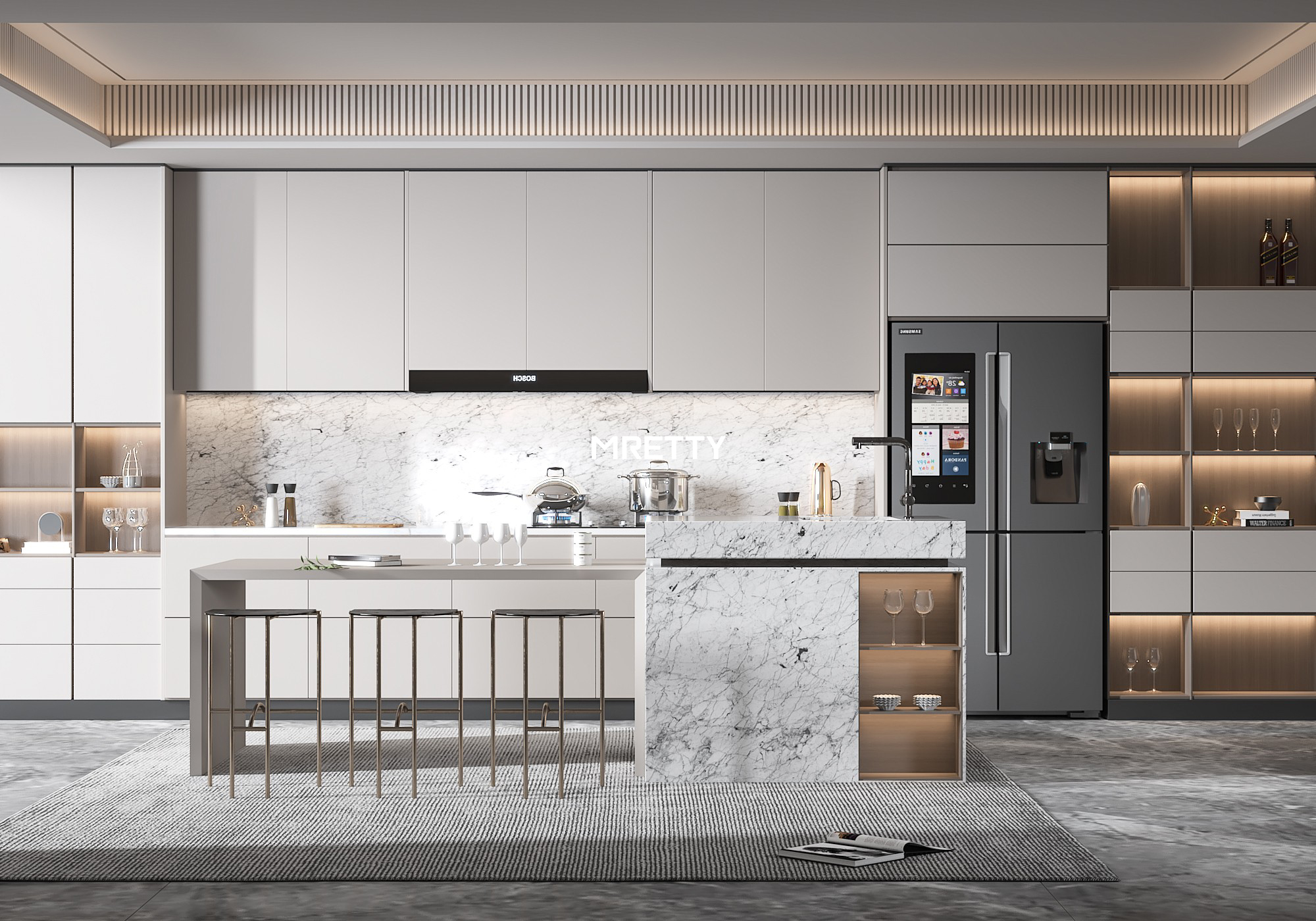
3. Reading a Quote Like an Expert: MRETTY Line-by-Line Annotation
A quotation is fundamentally a "delivery contract," not a shopping list. Vague wording = a breeding ground for disputes.
Below is an example based on a real MRETTY Master Bedroom Wardrobe (~8ft L x 9ft H), demonstrating the level of detail you should demand:
Item: Master Bedroom Wardrobe (8ft L × 9ft H)
| Line Item | Specification Detail (Must Be Clear) | MRETTY Standard (Why It Matters) | Est. Cost (S$) |
|---|---|---|---:|
| 1. Carcass Core | Imported Multi-ply, E0-grade (<0.5mg/L formaldehyde) | Healthier air; more stable against humidity (superior to just "plywood") | 1,200 |
| 2. Internal Finish | White PVC Laminate | Bright, wipeable, durable (interiors need longevity too) | 350 |
| 3. External Finish | Laminate, FENIX 0720 Nero Ingo | Nano-tech super-matte, anti-fingerprint; far more scratch-resistant than std laminate | 1,100 |
| 4. Door Type | 4 Casement Doors | Full access storage; no track restrictions; easier maintenance | 600 |
| 5. Hardware | Blum CLIP top Soft-Close Hinges (×12) | Industry benchmark; 200,000+ cycle life; finger-safe, consistent closing feel | 480 |
| 6. Accessories | Drawers ×3 w/ Blum TANDEM Slides | Smooth even when fully loaded; quantities/systems clearly stated | 550 |
| 7. Labor / Install | Factory Pre-fab + On-site Pro Assembly | Pre-assembled/tested in factory → clean on-site installation | 700 |
| 8. Subtotal | | | 4,980 |
| 9. GST (9%) | Goods & Services Tax | Legally itemized by GST-registered company | 448.20 |
| 10. Total | | | 5,428.20 |
This format leaves no grey areas: you see exactly which board, which core, and which hinge brand your money pays for.
❌ Common Mistake: Accepting vague terms like "1 lot carpentry," "moisture-resistant plywood," or "soft-close hinges."
✅ Better Approach: Demand the line-by-line detail shown above. Inability to provide this = either hiding something or lacking professionalism.
Want a Transparent Quote for Your Home?
MRETTY provides no-obligation design consultations and delivers itemized quotations with zero hidden clauses. You can also download our prepared "Custom Furniture Quote Self-Checklist" to ask the right questions of any supplier.
4. Step-by-Step Guide to Getting an Accurate Quote
To prevent quotes from being "fictional," follow a fixed process:
- Lock Down Requirements First: Which rooms need work? What is each item mainly used for? (Hanging clothes / shoes / TV / dry goods?)
- Prepare Floor Plans / Dimension Drawings: No drawings = the other party can only guess; with drawings = both sides speak the same reality.
- Choose the Right Collaboration Type:
- ID (Interior Designer): Best if you want "overall style cohesion + minimal personal involvement," though the budget includes design/coordination costs.
- Contractor: You have the drawings and find someone to execute and coordinate—provided you can supervise yourself.
- Direct-to-Factory (like MRETTY): Focuses more on "spending money on the cabinets themselves" while still providing design liaison and installation coordination; often the smarter value play.
> My advice: If you're time-poor and want visual unity → ID. If you know what you want and prefer every dollar to land on materials/hardware → direct-to-factory is usually wiser.
- Communicate On-Site Once: Let them see beam positions, DB boxes, water inlets—on-site info turns quotes from "guessing" to "calculating."
- Compare Only "Like-for-Like": Give the same floor plan and requirement list to 2–3 firms for itemized quotes; then compare specifications line-by-line, not just the final digit.
❌ Common Mistake: Mass-sending "Quote for 4-room HDB" to ten firms and picking the lowest.
✅ Better Approach: First shortlist by reputation and portfolio, then ask the filtered 2–3 firms for quotes based on identical parameters—only then is comparison valid.
5. Avoiding the "Hidden Cost" Traps
The number written on the quote isn't always what you ultimately pay. Low starting prices often rely on "exclusions":
- GST (9% Goods & Services Tax): Clarify if the quote includes GST. S$30,000 ex-GST becomes S$32,700.
- Electrical/Plumbing Point Relocation: Millwork quotes typically exclude "moving sockets / relocating sinks." Those are separate trades.
- Demolition & Hacking: Removing old cabinets/old walls is usually itemized separately; confirm if it's in scope.
- Haulage & Debris Removal: Old cabinets need to be disposed of—don't assume it's included.
- Protective Measures: Floor protection mats, dust covers—crucial, but sometimes listed as extras.
- Revision Cycles: Most allow 1–2 rounds of 3D revisions; charges may apply beyond that—ask upfront.
6. Frequently Asked Questions (FAQ)
Q: Is a lower PFR (Price Per Foot Run) always better?
Not necessarily. PFR only represents "what exists per foot of length," not the grade of that "what." You must check the core material, finish, hardware, edge-banding, and installation accountability.
Q: Is E0-grade board necessary?
If you care about odors, long-term indoor air quality, and verifiable environmental standards, yes. It is more certifiable than vaguely described "moisture-resistant plywood."
Q: Is Blum hardware worth the premium?
If you want drawers that don't stick after three years, doors that don't sag, and a quiet, smooth feel every day—yes. It lowers your "long-term cost of ownership."
MRETTY: Premium Bespoke Kitchen & Cabinet Systems Provider in Singapore.
