
 Singapore
 China
China
Before Starting Your Custom Journey, Answer One Question
Can you name 3 core differences between high-end custom furniture and ordinary custom pieces, specifically in terms of production craftsmanship?
If your answer stops at "different boards" or "more expensive", this article is written exactly for you. As a full-scope designer with 10 years of experience in Singapore, I've found far too many homeowners have blind spots when it comes to understanding custom furniture production processes — they only care about how the render looks, and ignore the critical details that decide whether their furniture will last 10 years, or release noxious odors during rainy season.
This isn't just about money. Picking the wrong craftsmanship means your new wardrobe's edge banding could crack and peel within 2 years, or emit a sharp chemical smell every time humidity spikes. Learning to read the actual full-home custom production workflow is the first step to protecting your investment, and avoiding headaches down the line.
Decode the Full Workflow: Demystifying the End-to-End Process of Custom Furniture From Design to Installation
A high-quality custom furniture piece is born from a precise, interlinked system. To help you stay in full control of your project, we break it down into the 8 core steps MRETTY strictly executes for every household:
Step 1: On-Site Precision Measurement
The foundation of all work. Designers don't just measure dimensions — they inspect wall flatness, check reserved plumbing/electrical points, and assess load-bearing capacity. Back in November 2025, I handled a BTO project where our precision infrared measuring tool detected an 8mm wall tilt, letting us adjust the design phase proactively to avoid installation risks later.
Step 2: Deepened Design & Drawing Sign-Off
Designers produce renders and construction drawings based on your needs and measurement data. This is the step where you should spend the most energy: carefully confirm layout, color, material and internal structure. Once you sign off on the drawings, the factory will produce strictly to spec — any changes after this point will incur steep extra costs.
Step 3: Technical Order Submission & Smart Nesting/Disassembly
Confirmed drawings are handed to the factory's technical team. They "disassemble" complex furniture into individual board components, generating production instructions that include dimensions, hole positions, edge-banding requirements and more. At MRETTY's smart factory, this process is fully automated, with 99.9% accuracy.
Last month, our system flagged a potential conflict in a complex wardrobe design for a Punggol condo: a drawer slide was interfering with an internal hinge position. With manual nesting/disassembly, this would only have been caught on installation site, causing massive delays. The system caught it pre-production, letting us adjust the design immediately with zero loss.
Step 4: CNC Cutting
Production instructions are sent to German HOMAG CNC beam saws. The computer plots the most material-efficient cutting path, then cuts at high speed with 0.2mm precision — completely unmatched by manual push saws.
Step 5: Fully Automatic Edge-Banding
This is the first threshold for judging craftsmanship quality. Cut board edges are fed into edge-banding machines that apply adhesive, press on edge tape, trim and polish in one continuous pass. This is the core of moisture-resistant craftsmanship for Singapore custom furniture, which we'll detail in the next chapter.
Step 6: Precision Drilling & Slotting
Boards are sent to 6-sided CNC drilling centers. The machine completes all holes for connectors and shelf pins on all 6 faces of the board in one go, ensuring seamless fits during installation.
Step 7: Test Assembly & Quality Inspection
Before shipping, complex cabinet sections undergo trial assembly to check that all components slot together smoothly, and door gaps are even. QC staff inspect every single board for appearance, dimensions and craftsmanship, rejecting even minor flaws.
Step 8: Packaging, Shipping & On-Site Installation
Passed components are packed securely to prevent transport knocks. Experienced installation masters are the final guarantee of a perfect handover — their professionalism directly impacts the final look and service life.
❌ Common Pitfall: Assuming the production timeline starts counting from when you pay the deposit.
✅ Key Clarification: Production lead time refers strictly to the period from "design drawing confirmed & order submitted to factory" to "production complete & ready to ship". At MRETTY, thanks to smart manufacturing, this timeline stays stable at 25–30 working days.
This rigorous 8-step process minimizes human error through standardization and automation, ensuring what you see is exactly what you get.
Tackling the Humidity Challenge: Choosing Board Materials & Craftsmanship Suited to Singapore's Climate
In Singapore, furniture's biggest enemy isn't wear and tear — it's omnipresent moisture. Average annual humidity above 80% imposes extremely strict requirements on board materials and craftsmanship.
What boards can stand up to Singapore's humid weather?
Singapore's Housing & Development Board (HDB) home maintenance guidelines note that over 60% of damage to wooden furniture is linked to moisture. Not all boards can resist humidity: High-Density Moisture-Resistant Particleboard: The current mainstream, smart choice. Quality particleboard has moisture-resistant additives added during manufacturing, with stable structure and low warping risk, making it ideal for carcasses. Multi-Ply Plywood: Made of cross-laminated thin wood veneers, with decent moisture and load-bearing performance. But market quality varies wildly — inferior glues tank its eco-friendliness, and it usually costs 20%–40% more than particleboard. Medium Density Fiberboard (MDF): Uniform texture, good for shaped finishes (e.g. carved door panels). But its core soaks up moisture like a sponge — absolutely not recommended for cabinet carcasses in Singapore.
From experience serving 500+ Singapore households, high-quality moisture-resistant particleboard is the best balance of performance and cost. Many people assume plywood is "more solid", but in HDB/condo settings, top-tier moisture-resistant particleboard is almost always the better pick. Why? Its structure is more uniform, performance more stable. Low-end plywood can have internal voids and inconsistencies that make it warp unevenly with humidity swings. Sourced from reputable suppliers, particleboard's moisture resistance and physical properties are highly standardized — performance is far more predictable and reliable.
How important is edge-banding craftsmanship?
If moisture-resistant boards are the first line of defense, edge-banding is the "moat" that keeps humidity out. It fully wraps the exposed core of cut boards to block water vapor intrusion, directly deciding furniture lifespan.
| Process Comparison | PUR Edge-Banding (Polyurethane Reactive Hot-Melt Adhesive) | EVA Edge-Banding (Ethylene-Vinyl Acetate Copolymer) |
| :--- | :--- | :--- |
| Mechanism | Chemically cures into an irreversible, rock-solid layer | Physically cools and solidifies; can be re-melted with heat |
| Water Resistance | Excellent. Glue line as thin as 0.1mm, nearly seamless, fully blocks moisture | Average. Thicker glue line; can de-bond and peel in prolonged hot/humid conditions |
| Heat Resistance | Withstands up to 150°C, no issues in kitchen environments | Poor. Softens/deforms above 80°C |
| Eco-Friendliness | Solvent-free, zero harmful emissions after curing | Contains organic solvents, may emit low VOCs |
| Cost | Higher. Equipment and adhesive cost 3–5x EVA systems | Low. Standard for budget factories |
I'll say this plainly: PUR edge-banding is not a "nice-to-have" for Singapore custom furniture craftsmanship — it's a necessity. In 2025 we ran a 3-month side-by-side immersion test on the two edge-banding types: EVA-banded boards showed obvious swelling after 45 days. MRETTY PUR-banded boards remained fully intact after 90 days. That cemented our decision to make PUR edge-banding standard across all product lines. It adds ~8% to production cost, but buys you 10+ years of peace of mind.
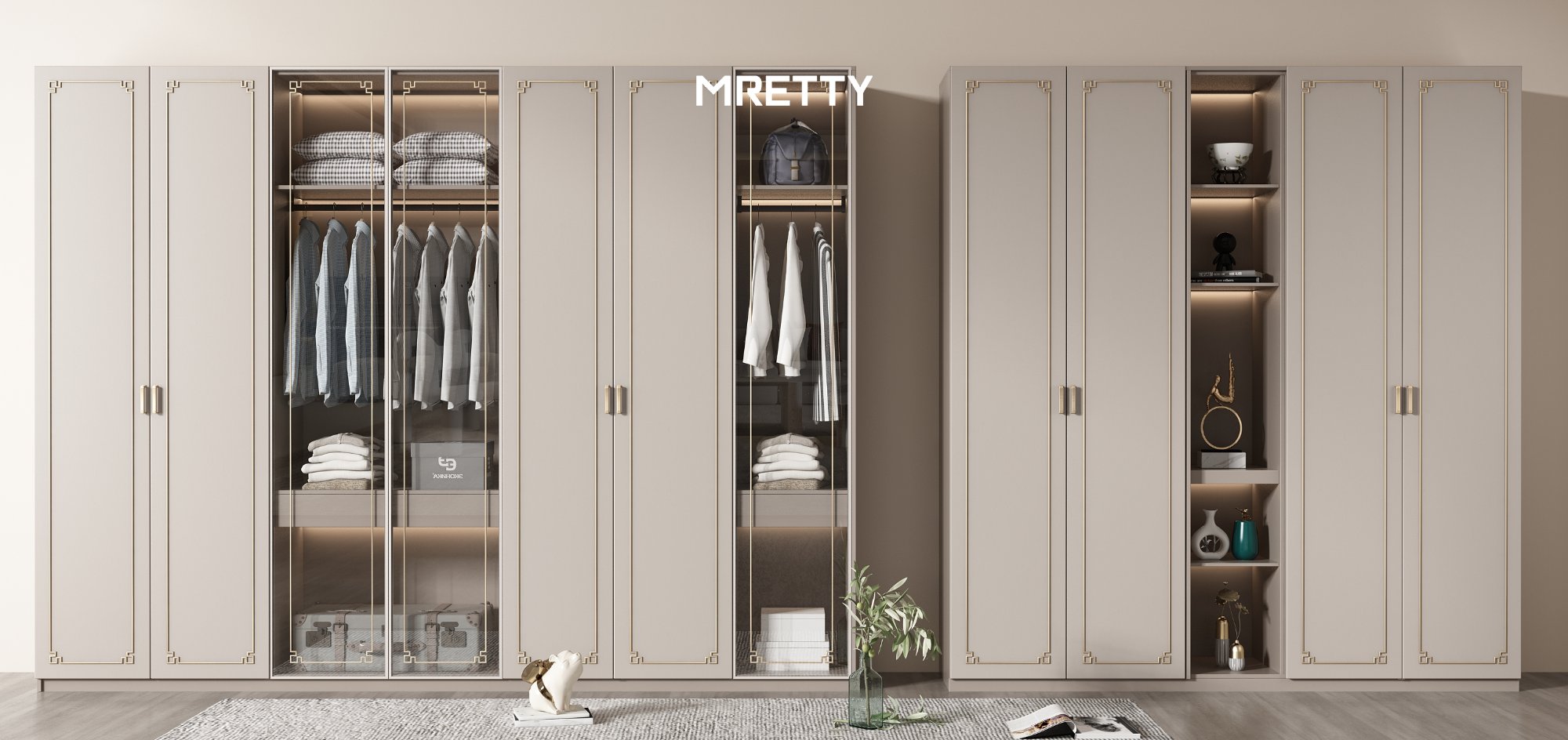
Zoom In on Details: How to Judge if Custom Furniture Craftsmanship Is High Quality
You don't need to be confused by sales jargon when visiting showrooms or doing final inspections. Learn to check these 3 key points, and you can assess craftsmanship like a pro:
Detail 1: Check if edge-banding is smooth with no visible glue line
Most直观 inspection point. Run your hand along the board edge: Top Quality: Surface is smooth, transition rounded and not scratchy. In raking light, you can barely see a line between the edge tape and the board surface. This is only achievable with German heavy-duty edge-banding equipment + PUR adhesive. Low Quality: Visible glue line, even adhesive overflow. Edge has a wavy texture, feels scratchy. I visited a new home in Tampines last year where the contractor used the cheapest EVA edge-banding — the tape started peeling off after just one year, exposing yellowed core board underneath.
Detail 2: Check if drill holes are precise with no chipped edges
Pull out a drawer, look at the rail holes on the side panel; open a door, check shelf pin holes: Top Quality: Hole edges are smooth, no chipping or burrs. All holes line up perfectly, depth consistent. This means a high-precision CNC drill center was used, guaranteeing tight fits and structural stability. Low Quality: Obvious splintering/chipping around holes. This doesn't just look bad — it reduces screw bite force, so furniture loosens over time.
Detail 3: Test if hardware operates smoothly with damping
Hardware is the joints of your furniture, dictating daily use experience: Top Quality: Drawers glide smoothly, have soft-close damping that pulls them gently shut at the last inch. Doors open/close with sturdy hinge support, no wobble. MRETTY uses Austrian Blum or German Hettich premium hardware as standard, rated for 200,000+ open/close cycles. Low Quality: Noisy, sticky drawers that need force to close fully. Thin hinges, doors may sag or not close flush.
Counter-Consensus Take: Why "Solid Wood = Best" Is a Trap for Custom Cabinetry
When people talk about good furniture, the first reflex is "pure solid wood" — the supposed gold standard of quality.
In reality, for precision-fit whole-home custom cabinetry in Singapore, this assumption is usually wrong. I've seen clients pay top dollar for solid wood cabinet doors, only to have them warp so badly after one rainy season they won't close. The problem is wood's natural property: it expands and contracts with humidity. In Singapore's high-moisture environment, dimensional shifts are especially pronounced, leading to warped doors and stuck drawers.
High-quality engineered boards — like the European-import moisture-resistant particleboard we use — are industrially treated for hyper-consistent dimensions. When paired with 0.2mm CNC machining and fully sealed PUR edge-banding, their durability, structural stability and service life actually outperform improperly treated solid wood in the same conditions. The key takeaway? In modern custom furniture production processes, top-tier craftsmanship matters far more than expensive raw materials for final quality.
Beyond Industry Standards: MRETTY's Environmental & Craftsmanship Commitments
A healthy home starts with extreme rigor for materials and process. We know for families with kids or sensitive residents, formaldehyde-free eco-friendly custom furniture production is their #1 concern.
Current international formaldehyde emission standards for engineered boards:
E1 Grade: ≤ 0.124 mg/m³ (basic market entry threshold)
E0 Grade: ≤ 0.050 mg/m³ (high standard)
ENF Grade: ≤ 0.025 mg/m³ (one of the strictest current tiers)
All boards used in MRETTY product lines meet and exceed E0 eco-standards. Our internal QC regular sample tests show actual formaldehyde emissions around 0.018 mg/m³ — far better than even the strict ENF limit. Our PUR edge-banding is also solvent-free, eliminating secondary pollution from the edge-sealing process.
Our craftsmanship system is purpose-built for Singapore's climate. Beyond E0 eco-grade boards and PUR edge-banding, we obsess over extra details:
- Reinforced back panels: For HDB walls prone to residual moisture, our wardrobe back panels get moisture treatment plus added batten supports to prevent warping/mold from wall contact.
- Elevated cabinet feet: All floor-standing cabinets come with adjustable waterproof feet that lift the carcass off the floor, fully isolating it from ground moisture — a detail most contractors skip.
- Smart Manufacturing Advantage: MRETTY furniture production processes run on our 15,000㎡ smart factory. Full digital end-to-end drive boosts efficiency by 40%, and cuts human error rate to below 0.1%, ensuring your furniture is structurally precise, stable and durable.
Remember: home eco-friendliness is a full-chain system. Boards, adhesive, edge-banding AND installation accessories all impact air quality. Choosing a brand like MRETTY that provides an end-to-end eco solution is the only way to be truly safe.
Understanding custom furniture production processes isn't about making you a factory expert — it's about giving you clear judgment and agency when building your home. Craftsmanship is the skeleton of your home, design is its soul. Picking the right process lays a solid, durable, healthy foundation for your space.
At MRETTY, we're obsessive about craftsmanship. Reach out to our design team to talk about applying these top-tier processes to your home.
About the Author
Aida, Senior Lead Designer, MRETTY Full-Home Custom Team With over 10 years of experience in residential design and project management, Aida specializes in end-to-end solutions for Singapore households, covering space planning, material craftsmanship and soft furnishing coordination. She believes "space is the physical expression of a resident's inner spirit, and design is the journey that guides them to recognize that self." She works across modern, Italian luxury, French, Japandi, and mid-century styles to find each client's truest aesthetic, embedded in functional, beautiful living environments. To date she has designed 500+ local homes (HDB, condo and landed) and is widely trusted by clients for her technical rigor and attention to detail.
Frequently Asked Questions (FAQ)
How long is the production lead time for custom furniture?
From final drawing sign-off and factory order submission to production completion, lead time is ~25–30 working days. This does not include pre-design discussions or on-site installation time. Choosing a brand with a smart manufacturing factory like MRETTY keeps lead times stable and predictable.
How do I judge if custom furniture craftsmanship is good?
Check 3 quick things: 1. Edge-banding: Smooth, seamless transition, no scratchy feel or visible glue line. 2. Drill holes: Clean, no chipping/splinters, all aligned. 3. Hardware: Drawers glide silently with soft-close, doors don't wobble or sag. These are direct proof of high-end furniture manufacturing quality.
What board material is best for whole-home customization?
In Singapore, high-density moisture-resistant particleboard is the top pick. Stable performance, great cost-performance ratio. MDF has terrible moisture resistance, avoid for carcasses entirely. When checking eco-grades (E0/E1), always prioritize the "water thickness swell rate" metric alongside formaldehyde numbers.
What's the difference between custom furniture and ready-made furniture?
Three core gaps: 1. Space utilization: Custom fits wall-to-wall, uses every inch (critical for Singapore HDB/condos). 2. Personalization: Internal dividers, hanging vs folded ratios, appliance niches tailored to your habits. 3. Style unity: Consistent material, color and finish across all cabinets in the home, no clashing "almost-matching" tones.
What's the difference between MRETTY's smart factory and traditional factories?
Core difference is automation and precision. MRETTY's smart factory runs full German HOMAG automated lines, with computer-controlled cutting, edge-banding and drilling, error margin within 0.2mm. Traditional factories rely on manual labor and old equipment, with large size variances, unstable quality, and far more common issues like chipped edges or missed seals.
Is high-end imported hardware really necessary?
Absolutely. Hardware is the most frequently used moving part of your furniture — its quality directly dictates durability and daily experience. Premium lines like Austrian Blum have smooth glide, high load rating and 200,000+ cycle ratings (10–15 years of daily use) that cheap hardware can't touch. It's the single highest-ROI investment for long-term home quality feel.
MRETTY: Premium Bespoke Kitchen & Cabinet Systems Provider in Singapore.
