
 Singapore
 China
China
TL;DR: Core Advantages of MRETTY’s Smart Factory
- Sub-millimeter precision: Crafting seamless built-in cabinets for HDB flats and Condominiums.
- Project lead time reduced by up to ~40%: More stable and faster than traditional carpentry workshops.
- Consistent, refined edge-banding and finishes: Automated edge-banding better resists Singapore’s high humidity, preventing bubbling and delamination.
- Material waste reduced by over 15%: Optimized nesting via ERP systems means less waste and more predictable delivery.
So-called "smart factory furniture manufacturing" refers to the introduction of Industry 4.0 technologies (robotics, data connectivity, automated production lines, etc.) into production. Digital workflows transform "design files" directly into high-precision custom furniture. For homeowners, this means better alignment between cabinets and walls/floors, more consistent quality, more predictable timelines, and greater design freedom.
The New Benchmark for Custom Furniture in Singapore
Just five years ago, mentioning "custom furniture" in Singapore conjured images of visiting local carpentry workshops, unpredictable timelines, and clouds of dust on-site. By 2026, that old paradigm is largely obsolete. Smart factory furniture manufacturing is becoming the expected baseline for homeowners.
This is not a passing trend, but a shift from "relying on human estimation and feel" to "ensuring certainty through data and programmed processes." Last year, I handled a case where a walk-in wardrobe carpentry project required a complete redo due to measurement errors. The solution wasn't manual remediation, but re-breaking the design into digital components and sending them to the smart factory for file-based production. The replacement parts arrived and aligned perfectly on the first try. Drawing on 14 years in this industry, this guide explains why this method is fast becoming the industry standard.
Core Q&A: Your Smart Factory Primer
Before diving into the process, let’s address the two questions clients ask most often.
What is a "Smart Factory" in Furniture Manufacturing?
It is essentially a data-driven automated production base that integrates several key capabilities:
- CNC (Computer Numerical Control) machines handle precision cutting and drilling.
- Robotic arms/automated handling manage material flow.
- ERP (Enterprise Resource Planning) software oversees orders, production scheduling, traceability, and progress tracking.
These systems communicate with each other: your confirmed 3D design becomes machine-readable instructions, minimizing human intervention—this is the core of an Industry 4.0 furniture factory.
How Does a Smart Factory Make Furniture Better Suited for Singapore Homes?
It boils down to two things: consistency + precision. Machines don’t have "off days." Every cut is program-controlled, with tolerances achievable to approximately ±0.1mm—a level humans struggle to replicate consistently. In your home, this translates to uniform cabinet door gaps, built-in wardrobes/storage walls that sit flush against walls and floors without unsightly black gaps, and automated edge-banding that forms a seal far more resistant to moisture—critical for Singapore’s humid environment.
1. Core Technologies: Inside MRETTY’s Automated Furniture Production System
"Smart factory" sounds abstract, but within MRETTY’s 15,000㎡ facility, it comes down to several key technologies working in concert:
- CNC (Numerical Control Processing): We use equipment systems from Germany’s Homag and Italy’s Biesse Group. The designer’s software model sends data directly to the workshop floor—CNC cuts E0-grade boards according to the file, not manual marking and hand-held tools.
- Automated Edge Banding: This step determines both aesthetics and durability. Equipment applies PUR (Polyurethane Reactive Hot Melt Adhesive) at stable high temperatures, forming a near-waterproof, moisture-resistant seal along each board edge—explaining why kitchen cabinets and wardrobes resist edge swelling and delamination despite Singapore’s alternating air-conditioned and humid cycles.
- ERP Manufacturing System (The Central Brain): Nesting optimization, process scheduling, component tracking, progress visualization… This digital backbone ensures "speed" does not compromise "accuracy."
- ❌ Common Misconception: Assuming any machine cutting equates to "factory-quality." A standalone electric saw ≠ a smart factory; the difference lies in how deeply design, machining, and management software are integrated.
- ✅ A Smarter Question: Ask suppliers about their tech stack: Do they have end-to-end ERP? What industrial-grade CNC and edge-banding machines are used? Do they conduct in-factory pre-assembly checks? These answers quickly reveal who practices true Industry 4.0.
2. MRETTY Smart Factory vs. Local Carpentry Workshops: An Expert Comparison
Many homeowners feel traditional carpenters possess more "artisan soul" or flexibility.
However, based on observations across hundreds of projects, when the goal is large-scale built-in cabinetry and whole-home integrated carpentry, the conclusion often reverses: The "replicable complex precision" achievable by a smart factory is difficult for manual labor to reproduce at scale—what is known as mass customization: the same intricate details can be maintained consistently across multiple cabinet sets throughout the home.
| Comparison Dimension | MRETTY Smart Factory | Traditional Singapore Carpentry Workshop (Typical Scenario) |
| :--- | :--- | :--- |
| Precision | Sub-millimeter (approx. ±0.1mm) guaranteed by CNC programming | Higher variance (approx. ±2–5mm), dependent on craftsman’s condition/tools that day |
| Lead Time | Approx. 4–6 weeks (more predictable) | Approx. 8–12 weeks or longer (more susceptible to manpower issues and rework) |
| Finish Consistency | Machine-applied; edge-banding/color matching more stable | Prone to inconsistencies, bubbles, glue marks, and other variables |
| Edge Seal Quality | PUR automated edge-banding; more moisture-resistant, less delamination | Manual gluing/local pressing; more vulnerable in high humidity |
| Board Traceability | Managed toward certified E0-grade systems | Sometimes opaque sourcing/grading; quality varies |
| Material Utilization/Waste | Computer-optimized nesting; waste can be minimized (common target <5%) | Manual nesting often yields 15–20% waste |
| Complex Shapes/Repetitive Details | High: Patterns, arrays, modular details produced consistently | Limited by manual tooling and physical stamina |
| Cross-Cabinet Consistency | Scan verification, digital replication; extremely high consistency | Even identical cabinets may show visible differences |
- ❌ Common Misconception: "Handmade = more premium." For "seamless built-in systems" (handleless kitchen cabinets, floor-to-ceiling wardrobes, full-wall storage), machine precision offers an objective advantage.
- ✅ A More Reasonable Match: A single rustic dining table from an artisan can be charming; but for "whole-home seamless integration with zero tolerance for misalignment," a smart factory is more likely to deliver the probability you desire.
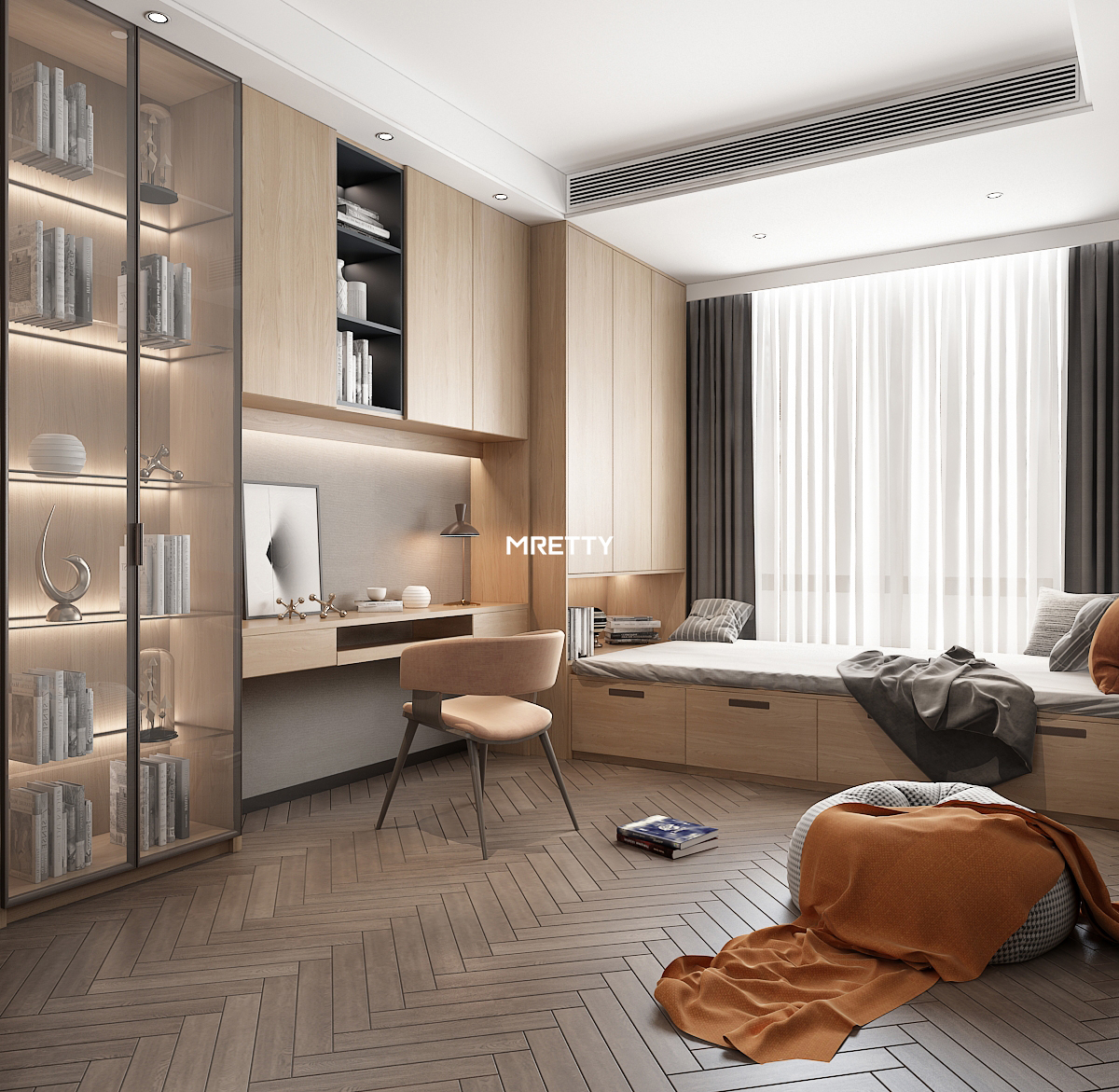
3. The MRETTY Smart Factory Process: From Design to Delivery
Many clients are surprised the first time they hear this: custom furniture can be "assembly-line-like, yet made only for your home." Here are the transparent steps I personally oversee:
- Digital Design & Simulation (Week 1)
Finalize layouts/elevations, materials, and hardware (e.g., Blum / Hettich grade). Output precise 3D models—what you see closely approximates the final product, removing guesswork.
- Data Enters the Factory (Production Day 1)
Once the design is locked, the data packet enters MRETTY’s factory queue: ERP parses the files → nesting optimization (material saving) → machine time allocation, all run by the system.
- Automated Production (Days 2–15)
Robotic arms/suction cups load materials → CNC cutting and drilling → transfer to automated edge-banding stations → labeling/identification. Think of it as: one high-precision production batch run exclusively for "your floor plan."
- Quality Control & In-Factory Pre-Assembly (Days 16–20)
Each board is scanned against the original file; for critical projects, we conduct in-factory trial assembly/alignment: eliminating 99% of potential "on-site misfits" before they reach your home, avoiding a messy construction site.
- Logistics & On-Site Installation (Weeks 4–6)
Flat-packed, labeled by area, delivered to your home; installation teams work according to assembly logic. Because pre-checks happened in the factory, on-site work is faster, cleaner, and significantly reduces dust and time costs.
There is no "sawing in your living room for half a month" chaos. Only a precise, seamless fit.
!https://via.placeholder.com/800x400.png/E8F5E9/000000?text=Automated+CNC+Furniture+Cutting
- ❌ Common Misconception: Focusing only on "who installs in the final days." If production goes off track, the site team can only compensate with silicone and wooden fillers.
- ✅ A More Reliable Approach: Ask suppliers to clearly explain the process from "design lock → factory QC → installation closure"; the more transparent the workflow, the fewer pitfalls.
4. Hyper-Local Solutions: Why Smart Manufacturing is Perfect for HDB BTO & Condo Renovations
The true value of smart factory furniture manufacturing SG often lies in how it solves Singapore’s "local headaches": compact layouts, non-straight walls, awkward beams/columns, and a humid climate.
- HDB BTO: Every square foot counts. Machine precision allows us to design storage beds, full-height shoe cabinets, and full-wall storage that "hug walls and columns without wasting space"—every millimeter reclaimed translates to better daily living.
- Condominiums (especially older ones): Older apartments often have walls that aren’t perfectly plumb and floors that aren’t level. We use rigorous laser/point measurements on-site, converting "non-standard angles" into machinable data for the factory, resulting in panels that truly embed seamlessly—rather than relying on thick silicone to hide gaps.
- Durability Aspect: The combination of E0-grade moisture-resistant core boards + PUR edge-banding is engineered for Singapore’s cycles of air-conditioning/dehumidification, monsoon seasons, and wet kitchen zones, reducing the likelihood of swelling, darkening, and delamination.
- ❌ Common Misconception: Directly copying European magazine designs without considering local climate and board construction logic. No matter how beautiful the design, if edge-banding and core materials cannot withstand humidity, problems emerge within months.
- ✅ A More Prudent Approach: Lock in "weather-resistant construction standards" (E0/PUR/moisture-resistant cores) first, then discuss aesthetics; and explicitly include these items in your confirmation documents.
Frequently Asked Questions
Why choose smart factory furniture in Singapore over traditional carpentry?
For whole-home built-in systems, smart factories excel in precision, consistency, and predictable lead times. Traditional carpenters are suitable for "small-batch, artisanal single pieces," but when facing large-scale built-in cabinetry and cross-space modular uniformity, automation offers superior reproducibility and reduces on-site rework and guesswork.
What key technologies are used in a smart furniture factory?
The core is CNC machines (cutting/drilling) → automated edge-banding → (optional) robotic loading/unloading → ERP system linking scheduling and traceability. Only when these links are integrated can it be called Industry 4.0, not merely "buying a CNC saw."
Is smart factory production more environmentally friendly?
Generally, yes. ERP nesting optimization increases the utilization rate of large boards, pushing waste rates toward much lower levels (many cases aim for <5%), compared to 15–20% waste from traditional manual nesting. Saving materials benefits both your budget and the environment in the long run.
MRETTY: Premium Bespoke Kitchen & Cabinet Systems Provider in Singapore.
