
 Singapore
 China
China
A technical specification document is the master blueprint of your project. It defines, in exhaustive detail, every material, finish, hardware component, and exact dimension of your custom furniture. This document is mission-critical — and in Singapore alone, we have observed that specification clarity alone can swing project costs by as much as 30%. It is the single most powerful tool for locking in quality, controlling budget, and translating vision into precision-built reality.
TL;DR: Your Guide to Technical Specs
- Define every detail. The spec sheet is the buildable blueprint for your custom furniture — covering materials, hardware, and dimensions.
- Control your budget. Clear specs prevent costly errors and ensure you only pay for confirmed quality.
- Verify quality. Use the spec sheet to check machining tolerances (±1mm), material grades (e.g. E0), and hardware authenticity (Blum vs. no-name).
- Demand Singapore-specific details. Ensure materials are moisture-rated and — where applicable — compliant with HDB renovation guidelines.
FAQ: Core Insights
What's the difference between a spec sheet and a mood board?
A mood board captures how the design feels — inspiration, atmosphere, the emotional direction. A technical specification sheet translates that feeling into a precise, buildable instruction set. A mood board might show a "warm wood-grain wardrobe"; the spec sheet defines it as: "18mm E0-grade plywood carcass, finished in Lamitak WPL 4321X laminate, edged in 1mm ABS, Blum Clip top Blumotion hinge, 110° opening."
Why do material specifications matter so much for Singapore renovations?
They directly impact durability, safety, and cost — especially in our tropical humidity. Specifying moisture-resistant (MR) plywood over standard MDF can prevent warping that we have seen manifest in as little as 12 months. And specifying Low-VOC, E0-grade boards isn't just technical posturing — it is a critical health consideration for your family's indoor air quality.
Why Technical Specifications Matter More Than Ever
Just five years ago, "custom" furniture in Singapore might have meant picking a laminate colour. Today, true whole-home customisation drills down much deeper. The industry's centre of gravity has shifted from aesthetics alone to performance and longevity. Homeowners now discuss drawer slide cycle life and formaldehyde emission classes. That makes mastering interior design technical specifications essential.
This document is the technical contract between you and your builder. Having completed over 1,000 custom residential projects across Singapore, we can state definitively: over 90% of renovation disputes stem from ambiguous or missing specifications. A detailed spec sheet is your #1 quality assurance tool — it ensures the premium materials you paid for are exactly what get installed in your home.
Just last month, we were reviewing a scheme for a Bidadari condo. The client had specified "dark wood-grain" shelving. The contractor quoted for laminate; the client had solid walnut in mind — a 400% cost gap. The specification we had drafted in advance defined it as "E0 plywood substrate, walnut veneer overlay" — averting weeks of argument and thousands in losses.
Debunking the Myth: "Detailed Specs Are Overkill"
Many homeowners think a detailed spec sheet is unnecessary paperwork — something designers use to pad billable hours.
The reality is exactly the opposite.
Vague specs hand the contractor a blank cheque. Ambiguity breeds expensive assumptions, variation orders, and disputes. A precise spec sheet is a self-repaying investment. It saves money by eliminating rework and guarantees you receive the exact quality matching your price tag — with no expensive surprises.
How to Read a Carpentry Specification Sheet Like a Pro
A well-structured carpentry specification table can look intimidating at first, but its logic is clear. Understanding each section lets you hold meaningful conversations and verify quality. Think of it as an exploded parts list for every built-in element.
Here are the core components you will encounter:
| Section | What It Defines | Why It Matters |
| :--- | :--- | :--- |
| 1. Carcass Material | The internal structure — material (e.g. MR plywood), thickness (18mm standard), grade (e.g. E0) | The hidden skeleton that determines whether your cabinet lasts 3 years or 15 |
| 2. Finish Specifications | Visible surfaces — laminate brand & code (e.g. "Formica 1234"), veneer species & grain direction | What you actually see and touch every day |
| 3. Hardware Schedule | All functional parts — hinge brand/model (e.g. "Blum 110° Clip top"), drawer slide type, handle spec, damping features | The mechanical soul; decides if doors/drawers still feel premium in Year 10 |
| 4. Dimensions & Shop Drawings | Exact measurements, elevations, clearances | Solves "where" and "how big"; the spec sheet solves "with what" |
Homeowners tend to fixate on finishes — the laminate or veneer they can see and touch. But the most dangerously overlooked component is hardware. It is easy to be impressed by soft-close hinges on a showroom tour, but the spec sheet forces a harder question: Is this a no-name hinge rated for 20,000 cycles, or a Blum hinge certified for 200,000+? That detail decides whether your cabinet doors still sit flush a decade later.
Built-In Furniture Technical Details for Singapore's Climate
Singapore's high humidity is the ultimate stress test for furniture. Materials that perform fine in dry climates can fail here. When reviewing built-in furniture technical details, prioritising climate-adapted materials is non-negotiable.
For carcass material, we specify Moisture-Resistant (MR) Plywood over standard MDF or particleboard. MDF can deliver a flawless painted surface in arid zones, but it absorbs moisture and swells — making it a high-risk option for kitchens and bathrooms. Our analysis shows: premium plywood exhibits up to 70% lower expansion under humid conditions compared to standard particleboard.
Hardware is the other critical frontier. Corrosion is real here. The hardware schedule should specify stainless-steel components or certified anti-corrosion coated parts. Brands like Blum, Hettich, and Häfele subject their mechanisms to rigorous salt-spray testing to certify environmental resilience. Saving a few dollars on generic hinges can cost you rust and failure within years.
In a recent Sail @ Marina Bay project, another firm had initially proposed solid timber door panels for the master wardrobe. We strongly advised against it — coastal microclimate, extreme warp risk. We specified premium MR plywood with veneer. Two years on? The client's doors remain perfectly flush. No expensive do-over.
What Are the Quality Standards for Custom Cabinetry in Singapore?
While the BCA provides broad building guidelines and HDB enforces its own renovation framework, specific cabinetry quality standards are typically set by the manufacturer. You must read between the lines.
Key quality markers to demand:
- Material Grade: Demand E0-grade (or at minimum E1). This European standard caps formaldehyde emissions, protecting your indoor air. Many low-cost suppliers still quietly run E2-grade boards.
- Hardware Authentication: Do not accept "soft-close hinges" as a description. The spec must name the brand — Blum or Hettich. At MRETTY, Blum hardware is our standard — 200,000-cycle certified, equating to 20+ years of daily use.
- Machining Tolerance: This is the hallmark of high-end fabrication. Our furniture quality standard holds ±1mm tolerance. Uniform, hairline-even gaps between doors — the detail that defines a luxury feel.
What does ±1mm vs ±3mm tolerance actually look like? At ±1mm, door gaps are perfectly consistent — straight, razor-sharp lines. At ±3mm, you see visibly uneven reveals — 2mm here, 5mm there. That is the difference between a seamless, architectural look and "just okay."
| Quality Marker | Industry Standard Practice | MRETTY Standard |
| :--- | :--- | :--- |
| Board Grade | E1 / E2 | E0 (lowest formaldehyde) |
| Machining Tolerance | ±3 to 5mm | ±1mm (seamless finish) |
| Hardware | Generic damping hinges | Blum (200K-cycle certified) |
| Edge Banding | Thin PVC (0.4mm) | ABS edging (1mm+, high-impact) |
The MRETTY Standard: From Drawing Board to Finished Product
A specification's value is only as good as the system executing it. This is where many renovation projects break down. At MRETTY, we integrate design, specification, and production into one chain. Our spec sheet isn't just a document — it is a direct input into our automated manufacturing workflow.
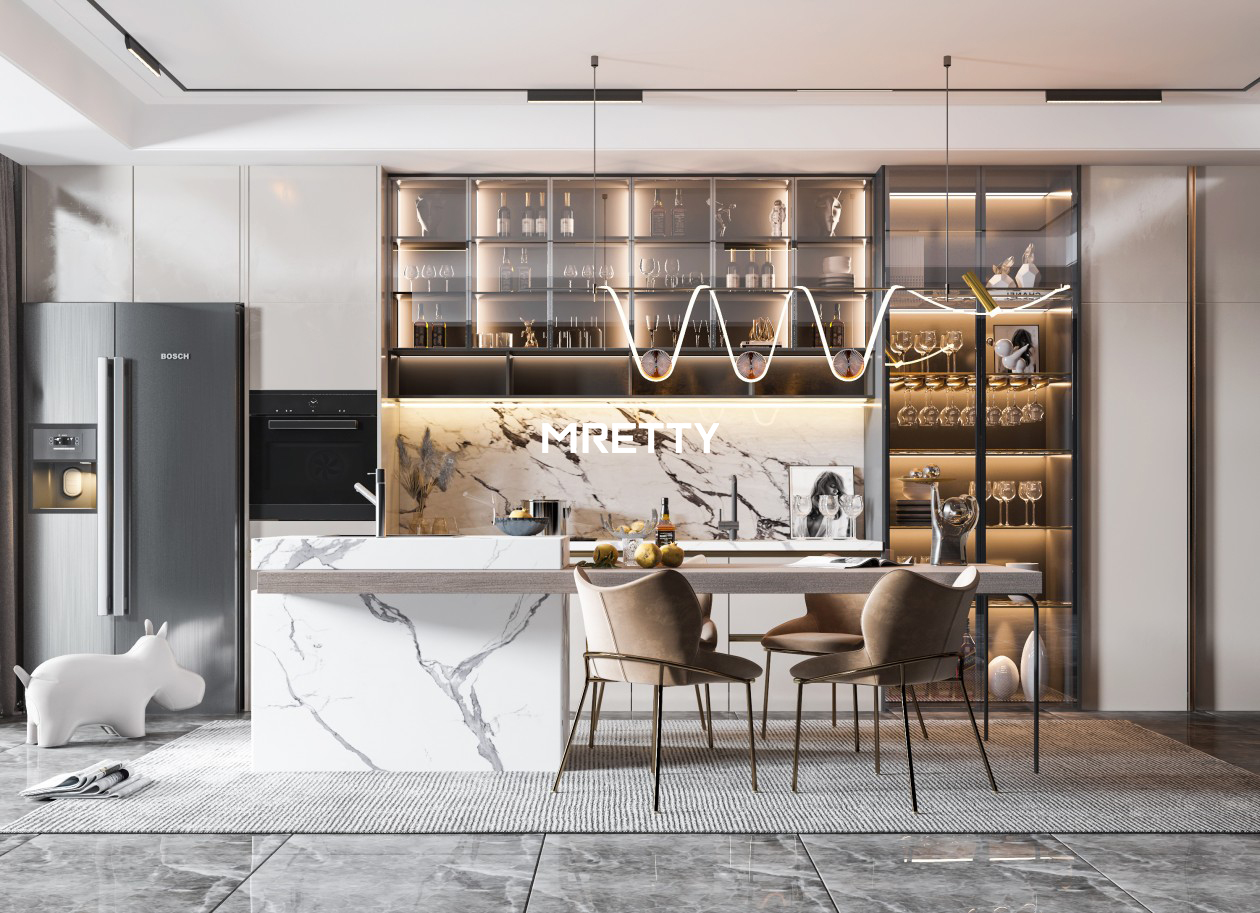
Take a kitchen island we produced in Q1 2026. The spec called for a Caesarstone 5131 Calacatta Nuvo countertop with 40mm mitered edge, E0 plywood carcase base, and Blum Legrabox drawers. Those exact codes were entered into our system. Our CNC machinery cut the carcase to 0.5mm precision, guaranteeing fit. The hardware schedule auto-triggered inventory allocation of the correct Blum slides and hinges.
This digital workflow eliminates human translation error — guaranteeing what is written on the spec is what comes out of the factory. That is why we can commit to ±1mm. The MRETTY standard isn't a promise; it is a technology-driven, verifiable output.
The Blueprint to Perfection
Mastering your project's technical specifications is the key to a successful renovation. It translates subjective wishes into objective, measurable instructions. This blueprint protects your budget, guarantees material integrity, and ensures the end result faithfully reflects your vision.
Based on our ten years of experience, the clients who take the time to understand this document consistently rank among the most satisfied with their outcomes. Because they are informed. They are in control. And they own the success of their project.
MRETTY: Premium Bespoke Kitchen & Cabinet Systems Provider in Singapore.
