
 Singapore
 China
China
TL;DR: To protect furniture in Singapore’s humidity, you must control indoor moisture, ensure airflow, and select materials engineered for the tropics. For custom furniture, proactive design—like integrated ventilation gaps and corrosion-resistant hardware—is key. Regular cleaning and strategic dehumidifier use are essential to prevent mold, wood warping, and hardware rust.
The New Reality of Furniture Longevity
Furniture care used to be simple. Back in 2020, maintenance advice was little more than wiping up spills promptly. By 2026, the conversation has shifted entirely. For owners of high-end homes, protecting your furniture investment from Singapore’s climate begins long before the piece enters your home.
It starts at the design stage.
How to Diagnose Climate Impact and Protect Your Investment
Singapore’s climate is a persistent stress test for your home’s interior. According to the National Environment Agency (NEA), the average annual relative humidity (RH) reaches 84%. When RH climbs above 60%, it creates the perfect breeding ground for mold, warping, and corrosion.
Here are the core strategies for furniture care in Singapore’s climate:
| Strategy | Specific Action |
| :--- | :--- |
| Control Humidity | Actively maintain indoor RH between 40%–60% |
| Ensure Airflow | Promote cross-ventilation; eliminate stagnant, moist air |
| Choose Materials Wisely | Select materials and hardware engineered for tropical climates |
| Clean Smart | Prioritize dry cleaning methods; avoid products that trap moisture |
| Proactive Design | Build solutions like ventilation gaps directly into furniture structures |
| Wood Acclimatization | Insist on local climate moisture content adjustment before manufacturing |
These issues are not merely cosmetic—they pose a material threat to the lifespan and value of your custom furniture.
Just last month, I inspected a beautiful Suar wood TV console at a client’s home in Katong. It was a stunning piece, but the back was covered in a thick layer of white mold. The cause? The console was pushed flush against the exterior wall, trapping a pocket of hot, humid air with nowhere to escape. A mere 5cm gap could have saved it.
❌ Common Mistake: Ignoring a musty smell in the wardrobe.
✅ Smarter Approach: Treat a musty odor as an urgent warning. It is the first sign of mold growth. Immediately investigate the source, clean the area, and boost ventilation or dehumidification.
❌ Common Mistake: Pushing large furniture flush against the wall.
✅ Smarter Approach: Always leave a 5–10cm gap between large furniture and the wall. This is the most effective (and simplest) way to improve airflow and prevent trapped moisture.
In my ten years of designing for Singapore homes, I have seen unchecked moisture lead to thousands of dollars in repairs. Understanding that "high humidity causes damage" is only the first step; establishing a protective routine is the key.
How to Proactively Safeguard Wood Furniture and Preserve Its Beauty
Wood is hygroscopic—it naturally absorbs and releases moisture from the air. In our climate, this process leads to swelling, shrinking, and eventually warping.
The solution has two layers:
- Select the right wood species
- Ensure it is properly pre-treated through "moisture content acclimatization"
At MRETTY, all our imported wood is seasoned in the controlled climate environment of our 15,000 sqm smart factory. This crucial step stabilizes the wood’s moisture content (MC) to 8%–12%—the ideal range for Singapore. This happens before we cut the first board, fundamentally reducing the risk of future warping.
If the wood’s MC is too high (e.g., 18%) at manufacture, it will shrink and crack as it releases moisture to match your drier indoor environment. Conversely, if the wood is too dry, it will absorb ambient moisture, swell, and warp—causing drawers to stick and doors to scrape the floor.
What is the Best Wood for Singapore’s Humid Climate?
Not all woods are equal. Dense, naturally oily tropical hardwoods are the top choice for Singapore—their natural properties grant them double resistance to moisture and pests. Teak and Suar wood are prime examples.
Engineered wood can also perform well, but with a caveat: the core must be high-quality moisture-resistant substrate, and the veneer must be perfectly edge-banded. The quality of the edge banding determines whether moisture can seep in—if the banding peels or is too thin, the laminate will bubble and peel as moisture infiltrates.
How to Prevent Mold on Wood Furniture in Singapore
Prevention is fundamentally environmental control. First, ensure airflow inside and outside the cabinet. Second, keep surfaces clean—dust is a nutrient source for mold spores.
Many believe a thick coat of varnish is the ultimate protection. But in reality, in Singapore’s climate, this can be a trap.
I have seen too much furniture destroyed not by direct moisture, but by moisture trapped beneath a damaged finish. The finish inevitably gets micro-scratches or chips during daily use. Moisture seeps in through that opening and gets trapped—it cannot escape. This creates a greenhouse effect inside the wood, leading to white haze, peeling, and even rot from the inside out.
| Comparison Item | Teak Oil / Hard Wax Oil | Varnish / Nitrocellulose Lacquer |
| :--- | :--- | :--- |
| Protection Mechanism | Penetrates the wood, nourishing from within | Forms a hard, sealed layer on the surface |
| Appearance | Natural matte, enhances wood grain | Glossy or satin, can have a "plastic" look |
| Response to Humidity | Allows wood to "breathe"; high fault tolerance | If the seal breaks, it traps internal moisture |
| Maintenance | Re-oil every 6–12 months | Durable, but extremely difficult to repair locally |
| Best For | Indoor pieces seeking natural feel, outdoor furniture | High-use surfaces like dining tables (requires extra care) |
For many high-end wood pieces, a quality oil finish offers more reliable long-term performance and repairability in a humid climate.
❌ Common Mistake: Assuming varnish makes wood "waterproof."
✅ Smarter Approach: Understand that varnish is a surface seal—once compromised, it traps moisture inside. Controlling the room’s humidity is the fundamental solution.
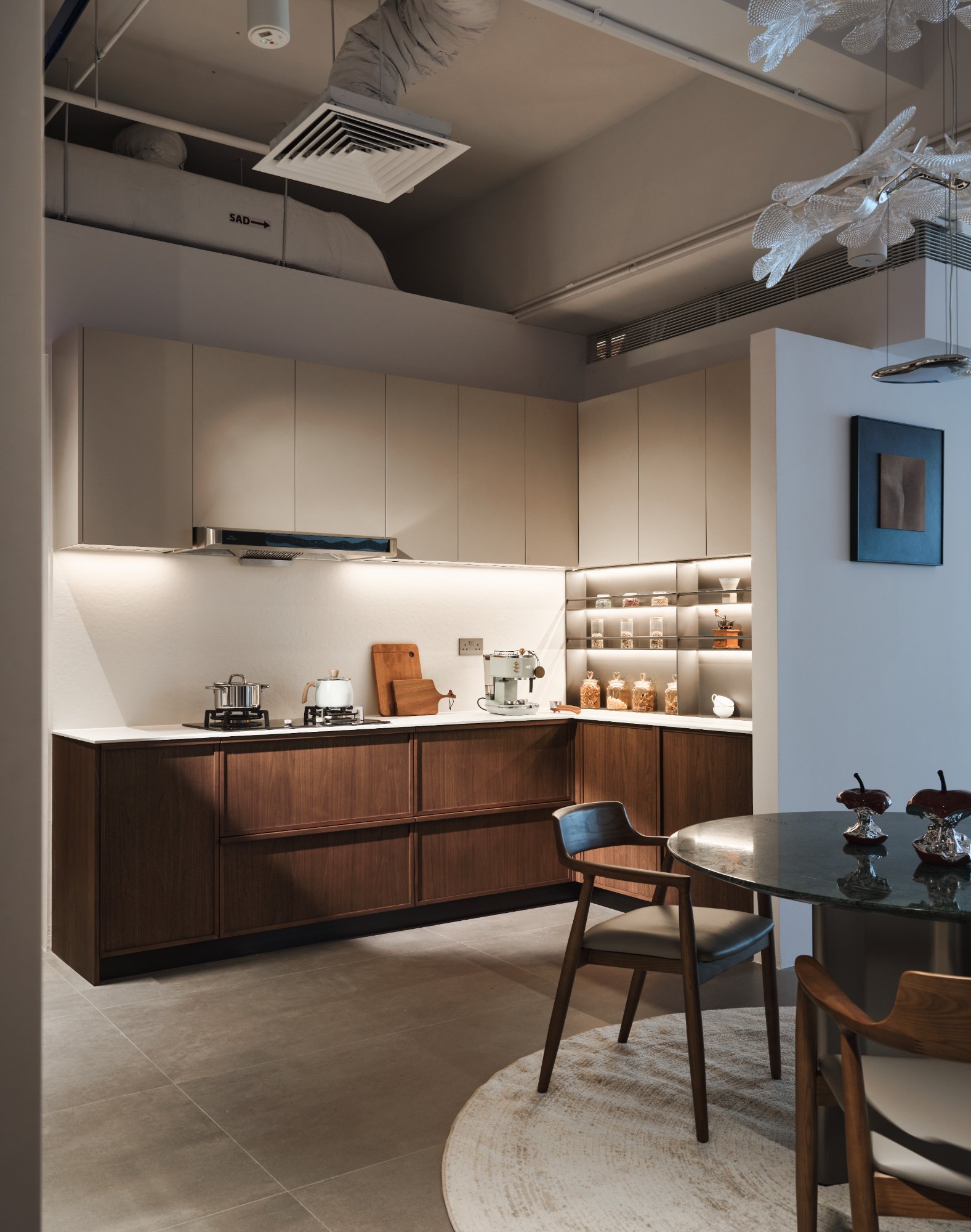
How to Maintain Custom Systems and Keep Your Home Perfect
Furniture care in Singapore’s climate is amplified in integrated systems like walk-in wardrobes and full-height kitchen cabinets. Here, maintenance is determined at the initial design stage.
At a client’s home near East Coast Park, we designed a walk-in wardrobe with hidden ventilation channels at the top and bottom. Last year, they told me this "invisible detail" saved their luxury bags during a week-long power outage (with AC and dehumidifiers off).
Similarly, in a penthouse project in the Orchard area, the client wanted a full-height media wall. Knowing the cold refrigerant pipes behind it could create condensation against the structural wall, we designed the carcass with a 50mm wall offset and embedded passive vents. This detail prevented hidden mold growth behind the beautiful feature wall.
Moisture Defense Checklist: Protecting Built-In Wardrobes
A wardrobe is essentially a dark, enclosed box—a perfect incubator for mold. Use this checklist for wardrobes and custom kitchen cabinets in humid climates:
- Do Not Overpack: Leave gaps between clothing for air to circulate.
- Weekly Ventilation: Leave wardrobe doors ajar for a few hours weekly.
- Use Desiccants: Place silica gel packs or bamboo charcoal bags in corners; replace every 1–2 months.
- Check the Back: Ensure the wardrobe is not directly against an exterior wall prone to seepage.
- Choose the Right Hardware: At MRETTY, we specify premium hardware from Blum and Hettich, which undergo salt spray testing to ensure they resist rust and sticking in high humidity.
❌ Common Mistake: Using adhesive battery-powered puck lights inside cabinets.
✅ Smarter Approach: Plan for professionally wired low-voltage LED strips. The slight warmth helps slightly lower humidity inside, preventing mustiness.
❌ Common Mistake: Choosing handles and hinges based only on style.
✅ Smarter Approach: Prioritize material and finish—choose 304 or higher-grade stainless steel, anodized aluminum, or hardware with certified anti-corrosion coatings. This small detail prevents future rust and functional failure.
How to Choose the Right Tools and Services for Total Peace of Mind
Even with optimal design, Singapore’s climate demands active defense.
Dehumidifiers are non-negotiable tools. The question is not "if" but "what type" and "where." For large walk-in wardrobes, a 20-liter compressor dehumidifier is usually ideal; for smaller enclosed cabinets, rechargeable mini-dehumidifier boxes suffice.
For high-end homes, beyond capacity, look for:
- Quiet operation (preferably below 45 dB)
- Continuous drain hose support (eliminates the chore of emptying tanks daily)
- Smart features: Wi-Fi control + built-in humidistat are no longer luxuries but necessities for effortlessly maintaining the perfect environment.
As for anti-mold furniture sprays on the market, I am conservative: they treat the symptom (surface mold) but not the root cause (excess moisture). They can be used for spot treatment, but your energy should focus on ventilation and dehumidification.
FAQ: Does a Walk-In Wardrobe in Singapore Need a Dehumidifier?
Absolutely. Walk-in wardrobes concentrate textiles, leather, and wood with limited airflow—making them high-risk environments. A dehumidifier set to a target of 50% RH is the best defense to protect expensive clothing, bags, and the cabinetry itself.
When to Call Experts for Professional Furniture Maintenance in Singapore
Seek professional help in these scenarios:
- Deep Scratches or Damage: Repairing high-end finishes is a specialized skill.
- Recurring Mold: If mold returns after cleaning, there may be underlying structural leakage.
- Refinishing: Large-scale re-oiling or re-sanding of dining tables is best left to professional restorers.
- Hardware Adjustment: The precision hinges on MRETTY furniture may require periodic fine-tuning.
❌ Common Mistake: Sanding down and touching up a varnished table yourself.
✅ Smarter Approach: Do not. Spot repairs on modern finishes are nearly impossible to blend invisibly and often make the damage worse. Call a professional furniture restorer.
A Home Built to Last
Caring for high-end furniture in Singapore is not about fighting the climate; it is about respecting it. This means making smart choices from the very beginning—from the partner you choose to the materials you specify.
A MRETTY home is built for endurance.
MRETTY: Premium Bespoke Kitchen & Cabinet Systems Provider in Singapore.
