
 Singapore
 China
China
In the pursuit of a beautiful home, the details matter. From the graceful lines of a custom wardrobe to the warm welcome of a bespoke entryway cabinet, every element contributes to a sanctuary of comfort and style.
Yet, beyond the visible artistry lies an invisible consideration crucial to your family’s well-being: indoor air quality. Central to this is understanding formaldehyde emission standards in Singapore, a key factor in creating a truly healthy and luxurious living space.
Formaldehyde is an organic compound that exists all around us, but its concentration indoors can be significantly higher due to its use in manufacturing building materials and home furnishings. For homeowners embarking on a journey of whole-house customization, awareness of these standards is not merely technical—it is an essential part of crafting a home that is as safe as it is stunning.
This guide illuminates the importance of these regulations and empowers you to make choices that protect your health while realizing your design vision.
What is Formaldehyde and Where is it Found?
Formaldehyde is a colorless, strong-smelling gas. It is a volatile organic compound (VOC), which means it easily becomes a gas at room temperature. In nature, it's produced by most living organisms as part of normal metabolic processes.
However, the primary concern for homeowners stems from its widespread use in manufactured products, particularly in the resins that bind wood-based materials. These formaldehyde-based resins, such as urea-formaldehyde (UF) and phenol-formaldehyde (PF), are valued for their strength and cost-effectiveness.
They act as a powerful adhesive in a vast array of engineered wood products that form the foundation of modern cabinetry and furniture. You can find them in:
- Particleboard: Commonly used for the core structure of kitchen cabinets, wardrobes, and shelving.
- Medium-Density Fiberboard (MDF): A denser material often used for cabinet doors, decorative panels, and custom-shaped furniture pieces.
- Plywood: Used for structural components, back panels, and drawer boxes.
- Veneers and Laminates: Adhesives containing formaldehyde are used to bond these decorative surfaces to the core material.
Because these materials are so prevalent in home construction and renovation, they can be significant sources of indoor air pollution. The formaldehyde in the resins doesn't remain locked away; it is slowly released into the air over time through a process called off-gassing. This process is most intense when products are new but can continue for years, contributing to the overall chemical load within your living environment.
The Health Risks of Formaldehyde Exposure
Living in an environment with elevated formaldehyde levels can pose significant health risks. The severity of these effects often depends on the concentration of the gas in the air and the duration of exposure. Our bodies are sensitive to this compound, and reactions can range from mild irritation to more serious long-term health consequences.
Short-Term Effects
Even at low levels, formaldehyde can be an irritant. Inhaling the gas can lead to a range of immediate, uncomfortable symptoms. These are often the first signs that the air quality in your home may be compromised. Common short-term effects include:
- Watery, burning, or itchy eyes
- Sore throat and coughing
- Headaches and dizziness
- Nausea
- Skin irritation or rashes
Individuals with asthma or other respiratory conditions may find that formaldehyde exposure triggers or worsens their symptoms, leading to wheezing and difficulty breathing. The strong, pungent odor associated with new furniture or a recent renovation is often a tell-tale sign of active off-gassing.
Long-Term Health Concerns
Prolonged or chronic exposure to formaldehyde is a more serious matter. Health organizations worldwide have studied the compound extensively and have linked it to severe health outcomes. The International Agency for Research on Cancer (IARC), part of the World Health Organization (WHO), classifies formaldehyde as a Group 1 carcinogen, meaning there is sufficient evidence that it causes cancer in humans.
Specifically, long-term exposure has been strongly associated with an increased risk of nasopharyngeal cancer (a cancer of the upper part of the throat behind the nose) and certain types of leukemia. Beyond cancer, chronic exposure can lead to persistent respiratory problems and may contribute to the development of allergic sensitivities.
For families with young children, whose developing bodies are more vulnerable to environmental toxins, minimizing exposure is especially critical. Creating a low-emission home environment is a fundamental step in safeguarding your family's health for years to come.
Singapore's Formaldehyde Emission Standards Explained
Recognizing the potential health hazards, Singapore has established clear and stringent regulations to control formaldehyde emissions from building products. These standards are designed to protect public health by ensuring that materials used in homes and public spaces release only minimal levels of formaldehyde, thus maintaining safe indoor air quality.
The primary regulation governing this is the Singapore Green Building Product (SGBP) certification scheme, managed by the Singapore Green Building Council (SGBC). While initially voluntary, its standards have become a benchmark for quality and safety in the construction and renovation industry. For wood products and furniture, the SGBP scheme sets specific limits on formaldehyde emissions, aligning with internationally recognized testing methods.
Key Emission Classes and Compliance
Under the SGBP scheme, products are often classified based on their formaldehyde emission rates, which are measured in milligrams per liter (mg/L) or parts per million (ppm). These classifications help consumers, designers, and builders identify materials that meet the required safety levels. The most common standards referenced in Singapore are derived from European (EN) and Japanese (JIS) systems:
- E1 Standard: This is the widely accepted minimum safety standard in Singapore for indoor applications. Materials certified as E1 have been tested and shown to have formaldehyde emissions below a certain threshold (typically ≤ 0.1 ppm). Reputable providers of custom furniture will exclusively use materials that meet or exceed this E1 classification.
- E0 Standard: A stricter standard indicating even lower formaldehyde emissions. While not always mandated, E0 materials are considered a superior choice for health-conscious homeowners, as they release significantly less formaldehyde than E1-grade products.
- Super E0 (or F): This represents the highest level of safety, originating from the Japanese Industrial Standards (JIS). The F (F-Four Star) rating is the most stringent in the world, signifying ultra-low formaldehyde emissions. Products bearing this certification are considered the premium choice for creating the healthiest possible indoor environment, especially for bedrooms, nurseries, and spaces occupied by sensitive individuals.
Compliance is verified through third-party laboratory testing, where samples of materials like MDF and particleboard are placed in a controlled chamber to measure the amount of formaldehyde they release over a specific period. Only products that pass these rigorous tests can be certified.
Singapore's Standards in a Global Context
To appreciate the robustness of Singapore’s approach, it is useful to compare its standards with those in other parts of the world. While many countries regulate formaldehyde, the specific limits and enforcement mechanisms can vary.
- Europe: The European Union has largely harmonized around the E1 standard as the mandatory minimum for all wood-based panels sold within the EU. This has been a driving force in making E1 the global benchmark for safe furniture. Some countries, like Germany, have even stricter national requirements.
- United States: The U.S. Environmental Protection Agency (EPA) implements the Toxic Substances Control Act (TSCA) Title VI, which sets emission standards for composite wood products. These standards are comparable to the E1 classification, establishing a national requirement for low-emission materials across the country. California was a pioneer in this area with its California Air Resources Board (CARB) regulations, which were later adopted nationwide.
- Japan: Japan boasts some of the most stringent formaldehyde regulations in the world with its F-Star system under the Japanese Industrial Standards (JIS). The F*** (F-Four Star) rating is the highest grade, signifying an emission level that is nearly undetectable. This standard is often looked to as the gold standard for indoor air quality.
Singapore’s adoption of the E1 standard as a baseline, with a strong market preference for even safer E0 and F** materials, places it among the leading countries in prioritizing consumer health. This alignment with rigorous international norms ensures that residents have access to products that meet a high global standard of safety.
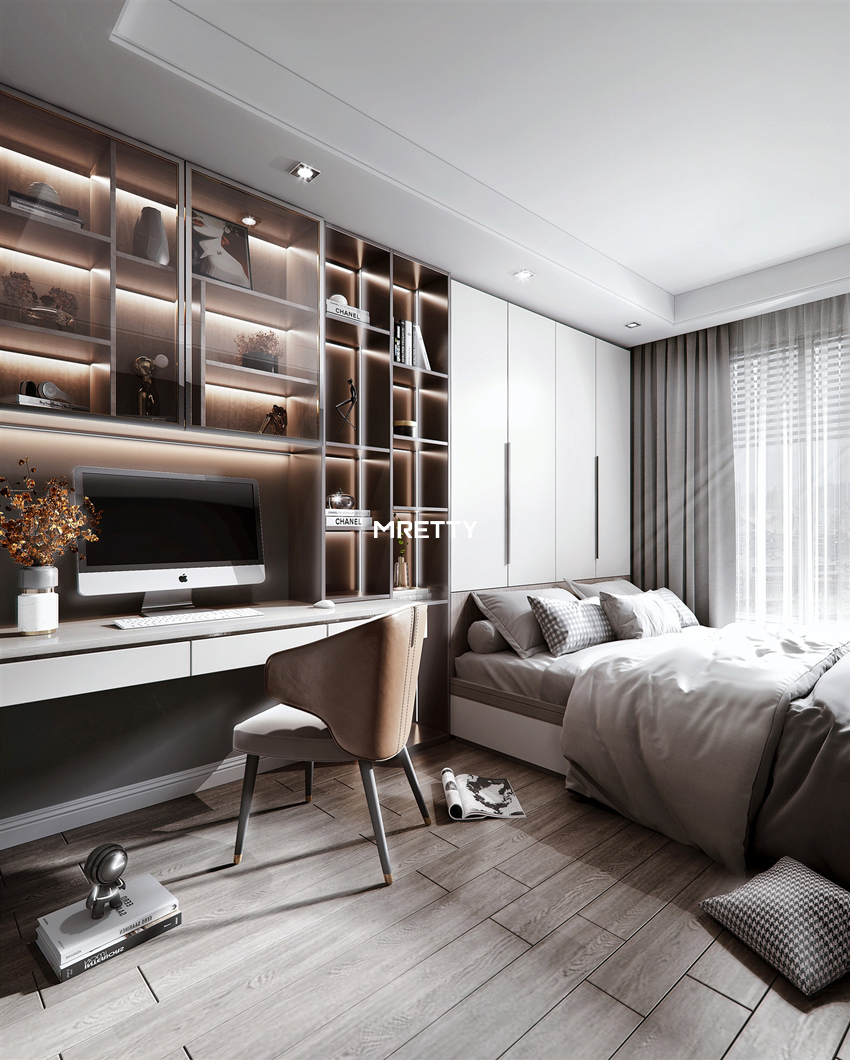
MRETTY’s Commitment to Your Health and Home
For a home to be truly luxurious, it must be a place of well-being. At MRETTY, this principle is at the core of everything we do. We understand that the elegance of a custom-designed kitchen or the seamless functionality of a bespoke walk-in closet is only meaningful if it contributes to a healthy living environment.
That is why our commitment to safety is as uncompromising as our dedication to craftsmanship. We go beyond simply meeting the minimum requirements. MRETTY exclusively utilizes materials that adhere to the stringent E0 and E1 formaldehyde emission standards.
This ensures that every cabinet, wardrobe, and wall panel we craft for your home is built with your family’s health as the highest priority. By sourcing our core materials from world-renowned suppliers who share our values, we guarantee that the foundation of your custom furniture is not only durable and beautiful but also safe.
Our dedication to sustainable and responsible practices is further validated by our use of materials from suppliers who carry the Forest Stewardship Council (FSC) certification. This prestigious certification ensures that the wood used in our products is sourced from forests that are managed responsibly, promoting environmental conservation and social benefits.
When you choose MRETTY, you are choosing a partner who believes that true luxury is a blend of sophisticated design, impeccable quality, and a profound respect for both people and the planet.
How to Choose Low-Emission Products for Your Home
As a discerning homeowner, you have the power to create a healthier living space through informed choices. When planning your renovation or selecting new furniture, here are practical steps you can take to minimize formaldehyde exposure:
- Ask for Certification: When engaging a custom furniture provider, always ask for documentation confirming the formaldehyde emission class of their materials. Do not hesitate to request proof of E1, E0, or F*** compliance. A reputable company like MRETTY will be transparent and proud to provide this information.
- Look for Quality Labels: In addition to formaldehyde ratings, look for other quality certifications like the SGBP label or FSC certification. These serve as reliable indicators of a manufacturer's commitment to safety and sustainability.
- Prioritize Solid Wood (with caution): While solid wood does not contain the formaldehyde-based resins found in engineered boards, be mindful of the finishes. Lacquers, varnishes, and paints can also be sources of VOCs, including formaldehyde. Inquire about low-VOC or water-based finishes.
- Ventilate Your Home: After a renovation or the delivery of new furniture, ensure good ventilation. Open windows and doors regularly to allow any off-gassing fumes to dissipate. Air purifiers with activated carbon filters can also help capture airborne formaldehyde.
- Trust Your Senses: A strong, persistent chemical smell is a red flag. While some initial odor is normal, it should fade relatively quickly. If the smell lingers for weeks or causes irritation, it could indicate high levels of off-gassing.
By prioritizing materials with proven low-emission ratings, you invest directly in the long-term health and comfort of your home.
Conclusion: A Beautiful Home is a Healthy Home
Crafting your ideal living space is a journey of personal expression. It is about creating an environment that reflects your style, supports your lifestyle, and provides a sanctuary for you and your loved ones. In this pursuit, the invisible quality of the air you breathe is as vital as the visible beauty of the design.
Understanding and prioritizing low formaldehyde emission standards is a crucial step in ensuring your home is a haven of health and well-being. By choosing materials that meet or exceed Singapore's stringent E1 and E0 regulations, you are making a profound investment in your family's future.
At MRETTY, we believe that exceptional design and uncompromising safety go hand in hand. Our commitment to using only certified low-emission, FSC-accredited materials ensures that your bespoke furniture is a source of joy and beauty, without compromise.
MRETTY: Premium Bespoke Kitchen & Cabinet Systems Provider in Singapore.
