
 Singapore
 China
China
Designing a home in Singapore is an exciting journey, but it comes with its own set of challenges. One of the biggest decisions you will face is choosing the right materials for your built-in furniture. From the bustling heart of your kitchen to the serene storage of your bedroom wardrobe, the material you select forms the backbone of your interior design.
In a tropical climate like ours, where humidity and heat are constant companions, the choice of material isn't just about aesthetics—it's about longevity, health, and functionality. You need materials that can withstand moisture without warping, resist pests, and maintain their beauty over years of use.
This comprehensive guide to Singapore cabinetry material comparison will walk you through everything you need to know. We will dissect the most popular options available in the local market, compare their strengths and weaknesses, and help you make an informed decision that suits your lifestyle, budget, and design vision. Whether you are renovating an HDB flat or designing a luxury condo, MRETTY is here to ensure your custom cabinetry stands the test of time.
Understanding the Core: What Goes Inside Your Cabinets?
When you look at a beautifully finished cabinet, you are usually seeing the surface laminate or finish. However, the true strength of the cabinet lies in its core material. This is the structural base that determines how much weight the shelf can hold, how well the screws stay tight, and how resistant the unit is to Singapore's humid environment.
Plywood: The Durable Favorite
Plywood is arguably the most popular choice for high-quality carpentry in Singapore. It is made by gluing together thin layers of wood veneer (plies) with the grain of each layer running perpendicular to the one before it. This cross-graining technique reduces the wood's tendency to split and makes it incredibly stable.
- Pros:
- High Strength: Excellent load-bearing capacity, making it perfect for kitchen cabinets and bookshelves. - Moisture Resistance: Superior to many other engineered woods in humid conditions. - Screw Holding: Holds screws and hinges tightly over time.
- Cons:
- Cost: Generally more expensive than particleboard or MDF. - Surface: The edge requires finishing (usually with ABS trimming or solid wood edging).
- Best For: Kitchen carcasses, bathroom vanities, and heavy-duty storage areas.
Medium Density Fibreboard (MDF): The Smooth Operator
MDF is an engineered wood product made by breaking down hardwood or softwood residuals into wood fibers. These fibers are combined with wax and a resin binder, then formed into panels by applying high temperature and pressure.
- Pros:
- Smooth Surface: It has no knots or grain, providing a perfectly flat surface for painting or applying thin veneers. - Consistency: Uniform density throughout.
- Cons:
- Moisture Sensitivity: Highly susceptible to water damage. It acts like a sponge, swelling and warping if water penetrates the surface. - Weight: Heavier than plywood and particleboard.
- Best For: Dry areas only, such as decorative wall panels or painted cabinet doors in bedrooms (away from ensuite bathrooms). Not recommended for Singapore kitchens or bathrooms.
Particleboard (Chipboard): The Budget-Friendly Option
Particleboard consists of wood chips, sawmill shavings, or even sawdust, and a synthetic resin or other suitable binder, which is pressed and extruded.
- Pros:
- Cost-Effective: The cheapest option among the three. - Eco-Friendly: Often made from waste wood products.
- Cons:
- Low Durability: Prone to sagging under weight. - Moisture Vulnerability: Expands significantly and disintegrates when wet. - Weak Screw Holding: Screws can loosen easily over time.
- Best For: Low-budget, temporary furniture or rental units. Generally, MRETTY advises against using standard particleboard for permanent residential fixtures due to longevity concerns.
Blockboard: The Lightweight Structural Choice
Blockboard features a core of softwood strips placed edge-to-edge between two layers of wood veneer. It acts somewhat like a sandwich.
- Pros:
- Lightweight: Lighter than plywood and MDF. - Resistance to Warping: Good stability for long shelves.
- Cons:
- Strength: Not as strong as plywood for heavy loads. - Directional Strength: Only strong along the grain of the core blocks.
- Best For: Long shelving units, doors, and areas where weight reduction is necessary.
Finishing Touches: Surface Materials Compared
Once you have selected a core, the surface finish determines the look, feel, and scratch resistance of your cabinetry.
High-Pressure Laminate (HPL)
HPL is the industry standard for Singapore cabinetry. It involves fusing multiple layers of paper under high pressure and temperature.
- Durability: Extremely high. Resistant to scratches, heat, and moisture.
- Variety: Available in thousands of finishes, from matte and gloss to realistic wood grains and stone textures.
- Maintenance: Easy to wipe clean.
- MRETTY Verdict: The top choice for 90% of Singapore homes due to its balance of durability and style.
Acrylic
Acrylic finishes provide a high-gloss, glass-like appearance that is seamless and modern.
- Aesthetics: Stunning mirror-like finish that brightens up spaces.
- Durability: Resistant to moisture and UV light (won't yellow easily).
- Scratch Resistance: Prone to scratches and fingerprints, though high-quality acrylics are improving in this regard.
- MRETTY Verdict: Excellent for modern, minimalist kitchen upper cabinets or feature walls.
Melamine
Melamine is a resin-impregnated paper thermally fused directly onto the substrate (usually particleboard or MDF).
- Cost: Very affordable.
- Durability: Moderate. Good resistance to moisture and scratches but can chip at the edges.
- MRETTY Verdict: Often used for the interiors of cabinet carcasses (the white or grey internal boxes) rather than the visible exterior doors in high-end customization.
Lacquer / Polyurethane (PU) Paint
This involves spraying layers of paint onto the wood surface (usually MDF or solid wood).
- Aesthetics: Offers a seamless, edge-free finish in matte, satin, or high gloss.
- Customization: Any color is possible.
- Durability: Susceptible to chipping. High maintenance.
- MRETTY Verdict: Beautiful for classic, shaker-style cabinets where you want routed designs on the doors, but requires careful handling.
Singapore Cabinetry Material Comparison: Feature by Feature
To help you visualize the differences, we have compiled a comparison based on the factors most critical to Singaporean homeowners:
Durability in Humid Conditions
Singapore's average humidity hovers around 80%. This is the silent killer of cabinetry.
- Best Performers: Marine-grade Plywood, High-quality Plywood with HPL.
- Average Performers: Moisture-resistant MDF (often green-tinted core).
- Poor Performers: Standard Particleboard, Standard MDF.
- Expert Tip: For areas like the kitchen sink cabinet and bathroom vanities, always insist on high-grade water-resistant plywood. At MRETTY, we prioritize materials that can withstand the tropical climate.
Formaldehyde Emissions & Health Safety (ENF Standards)
Indoor air quality is vital, especially for families with young children or elderly members. Formaldehyde is a common chemical found in the glues used for engineered woods.
- E1 / E0 Standard: The traditional European standard. E0 is safer than E1.
- ENF Standard: The highest environmental standard currently available (top-tier).
- Why MRETTY chooses ENF:
- We are committed to the health of your family. MRETTY uses ENF-certified boards for our premium custom systems. This ensures formaldehyde emission levels are negligible, making your home safe from day one. When comparing materials, always ask your provider for their emission rating.
Load Bearing Capacity
If you are storing heavy stacks of ceramic plates, cast iron pots, or a library of books, your shelves need to hold up without bowing (sagging in the middle).
- Solid Wood: Strongest (but expensive and prone to warping).
- Plywood: Excellent strength-to-weight ratio.
- Blockboard: Good for long spans.
- MDF/Particleboard: Prone to sagging over time under heavy loads.
Application Guide: Choosing the Right Material for Every Room
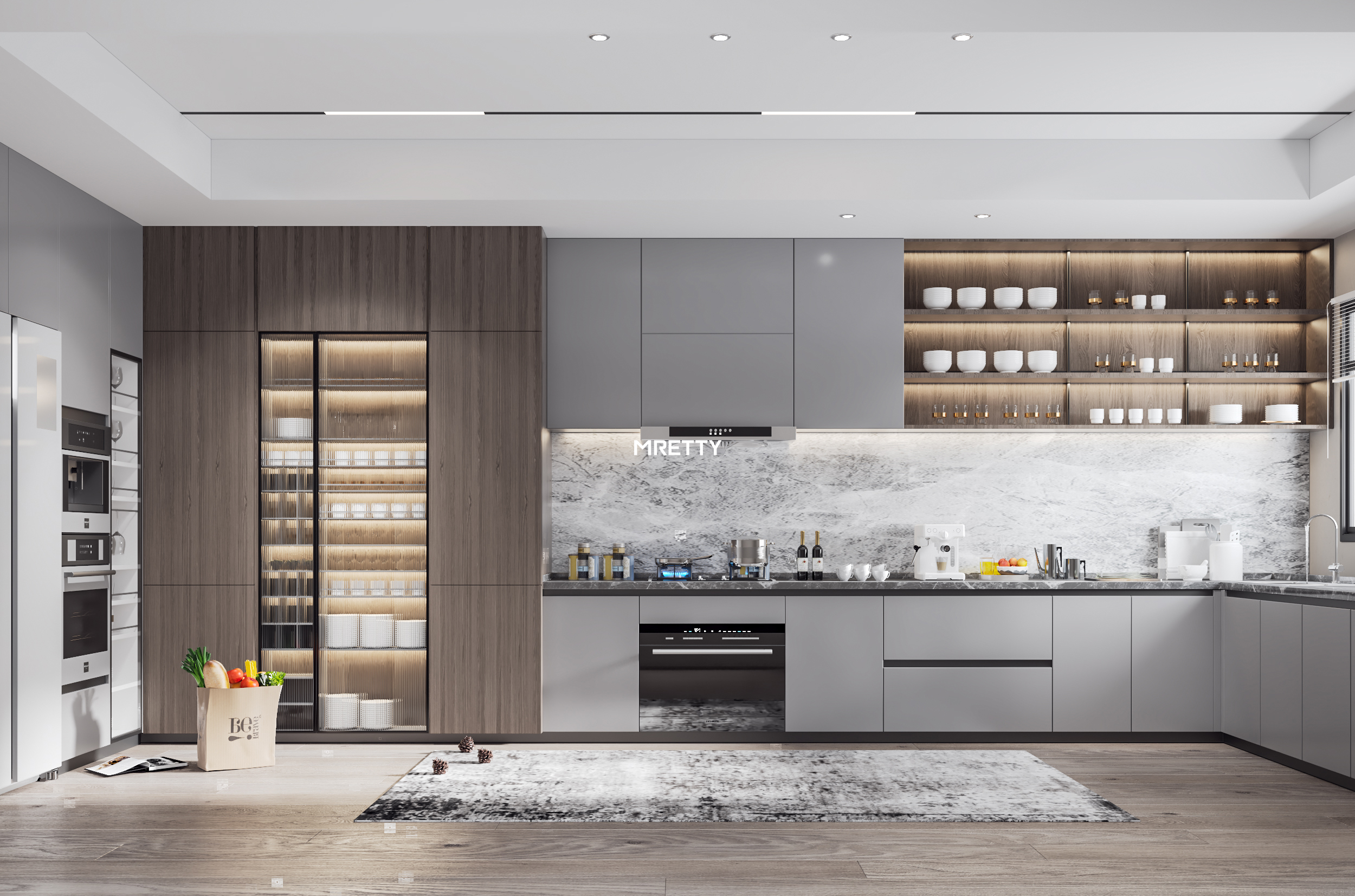
The Kitchen: The Workhorse of the Home
Your kitchen endures heat, oil, water, and heavy usage.
- Recommendation:
- Core: High-quality Water Resistant Plywood. - Finish: High-Pressure Laminate (HPL) or Acrylic. - Countertops: Sintered Stone or Quartz (Note: MRETTY specializes in the cabinetry systems beneath these tops).
- Why: You need materials that won't swell when the inevitable pipe leak happens or when you're washing down surfaces.
The Bedroom Wardrobe: Style Meets Storage
Wardrobes generally face less moisture but require large, straight panels for doors.
- Recommendation:
- Core: Plywood or High-Density Blockboard for structural integrity. - Doors: Plywood with Laminate, or Glass/Aluminum frame doors for a modern luxury look. - Interiors: Melamine-faced plywood for easy cleaning and scratch resistance.
- Why: While MDF can be used for doors to achieve complex routed designs, plywood carcasses ensure the wardrobe structure remains rigid for decades.
The Bathroom Vanity: The Wet Zone
This is the most hostile environment for wood products.
- Recommendation:
- Core: Strictly Marine Plywood or waterproof WPC (Wood Plastic Composite) boards. - Finish: Laminate with seamless edge banding.
- Why: Steam and splashes are daily occurrences. Standard materials will peel and rot within a year or two.
The Living Room TV Console & Display
Aesthetics are key here.
- Recommendation:
- Core: Plywood is versatile enough for floating consoles (wall-hung) as it holds wall anchors securely. - Finish: Wood veneer, textured laminates, or fluted paneling designs.
- Why: Safety is paramount for wall-hung units; plywood provides the necessary screw-holding strength to prevent units from falling.
MRETTY vs. The Rest: The Premium Difference
In the crowded Singapore renovation market, it is easy to get confused by low quotes that hide low-quality materials. Here is how MRETTY stands apart in the realm of bespoke cabinetry.
Material Transparency
Many contractors quote "solid plywood" but use low-grade soft-wood plywood with gaps in the core layers. MRETTY uses premium-grade, void-free plywood cores that offer superior structural integrity. We are transparent about what goes inside your cabinets.
The ENF Promise
As mentioned, we don't just meet standards; we aim to exceed them. Our commitment to ENF-certified materials means you aren't just buying furniture; you are investing in a healthier home environment free from harmful VOCs.
Customization Capability
We are not selling boxes off a shelf. MRETTY is a full-house custom solution provider. Whether it's a walk-in closet, a complex kitchen island layout, a study room bookshelf, or a bespoke shoe cabinet at your entryway, we tailor every millimeter to your floor plan.
Edge Banding Technology
The edge of a cabinet door is its weakest point against water ingress. MRETTY utilizes advanced edge-banding machinery that applies ABS edging with minimal glue lines, creating a near-seamless bond that protects the core material from humidity.
Cost Analysis: Investing in Quality
"Is it worth paying more for better materials?" This is the most common question we hear.
Let’s break it down over a 10-year period.
Scenario A: The Budget Choice (Low-Grade Particleboard)
- Initial Cost: $5,000 for a kitchen.
- Year 3: Edges start peeling due to humidity.
- Year 5: Sink cabinet floor rots from a minor leak; drawers start to misalign as screws loosen in the chipboard.
- Repair/Replacement Cost: $6,000 (prices rise over time).
- Total Cost: $11,000 + Stress + Inconvenience.
Scenario B: The MRETTY Choice (Premium Plywood & ENF Materials)
- Initial Cost: $7,500 for a kitchen.
- Year 3: Looks brand new.
- Year 5: Structurally sound.
- Year 10: Still functioning perfectly.
- Total Cost: $7,500.
Conclusion: Investing in high-quality materials upfront is cheaper in the long run. Cabinetry is a permanent fixture; unlike a sofa, you cannot easily swap it out.
Conclusion: Making the Right Choice for Your Home
Choosing materials for your Singapore home renovation is a balancing act of budget, aesthetics, and durability. However, given our tropical climate and the intense usage typical of Singaporean households, skimping on the core material of your cabinetry is a risk not worth taking.
At MRETTY, we believe that true luxury lies in longevity and health. By opting for superior plywood cores, robust laminates, and ENF-certified eco-friendly materials, you are ensuring that your home remains a sanctuary of comfort and style for years to come.
Your home deserves the best. Don't settle for "good enough." Choose materials that honor your investment and your family's well-being.
Ready to Transform Your Space?
Whether you are looking for a sleek modern kitchen, a luxurious walk-in wardrobe, or a smart storage solution for your living area, our team of experts is ready to guide you.
"Design is not just what it looks like and feels like. Design is how it works." – Steve Jobs. Let us make your home work beautifully for you.
Book a Free Consultation Now
Author: Yang Song
Senior Design Consultant, MRETTY
Winner of the 2024 Asia-Pacific Interior Design Excellence Award
Specialist in High-Efficiency Spatial Planning for Urban Homes
MRETTY: Premium Bespoke Kitchen & Cabinet Systems Provider in Singapore.
Frequently Asked Questions (FAQs)
Q1: Can I use solid wood for my kitchen in Singapore?
While solid wood is beautiful, it is highly reactive to Singapore's fluctuating humidity. It can warp, crack, and expand, leading to doors that don't close properly. High-quality plywood with a wood veneer or HPL finish is a much more stable and practical choice for our climate.
Q2: What is the difference between E1 and ENF grade materials?
E1 is a standard emission class acceptable in many countries. ENF (Emission Non-Formaldehyde) is a much stricter standard, indicating that the material releases practically zero formaldehyde. MRETTY prioritizes ENF materials to ensure the safest possible air quality for your home.
Q3: How do I maintain my MRETTY cabinets?
For HPL and acrylic surfaces, a soft cloth dampened with warm soapy water is usually sufficient. Avoid abrasive scourers or harsh chemical cleaners. Wipe spills immediately to prevent any potential moisture issues at the seams.
Q4: Do you provide countertops and appliances?
MRETTY specializes in the bespoke design and manufacturing of the cabinetry systems (kitchen cabinets, wardrobes, vanity units, etc.), wall paneling, and select interior doors. While we coordinate seamlessly with countertop and appliance dimensions to ensure a perfect fit, we focus our manufacturing expertise on the cabinetry itself.
Related Products
- Bespoke Kitchen Systems
- Luxury Walk-in Wardrobes
- Custom Bathroom Vanities
- Study & Home Office Solutions
