
 Singapore
 China
China
The concept of home is evolving significantly. As we progress into the 21st century, there's a growing demand for living spaces that are both aesthetically stunning and environmentally responsible. This shift heralds the era of Cross-Laminated Timber (CLT) homes, a revolutionary construction method transforming skylines and residential neighborhoods alike. It offers a sustainable alternative to traditional concrete and steel, without compromising on strength or style, recognizing that a home is defined by the life within it and the functionality of its interior spaces.
For homeowners in Singapore and globally, the rise of CLT signifies a move towards natural, breathable, and warm living environments, establishing a new benchmark for eco-luxury. To truly honor the integrity of a CLT structure, the interior elements—specifically cabinetry, wardrobes, and wall systems—must match its quality and sustainable ethos. This is where the synergy between advanced architecture and premium interior customization becomes crucial. This guide will explore the world of CLT, its history, environmental impact, and how brands like MRETTY craft perfect interior systems to complete these architectural masterpieces.
The Rise of Cross-Laminated Timber (CLT)
What is Cross-Laminated Timber?
Cross-Laminated Timber, or CLT, is often called the "concrete of the future" due to its strength, but it boasts a significantly lighter carbon footprint. It is an engineered wood product made from layers of kiln-dried lumber boards stacked in alternating directions at 90-degree angles. These layers are bonded with structural adhesives and pressed to form solid, straight, and rectangular panels.
This cross-lamination process gives the material exceptional dimensional stability and strength. Unlike standard timber, which can warp or shrink, CLT panels remain rigid, allowing them to be used as load-bearing walls, floors, and roofs. It integrates the warmth and beauty of wood into structural engineering, facilitating faster, quieter, and cleaner construction processes.
A Brief History of CLT
The journey of CLT began in Europe in the early 1990s, developed primarily in Austria and Germany. Initially, it was conceived as a method to utilize smaller timber cuts that would otherwise be considered waste. As engineering capabilities advanced, architects recognized the immense potential of these massive timber panels to replace traditional masonry and concrete in both residential and commercial buildings.
Over the past three decades, CLT has expanded from the Alpine regions of Europe to North America, Australia, and parts of Asia. This global adoption has fueled a "Mass Timber" movement, leading to the construction of timber skyscrapers and expansive residential estates. While Singapore is often perceived as an urban landscape dominated by concrete, the increasing push for sustainable building technologies is opening doors for mass timber applications, fundamentally influencing how we perceive luxury and sustainability within our local context.
Why CLT is Revolutionizing Construction
CLT is transforming the construction industry for several compelling reasons:
Speed and Precision: CLT panels are prefabricated in a factory using CNC (Computer Numerical Control) technology, cut to exact specifications. They arrive on-site ready for assembly, much like a giant kit of parts, a precision that mirrors the approach in high-end interior customization where millimeter-perfect accuracy is essential.
Thermal Performance: Wood is a natural insulator, making CLT homes require less energy for cooling—a significant advantage in tropical climates. The solid wood panels provide thermal mass, effectively regulating indoor temperatures and creating a consistently comfortable living environment.
Biophilic Design: Humans possess an innate connection to nature. Living in a structure where wood is the primary element has been shown to reduce stress levels and enhance overall well-being. The exposed wood grain of CLT walls offers a calming, organic aesthetic that paints or wallpapers simply cannot replicate.
Environmental Impact and Sustainability of CLT
The construction industry has historically been a major contributor to global carbon emissions. CLT fundamentally shifts this narrative by offering a more sustainable approach.
Carbon Sequestration
Trees naturally absorb carbon dioxide as they grow. When these trees are harvested and processed into CLT, that carbon remains sequestered within the wood for the entire lifespan of the building. In stark contrast, the production of concrete and steel releases vast amounts of CO2 into the atmosphere. By choosing a CLT home, homeowners are essentially living in a carbon vault, actively contributing to the reduction of greenhouse gases.
Sustainable Forestry
The legitimacy of CLT as a sustainable building material depends heavily on responsible sourcing. The timber used must originate from sustainably managed forests where trees are replanted at a rate exceeding harvesting. This unwavering commitment to environmental stewardship is a core value shared by premium interior brands.
Just as a CLT home relies on certified timber, MRETTY ensures that the materials used in our bespoke cabinetry and wall paneling systems adhere to strict environmental standards. We often utilize FSC-certified sources to guarantee that your luxury interior is as kind to the planet as it is beautiful.
Designing Bespoke Interiors for CLT Homes
A Cross-Laminated Timber home presents a unique aesthetic canvas. The structural walls are often left exposed, celebrating the natural beauty of the wood. This creates both a challenge and an exciting opportunity for interior design: How do you furnish a space that is already so visually rich?
The answer lies in Custom Integrated Systems. Off-the-shelf furniture frequently clashes with the architectural purity of a CLT home. The ideal solution is bespoke joinery that acts as a natural extension of the architecture, seamlessly blending with the timber structure.
The Bespoke Kitchen: Harmonizing with Wood
In a CLT home, the kitchen is much more than a workspace; it is a central focal point that must seamlessly blend with the timber shell.
Material Contrast: To prevent a "wood overload," designers often incorporate matte laminates, stones, or lacquered finishes for kitchen cabinetry. These materials provide a sophisticated contrast to the timber walls. MRETTY’s premium kitchen systems offer a vast palette of finishes—from sleek anti-fingerprint surfaces to textured stone looks—that achieve the perfect visual balance against a natural wood backdrop.
Integrated Design: The precision inherent in CLT construction allows for kitchens that fit flawlessly into alcoves or span entire walls without unsightly gaps. A MRETTY custom kitchen maximizes every inch of space, utilizing floor-to-ceiling cabinetry that enhances the height and grandeur of the timber structure.
The Island Centerpiece: In an open-plan CLT home, a substantial kitchen island serves as a vital anchor for the space. Custom-designed islands, often featuring integrated storage and dining extensions, become the social hub, effectively bridging the gap between the culinary zone and the primary living area.
Wardrobes and Walk-in Closets: Structural Elegance
The storage demands of a modern family extend far beyond the capacity of a simple cupboard.
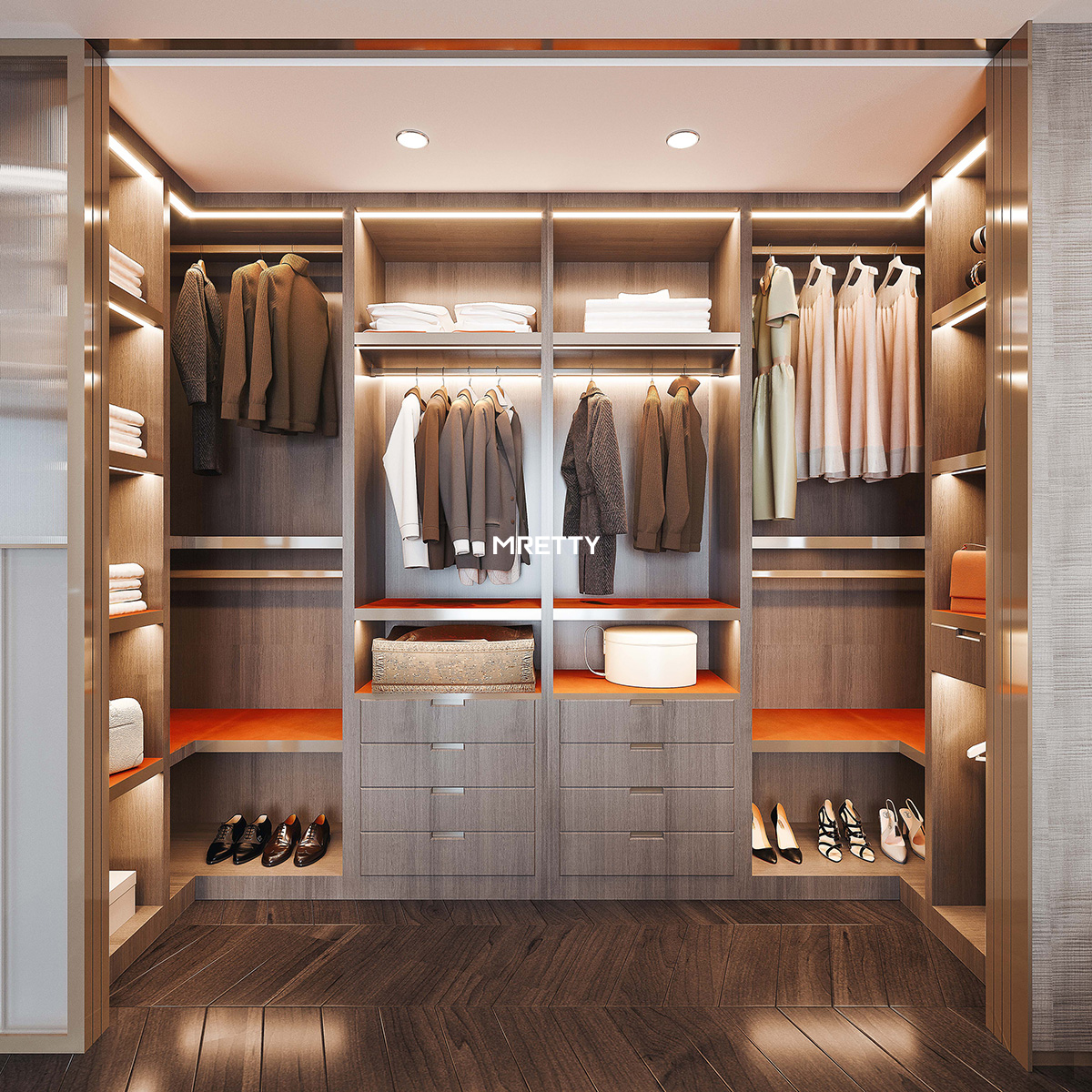
Built-in Perfection: In a CLT home, freestanding wardrobes can often appear as an afterthought. The ideal solution is a Walk-in Closet or a built-in wardrobe that feels intrinsically connected to the building's core design. MRETTY’s systems are precisely engineered to integrate directly with the building’s dimensions, delivering a streamlined look that enhances the overall sense of spaciousness.
Organizational Luxury: Beyond the exterior finish, the internal configuration is paramount. Customized compartments for accessories, dedicated long-hanging sections for evening wear, and soft-close drawers for delicates ensure that the wardrobe is a true sanctuary of order and efficiency.
Glass and Aluminum: To introduce a contemporary touch and modernize the rustic appeal of timber, MRETTY often incorporates aluminum frame glass doors into wardrobe designs. This transparency adds a layer of sophistication and allows light to flow freely, preventing the substantial timber walls from making the room feel enclosed.
Wood Wall Paneling: The MRETTY Signature
While CLT walls possess inherent beauty, not every partition in a home is constructed from structural timber. For partition walls or renovation projects in concrete condos (such as HDBs or private apartments) aiming to emulate the CLT aesthetic, Custom Wood Wall Paneling offers the perfect solution.
Creating Atmosphere: MRETTY specializes in high-quality wood veneer and laminate wall paneling that can transform a cold concrete room into a warm, inviting space reminiscent of a timber home. These panels can be thoughtfully designed with integrated hidden doors, leading to areas like a bathroom or pantry, thereby creating a seamless, uninterrupted visual flow.
Acoustic Benefits: Much like CLT, applied wall paneling can effectively dampen sound, creating a quieter and more intimate acoustic environment. This makes it an ideal solution for spaces such as home theaters or dedicated study rooms.
The Study and Home Office
The contemporary work-from-home era necessitates a dedicated, well-designed workspace.
Ergonomics and Storage: A custom study unit by MRETTY skillfully combines ergonomic desk heights with extensive shelving for books and files. By customizing the shelving to the exact height of the room, we ensure efficient utilization of vertical space, keeping the floor area clear and the room feeling spacious and uncluttered.
Entryway and Shoe Cabinets
First impressions are critical. In a home that celebrates structure and order, a cluttered hallway is simply unacceptable.
Discreet Storage: Custom entryway systems provide discreet storage for shoes, bags, and daily essentials behind sleek, handleless doors. These units can be designed to float elegantly above the floor or seamlessly integrate a seating bench, effectively merging essential functionality with high design.
MRETTY vs. The Competition: Why Choose MRETTY?
When investing in a high-concept home or undertaking a premium renovation, the selection of your interior fit-out partner is paramount. Discerning homeowners consistently choose MRETTY over standard contractors or mass-market brands for several compelling reasons:
| Feature | MRETTY (Premium Bespoke) | Standard Mass-Market Brands | General Contractors |
| :----------------- | :------------------------------------------------------------------------------------ | :----------------------------------------------------- | :---------------------------------------------------------- |
| Material Quality | High-grade, eco-friendly substrates (E0/Super E0), FSC-certified options, moisture-resistant. | Standard particle board, often with higher formaldehyde emissions. | Variable quality, often dependent on lowest cost suppliers. |
| Customization | 100% Tailored. Every millimeter is accounted for. Flexible internal configurations. | Modular "blocks" with fixed sizes. Filler strips used to hide gaps. | Custom on-site fabrication, but often lacks the finish quality of factory precision. |
| Design Integration | Holistic approach. We design systems (kitchen, wardrobe, paneling) to flow together visually. | Disjointed. Kitchen design may not match the wardrobe or living area units. | Functional but often lacks high-end aesthetic sensibility. |
| Hardware | Premium international hardware (runners, hinges) ensuring longevity and soft-closing luxury. | Standard generic hardware that may fail or sag over time. | Basic functional hardware. |
| Sustainability | Committed to sustainable practices and non-toxic materials, safe for families. | Often prioritize cost over environmental safety. | Rarely a priority unless specified (and charged extra). |
The MRETTY Difference: We understand that a wardrobe is more than just a box for clothes, and a kitchen is more than a set of cupboards. They are meticulously engineered systems designed to enhance your daily life. Our philosophy aligns perfectly with the precision and quality inherent in CLT construction—built to last, built for purpose, and built with profound respect for the environment.
Customer Showcase: Case Studies
While CLT is primarily an architectural method, its principles of precision and nature-inspired living are skillfully applied in many of our projects across Singapore's most prestigious residences.
Case Study: The "Urban Sanctuary" Condo Renovation
Client: The Lee Family
Brief: The clients expressed a strong desire for the aesthetic of Japanese and Scandinavian timber homes but resided in a modern concrete condo. They aimed to infuse warmth and sustainability into their high-rise unit without using structural timber.
The MRETTY Solution:
Living Area: We installed full-height wood veneer wall paneling that ingeniously concealed the entrance to the household shelter and the master bedroom, creating a clean, seamless timber-box effect.
Kitchen: A minimalist open kitchen was designed, featuring matte grey cabinetry to provide a striking contrast with the wood panels, and was equipped with a custom island perfect for family breakfasts.
Master Robe: A walk-in closet system using our "Airy" profile—a combination of open shelving mixed with elegant glass-door cabinets—was implemented to maintain a light, spacious feel.
Outcome: The client's feedback: "MRETTY transformed our cold apartment into a warm home. The wall paneling feels so solid and premium, it’s like living in a different building entirely."
Frequently Asked Questions (FAQ)
Q: Does MRETTY actually build CLT structures?
A: No, MRETTY specializes in the interior fit-out and custom joinery systems (kitchens, wardrobes, cabinetry, wall paneling). We are the perfect partner to finish the interior of a CLT home or to introduce the high-end timber aesthetic into a standard concrete home through our paneling and cabinetry solutions.
Q: Can your materials withstand Singapore's humidity?
A: Absolutely. We utilize high-quality, moisture-resistant substrates for our cabinetry and paneling. Our materials are rigorously tested to withstand the tropical climate, ensuring that your investment does not warp or degrade over time.
Q: What is the lead time for a whole-house customization project?
A: Typically, a full-home project ranges from 8 to 12 weeks from design confirmation to final installation. This timeframe allows for precise factory manufacturing and stringent quality control before the units arrive at your home.
Q: Do you offer eco-friendly options?
A: Yes, sustainability is a core pillar of our philosophy. We offer boards with low formaldehyde emissions (E0 standards) and source materials from sustainable suppliers. This commitment ensures your indoor air quality remains healthy and safe for your family.
Related Products for Your Home
Enhance your living space with MRETTY's range of specialized systems:
Custom Kitchen Systems: From efficient dry kitchens with islands to robust heavy-duty wet kitchens, all tailored precisely to your cooking habits.
Luxury Walk-in Wardrobes: Boutique-style storage solutions designed specifically for your cherished fashion collection.
Bespoke Study & Bookshelves: Integrated home office solutions crafted for maximum productivity and aesthetic appeal.
Decorative Wall Paneling: Premium wood and laminate cladding ideal for creating stunning feature walls and seamlessly integrating hidden doors.
Entryway & Shoe Storage: Organized and well-ventilated cabinets to ensure a welcoming and clutter-free entrance.
Bathroom Vanity Units: Moisture-resistant, floating, or floor-standing designs that contribute to a spa-like and luxurious bathroom experience.
Conclusion: Crafting a Sustainable Legacy
Cross-Laminated Timber homes are far more than a fleeting trend; they stand as a powerful testament to what is achievable when advanced engineering harmonizes with nature. They represent a future where our homes actively contribute to the well-being of the planet. However, a sustainable structure inherently deserves an interior that eloquently echoes its foundational values.
Choosing MRETTY means selecting a partner who deeply understands the nuances of high-end design and the profound importance of environmental responsibility. Our unwavering commitment to using high-quality, responsible materials ensures that your custom cabinetry and wall systems are not only safe for your family but also actively contribute to a greener world. We diligently leverage the rigorous standards of forestry certifications, such as FSC, in our material selection process to provide you with complete peace of mind.
Whether you are embarking on the construction of a new timber home or undertaking a renovation of a condo to reflect a natural ethos, our dedicated team is poised to transform your vision into reality with unparalleled precision, exquisite style, and a steadfast commitment to sustainability.
Ready to elevate your home with premium bespoke interiors?
[Book a Free Consultation Now]
Written by:
Pan Junqi
Principal Designer at MRETTY
Pan Junqi is a celebrated figure in Singapore's interior design scene. Known for his "Minimalist-Organic" approach, he recently received the Excellence in Residential Design Award 2024 for his work on the "Verdant Hills" project, which seamlessly integrated custom bespoke joinery into a sustainable architectural framework.
MRETTY: Premium Bespoke Kitchen & Cabinet Systems Provider in Singapore.
