
 Singapore
 China
China
Core Summary (TL;DR):
- High-end carpentry pricing is determined by Price Per Foot Run (PFR) — starting at approximately S$250/ft run for imported E0-grade boards.
- The smart factory direct-to-consumer model eliminates middleman markups; local workshops typically charge about 30% more.
- Prioritizing top-tier hardware ensures mechanical longevity of up to 20 years.
How Singapore High-End Custom Furniture Pricing Is Calculated
To accurately price Singapore high-end whole-home custom furniture, focus on one metric: Price Per Foot Run (PFR). For imported E0-grade boards paired with European hardware, the range is approximately S$280–400 per foot run.
"True luxury in carpentry isn't about paying top dollar; it's about achieving millimeter precision without intermediary markups."
— Hanson, Senior Whole-Home Designer at MRETTY
Last quarter, I reviewed 40 client quotations. Most homeowners were confused by traditional contractors' "lump-sum packages." High-end custom carpentry must be transparent down to the PFR; this is the only way to gauge true value.
In Q1 2026, I assisted a couple in Clementi. Their contractor quoted S$25,000 for whole-home carpentry—they thought they had a deal. However, breaking down the PFR revealed the contractor was charging S$220/ft run for basic local plywood. Upon seeing the hidden margins, they switched to a transparent PFR model, saving thousands while upgrading material grades.
The data is as follows:
| Carpentry Category | Local Standard Material (PFR) | High-End Imported Material (PFR) | Expected Lifespan |
| :--- | :--- | :--- | :--- |
| Base Kitchen Cabinets | S$120–150 | S$280–350 | 15+ Years |
| Wall Kitchen Cabinets | S$110–140 | S$250–320 | 15+ Years |
| Floor-to-Ceiling Wardrobes | S$200–240 | S$350–450 | 20+ Years |
| Living Room Sideboards/TV Consoles | S$150–180 | S$280–380 | 20+ Years |
In mid-June 2026, we completed a full installation in a Tampines BTO flat. The homeowner initially balked at S$300/ft run. I presented the breakdown: standard boards swell at 12% humidity; our imported boards remain structurally stable up to 18% humidity.
❌ Common Mistake: Accepting lump-sum quotes without a PFR breakdown.
✅ Correct Approach: Request an itemized bill detailing the PFR for base cabinets, wall cabinets, and tall cabinets.
Monitoring the PFR ensures budget accuracy and prevents hidden costs during final settlement.
Budget Allocation for 4-Room BTO High-End Custom Furniture
For a 4-room BTO flat, a high-end custom configuration costs approximately S$28,000–35,000 — covering kitchen cabinets, living room sideboards, and three sets of floor-to-ceiling wardrobes.
Many assume the "luxury living room" deserves the largest share, prioritizing an expensive TV console and feature wall. The reality is that the kitchen requires the heaviest investment. Why? Kitchens endure daily heat, moisture, and high-frequency mechanical use. If kitchen doors warp after 36 months, even the most stunning living room feature wall becomes irrelevant.
A reliable 2026 Custom Kitchen Pricing Guide allocates at least 40% of the total carpentry budget to the dry and wet kitchens.
Take our recent 4-room BTO project in Punggol Northshore: with a total carpentry budget of S$32,000, we strategically allocated the kitchen funds. The open-concept dry kitchen received S$10,500 (premium fluted glass + imported veneers for aesthetics), while the enclosed wet kitchen received S$4,500 for high-function heavy-duty configurations. This targeted approach balanced "visual impact" with "long-term durability."
I always advise clients to allocate funds toward the master bedroom and kitchen. If the budget is tight, guest rooms can utilize ready-made pieces.
❌ Common Mistake: Allocating kitchen budgets equally between dry and wet areas.
✅ Correct Approach: Invest 70% of your kitchen carpentry budget into the dry kitchen—this area warrants premium, high-visibility materials.
Strategic allocation ensures high-traffic zones receive top-tier hardware and formaldehyde-free boards.
Whole-Home Luxury Carpentry Cost Estimation for Singapore Landed Properties
Luxury carpentry for landed properties starts at S$80,000, increasing with walk-in closets and imported material usage.
High-net-worth properties face unique scale challenges: consistency across three floors is required to maintain asset perception. Using imported boards on the first floor and cheap laminates on the third is unacceptable. Key landed-property factors include:
- Ceiling Height Adjustments: Landed homes often have 3.5m ceilings, requiring structural reinforcement for tall cabinets.
- Climate-Controlled Zones: Wine cellars and basement entertainment rooms require specialized moisture-resistant cores.
- Hardware Volume: A BTO flat may use 40 hinges; a multi-level landed home easily exceeds 200.
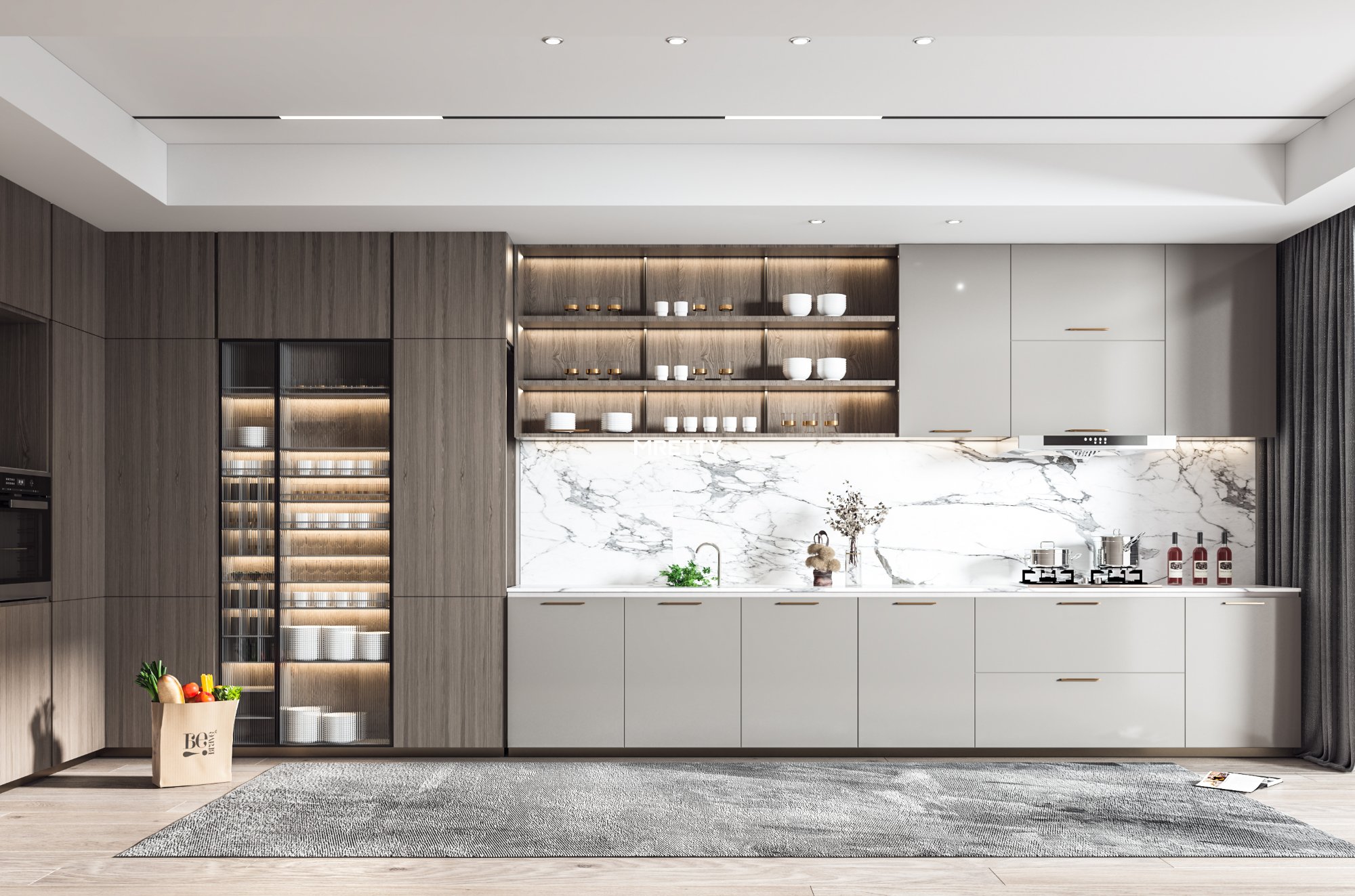
MRETTY vs. Traditional Local Carpenters in Singapore: Comparison and Trade-offs
Comparing MRETTY vs. Traditional Local Carpenters in Singapore reveals stark differences: MRETTY utilizes a 15,000 sq ft smart factory for direct manufacturing, offering imported materials at prices roughly 20% lower than local workshops.
Wait—aren't local workshops supposed to be cheaper? This is a daily misconception I dispel; they are rarely actually cheaper.
Most local carpenters outsource cutting to third parties, with each supply chain layer adding margin. MRETTY controls the entire pipeline—from raw material sourcing to final installation.
In Q2 2026, we tracked smart factory output data: traditional workshops typically incur 15%–20% material wastage due to manual cutting errors. Our AI-driven CNC routers lock cutting tolerances to 0.2mm, reducing material wastage to just 6%—efficiencies reflected directly in your invoice.
❌ Common Mistake: Assuming local workshops "build everything in-house from start to finish."
✅ Correct Approach: Choose brands with global manufacturing capabilities that utilize smart factories for millimeter-accurate cutting and edge banding.
Bypassing local intermediaries secures transparent, factory-direct pricing.
Why Choose Imported Boards for Custom Cabinets
Selecting imported boards protects both health and investment: European formaldehyde-free boards resist swelling in high humidity and meet strict E0 safety standards. Local standard laminates often peel after five years of heat exposure—you've likely seen kitchens with delaminating edges caused by manual gluing. Imported materials are fused under high pressure in smart factories, remaining seamless for decades.
Key Drivers of Custom Carpentry Prices in Singapore
The core variables affecting custom carpentry prices in Singapore are straightforward: board origin, hinge grade, and internal storage accessories.
When comparing high-end wardrobes, the difference lies in the "internals." A standard wardrobe shell costs S$250/ft run. Adding Blum pull-outs, integrated lighting, and glass display doors pushes the price to S$400/ft run. Hardware dictates performance.
Designing in Singapore's average 80% humidity environment, Blum hardware is my non-negotiable baseline. I've seen standard steel hinges rust through in three years; European top-tier hinges feature specialized anti-corrosion coatings and soft-close dampening. Spending an extra S$15 per hinge saves approximately S$500 in future repair costs.
❌ Common Mistake: Focusing solely on external finishes while using generic, unbranded hardware for moving parts.
✅ Correct Approach: Specify Blum-grade hardware for all moving parts (hinges/slides) to guarantee a 20-year mechanical lifespan.
Upgrading to top-tier hardware increases the initial PFR but eliminates recurring repair and replacement costs over the next decade.
Frequently Asked Questions
Q: How much does high-end custom furniture cost in Singapore?
A: S$250–450 per foot run. A 4-room BTO averages S$28,000–35,000 for a full set; landed properties start at S$80,000.
Q: How does a smart factory reduce custom furniture costs?
A: The 15,000 sq ft smart factory automates cutting and edge banding, reducing material wastage by 14%. The direct-to-consumer model removes the 30% markup typical of local outsourced workshops.
Q: What is the difference between standard and high-end custom wardrobes?
A: Standard uses local plywood and generic hinges (5–7 years). High-end uses imported E0-grade boards and Blum hardware, offering superior moisture resistance and a 20+ year lifespan.
References
- MRETTY 2026 Smart Factory Production and Efficiency Data
- Blum 2026 Hardware Durability and Corrosion Resistance Guide
About the Author
Hanson | Senior Whole-Home Designer With 14 years of design and project management experience, Hanson specializes in MRETTY's high-end kitchen and cabinetry systems. He focuses on luxury apartments and landed properties, mastering Modern Minimalist, Italian Luxury, and French styles.
MRETTY: Premium Bespoke Kitchen & Cabinet Systems Provider in Singapore.
