
 Singapore
 China
China
TL;DR: Your MRETTY quotation is driven by three big levers—materials, dimensions, and hardware.
A typical cost structure looks like this: materials (boards & finishes) ~40–50%, craftsmanship & installation ~25–30%, hardware ~15–20%, with the balance covering design, logistics, and service. MRETTY uses higher-grade E0-grade boards and precision smart-factory production; the headline number may look close to many on-site carpentry quotes, but the difference shows up in health, fit accuracy, and long-term cost of ownership.
👉 Get a line-item, no-obligation MRETTY quotation and see exactly where your home's investment goes.
Can Custom Interior Fitting Increase Resale Value?
Market research suggests that in Singapore, high-quality, integrated custom storage is increasingly a material plus-factor for buyers. The impact on "realizable value" isn't mystical—it comes from space efficiency, visual cohesion, and durability.
But MRETTY prefers to push the conversation one step forward: it's less a "renovation expense" and more a long-term investment in living quality, family health, and your home's long-term condition.
Last month in a new Tampines BTO, I walked a homeowner through an itemized quotation. They'd been anxious about "overspending." But once they saw where the money actually went—E0-grade board health logic, soft-close hardware daily feel, factory edge-banding vs Singapore humidity—they reframed the spend from "renovation consumption" to "investment in future-proof value."
1) The 3 Core Cost Drivers Behind MRETTY Furniture Pricing
Clients always ask: "How much is MRETTY, exactly?" The only honest answer is—it depends on the choices you and we agree on.
Factor 1: Imported Materials & Eco Grades (Largest Share)
MRETTY's pricing base is a higher-grade, healthier material system:
- We typically specify E0-grade boards (lower formaldehyde emissions, closer to a "near-zero" health aspiration) for core carcasses, rather than cheaper, opaque low-grade options.
- Finish tier decides final look and budget elasticity:
- Laminate / Melamine (HPL/Impregnated Paper): Most controllable, best ROI; massive color/texture range. - Real Wood Veneer / Lacquer: Mid–high tiers; emphasizes "premium feel" and unified tone. - FENIX® / Sintered Stone: High-end technical surfaces—anti-fingerprint, low-glare, refined touch—sitting at the top of the material budget band.
❌ Common mistake: judging only by whether the finish "looks nice," ignoring core board grade and edge-banding process.
✅ Smarter: set the health & moisture-resistance baseline first (E0, edge-seal, structural stability), then express style through finishes.
Factor 2: Dimensions, Layout Complexity & "Engineering" Detail
- Full-height carcasses (2.4m → ~3.2m ceiling) mean more material, more hardware, longer install sequences.
- The more "engineered" the internals (drawers, pull-outs, LED, power integration, angled/radiused corners), the more the smart factory CNC precision matters—and the more it shows up in man-hours & accessory costs.
Factor 3: Hardware Brand & System Level (What You Touch Every Day)
MRETTY tends to spec Blum (Austria) / Hettich (Germany)—hardware with quantifiable cycle-life:
- Soft-close, load-stable, long-term tactile quality.
- Heavy kitchen drawers, high-frequency wardrobe hinges—saving on hardware often "pays back" in repairs and daily annoyance.
2) How to Budget for MRETTY Whole-House Customization
In Singapore, the scariest way to set a renovation budget is "gut feeling." A steadier approach is watch the ratios + watch the variables.
A Typical MRETTY Project Cost Structure (Reference Framework)
| Where the Money Goes | Approx. % | What You're Actually Buying | |:---|:---|:---| | Boards + Finishes (Materials) | 40–50% | E0-grade cores, surface finishes, moisture/seal system | | Craftsmanship & Installation (Workmanship) | 25–30% | Measure → Drafting/Detailing → Factory precision → On-site assembly → Handover | | Hardware | 15–20% | Hinges / Slides / Organizers / Supports / Soft-close systems | | Design, Logistics & Service (incl. GST) | 10–15% | Scheme, 3D/detailing, production scheduling, protection, coordination |
The point of these ratios isn't to sell "doors"—it's to show you're buying a controllable system: design → manufacturing → site handover, closed-loop.
Quick Magnitude Example
A ~2.4m master-bedroom wardrobe in a 4-room flat:
- Standard laminate scheme: roughly S$2,800 upwards
- Upgrade to FENIX®, more internal drawers, lighting integration: can reach S$4,500+
(Final numbers follow your dimensions/layout/confirmation; this is only an "interval feel.")
❌ Classic trap: accepting a "lump-sum total" with no breakdown.
✅ Smarter: ask for an itemized quotation so you can make trade-offs with eyes open.
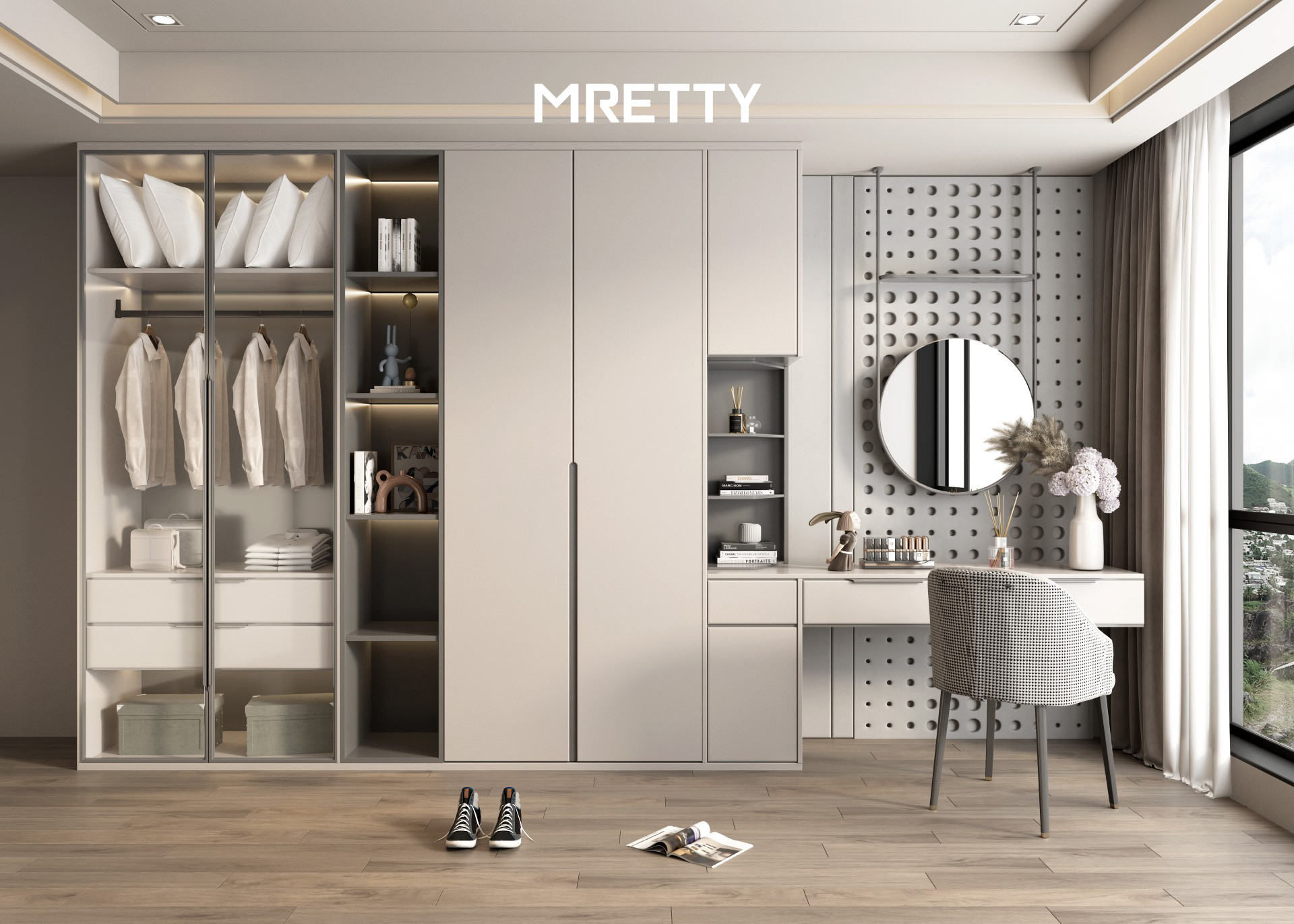
3) MRETTY Pricing vs Local Carpentry & IKEA: Compare Value, Not Just Sticker Price
Comparing "price per foot run" alone is misleading. The fairer question is: what kind of certainty is your money buying?
| Comparison | MRETTY | Local Carpenter (mostly on-site) | IKEA PAX system |
|:---|:---|:---|
| Material health baseline | E0-grade boards (low-emission orientation) | Depends on supplier/quote; commonly E1/E2-tier | Particleboard-core dominant (different positioning) |
| Production accuracy | ~15,000 sqm smart factory ecosystem[citation:brand claim], CNC tolerance controllable to sub-mm level | Mostly manual cutting; stronger on adaptability, weaker on repeatable tolerance | Mass-produced modular |
| Custom freedom | True full-custom (size / scribe / irregular shape) | High, but bounded by manual-ceiling | Fixed modular grid—you adapt to it |
| Edge-banding / moisture stability | Factory PUR/hot-press edge system | Manual edge-banding; harder to guarantee in humid season | Standard edge/tape systems |
| Warranty / traceability | Project-grade QA system | Usually ~1yr-ish, person-dependent | 10-year limited (per module) |
| Lead time | ~45–60 days (detailing + production slot) | ~30–45 days | Faster if in stock |
MRETTY vs Local Carpentry (Singapore)
"Cheaper workmanship" isn't a rule; the source of certainty differs: Carpentry wins on flexibility; MRETTY wins on replicable precision + health baseline. I've seen older apartments with uneven walls where previous carpentry left visible gaps; we used 3D laser scanning + factory cut-tolerance control so panels "absorb" the out-of-plumb—clean scribes, repeatable. That result is hard to stabilize purely by hand.
MRETTY vs IKEA PAX
Not a win/lose—more a needs divide:
- Tightest budget + dimensions happen to fit the grid → IKEA is a valid tool.
- Zero-waste space, unified style, health baseline, long-term tactile quality → MRETTY sits in a different tier.
4) Reference Frameworks: Price Scenarios by Home Type in Singapore
I won't invent a fake "2026 fixed price list." Instead, use scenario logic so you can locate yourself.
Scenario 1|4-Room HDB BTO: Wardrobe + TV/Storage Feature Wall
Goal is usually turn area into volume: full-height carcasses reclaim the top "dead zone," TV wall integrates shoes/displays/cabling. Price-sensitive families tend to put money where it counts: moisture-resistant core + soft-close hardware + sensible internal zoning, with high-ROI laminates doing the visual heavy lifting.
Scenario 2|Condo "Walk-In": When "statement" Meets Layout Limits
Many homeowners assume they must do a walk-in. My field advice: when clear room width is much below ~3.5m, a top-tier full-height built-in + wider circulation often reads larger than a squeezed walk-in. Shift the saved space budget into: glass doors, lighting, internals (jewelry insert / pull-out pants rack / drawer subdivision)—actual luxury improves.
Scenario 3|MRETTY Custom Kitchen: Where Complexity Pays (or Drains)
Kitchen is the system play: carcasses + countertop + appliance integration + M&E coordination.
- Cabinets are just the skeleton.
- Countertop material (quartz/sintered), splash zone, hardware frequency, power & lighting—those decide whether it stays great after 10 years.
5) What the "Real Value" Behind MRETTY Pricing Actually Is
A MRETTY quote number doesn't map to "more expensive door skins." It maps to:
- Health baseline (indoor air is invisible—until it isn't)
- Daily tactile feel (smooth, quiet, precise)
- Ability to correct layout defects (crooked walls, beams, short returns—handled as data)
- Total cost of ownership over time (fewer repairs, fewer replacements, less drama)
You're not buying carpentry. You're buying a deliverable living system.
Frequently Asked Questions (FAQ)
1) Is the MRETTY quotation/consultation really free and no-obligation?
Yes. Based on your floor plan and requirements, we produce an actionable assessment with an itemized quotation and scheme notes; you can take it, compare, and decide.
2) Roughly how much is a MRETTY kitchen in Singapore?
It varies widely: a compact kitchen in standard finishes can start around ~S$8,000; larger layouts with premium finishes/tops/hardware can cross S$30,000+. The driver isn't "average price"—it's your home's area, configuration, and engineering complexity.
3) Why is lead time often quoted ~45–60 days?
Because "custom" isn't warehouse dispatch: detailing/sign-off → material call-off → smart-factory production → QC → scheduled install. Time is spent on controllable quality, not rushed luck.
4) I already have an interior designer—can we still use MRETTY?
Yes. We often collaborate with third-party IDs: they own style & zoning; we take over detailing, production, and install QA. (Boundaries should be written into the contract to avoid "multiple bosses" in one workflow.)
About the Author
This piece is organized by the MRETTY Singapore content team (written from a Senior Designer perspective), based on 14 years of frontline whole-house customization delivery across HDB BTO → Condos → Landed, focused on precision, healthier materials, and long-term usability.
MRETTY: Premium Bespoke Kitchen & Cabinet Systems Provider in Singapore.
