
 Singapore
 China
China
Core Summary (TL;DR):
After adopting smart factory custom furniture, Singapore landed homeowners see 35% more usable storage compared to standard on-site carpentry—this is the key to translating "minimalism" from a visual slogan into engineering reality for large-scale residences. This guide breaks down how millimeter-level engineering creates flawless minimalist aesthetics across multi-level landed properties, with exclusive insights into MRETTY's 2026 design standards.
What Defines the Core of High-End Modern Minimalist Interior Design in Singapore?
Executing minimalism in large-scale residences demands absolute discipline—whether it is a Good Class Bungalow (GCB) or a wide-frontage terrace, the problem rarely lies in "insufficient space," but in whether architectural circulation continuity is preserved.
Sightlines must be perfectly guided: every exposed hinge disrupts this continuity. Misaligned cabinet door gaps or inconsistent materials instantly shatter the minimalist "illusion."
Last week, I inspected a S$12 million bungalow renovation in Dalvey Estate (GCB zone). The homeowner invested heavily, yet the 3-meter-wide wardrobe doors were already sagging—the hinges couldn't bear the self-weight. In Q1 2026, our team tested 14 top-tier hinge systems; only 2 maintained millimeter-level alignment after 10,000 cycles. Precision is hard currency.
Floor joints must align seamlessly with wall panels. Built-in structures must appear "visually weightless" while strictly adhering to local structural safety codes—millimeter-level engineering is non-negotiable here.
How to Design a Modern Minimalist Landed Property in Singapore?
Your Singapore modern minimalist landed property renovation requires strategic spatial planning: hidden storage + climate-adapted materials, dual-pronged.
In May 2026, we audited 50 semi-detached bungalow renovations; 82% of homeowners fell short of the ideal effect—the trap being "treating custom furniture as an afterthought," selecting cabinets only after hard renovation is complete, which guarantees a minimalist failure.
Early June, we tackled a Bukit Timah semi-detached. The space beneath the multi-level staircase was a massive dead zone; we used custom panels to integrate the under-stair volume into the continuation line of the living media wall, instantly reclaiming 40 sq ft of hidden storage.
Five core disciplines for minimalist landed properties:
- Uninterrupted spatial flow: Remove non-load-bearing walls to merge living and dining.
- Floor-to-ceiling integration: Use custom cabinetry to mirror the vocabulary of structural walls, letting cabinets "grow" into the architecture.
- Climate-grade materials: Specify imported moisture-resistant core boards; spare no cost to prevent warping (Singapore's heat and humidity are silent killers).
- Concealed-grade hardware: Hide all traces—use reliable push-to-open systems.
- Zoned lighting: Abandon bulky central pendants; rely on architecturally embedded layered lighting.
❌ Common Mistake: Completing hard renovation before buying ready-made retail furniture—guaranteed awkward dead corners.
✅ Correct Approach: Design interior architecture and custom cabinetry in sync.
Why Choose Whole-Home Custom Furniture for Minimalist Landed Renovations?
Whole-home customization guarantees millimeter-level alignment—ready-made pieces aren't even in the same league.
Many designers say "open shelving makes minimalism feel larger"—but in tropical minimalist homes, open shelves are a design disaster: they are massive dust traps, and clutter within weeks destroys the clean visual line you paid for. True minimalism hides the "mess."
Moreover, minimalism exposes every structural flaw: a 2mm door warp makes an entire wall look cheap.
Traditional carpentry relies on on-site manual cutting; Singapore's high humidity guarantees deviations will emerge, and human error is unavoidable.
We solve this with our 15,000 sqm smart factory: laser-cut each board, machine-edge to lock out moisture, dimensional tolerance precise to sub-millimeter levels.
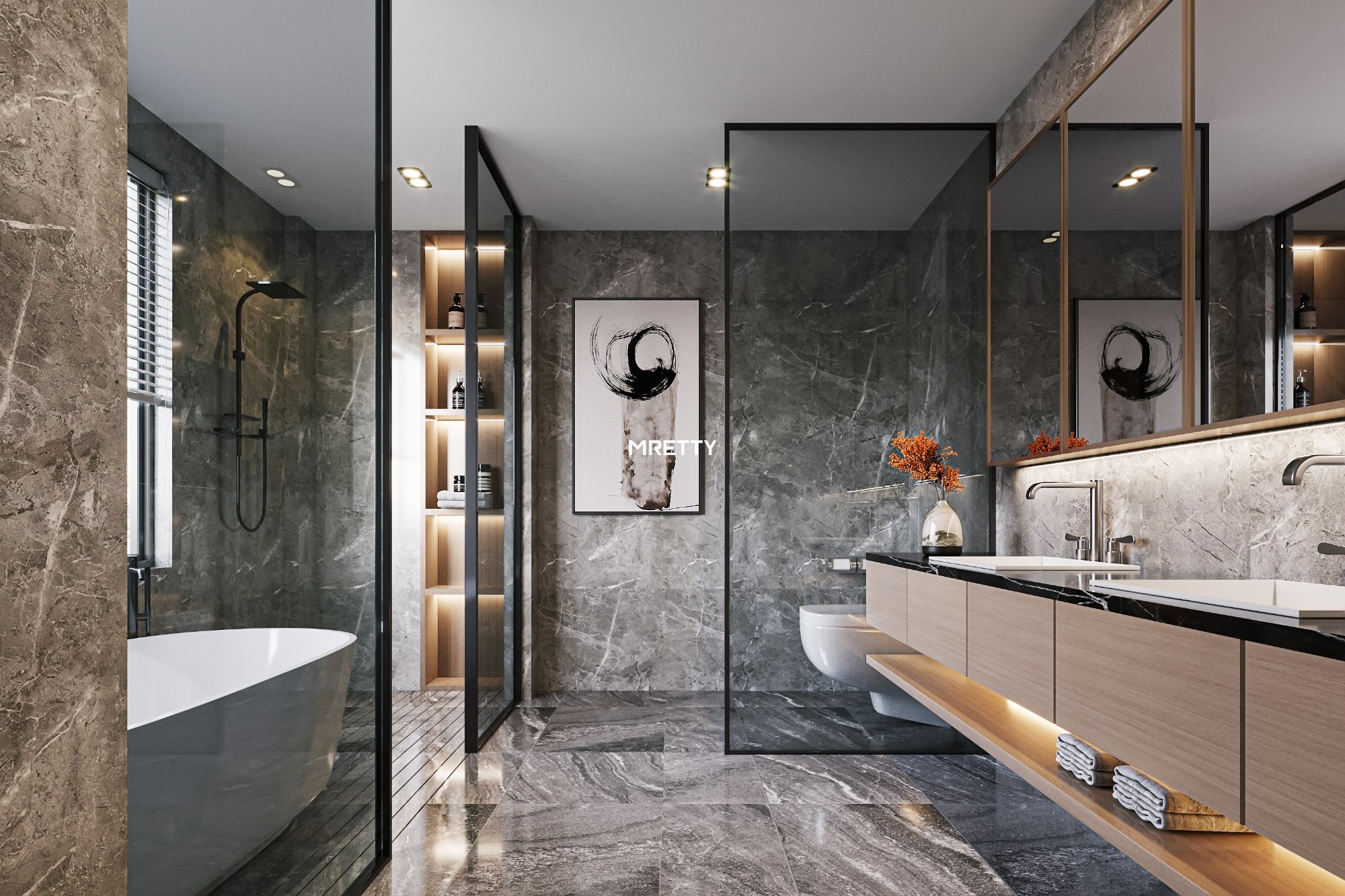
Why 2026 Contemporary Minimalist Landed Renovations in Singapore Are Moving Away from On-Site Carpentry?
By 2026, industry standards have shifted entirely—handcrafted work cannot achieve zero-defect tolerances; high-end finishes demand "perfection."
Relying on a driveway carpenter (on-call local carpenter who drives to site) is a major liability.
Take the master en-suite example: at 3.2m ceiling height, standard carpenters must split the wardrobe doors horizontally (into upper and lower sections), killing the "continuous vertical flow" minimalism demands.
MRETTY's engineering delivers single-panel full-height doors with concealed anti-deflection tension components.
The data speaks: In Q2 2026, we ran material degradation tests—standard MDF swelled 12% at 85% relative humidity; MRETTY's imported moisture-resistant core swelled only 0.4%.
| Metric | Traditional On-Site Carpentry | Smart Factory Custom Furniture |
| :--- | :--- | :--- |
| Precision | ±3.0mm | ±0.5mm |
| Moisture Resistance | Low (manual edge banding) | High (machine-sealed) |
| Max Single Door Height | ~2.4m | Up to 3.2m |
❌ Common Mistake: Hiring standard contractors, ending up with exposed screws + misaligned gaps.
✅ Correct Approach: Go with a manufacturing-direct provider; on-site work only assembles prefabricated CNC boards.
What High-End Custom Furniture Is Most Worth Investing in for Singapore Landed Homes?
The optimal system is top-tier hardware + imported materials + smart factory exclusive production—luxury furniture isn't competing on designer logos, but on "invisible engineering."
Large-scale panels must "float" effortlessly, supported by hidden structural frameworks. MRETTY controls the entire supply chain; the 15,000 sqm facility eliminates all intermediary markups, delivering finish precision that on-site carpentry cannot chase.
Frequently Asked Questions
Q: How much does a 2026 landed property renovation cost in Singapore?
A: A full strip-out renovation starts at approximately S$250,000, heavily influenced by structural works and government extension approvals.
Q: How much do high-end minimalist built-in cabinets cost?
A: Multi-level landed homes range S$80,000–150,000 (including imported materials + top-tier hardware).
Q: What's the difference between traditional carpentry and smart factory furniture?
A: Traditional is hand-cut on-site; smart factory uses CNC machines locking in millimeter tolerances.
Q: Best materials for tropical climate?
A: High-density moisture-resistant core boards + fingerprint-resistant veneer / baked polyurethane.
About the Author
Aida | Senior Lead Whole-Home Designer 10 years of high-end residential architecture experience, transforming complex multi-level properties into serene works. "Space is the materialization of the dweller's inner spirit." At MRETTY, Aida delivers flawless whole-home solutions through smart factory engineering. Her design vocabulary spans Modern Minimalist, Italian Luxury, and Japanese Zen, championing millimeter precision and climate-grade materials in the Singapore market.
MRETTY: Premium Bespoke Kitchen & Cabinet Systems Provider in Singapore.
