
 Singapore
 China
China
TL;DR: Key Points for Small Room Walk-In Wardrobes
Choose the Right Layout: For rooms under 12 sqm, galley or L-shape designs work best.
Prioritize Smart Storage: Use pull-down hanging rails and vertical drawers to double usable space.
Master Visual Tricks: Integrate full-length mirrors and layered lighting to make the space feel larger.
Select Climate-Adaptive Materials: Opt for low-VOC, high-density, moisture-resistant panels to combat Singapore’s high humidity.
1. Is a Walk-In Wardrobe Possible in a Small HDB or Condo Room?
Absolutely. As a designer, the biggest misconception I encounter is that walk-in wardrobes require a massive master bedroom.
The reality? A clever walk-in wardrobe design for a small bedroom hinges on intelligent spatial planning, not sheer floor area. Through customization, we can create a luxurious walk-in experience in rooms previously deemed too small.
For example, a new HDB master bedroom is typically around 14 sqm. A compact walk-in wardrobe needs only about 4-5 sqm. This leaves ample space for your bed and clear circulation paths. It is about rethinking the floor plan, not just filling it.
❌ Common Mistake: Believing you must hack walls or sacrifice an entire room. This is often costly and unnecessary.
✅ Better Practice: Construct a "wardrobe partition." This creates a walk-in area behind the headboard without major structural alterations.
FAQ: What is the Minimum Size for a Walk-In Wardrobe in Singapore?
As a rule of thumb, a small galley walk-in wardrobe requires an area of approximately 1.5m wide × 1.7m deep. This provides 600mm of cabinet depth and a 900mm walkway. This clearance is the minimum comfort standard recommended by Singapore’s Building and Construction Authority (BCA). An L-shape design may require at least a 1.8m × 1.8m corner. These compact walk-in wardrobe ideas are feasible in most HDB and condo rooms.
A well-planned walk-in wardrobe relies on precision customization, not vast square footage. This makes it a viable luxury even in compact urban homes.
2. Best Walk-In Wardrobe Layout for Small Spaces: Galley vs L-Shape
Choosing the right layout is the most critical decision in apartment small bedroom walk-in closet design. For rooms under 12 sqm, you have two realistic options: galley and L-shape. U-shape wardrobes are rarely an option as they require at least 2.1m of width to function properly, which is too bulky for most small rooms.
Galley (or Linear) Layout
This is the most space-efficient layout. It consists of two parallel rows of wardrobes forming a central corridor. You can utilize existing opposing walls or create a partition wall, a common practice in HDB flats.
Minimum Width: 1.5m (600mm wardrobe + 900mm walkway)
Best For: Rectangular rooms; creating a pass-through zone to the master bathroom.
Designer Note: In a recent 3-room HDB project in Bidadari, we created a galley walk-in wardrobe behind the bed. The client was initially hesitant, fearing the partition would make her 10 sqm room feel like a box. But the result transformed her morning routine. Instead of facing messy corners, she gained a dedicated, calm dressing area. She said it felt like a private boutique every morning, reducing stress at the start of her day. It is not just about storage; it is about quality of life.
L-Shape Layout
This layout utilizes two adjacent walls. It helps the room feel more open. It is an excellent choice for square rooms or converting awkward corners into functional storage.
Minimum Area: Approximately 1.8m × 1.8m corner
Best For: Square rooms; integrating wardrobes without building new partitions.
Designer Note: For corner units, I always push clients to invest in quality hardware like Häfele’s LeMans II corner pull-out baskets. It eliminates the "dead zone," making every inch accessible. Standard shelves in deep corners are often a source of future regret.
| Feature | Galley Layout | L-Shape Layout |
| :--- | :--- | :--- |
| Best Suited For | Narrow, rectangular rooms | Square rooms, corner spaces |
| Space Efficiency | Extremely high | High |
| Sense of Openness | Moderate | Good |
| Minimum Walkway | 900mm | Not applicable (opens into room) |
| Suitable for HDB BTO | Yes (partition behind bed) | Yes (utilizing room corner) |
| Cost | Usually lower | Potentially higher if corner hardware is used |
❌ Common Mistake: Forgetting door swing clearance. Standard swing doors require 600mm of clear space. This can ruin a compact layout.
✅ Better Practice: Use sliding doors. Alternatively, adopt an open-concept design within the walk-in area. This saves floor space and improves flow.
Your final choice between galley and L-shape depends on your room’s exact dimensions and your desired circulation flow.
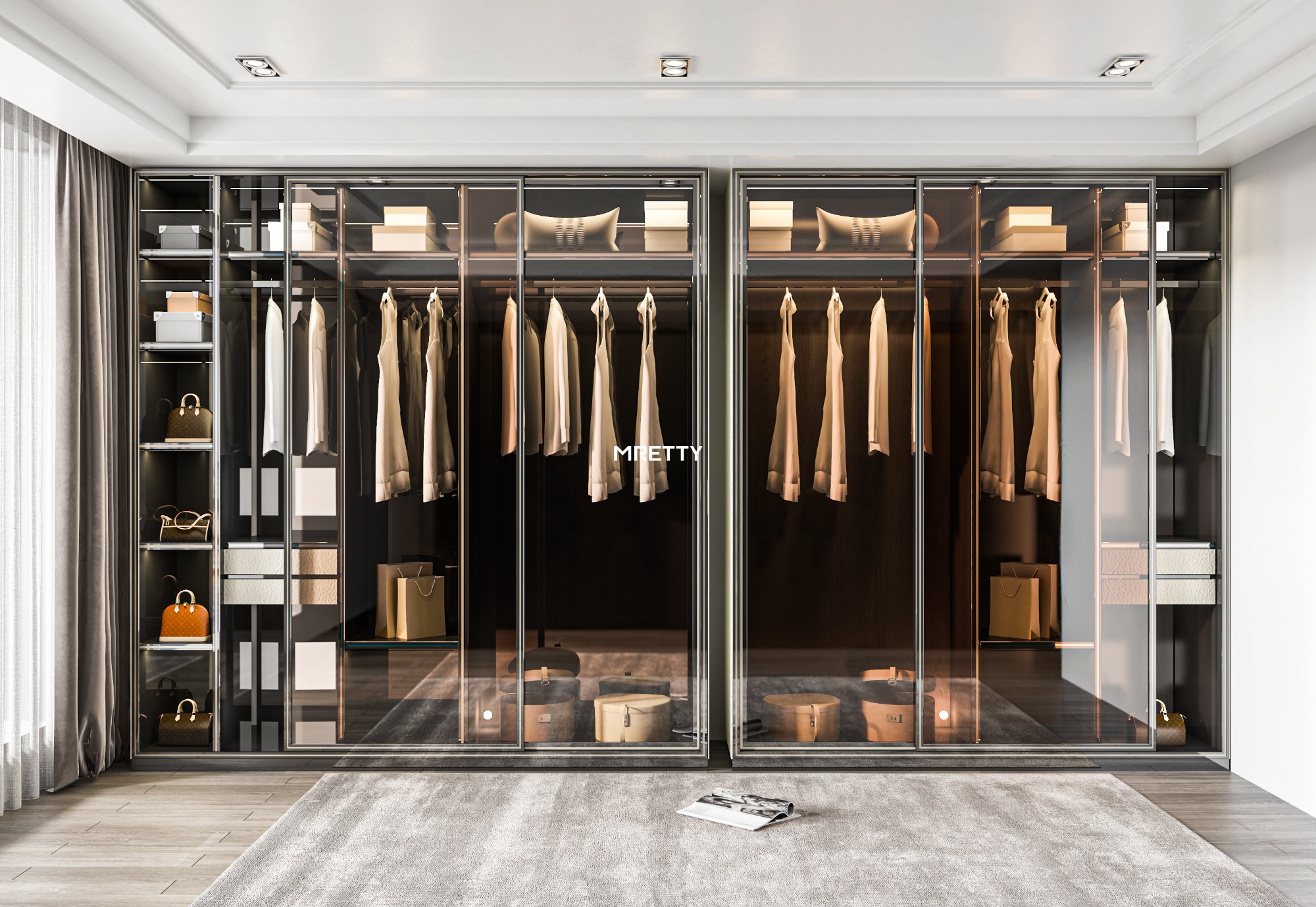
3. 7 Key Strategies for a Small Bedroom Walk-In Wardrobe
Once the layout is chosen, success lies in the details. These are the strategies I use to maximize every cubic centimeter in walk-in wardrobes for small HDB rooms.
- Go Vertical: Most people only use the middle 50% of their wardrobe height. Custom carpentry can extend storage to the ceiling. Use pull-down hanging rails to make high storage accessible.
- Integrate Mirrors: Full-length mirrors are essential. Mirror or reflective glass cabinet doors visually double your perception of space.
- Use Smart Lighting: A single bulb makes a space feel like a cave. Instead, install integrated LED strip lighting inside cabinets and beneath shelves. This improves visibility and adds a high-end boutique feel.
- Opt for Slim Profiles: Bulky frames and thick shelves waste space. MRETTY’s precision engineering allows for stronger, slimmer panels. This gives you extra centimeters of internal storage, adding up significantly.
- Modular Thinking: An effective space-saving walk-in wardrobe layout for a BTO bedroom uses modular design. Consider dedicated shoe drawers, partitioned jewelry trays, and multi-level hanging zones.
- Rethink Open Shelving: A common tip for small spaces is to use open shelving to reduce visual weight. But actually, for walk-in wardrobes, this often backfires. Walk-ins are high-density storage zones. Open shelves packed with clothes and boxes create massive visual clutter. This makes a small space feel more chaotic, not larger. The goal is a serene, boutique-like experience. Strategically using closed cabinetry achieves this far more effectively.
- Create a Walk-In Without Hacking Walls: The partition method is key. A custom floor-to-ceiling partition can double as a headboard and the rear wall of your new wardrobe. It is a structural way to define space without triggering HDB permit hassles.
We recently completed a project at The Sail @ Marina Bay, where the master bedroom had an awkward, non-vertical corner. The client wanted a walk-in wardrobe but believed it was impossible. We used two key strategies. First, we built an L-shaped wardrobe using MRETTY’s slim-profile panels, gaining nearly 5cm of internal depth. Second, we integrated LED lighting in every cabinet. This eliminated dark corners, making the compact space feel bright, open, and luxurious.
❌ Common Mistake: Using off-the-shelf storage boxes. They are inefficient, create wasted gaps, and look cluttered.
✅ Better Practice: Invest in integrated, custom drawers and dividers. This ensures every item has a place and you utilize 100% of the available volume.
FAQ: Is a Walk-In Wardrobe a Good Idea for a Small HDB Flat?
Yes, if designed correctly. Custom walk-in wardrobes typically offer more organized storage than standard wardrobes that fail to utilize the room’s full height. For a typical 3-room HDB flat, a well-designed walk-in wardrobe improves organization and can significantly increase property value.
4. Material Science: Why MRETTY’s Panels Excel in Singapore’s Climate
This is a critical topic. Singapore’s humidity is relentless, averaging over 84%. Your wardrobe is constantly battling moisture. This leads to warped doors, mold growth, and musty odors.
Many carpenters use standard MDF or particleboard. These materials are not rated for high humidity and may swell or delaminate within 2-3 years. MRETTY’s material science offers a distinct advantage.
Our Core Advantage: European Imported E0-Grade Panels
Extreme Moisture Resistance: Our panels are compressed under immense pressure. This creates a high-density core that is significantly more resistant to moisture.
Zero Formaldehyde (E0-Grade): This is the highest safety standard. In an enclosed space like a walk-in wardrobe, minimizing Volatile Organic Compounds (VOCs) is crucial for healthy air. E0-grade means formaldehyde emissions are below 0.5mg/L, far safer than common E1 or E2 grades.
Precision Manufacturing: Our 15,000 sq ft smart factory ensures every panel is cut with millimeter accuracy. Edges are perfectly sealed. This barrier prevents moisture from penetrating the core—the primary cause of panel failure.
Here is an important detail. MRETTY’s panel density exceeds 750 kg/m³. Standard particleboard typically ranges around 600-650 kg/m³. This ~20% density increase has a massive impact on screw-holding strength. It means heavy hardware stays firmly in place for decades. Hinges won’t sag. Drawers won’t misalign. This is the engineering behind a wardrobe that feels solid every time you use it.
Best Practices for Walk-In Wardrobes in Singapore’s Humidity
Design also plays a role in combating humidity. I always incorporate ventilation design. This can be a subtle 10mm gap at the top of the door or designing a cabinet cavity to house a dehumidifier. These small details have a huge impact on the long-term health of your wardrobe.
❌ Common Mistake: Choosing materials based solely on color and price.
✅ Better Practice: Prioritize core density and emission grade. Always insist on E0-grade. A slightly higher initial investment avoids costly replacement costs later.
By choosing climate-adapted materials, you ensure your investment remains beautiful and functional for decades.
5. Planning & Budget: What to Expect
A well-executed walk-in wardrobe is an investment in your home and daily life. Compared to DIY options, professional customization offers superior durability and functionality. Here is a realistic breakdown.
Checklist for Designing a Small Walk-In Wardrobe
Prepare this information before consulting a designer:
Precise Room Dimensions: Measure length, width, and ceiling height.
Your Clothing Inventory: How much hanging space do you need? How many pairs of shoes? How much folded clothing?
Define Your Budget: Understand your comfortable spending range. This helps your designer find the best solution.
Inspiration Images: Gather pictures of styles and functions you like.
As a designer, I caution clients against "Price-Per-Foot" (PFR) quotations. They are highly misleading. Why? PFR pricing is like a restaurant charging per "plate" without telling you if it is chicken rice or lobster. It ignores the factors that determine 80% of the cost: internal configurations, hardware types, door finishes, and lighting. Just last May 2026, a client showed me a low PFR quote that didn’t even include soft-close hinges. The real cost is in the details, not the linear length.
FAQ: How Much Does a Custom Walk-In Wardrobe Cost in Singapore?
As of mid-2026, custom walk-in wardrobe prices in Singapore vary based on size, materials, and complexity. For a high-quality custom solution in a small HDB or condo room, expect the following ranges:
Small Galley / L-Shape (approx. 4-5 sqm): S$4,000 - S$7,000
- Larger or More Complex Designs: S$7,000 - S$12,000+
This price typically includes design, manufacturing using quality E0-grade materials, high-end hardware (e.g., Blum or Häfele), and professional installation. Cheaper options exist but often compromise on material quality and durability.
Last quarter, a client showed me a quotation 30% lower than ours. Upon inspection, the cheaper option used low-grade E2 particleboard and generic hardware. The long-term cost of replacing warped doors and sagging shelves would far outweigh that initial 30% saving.
Your Dream Walk-In Wardrobe Awaits
Do not let limited square meters limit your imagination. With smart planning and the right materials, even Singapore’s most compact bedrooms can enjoy a luxurious walk-in wardrobe experience.
Ready to begin? Let the expert team at MRETTY help turn your vision into reality.
MRETTY: Premium Bespoke Kitchen & Cabinet Systems Provider in Singapore.
