
 Singapore
 China
China
TL;DR: A full renovation for a 4-room HDB typically falls between S$55,000–S$90,000, with a timeline of approximately 10–14 weeks. This guide breaks down the complete process, budget allocation, HDB/BCA compliance essentials, and the pros and cons of different collaboration models to help you avoid the most common pitfalls.
The Bottom Line: A whole-home renovation is a complete reconstruction of your home, encompassing planning, design, approvals, and construction. For a 4-room HDB, success hinges on rigorous project management and integrating a custom furniture system from day one, rather than patching things up later.
1. The 7 Standard Steps of a Whole-Home Renovation in Singapore
A successful renovation must advance in strict sequence. Skipping steps only leads to delays and budget overruns. Below is the fixed process we follow for every resale flat or BTO project:
- Step 1: Financial Planning
Set the total budget and secure funding; most critically, reserve 10%–15% as a contingency fund for unforeseen circumstances.
- Step 2: Design & Spatial Planning
This is where your vision takes shape. Finalize the style, floor plan, and review 3D renderings with your designer. Integrate the custom furniture system at this stage.
- Step 3: Selecting Your Partner
Decide whether to engage an Interior Designer (ID), a contractor, or a Design-Build integrated team. Obtain at least 2–3 detailed quotations and compare based on scope, materials, and project management capability.
- Step 4: Permits & Approvals
Your partner submits applications to the HDB or the Condominium Management Corporation Strata Title (MCST). For structural alterations, BCA (Building and Construction Authority) approval is mandatory. This step typically takes 2–4 weeks—work cannot commence until it is completed.
- Step 5: Demolition & Wet Works
Hacking begins: removing walls, old tiles, and fixtures, followed by masonry, plumbing, and electrical rewiring. This is the dustiest and noisiest phase.
- Step 6: Carpentry, Painting & Finishing
After the heavy work, the beautification phase begins: plastering, painting, flooring installation, and fitting the custom millwork system.
- Step 7: Cleaning, Handover & Defect Checks
Chemical cleaning → room-by-room inspection → walkthrough defect checks with your project manager → official key handover.
❌ Common Mistake: Rushing to hack walls before the 3D design and furniture scheme are 100% finalized.
✅ Better Approach: Lock down the design, layout, and custom furniture completely before breaking ground to avoid costly mid-project changes.
Last quarter, a client undergoing a whole-home HDB renovation decided to shift a wardrobe location after electrical wiring was completed. This "minor adjustment" caused a 5-day halt, costing an extra S$800 for rewiring and replastering. That money and time could have been saved with more deliberation in Step 2.
2. How Much Does a Whole-Home Renovation Cost in 2026?
This is everyone's first question. The final cost depends on property type, size, and scope of works. "Simply refreshing surfaces" versus "stripping everything back to bare concrete" are worlds apart.
Here are the realistic budget ranges for whole-home renovations in Singapore for 2026:
| Property Type | Estimated Total Renovation Cost (2026) |
|---|---|
| 3-Room HDB (BTO/Resale) | S$40,000 – S$65,000 |
| 4-Room HDB (BTO/Resale) | S$55,000 – S$90,000 |
| 5-Room HDB (BTO/Resale) | S$70,000 – S$120,000+ |
| Condominium (<120 sqm) | S$80,000 – S$150,000 |
| Landed Property (Terrace) | S$200,000 – S$400,000+ |
The above amounts typically include masonry, electrical/plumbing, carpentry, painting, and professional fees. Opting for a luxury home renovation in Singapore with high-end imported materials will push budgets significantly higher.
Why are resale flat renovations often more expensive than BTOs?
Resale units usually require extensive hacking: old tiles, old carpentry, old false ceilings. Wiring and pipes often need complete replacement to meet current standards—these are invisible but costly increments.
❌ Common Mistake: Looking only at the "total package price" without scrutinizing the details.
✅ Better Approach: Insist on an itemized quotation. It must specify material brands (e.g., EDL laminate), hardware models (e.g., Blum hinges), quantities, and specifications. Anyone quoting only "one set of kitchen cabinets" is a high-risk signal.
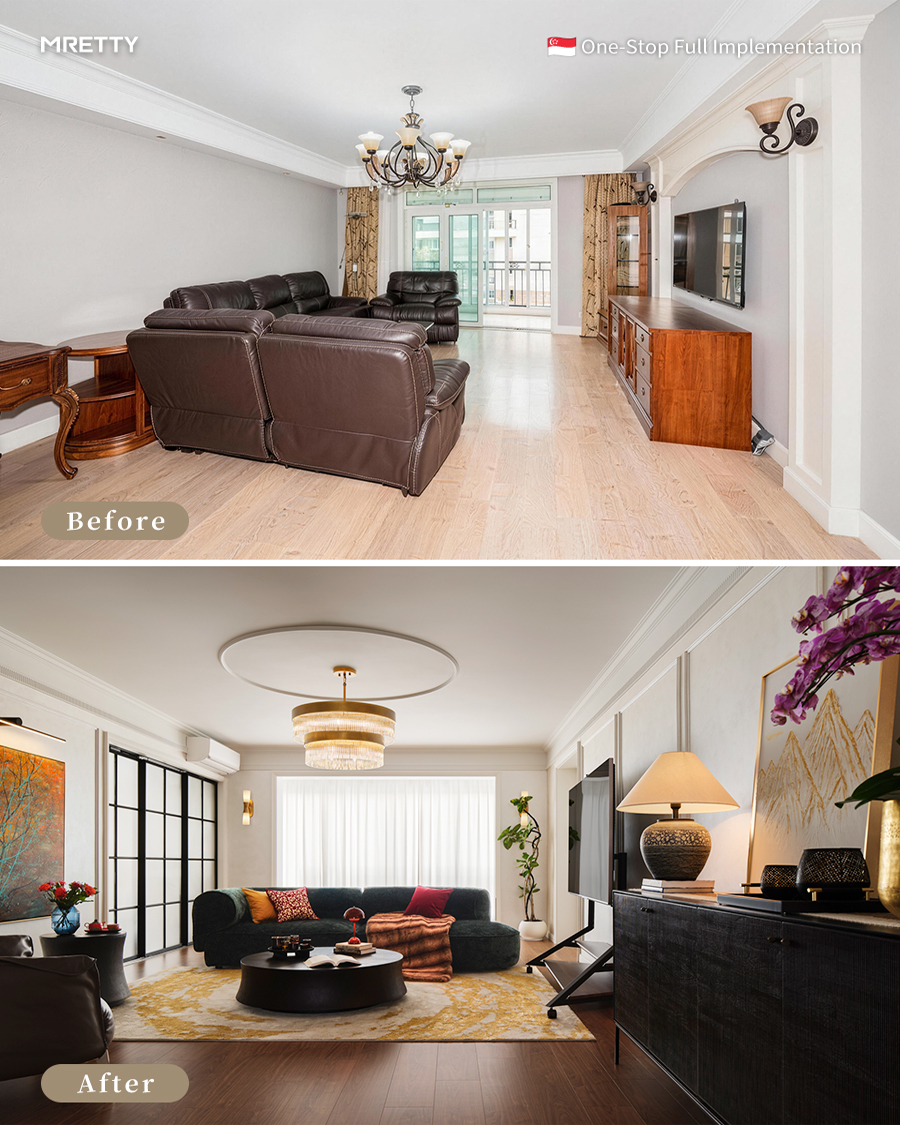
3. The "Furniture-First" Strategy: Building a Home That Truly Fits Your Life
Here is an industry secret: most people treat furniture as an afterthought, buying off-the-shelf pieces only after the renovation is done.
This is fundamentally wrong.
At MRETTY, we advocate "Furniture-First." Meaning: understand your actual lifestyle first, then derive the spatial design backward from the furniture dimensions.
A TV console isn't just a box; it is sized for your specific sound system, with hidden cable management built in. A wardrobe isn't just storage; it is zoned for your exact count of long coats, bags, and shoes.
Integrating custom furniture into your whole-home renovation solves problems before they occur:
- No awkward gaps between cabinets and walls.
- No dead corners left unused.
- No "looks nice but impractical" generic cabinets.
In Singapore's humid climate, material selection is critical. I have seen many expensive carpentry pieces warp within three years. Therefore, we use E0-grade boards (formaldehyde emission below 0.5mg/L, exceeding local safety standards) and emphasize high moisture resistance to prevent cabinet swelling in our local environment.
This approach also clarifies the whole-home renovation timeline. A typical project takes about 10–14 weeks. The prefabrication period for custom millwork is the biggest variable. By planning from day one, we can slot factory production directly into the master schedule, making the completion date far more predictable.
❌ Common Mistake: Waiting until after the renovation to piece together off-the-shelf furniture, resulting in clashing styles and wasted space.
✅ Better Approach: Plan your whole-home custom furniture system during the initial design phase to ensure millimeter-perfect fit and a unified aesthetic.
4. Navigating HDB & BCA Approvals: Your Compliance Checklist
Ignoring regulations can lead to fines or even court orders for demolition. Adhering to rules is a non-negotiable part of any whole-home renovation in Singapore. Your partner should handle this, but you must verify it is done.
HDB Whole-Home Renovation
The contractor must be an HDB-registered renovation contractor and apply for permits for:
- Wall hacking (even non-load-bearing walls)
- Changing floor finishes (tiles/parquet)
- All bathroom works
- Altering window positions or sizes
Condominium Whole-Home Renovation
The management company must submit plans to the MCST (Management Corporation Strata Title), strictly adhering to their rules on noise hours, work timing, and debris disposal.
Involving Structural Changes (Any Residential Property)
If removing beams or enlarging openings, BCA approval is required, backed by a Professional Engineer (PE)'s endorsement of the drawings.
In my view, bypassing permits to "save time" is the most reckless decision a homeowner can make. It is not just about fines; it is about safety. These regulations exist to ensure the structural integrity of your home and your neighbors'. The approval process is a checkpoint performed by qualified professionals on your behalf.
❌ Common Mistake: Assuming "the contractor says they'll handle permits" means everything is settled, without ever asking for proof.
✅ Better Approach: Before work starts, request a copy of the final approval letter from HDB or MCST—this is your only proof of compliance.
5. Choosing the Right Partner: ID, Contractor, or Design-Build?
Project success largely depends on whom you choose. In Singapore, there are three main collaboration models:
- Contractor
Executes only your drawings. Suitable if you already have a complete set of construction drawings and are willing to supervise progress on-site daily. The cheapest option, but demands the most effort from you.
- Interior Designer (ID)
Provides design, spatial planning, and coordination management. ID firms manage various subcontractors for you. Ideal for homeowners wanting creative direction and professional oversight—a balanced choice.
- Design-Build Integrated Company
True "turnkey." One company handles design, planning, construction, and even furniture manufacturing. For complex whole-home renovations, this model offers a single point of accountability, the clearest chain of responsibility, and the best chance of realizing the design intent without dilution.
When searching for the best interior design firm for whole-home renovation, you can filter through platforms like Qanvast or HomeRenoGuru. If your project heavily relies on the tight integration of design and custom millwork, a design-build team with its own factory often holds the advantage in precision and quality control.
❌ Common Mistake: To save money, hiring a designer, contractor, and carpenter separately, leading to finger-pointing among the three parties.
✅ Better Approach: For major renovations, use a single point of contact. An integrated team ensures everyone works from the same set of drawings, under the direction of one project manager.
MRETTY: Premium Bespoke Kitchen & Cabinet Systems Provider in Singapore.
