
 Singapore
 China
China
TL;DR: Quick Answers to Your Top Concerns
- What is the biggest gain? Making the space feel larger, brighter, and more social—perfect for the pace of modern Singaporean family life.
- What is the biggest challenge in Singapore? Managing heavy grease fumes/cooking odors and the psychological pressure of having a "messy kitchen" constantly on display.
- Is it suitable for my HDB? Yes. Provided the planning is sound and the necessary HDB approval processes for "wall hacking/structural changes" are completed, it can completely transform the usability of your entire flat.
1. Understanding the Open-Plan Kitchen and Dining Layout
An open-concept kitchen and integrated dining layout essentially removes the wall between the cooking and dining/living zones to create a unified space. For many Singaporean homes where "every square meter counts," this is not a minor tweak; it is a fundamental reset of spatial perception and living flow.
The result is "social cooking": the person preparing food is no longer isolated in a closed kitchen. Meal prep becomes an activity where family or guests can participate from the sidelines. In a recent 4-room BTO project in Punggol, the newly added island quickly became the true heart of the home—used for doing homework, drinking coffee, and quick breakfasts.
But here is a counter-intuitive point: many assume an open kitchen automatically feels more "social." Actually, it can also create social pressure. The kitchen is perpetually exposed to view, meaning "mess" is also perpetually exposed. This can lead to invisible anxiety about tidiness. Therefore, the key to a successful open layout is not looking like a showroom, but having:
- Integrated Storage: Clear countertops, hidden clutter, and smooth workflow.
- Easy-to-Clean Surfaces: Minimal seams, fewer dead corners, and resistance to oil and water.
Why this matters: An open layout changes your home's "social dynamics" and perceived value. The industry widely agrees that improved spatial flow is a tangible asset for attracting buyers/tenants—provided it is "usable and functional," not just photogenic.
❌ Common Mistake: Chasing the "aesthetic vibe" of an open kitchen while neglecting the functional foundation.
✅ Safer Practice: Start with solid space planning. Clearly map out the "kitchen work triangle" (the path between sink, stove, and fridge); efficiency always trumps aesthetics.
2. Mastering Layouts for HDB and Condo Spaces
There is no "one-size-fits-all" optimal layout in Singapore. Your open-concept kitchen and dining scheme must align with your unit's footprint and HDB renovation guidelines.
Three of the most effective and commonly executed options:
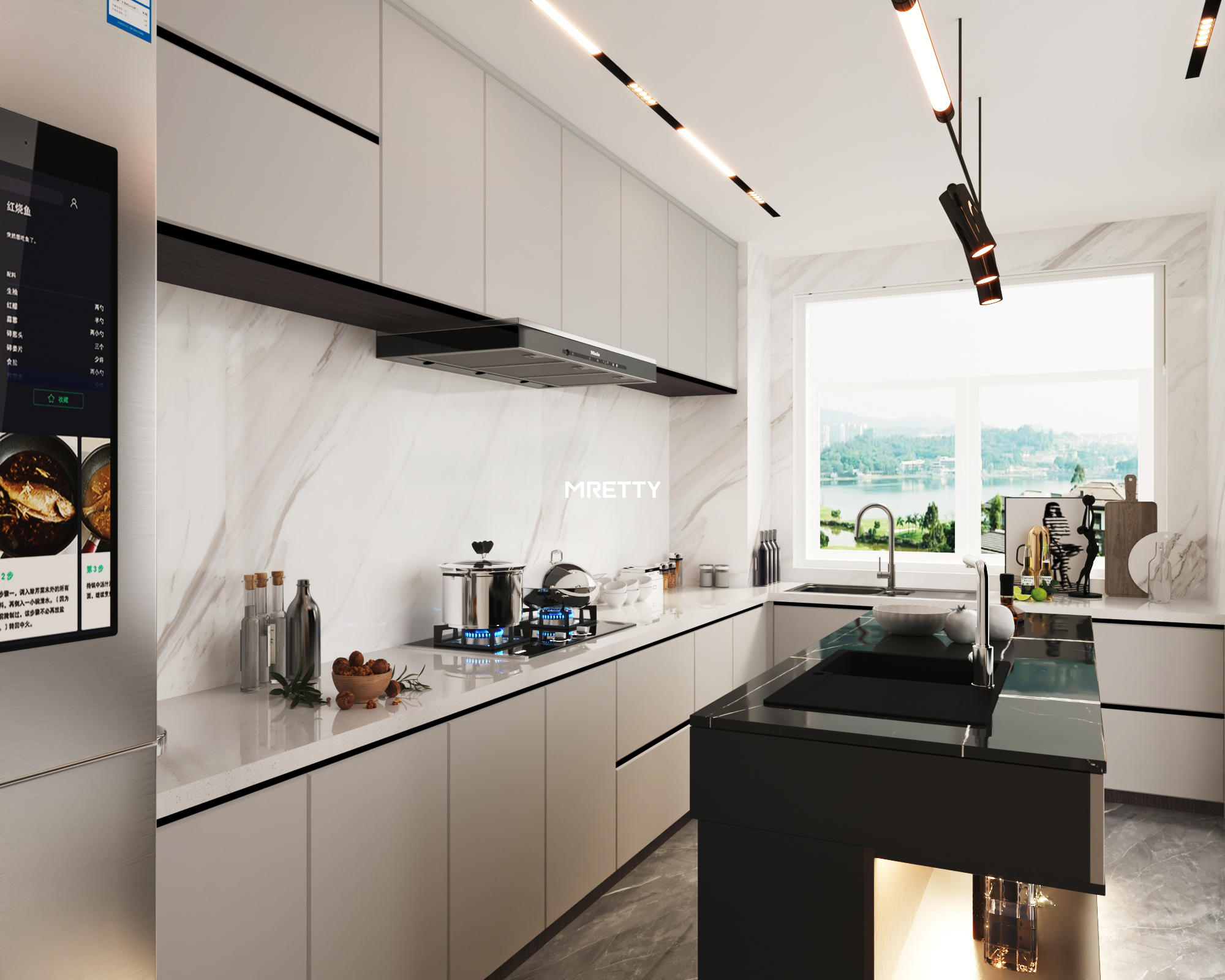
- Island Layout: The "gold standard" for larger spaces. The central island acts as a visual anchor for the kitchen zone while serving as a multi-functional hub for storage/prep/seating. Integrating the island seamlessly with the dining table is a popular way for families to maximize utility.
- Peninsula Layout: A more compact-friendly compromise for smaller apartments or HDBs—cabinetry extends out into the living area forming a "C/G shape," providing visual separation without consuming the walkway.
- Single-Wall + Parallel Dining: The savior for narrow, elongated layouts: full-height cabinets on one side, dining table on the opposite, keeping the visual flow open and being the most cost-effective.
Do not force key dimensions: aim to keep a 1.0–1.2m clear walkway around the main work zones, otherwise "open" becomes "cramped."
❌ Common Mistake: Cramming a massive island into a small HDB kitchen, sacrificing all circulation space and creating a sense of oppression.
✅ Safer Practice: Be realistic. Use a peninsula for compact layouts, or use a movable prep station (butcher block/cart) to gain "island functionality" without sacrificing essential passage space.
3. The MRETTY Difference: How Smart Manufacturing Creates a Truly Seamless Integration
Many companies can draw a pretty kitchen. MRETTY focuses on "precision execution that lasts a decade"—the secret is not more decoration, but manufacturing precision.
- Our 15,000 sq ft Smart Factory means cabinetry is "engineered": CNC cutting tolerances are sub-millimeter. Gaps between doors and drawers remain uniform and stable over time. That clean, "architectural" feel is not left to chance on-site.
- We use exclusively E0-grade panels (formaldehyde emissions ≤0.5mg/L). In a sealed, air-conditioned environment, this is not a marketing point; it is a hard metric affecting family health.
- Hardware follows Blum / Hettich standards: drawers glide, doors close softly, and mechanisms do not prematurely age. This is the "tangible luxury" you interact with daily.
❌ Common Mistake: Treating all "custom cabinets" as the same, only comparing who quotes lower.
✅ Safer Practice: Ask the right questions—Panel grade? (E0/E1?) Hardware brands and test standards? Can door gap tolerances be put in writing? (MRETTY uses <2mm alignment as a baseline, not just a verbal promise.)
A truly seamless open kitchen starts with a factory that treats engineering seriously.
4. Choosing the Best Materials for a Lasting Open-Concept Kitchen {#4-choosing-the-best-materials-for-a-lasting-open-concept-kitchen}
With the kitchen constantly "on display," materials must be beautiful + durable.
- Countertops: My primary recommendation is Engineered Quartz (e.g., Caesarstone / Silestone): non-porous, resistant to coffee/curry stains, and easy daily maintenance. Sintered Stone is the top-tier upgrade: heat and scratch-resistant, but with higher cost and installation demands.
- Cabinet Finishes: High-quality Laminate is the most practical choice—wide range of textures, moisture-resistant, and easy to wipe. Wood veneer can be used for warmth, but requires more disciplined maintenance (avoid letting water pool on edges).
- Backsplash/Splash Zone: Large-format slabs/tiles with minimal grout are best; a full slab quartz backsplash is more premium and easiest to clean, offering superior visual continuity.
❌ Common Mistake: Choosing porous marble for main worktops purely for prestige, resulting in inevitable staining and etching.
✅ Safer Practice: Use high-performance materials (quartz/sintered stone) for high-traffic work zones, reserving more delicate materials for low-frequency decorative accents (feature walls/localized finishes).
5. Effective Zoning & Lighting Strategies Without Walls {#5-effective-zoning-lighting-strategies-without-walls}
Without walls, how do you zone? Through "psychological boundaries" and layered design—this is the essence of Singapore open-concept kitchen zoning strategy.
- Flooring Transition: Durable tile/stone in the kitchen zone, warmer wood flooring or a coordinated tone in the dining zone naturally creates a visual boundary.
- Furniture as Boundaries: A sofa backing onto the kitchen acts as an "invisible partition"; a large rug under the dining table anchors the "eating zone."
- Layered Lighting (the most valuable tactic): A pendant light "anchors" the dining table → under-cabinet LEDs provide task lighting in the kitchen → recessed/wash lights provide ambient glow. Adding dimmer switches allows shifting from "bright prep mode" to "dinner ambiance."
❌ Common Mistake: Relying on a single ceiling light for the entire space, resulting in a flat, featureless look.
✅ Safer Practice: Layered lighting + scene control. Lighting is the "invisible partition line."
6. Solving the #1 Problem: Managing Cooking Fumes in Singapore {#6-solving-the-1-problem-managing-cooking-fumes-in-singapore}
Frankly, the biggest fear Singaporeans have of open kitchens is realistic: the smell of sambal belacan migrating to the sofa. This is not an aesthetic issue; it is an equipment issue.
- Focus on hood power measured in CFM (Cubic Feet per Minute). For local heavy cooking/stir-frying, I generally advise targeting systems around ≥900 CFM (adjusted for duct length and resistance). Many "slim, aesthetic" hoods only offer 300–500 CFM, which will struggle in an open layout.
- Traditional Chimney Hoods (External Exhaust) remain the most powerful option (prerequisite: building allows external wall access/reserved exhaust ducts).
- Downdraft Extractors: Systems like BORA / Gaggenau integrate the extractor into the cooktop, pulling fumes downwards. Visually sleeker, but requires careful calculation of system CFM, duct resistance, and maintenance.
Choose the right ventilation, and your open kitchen becomes one you "dare to use daily"; choose wrong, and it becomes an expensive showroom you hesitate to cook in.
7. Budgeting Your Renovation: A Realistic Look at Costs {#7-budgeting-your-renovation-a-realistic-look-at-costs}
When discussing Singapore open-concept kitchen renovation costs, avoid the illusion of a "flat per-foot price." It is like a menu quoting "$X per plate" without specifying if it is chicken rice or lobster: countertop material, island structure, appliance integration, exhaust strategy, electrical re-routing, wall patching/floor repairs, lighting, and smart switches—every single item dramatically shifts the total.
A safer way to structure your budget is to split it into three tiers:
- Essential Structural/Compliance/Hidden Works (exhaust pathways, electrical loading, HDB/BCA submission fees and making good if hacking is involved)—cutting corners here is the most dangerous.
- Core Custom System (cabinetry system + countertops + hardware grade + lighting)—this is the "longevity body" you touch and use daily.
- Expression Layer (finish upgrades, larger island, more built-in appliances, decorative backsplashes)—this can be prioritized, phased, or staged.
Budget Framework Reference (2026 Estimates)
| Tier / Component | HDB 4-Room (Typical 12-15 sqm Kitchen+Dining Zone) | Condo 2-Bedroom (Compact 8-10 sqm Kitchen+Dining Zone) | Controllable Items | Easy-to-Escalate Items |
| :--- | :--- | :--- | :--- | :--- |
| Structural / Compliance | S$1,500 – S$3,500 | S$1,000 – S$2,500 | HDB/BCA permit fees, basic wall patching | Major structural beam relocation, extensive floor retiling |
| Core Cabinetry System | S$12,000 – S$18,000 | S$9,000 – S$14,000 | E0 grade panels, standard laminate finish, Blum/Hettich basic hardware | Full upgrade to Fenix/High-gloss lacquer, Legrabox hardware, internal organizers |
| Countertops | S$3,000 – S$6,000 | S$2,000 – S$4,000 | 20mm Engineered Quartz | 30mm Sintered Stone, waterfall edges, integrated sinks |
| Island / Peninsula | S$4,000 – S$8,000 | S$3,000 – S$6,000 | Simple fixed island/peninsula | Hydraulic pop-up tops, integrated sinks, seating overhangs |
| Ventilation & Appliances | S$2,500 – S$5,000 | S$2,000 – S$4,000 | 900+ CFM External Chimney Hood | BORA/Gaggenau Downdraft systems, premium built-in ovens |
| Lighting & Electrical | S$1,500 – S$3,000 | S$1,200 – S$2,500 | Basic LED downlights, under-cabinet strips | Designer pendants, smart dimmers, extensive feature lighting |
| Total Estimated Range | S$24,500 – S$43,500 | S$18,200 – S$33,000 | | |
If you share your specific unit type (HDB/Condo/Landed), which walls you plan to remove, and your target appliance list, I can refine this into a market-aligned S$ range breakdown (explicitly marking "easy-to-escalate add-ons") tailored precisely to your project.
8. Your Dream Open-Concept Kitchen Starts with a Plan {#8-your-dream-open-concept-kitchen-starts-with-a-plan}
An open kitchen does not automatically become premium just because "the wall is hacked down." It is a systematic project: Workflow × Clutter-Free Storage × Stain-Resistant Materials × Powerful Extraction × Layered Lighting × Manufacturing Precision. Align these, and you gain a more breathable home; align only with "photos," and you might gain a more expensive mess.
Frequently Asked Questions {#9-frequently-asked-questions}
(If needed, I can expand on: HDB wall hacking compliance procedures, calculating actual CFM for local ducting, quartz vs. sintered stone maintenance differences, whether to include a sink in the island, and 6–8 other frequently asked questions, complete with FAQPage JSON-LD.)
About the Author {#10-about-the-author}
(In line with previous articles: Aida / Hanson, Senior Full-Home Principal Designer at MRETTY, with 10–14 years of experience in high-end residential customization in Singapore.)
MRETTY: Premium Bespoke Kitchen & Cabinet Systems Provider in Singapore.
