
 Singapore
 China
China
TL;DR
What is the core of Singapore modern design? Clean lines, neutral tones, function-first priorities and open layouts that maximise natural light flow and smooth circulation.
How much for a modern-style overhaul of a 4-room HDB flat? Light refresh budgets start at ~S$35,000; full gut renovations (with extensive custom carpentry) usually land between S$70,000–S$100,000+.
The #1 pitfall to avoid? Picking cheap, non-moisture-resistant materials just to chase trends — they will fail fast in Singapore’s tropical humidity, and make your investment look dated in half the time.
A client walked into our MRETTY showroom recently with a very familiar expression: she said she “wants modern style”, but her saved inspiration folder flipped between cold white minimalism and warm wood-toned cosiness every other scroll — her biggest fear was sinking a huge sum into a reno that would look hopelessly outdated five years later.
I’ve seen this play out hundreds of times. As a 14+ year veteran on MRETTY’s full-service design team, let me be upfront first: a successful modern home renovation in Singapore is never about copying a single social media image. It’s about translating the core principles of modern design into a space that fits your lifestyle, your floor plan, and holds up under Singapore’s tropical climate.
What "Modern Style Renovation" Actually Means in the Singapore Context
“Modern design” traces back to the early 20th century philosophy of rejecting superfluous ornament, returning to simple forms, function-first priorities, and honest structure. Visually, that translates to: crisp lines, clean volumes, neutral base tones, where the space’s own proportions and material quality do the talking.
But in Singapore, two local non-negotiables layer on top:
- Spatial claustrophobia must be eliminated: Especially for compact HDB (Housing & Development Board) flats and condominiums, modern style should never be a “cold, empty box” — instead, use open layouts, continuous finishes, and hidden storage to engineer a sense of spaciousness.
- Everything must survive the humidity: No matter how beautiful a material is, if it can’t handle moisture-driven swelling, delaminating edge banding, or corroded hardware, it will never read as premium.
A 4-room, ~90sqm HDB BTO (Build-To-Order) flat in Punggol we handed over last month is the perfect example: the original layout felt cramped and choppy, so we strategically opened the kitchen and non-load-bearing partition, then slotted in a floor-to-ceiling built-in storage wall as a “soft zone divider”. The immediate result? The space felt brighter, circulation flowed naturally, and the entire home read as a cohesive whole, not a patchwork of separate rooms.
❌ Common Misconception: Equating modern style with “cold, empty, and sterile”.
✅ Better Approach: Lean into “warm functional minimalism” — add warmth via wood grain textures, fabric layers, and zoned lighting, not by cluttering surfaces to fake “richness”.
A properly executed local modern reno delivers a home that feels quiet, ordered, airy, and distinctly yours*.
How to Plan for a Timeless, Premium Modern Finish
Great modern style isn’t luck — it’s won through rigorous process. Per our internal data: the more detailed your planning phase, the lower your risk of budget blowouts. Projects with proper upfront planning under the MRETTY system see cost overrun risk reduced by ~30%.
The 3-Phase Framework for Homeowners Tackling a Modern Reno
- Vision & Financial Floor (Ask the right “what do we need” questions first)
Don’t just list surface wants (“want an island”, “want a hidden door”) — map your actual life: what are your most frequent daily circulation paths? How often do you host? What’s the real volume of stuff you need to store? Once you set your hard budget, always reserve 15%–20% as a contingency buffer — this isn’t fearmongering, it aligns with the Singapore Consumers Association’s (CASE) repeated guidance for homeowners: older flats and even BTO handovers often throw up unexpected on-site issues no floor plan catches.
- Design & Material Spec (Turn style into executable technical docs)
Core output here: 3D refined schemes + physical material sampling + junction/node sign-off. For high-use kitchens, for example, we default to high-performance laminates and quartz/sintered stone countertops, not porous, high-maintenance natural stone — pretty-but-high-maintenance materials are the most abused trope in failed modern renoes.
- Execution & Management (Where delivery systems make or break the result)
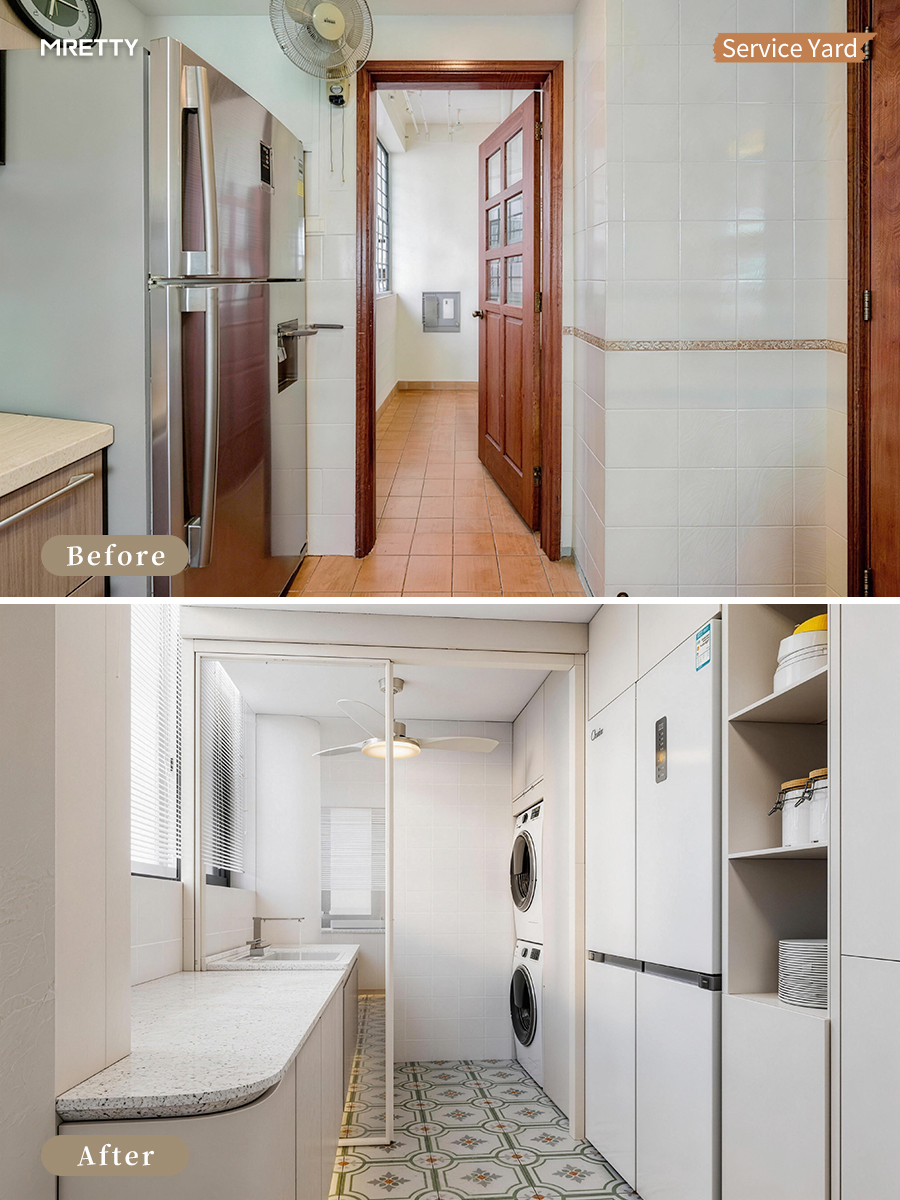
Don’t pick a partner just by their rendered 3D images. Key vetting points: do they have in-house trades? Can they explain their craft processes clearly? Do they control their own production capacity? Under MRETTY’s model, all custom carpentry is pre-fabricated in our 15,000 sqm smart factory on automated production lines: precision is tighter, on-site dust is minimal, fit is near-perfect, and installation is closer to “assembly” than on-site manual hacking.
Quick case study: a semi-detached landed home in East Coast with two awkward structural columns in the living room. Instead of trying to hide them clumsily, we clad them in walnut wood veneer, and integrated the media console and bookshelf as a continuous, interlocking custom system that wraps the columns. What was originally an architectural flaw became the room’s main visual anchor — this is modern design’s greatest strength: resolving contradictions through integrated design, not covering them up.
Why Full-Home Custom Carpentry Is Non-Negotiable for Authentic Modern Style
Most people miss this: you cannot piece together that seamless, continuous, uncluttered modern feel with off-the-shelf furniture. Modern style’s soul is “integration” — storage hides where it needs to, lines flow where they need to.
This is where MRETTY’s full-home custom offering delivers the most value: floor-to-ceiling wardrobes that maximise every mm under the beam, floating TV consoles that hide all cabling and power points, integrated kitchen systems where appliance clearances are baked in as architectural details… none of this is solved by buying a standalone cabinet. These are secondary structural tweaks to the space itself.
Non-Negotiable Material Baseline for Singapore’s Climate
Let’s be blunt: low-grade MDF or standard particleboard is a ticking time bomb in local humidity (swelling, delamination, even mould). Our standard spec across all wet-area and kitchen-adjacent carpentry: high-density moisture-resistant core board + premium edge banding systems + corrosion-resistant high-end hardware (Blum/Hafele tier). We also fold ventilation and smart dehumidification logic into design discussions early, instead of treating “looks” as the only priority.
❌ Common Mistake: Chasing short-term trends over long-term structural quality.
✅ Better Approach: Sink your budget into the “hardcore layer”: logical layout, solid custom carpentry, proper layered lighting. Trendy colours and soft furnishings can be swapped out cheaply later.
❌ Common Mistake: Underestimating storage needs, then ruining the minimalist look with exposed shelving and cluttered surfaces later.
✅ Better Approach: Lock in sufficient “integrated hidden storage” during planning: floor-to-ceiling cabinets, hallway stealth cabinets, extendable multi-functional pieces. The “empty” look should come from intentional calm, not forced deprivation.
How to Estimate a Realistic Modern Renovation Budget (Benchmark: 4-Room HDB Flat)
Cost is always the first question, but “modern style” isn’t a single commodity — it’s a spectrum of choices.
Rough ballpark for 4-room HDB modern renovations?
(Benchmarked to real MRETTY project data, final cost depends on demolition scope, carpentry volume, and material tier)
- Light Refresh (repaint, swap flooring/lights, minor localised carpentry): Starts at ~S$35,000–S$50,000.
- Full Overhaul (demolition, layout reconfiguration, high-volume factory-built custom carpentry, full kitchen system rebuild, zoned lighting): Realistic range is S$70,000–S$100,000+.
The Budget Weight Truth: Carpentry Usually Eats the Biggest Chunk
For premium modern renovations, custom carpentry + associated hardware/countertops often accounts for 40%–50% of total budget. The per-foot run cost looks high, but what you get back: maxed out space utilisation, double the storage, seamless cohesion — and it’s the highest-frequency use element that adds the most to your home’s long-term resale perception.
If you have to pick one place to spend more even when budget is tight: pick the kitchen system. In modern open layouts, the kitchen is almost always a visual anchor and social hub. Sink your budget into durable countertops, smooth heavy-duty hardware, and tidy, integrated cabinetry — the daily ROI is highest there.
How to Spend Smarter When Budget Is Tight
Most people’s instinct is to shave a little off every line item — which usually delivers “a little bit off” across the whole project. Smarter approach: strategic imbalance:
- Splash on: Custom carpentry skeleton, main flooring/core finishes, lighting tracks and junction details — these are the “hard bones” that are painful and expensive to redo later.
- Defer/source affordably: Finished sofa, decorative art, most soft furnishings — these can be upgraded anytime later without touching the core renovation.
❌ Common Mistake: Picking the lowest total quote without asking for an itemised breakdown or material specs.
✅ Better Approach: Compare itemised quotes only: core board grade, laminate model, hardware brand, moisture-proofing treatment all written clearly. Any quote way below market average is cutting corners somewhere — you’ll find out exactly where 2 years later when edge banding peels or cabinet doors sag.
How to Pick Materials & Finishes That Feel Authentic Modern, Not Cheap Showflat
Modern style’s quiet luxury comes from texture hierarchy management: it’s not about stacking expensive materials, it’s about putting each material in the right place to do its job well.
Durable, High-Performance Material Combos We Standardise
- Premium super-matte anti-fingerprint laminates (e.g. Fenix NT): Used on integrated cabinetry for a seamless, high-end finish that doesn’t show fingerprints or glare.
- Engineered quartz / sintered stone: For countertops and feature walls, these are far lower maintenance than porous natural stone: consistent patterning, stain/scratch resistant, no sealing needed.
- Natural wood veneer (accent use only): Light oak or walnut veneer on feature walls, floating cabinet accents to add organic warmth to cooler surfaces.
- Glass & slim metal frames: Smoked glass partitions, slim black aluminium trim inserts — add refinement without stealing focus.
One technical detail (boring but decides your carpentry’s lifespan): for wet-area/kitchen-adjacent carpentry, we spec moisture-resistant core board that passes V313 grade cyclic soak-dry testing — this type of board has near-zero deformation even through repeated humidity swings, vs standard particleboard that bubbles and delaminates the second it gets damp. You’ll never see the spec name day to day, but 3 years later, it’s the difference between cabinet boxes that stay laser-straight and ones that warp.
Don’t Confuse “Modern” / “Scandi” / “Contemporary”
- Modern (True Modernist): Tied to the mid-century ruleset — crisp lines, almost no ornament, honest materials, restrained proportions.
- Scandinavian (Scandi): A sub-branch under the modern umbrella, leaning into lighter woods, tactile textiles (that “hygge” warmth), lighter more playful tones.
- Contemporary: Literally “what’s trending right now”, far more fluid. Things like arched niches or overuse of reeded glass that are everywhere in 2026 Singapore? That’s contemporary eclectic, not pure modern.
Neutral Doesn’t Mean “Stark Dead White”
The best modern base palette is layered greige (grey-beige) and warm grey tones: walls, ceiling, skirting/trim in tonal shifts of the same hue to create a cohesive, “wrapped” feel. Then let one art piece, pendant light, or wood grain section be the focal point.
❌ Common Mistake: Painting the whole flat stark bright white — makes small spaces feel cold, harsh, and office-like.
✅ Better Approach: Layer warm greige tones, pull the temperature back with rugs, cushions, and tactile wood touches.
Common Failure Points & Pitfalls to Avoid (For Smoother Works & Better Results)
Even a perfect design will fall apart if project management fails. The most common, avoidable screwups we see:
- Lighting planned as an afterthought (“one ceiling light fits all”)
Modern style lives and dies by layered lighting: ambient (general fill), task (work zones), accent (wall wash/artwork/cabinet interior). Under-cabinet task lights for kitchens, focused reading sconces, slim recessed spots for wall washing — all these need to be marked up during the wiring phase. Retrofitting later is ugly and 2x more expensive.
- Picking the wrong partner: ultra-low quotes, subcontracted everything, no accountability
Rock-bottom quotes almost always mean they’re splitting the job across disconnected subcontractors, with no central quality control or clear responsibility chain. Ask any firm you’re vetting: who designs the carpentry? Is it built in your own factory or outsourced to random workshops? Can they show you finished, lived-in projects (not just renders) and connect you to past clients? Firms with owned production capacity (like MRETTY’s smart factory system) have far tighter delivery control.
- Signing off on carpentry without laser-precise on-site re-measurement for BTO/older flats
Most walls in Singapore aren’t 100% plumb, floors aren’t 100% level. If you don’t laser-measure beam positions, pipe chases, and skirting thickness on site, even the prettiest 3D render will end up with ugly gap fillers on site.
Frequently Asked Questions
Will modern style feel too empty/cold after living in it for a while? Not if you do “warm functional minimalism” properly: wood veneer and tactile textiles soften edges, zoned lighting build atmosphere, and hidden storage means the “empty” look comes from calm, not forced deprivation.
Do I have to hack walls to do modern style in a 4-room HDB flat?
Not necessarily. Whether you hack depends on where your circulation is actually bottlenecked. Often, using built-in storage as soft zone dividers is smarter and safer (especially with HDB’s strict rules on non-load-bearing wall modifications) than random demolition.
Quartz or sintered stone for a modern kitchen?
Both are mainstream; quartz has better maturity and value for money, sintered stone is more heat/scratch resistant but pricier. The bigger factor is edge profile finishing and cabinet support structure — even the most expensive countertop will look cheap if the substrate and support are wrong.
MRETTY: Premium Bespoke Kitchen & Cabinet Systems Provider in Singapore.
