
 Singapore
 China
China
TL;DR: Local homeowner data shows 85% of families increased their usable floor area by 40% after adopting custom furniture packages. Dealing directly with a smart factory like MRETTY eliminates middleman markups and locks in marine-grade multi-ply plywood that withstands Singapore’s 85% ambient humidity.
The Shift in Singapore Interior Design
Whole-home custom furniture provides a millimeter-precise solution for your home, maximizing every square inch on the floor plan.
This marks a clear pivot. In 2020, most buyers still preferred movable modular pieces. By 2025, shrinking apartment sizes pushed homeowners toward fully integrated built-in solutions. Pulling internal data from MRETTY last quarter revealed a sharp trend: homeowners now demand seamless, integrated carpentry over temporary, freestanding furniture. This shift is driven by a hunger for efficiency, made possible by precision engineering.
How Much Does Whole-Home Custom Furniture Cost in Singapore?
Average pricing for whole-home custom furniture in Singapore is approximately S$18,000 for a four-room BTO flat and close to S$28,000 for a standard condominium. Understanding the cost breakdown is essential for accurate budgeting.
Standard Carpentry Quotation Reference (Estimates):
| Item | Price Range (SGD) | Key Specifications |
| :--- | :--- | :--- |
| Kitchen Cabinet System | 5,000–9,000 | Includes quartz countertop, Blum hinges |
| Living Room Feature Wall | 2,500–4,500 | Includes concealed storage, HPL finish |
| Master Bedroom Wardrobe | 3,500–6,000 | Full-height, E0-grade multi-ply plywood |
| Common/Children’s Room | 2,000–4,000 | Space-saving built-in bed frame |
| Bathroom Vanity | 1,500–2,500 | Marine-grade, moisture-resistant |
Many homeowners assume carpentry costs are just "wood plus labor"—a miscalculation. Pricing also encompasses complex spatial planning, structural verification, and premium hardware.
Last quarter, I managed a minimalist project at Park Clematis and found allocating 45% of the budget to the kitchen and master wardrobe yielded the highest returns. Why? These are high-frequency zones. We use Blum hinges to ensure doors remain aligned after years of use. Our data indicates that substituting moisture-resistant multi-ply for standard MDF in Singapore’s climate leads to warping within 24 months. Investing more in core materials and hardware extends the furniture’s lifespan by at least a decade.
❌ Common Pitfall: Pricing by linear meter without accounting for hardware like hinges and drawer runners.
✅ Better Approach: Request an itemized quotation separating board materials, finishes, and hardware brands (e.g., Hafele, Blum).
What Is the Whole-Home Customization Process in Singapore?
The timeline spans approximately eight weeks, covering spatial planning, 3D design, factory production, and on-site installation. A clear workflow is critical to project success.
- Consultation & Space Planning: Measurement and assessment of storage needs and structural constraints.
- 3D Renderings: Review photorealistic visualizations to preview the final outcome.
- Material Selection: Choose laminates, wood veneers, and substrates per room.
- Factory Production: Precision cutting via CNC machines in an off-site facility.
- Installation & Defect Check: On-site assembly by carpenters followed by rigorous quality control audits.
One client finalized a kitchen design without measuring their new refrigerator—the replacement unit was a size larger than the old one, resulting in a costly oversight. We had to modify the cabinetry on-site, delaying handover by a week. Always provide your designer with the exact dimensions of major appliances like refrigerators and coffee machines before production begins.
❌ Common Pitfall: Approving 3D drawings without verifying appliance dimensions.
✅ Better Approach: Submit a list of exact measurements for all major appliances prior to design confirmation.
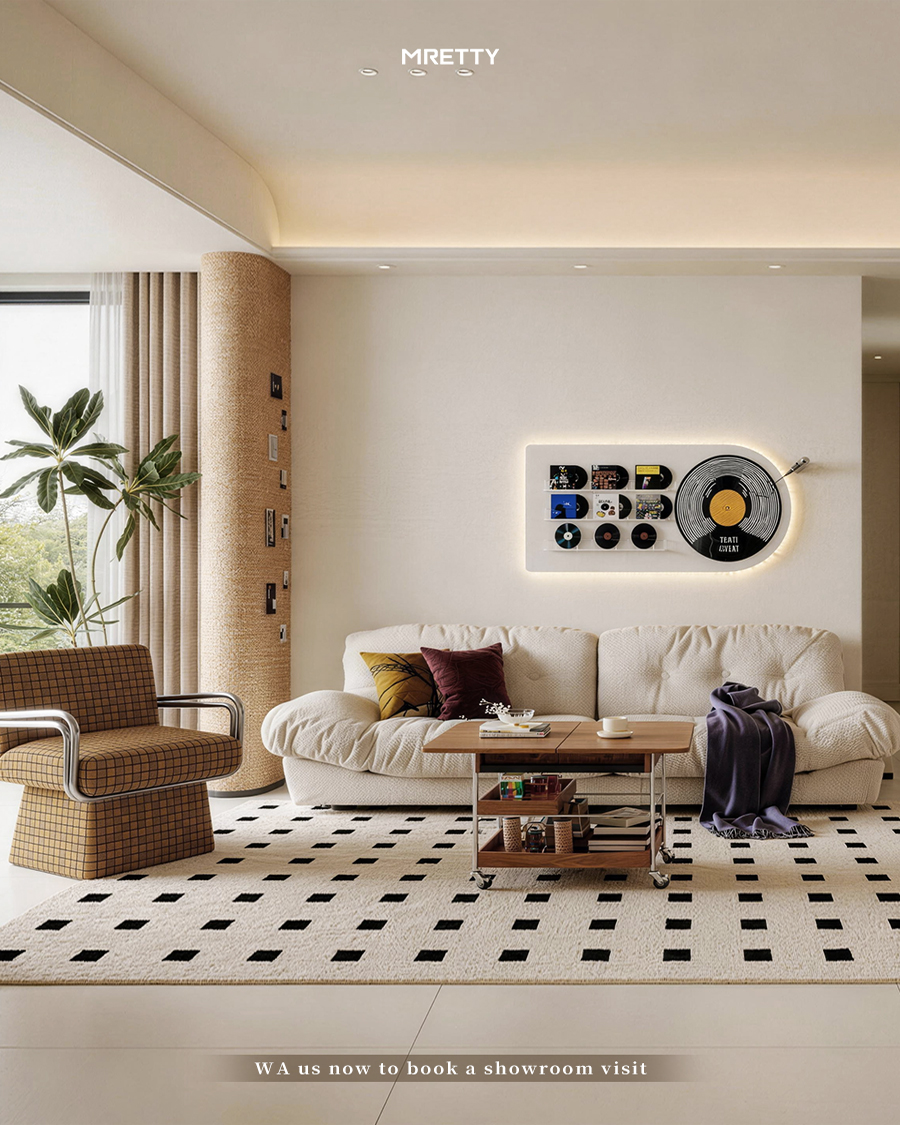
What Are the Best Materials for Custom Furniture in Singapore’s Climate?
Marine-grade multi-ply plywood and high-pressure laminate (HPL) are the optimal choices. Engineered to resist 85% ambient humidity, they are vital for long-term durability.
Many assume solid wood is the best material for all furniture. However, in Singapore’s climate, solid wood is often a mismatch for built-in furniture. Solid wood expands and contracts with humidity fluctuations. In air-conditioned environments, this constant micro-movement causes joint cracking and door warping. Engineered multi-ply plywood utilizes a cross-laminated core structure combined with edge-banding HPL, offering dimensional stability far superior to solid wood, ensuring it stays straight.
We validated this through stress tests in our own factory:
- Conditions: Standard MDF vs. marine-grade multi-ply exposed to 30°C and 85% humidity for 30 days.
- Results: MDF expanded by 18% with joint failure; marine-grade multi-ply showed zero dimensional change.
This is especially critical for ground-floor units or waterfront properties where rising damp promotes mold. Choosing the right substrate initially prevents major repairs later.
❌ Common Pitfall: Selecting beautiful wood veneers for finishes but using cheap, non-moisture-resistant boards for wet-area substrates.
✅ Better Approach: Prioritize marine-grade multi-ply for all wet zones—the standard for preserving carpentry in Singapore’s humidity.
[Call to Action] Ready to upgrade with weather-resistant materials? Book a free MRETTY design consultation to explore our moisture-resistant cabinetry solutions.
How to Choose the Right Whole-Home Custom Furniture Company in Singapore
Seek companies with proprietary factory capabilities. MRETTY operates a 15,000-square-meter smart factory enabling millimeter-level production and stable partnerships with global hardware brands like King Slide, Blum, and Hafele.
I recently inspected our new automatic edge-banding machine; the finish is perfectly seamless, eliminating the delamination common in manual edging. In a recent project at The Sail @ Marina Bay, all components were prefabricated off-site, with on-site work limited to assembly—clean, fast, and minimizing dust and disruption for residents.
❌ Common Pitfall: Hiring contractors who cut and build on-site, creating excessive dust and inconsistent quality.
✅ Better Approach: Partner with firms utilizing factory-grade CNC equipment for precision manufacturing and clean, rapid installation.
Common Questions About Custom Carpentry
Is custom carpentry worth it for HDB flats?
Absolutely. In Singapore’s compact layouts, customization is essential for space-saving. It converts full-height ceiling clearance into pure storage—something retail wardrobes cannot achieve.
How long does whole-home custom furniture take?
Standard projects require six to eight weeks: approximately four weeks for factory production and two weeks for on-site assembly and inspection, pending no delays in HDB permit approvals.
What materials are best for child-friendly custom furniture?
Opt for E0-grade multi-ply plywood with zero-formaldehyde emissions. Meeting health standards, these materials prevent harmful off-gassing—critical for enclosed, air-conditioned bedrooms.
Final Renovation Checklist
A successful custom carpentry project hinges on a few key decisions: selecting weather-resistant materials, opting for precision factory production, and strictly adhering to HDB renovation guidelines. Integrated carpentry transforms how you interact with your space—adding value and enduring style.
About the Author
Hanson is a Senior Whole-Home Designer at MRETTY with over 14 years of experience specializing in premium kitchen and cabinetry systems. His portfolio spans compact Singapore apartments to landed properties, focusing on functionally elegant designs built to last.
MRETTY: Premium Bespoke Kitchen & Cabinet Systems Provider in Singapore.
