
 Singapore
 China
China
Executive Summary: Durable Wet-Kitchen Guide
- Choose the Right Materials: Understand why moisture-resistant plywood, aluminium, and stainless steel outperform standard options under Singapore's 80%+ humidity.
- Optimise by Property Type: HDB, condo, and landed wet kitchens each need different design strategies — maximise both space and function.
- Understand the MRETTY Difference: 15,000 sq m smart factory + E0-certified materials = dual protection for health and durability.
Is Your "Waterproof" Kitchen Cabinet Actually Suited for Singapore's 80% Humidity & Heavy Wok Hei?
Many homeowners sink money into bespoke carpentry, only to see cabinet warping, delamination, and mould within a few years.
Why? Most schemes aren't engineered for sustained humidity and high-frequency use — they just slap standard materials under a thin "waterproof" decorative layer, and it fails fast.
The real solution takes a different path: combine material science, precision engineering, and climate-tailored design for Singapore. MRETTY stepped out of the surface-patch logic years ago — we analysed hundreds of local cabinet failure cases, then rebuilt the whole flow: from certified material sourcing to final installation, watching long-term performance end-to-end.
This guide breaks down what actually makes a wet kitchen durable, functional, and healthy.
Choose the Right Materials for Long-Term Durability in High Humidity
The best materials for Singapore wet-kitchen cabinets are moisture-resistant plywood, aluminium, and stainless steel — superior on moisture resistance and structural integrity.
Picking the right core is the most important decision for custom wet-kitchen cabinetry in Singapore — the key isn't the surface laminate, but what's underneath.
Singapore's annual average humidity sits 80%+, and in that environment standard MDF or particleboard absorbs moisture, swells, and degrades. From our internal analysis of cabinet repair cases 2023–2025, 65% of failures stem from core-board moisture degradation — that's why we run materials validated for tropical environments across the line. For instance, our multi-layer moisture-resistant plywood, layers bonded with waterproof adhesive to prevent delamination. For ultimate durability, aluminium kitchen cabinets are the inorganic answer — completely unfazed by water, pests, rust; the top pick for homeowners chasing low-maintenance cabinetry for Asian cooking.
A common misconception: high-gloss "waterproof" laminate = waterproof cabinet.
But the laminate is essentially just a decorative surface layer — the real failure point is always the invisible core and edge seams. One scratch or a loose edge-band, and moisture seeps in: core swells, laminate delaminates. That's why factory-grade high-pressure edge-banding matters more than the laminate itself — if the seal isn't tight, the "waterproof" label is empty words.
Below is the breakdown of best waterproof kitchen cabinet materials in Singapore:
Moisture-Resistant Plywood (E0): Our top recommendation — the solid feel of wood, but engineered with waterproof resin. We run E0 boards across the line, meeting the world's strictest formaldehyde emission standard (≤0.5 mg/L), protecting family health.
Aluminium: 100% waterproof, rust-proof, termite-proof. Earlier versions felt cold-industrial, but modern powder-coating now delivers refined finishes in varied tones.
Stainless Steel: The commercial kitchen standard — for good reason: hygienic, heat-resistant, fully waterproof. But the industrial texture and fingerprint-proning nature don't suit every home style.
Data Point: MRETTY's E0 boards can reduce formaldehyde concentration by up to 90% vs common E2 grade (based on our R&D division Q1 2026 controlled-environment testing).
❌ Common Mistake: Assuming "waterproof cabinet" just because the outer laminate looks the part.
✅ Better Approach: Request core-board specs and moisture-resistance grade; ask for a physical cross-section sample of the board.
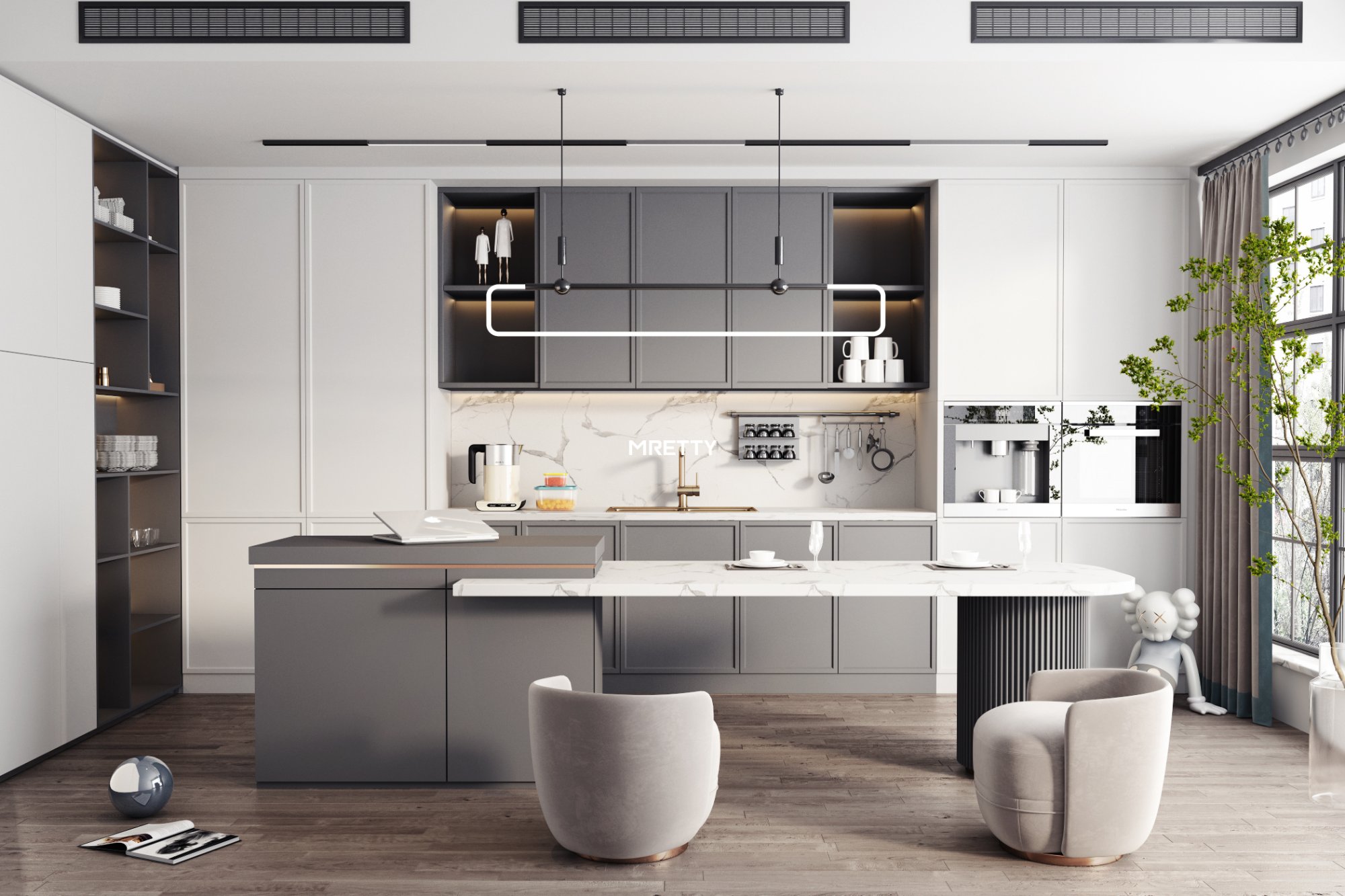
Engineered Wet-Kitchen Design for HDBs & Condos: Max Out Functionality
An efficient HDB and condo wet-kitchen scheme must prioritise smart storage, durable finishes, and powerful ventilation — non-negotiable.
A pretty kitchen that drags on daily workflow is a failed design. The challenge in typical HDB wet-kitchen cabinet design is building an efficient workflow in a small space — needs integrative thinking. On a recent 4-room BTO project, we did a galley layout with the quartz countertop extended into a small breakfast bar, swapping deep cabinets for full-extension drawers — this one change made access easy for the whole family, and usable storage rose ~30% by estimate. Key is designing by "flow," especially for compact HDB wet-kitchen custom cabinets.
Our functional design thinking:
- Zoning: Split the kitchen into five zones — consumables (larder + fridge), non-consumables (tableware), cleaning (sink), prep (countertop), cooking (hob). Logic decides cabinet placement; flow follows naturally.
- Ventilation First: A high-CFM hood is the lifeline for Asian cooking. We design cabinetry around the ventilation equipment — guaranteeing extraction efficiency while keeping visual integration.
- Material Synergy: Countertop pairing matters too — non-porous quartz + seamless backsplash/splashback is mandatory; oil-resistant, easy-wipe, complementing the durable cabinet base.
❌ Common Mistake: Stacking cabinet quantity blindly, ending up with a cramped, dark kitchen.
✅ Better Approach: Prioritise spatial quality and flow. Use smart accessories like pull-out larders and corner carousels — fewer cabinets, more usable space.
Integrate Premium Hardware for Lasting Performance
Premium hardware like Blum and Häfele is essential for long-term durability and smooth operation in wet-kitchen custom cabinets.
Doors and drawers are the highest-frequency components in a kitchen — reliability sits entirely on the mechanical hardware.
Using cheap unbranded hinges is a common cost-cut — doors misalign and sag within two years. We treat that as a failure point, so we run tier-one brands like Austrian Blum across the line. Blum hinges are certified for 200,000 cycles — that's 20+ years of typical household use. This isn't a luxury option; it's the baseline for a durable wet kitchen.
Picture a heavy drawer packed with pots: standard slides buckle under the load, hard to pull. Blum drawer systems handle 65kg and still glide silent, even fully loaded. This obsession with mechanical detail is core to the MRETTY philosophy — and a frequent note in MRETTY wet-kitchen cabinet reviews: you feel the quality every time you open a door.
❌ Common Mistake: Accepting default off-brand hardware to save a few hundred dollars upfront, hurting the long-term value of your Singapore wet-kitchen cabinet total cost.
✅ Better Approach: Write hinge and slide brand + model into the contract; ask for lifetime warranty from premium brands like Blum.
The MRETTY Advantage: Getting Manufacturing Precision Right
MRETTY's edge comes from the 15,000 sq m smart factory — German tech + imported E0 materials, delivering cabinets with unmatched precision.
This is where we diverge from other service providers.
Most bespoke kitchen carpentry services in Singapore run a workshop model — carpenter cuts and assembles on-site by hand, prone to human error and material variance. MRETTY is different — we're the manufacturer.
Your kitchen is designed in Singapore; exact specs go to the 15,000 sq m smart factory; German CNC equipment cuts every board at <0.5mm tolerance — precision handwork can't match, guaranteeing perfect alignment. This flow also enables advanced edge-banding — high-temp, high-pressure fuses the protective edge strip to the board, forming a seamless, permanent moisture-proof seal.
This manufacturing-led thinking unlocks the full potential of the material — whether you pick aluminium vs plywood cabinets in Singapore, durability still rides on precision manufacturing. Our factory flow guarantees aluminium frames stay perfectly square, plywood edge-banding stays zero-defect.
Call to Action: Experience the MRETTY Difference
Our precision flow builds cabinets that stand the years. See completed cases and understand our quality commitment.
[Download Our Digital Portfolio]
❌ Common Mistake: Assuming all "bespoke" cabinets are produced the same way, just picking the cheapest quote.
✅ Better Approach: Ask about the manufacturing flow — where are cabinets built? What equipment? What QC?
MRETTY's factory-direct model removes the instability of traditional carpentry, delivering a technical-grade product local workshops can't replicate.
FAQ
How much does a custom wet-kitchen cabinet cost in Singapore?
Custom wet kitchens in Singapore typically run S$6,000–20,000+. A 10-ft basic HDB wet kitchen in moisture-resistant plywood starts ~S$250/ft run; premium materials + Blum hardware can exceed S$600/ft run. Final Singapore wet-kitchen cabinet price depends on material (plywood vs aluminium), countertop (laminate vs quartz), and hardware choice.
About the Author
Hanson Bespoke Home Designer, MRETTY High-End Kitchen & Cabinetry Systems* 14 years of whole-home bespoke experience in Singapore, deep in material adaptation and precision manufacturing for tropical climates. Led hundreds of kitchen and cabinetry projects across HDBs, condos, and landed homes. Design philosophy: function first, long-term durability.
MRETTY: Premium Bespoke Kitchen & Cabinet Systems Provider in Singapore.
