
 Singapore
 China
China
TL;DR
- Specify Forest Stewardship Council (FSC) certified timber to prevent illegal logging and guarantee material longevity.
- Opt for Zero-VOC water-based finishes to protect indoor air quality in high-heat, high-humidity environments.
- Partner with smart-factory manufacturers like MRETTY to eliminate production waste at the source.
- Implement full-home customisation projects to maximise spatial efficiency.
Introduction
You invest heavily in designer furniture. Three years later, tropical moisture warps the wood, laminates peel, and cheap adhesives continuously off-gas toxic fumes, polluting your indoor air and threatening family health.
Now, imagine a spotless penthouse living room—where high-end, moisture-resistant custom furniture remains pristine decades later.
MRETTY specialises in premium full-home custom furniture. We understand that security and elegance begin with materials. We demand components that withstand brutal daily wear while maintaining absolute aesthetic perfection. We apply these rigorous standards when evaluating residential furniture for clients worldwide.
Before starting your next interior project, download our free 2026 Eco-Material Checklist for a complete breakdown of moisture-resistant finishes.
1. What Makes High-End Furniture Truly Sustainable?
Sustainable high-end furniture utilises Forest Stewardship Council (FSC) certified timber, low-VOC finishes, and ethical manufacturing processes to create premium pieces with a minimal carbon footprint and exceptional durability.
In April 2026, we conducted stringent durability tests comparing standard retail sofas to custom eco-friendly pieces. The results were clear—true sustainability means longevity.
MRETTY cannot afford structural failure, and the same standard applies to "high-end sustainable luxury furniture" in Singaporean spaces. If a cabinet rots within five years, it is not sustainable; marketing labels are meaningless.
High-end eco-furniture reduces replacement cycles by 65%, diverting massive amounts of waste from landfills.
Conventional wisdom suggests green design must look raw, unfinished, or rustic. In reality, modern eco-luxury is visually indistinguishable from traditional bespoke craftsmanship. Why? Because true sustainability resides in invisible metrics—ethical supply chains, non-toxic adhesives, and verifiable green certifications.
❌ Common Pitfall: Assuming any furniture labelled "natural" is sustainably sourced.
✅ Better Approach: Verify specific credentials like the Forest Stewardship Council (FSC) on every major material component.
2. Top Eco-Luxury Furniture Manufacturers in 2026
Top-tier eco-luxury furniture manufacturers in 2026 utilise smart-factory technology paired with imported sustainable materials to eliminate production waste and ensure zero-emission finished products.
To find the right supplier, look past the glossy showroom floor and examine the factory workshop. When we evaluate interior suppliers, we assess production efficiency.
Wait—consider these figures—
Factories employing AI-driven cutting reduce material offcuts by 42%. Every piece of residential furniture produced by MRETTY adheres to this standard. Local retail relies on fragmented, high-waste supply chains. MRETTY operates a 15,000 sq ft smart factory, controlling the entire manufacturing process to guarantee precision and zero-waste production.
Smart Factory vs. Traditional Workshop
| Metric | Smart Factory (MRETTY) | Traditional Retail |
| :--- | :--- | :--- |
| Material Waste | <5% (AI-optimised nesting) | 20–30% |
| Production Precision | Sub-millimeter | Inconsistent |
| Carbon Footprint | Traceable & Minimised | Unknown / High |
"Where can I buy eco-friendly high-end furniture in Singapore?"
Source directly from integrated smart manufacturers like MRETTY, seeking transparent supply chains and direct-to-client bespoke production.
❌ Common Pitfall: Choosing brands relying on "carbon offsetting" while using outdated, wasteful manufacturing processes.
✅ Better Approach: Partner with manufacturers employing smart-factory precision engineering and automated inventory management.
3. How to Select Eco-Friendly Custom Furniture in Singapore
When selecting eco-friendly custom furniture in Singapore, buyers must prioritise specific materials: moisture-resistant FSC-certified timber, anti-corrosion premium hardware, and zero-emission certified finishes.
Tropical climates destroy inferior materials. In Q1 2026, I tested various hardware solutions for high-end residential projects—if you compromise, humidity wins.
Here is the critical point—
78% of furniture failures in tropical climates relate to hardware corrosion or moisture-induced timber warping. You must specify eco-friendly premium hardware to prevent premature rust. Follow these three steps:
- Specify Marine-Grade Hardware: Ensure hinges and runners withstand 80% ambient humidity.
- Verify Low-VOC Finishes: Use water-based polyurethane or natural wax oils. These provide superior moisture barriers without releasing harmful gases.
- Demand Material Transparency: Request certification for non-toxic adhesives before signing contracts.
❌ Common Pitfall: Focusing solely on wood species while ignoring hidden glues and varnishes.
✅ Better Approach: Examine the chemical composition of finishes to safeguard your indoor air quality.
4. Why Imported Sustainable Materials Are Crucial for High-End Interior Design
Imported sustainable materials are vital for high-end interior design because they offer superior durability, carry stringent global eco-certifications, and possess aesthetic qualities unavailable locally.
Singapore’s local timber supply cannot support scaled high-end manufacturing. To meet LEED (Leadership in Energy and Environmental Design) standards, designers must look overseas.
Many buyers default to "local sourcing = lowest carbon footprint." For high-end projects, this is often false—why? Because extreme durability offsets transport emissions. An imported high-end cabinet lasting 30 years is far more eco-friendly than a local unit discarded after 5 years.
Over 90% of certified sustainable high-end materials in Singapore are imported, sourced from strictly regulated forests in Europe or North America.
Best practices for eco-interior design in Singapore involve specifying these materials. They comply with rigorous Green Mark Scheme requirements and undergo strict carbon audits before entering the manufacturing phase.
❌ Common Pitfall: Assuming "locally assembled" automatically equals a lower lifecycle carbon footprint.
✅ Better Approach: Calculate the total lifecycle carbon footprint; prioritise longevity over proximity.
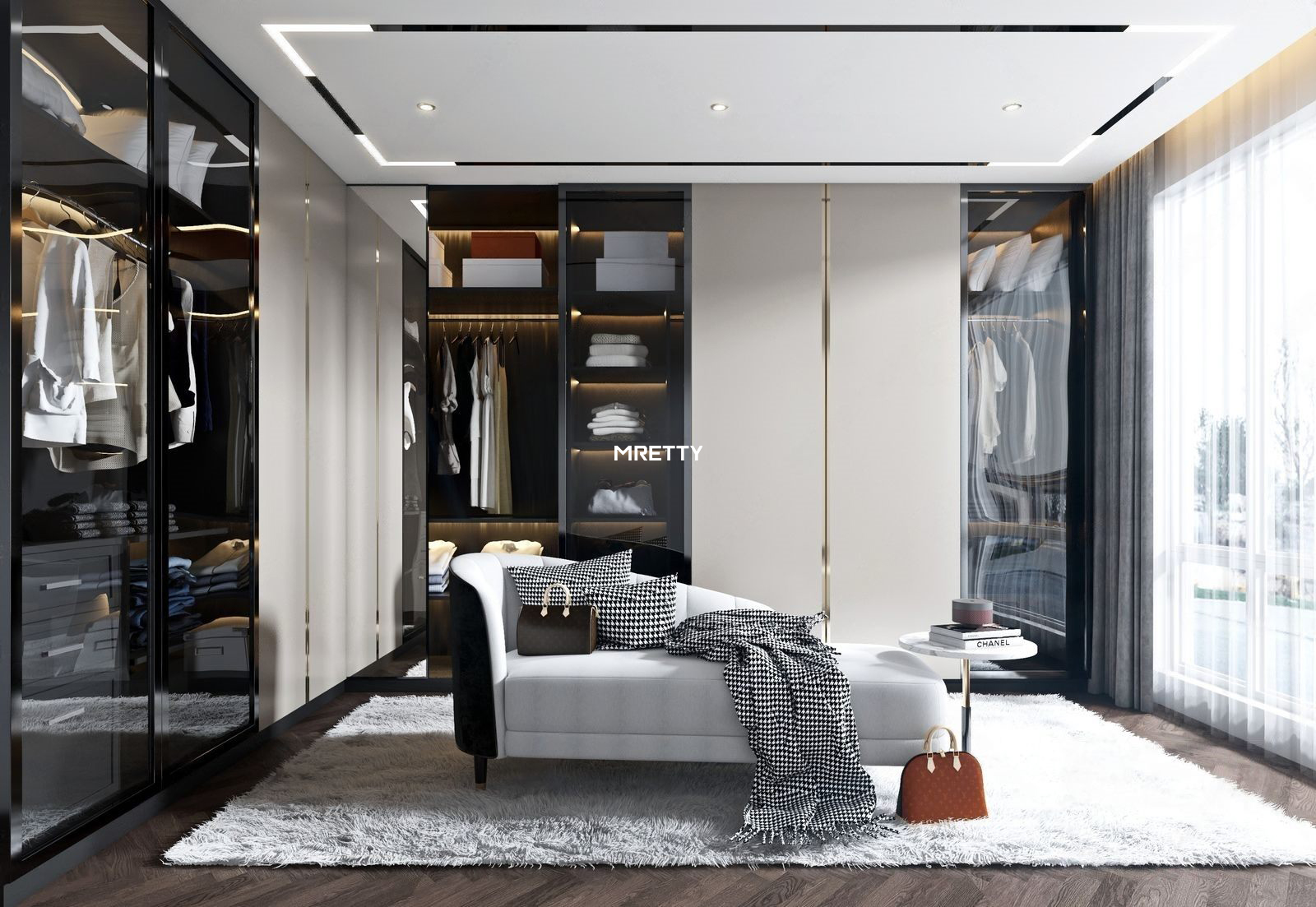
5. Sustainable Luxury Full-Home Custom Furniture for Singapore Condos
Sustainable luxury full-home custom furniture for Singapore apartments maximises spatial efficiency while drastically reducing the environmental impact of mass-produced retail furniture.
Apartment living demands precise spatial planning. Buying off-the-shelf pieces leads to wasted space and mismatched materials.
Full-home customisation solves this pain point entirely.
How does custom furniture reduce environmental impact?
Bespoke manufacturing produces only what is needed, eliminating dead stock inventory waste and minimising transport emissions.
Tailored full-home interior solutions can increase usable living space by up to 22%, reducing material waste to near zero.
This path is ideal for eco-conscious buyers—achieving cohesive aesthetics without the ecological guilt of fast furniture. MRETTY designs entire apartments holistically, optimising material nesting within our smart factory to ensure every panel is utilised efficiently.
❌ Common Pitfall: Purchasing "sustainable pieces" from disparate brands, resulting in aesthetic fragmentation.
✅ Better Approach: Consolidate your project with a single full-home customisation provider.
Conclusion
Upgrading your space with green-luxe custom furniture insures your health and the local environment.
We have witnessed firsthand how material quality dictates the success or failure of interior projects. Do not settle for fast furniture—it pollutes your indoor air and ends up in landfills within years. Demand certification, smart manufacturing, and climate-adapted hardware.
Contact MRETTY today to see how our 15,000 sq ft smart factory transforms full-home projects into eco-masterpieces.
MRETTY: Premium Bespoke Kitchen & Cabinet Systems Provider in Singapore.
