
 Singapore
 China
China
TL;DR: Your Quick Guide to Bespoke Integrated Kitchen Cabinets
Budget S$150–350 per foot run for bespoke kitchen carpentry.
Choose high-moisture-resistant plywood, not standard MDF, for durability.
Blend kitchen design with your home's overall aesthetic for cohesive visuals.
Prioritise quality hardware like Blum or Häfele for a kitchen that lasts decades.
Many assume bespoke kitchen carpentry in Singapore is an unaffordable luxury, and that off-the-shelf modular systems are the only budget-friendly option.
That's a misconception.
With 14 years in Singapore home design, I've found that smart planning makes a bespoke kitchen a high-value investment, not just an expense. A well-designed bespoke kitchen maximises every inch and outlasts standard schemes — saving you money long-term. Below, we break down how to own a high-end kitchen without a staggering price tag.
How Much Does Kitchen Carpentry Cost in Singapore?
Kitchen carpentry in Singapore typically runs S$150–350 per foot run. Total kitchen cost depends on four factors: materials, hardware, countertop, and design complexity.
Understanding "per foot run" matters — it's the industry standard for cabinet pricing. One foot run covers base + wall cabinets along one foot (30.48cm) of wall length. A 10-foot kitchen wall needs 10 foot runs of carpentry.
General cost breakdown by property type:
| Property Type | Typical Per-Foot-Run Rate (SGD) | Key Considerations |
| :--- | :--- | :--- |
| HDB BTO | S$160–240 | Standard layout; focus on max storage in compact space. |
| HDB Resale | S$170–280 | May involve hacking and rewiring — adds to total cost. |
| Condo | S$190–320 | Premium finishes common; unique layouts need more design work. |
| Landed | S$220–350+ | Typically larger wet/dry kitchen + premium materials. |
Expert Insight: 4-Room BTO Budget Sample
Based on projects completed Q1 2026, a typical 4-room BTO kitchen needs ~22 ft of cabinetry. At a mid-range S$200/ft run, carpentry = S$4,400. Add mid-range quartz countertop (~S$1,800) = S$6,200 before plumbing/electrical.
Factors directly affecting your Singapore kitchen carpentry price reference:
Core Material: High-moisture-resistant plywood costs more than MDF but is critical for Singapore's climate.
Finish: Standard laminate is baseline. Premium options like Fenix NTM or wood veneer push price up.
Hardware: Door hinges and drawer systems. Basic hardware is cheap, but quality soft-close systems from Blum or Häfele may add S$500–2,000+ to the project — every cent worth it.
Countertop: Ranges from budget laminate to popular quartz and high-end sintered stone.
❌ Common Mistake: Accepting the lowest quote without checking the material list. Some contractors use low-grade plywood or MDF that warps and swells within years in Singapore humidity.
✅ Better Approach: Insist on a detailed quote. Must explicitly list plywood grade, laminate brand, hinge and slide model (e.g. Blum Legrabox). The only fair comparison.
Is Carpentry More Expensive Than an IKEA Kitchen?
Yes, bespoke carpentry has higher upfront cost than IKEA, but it delivers better long-term value. Bespoke uses superior moisture-resistant materials and maximises every inch — critical for compact HDB and condo kitchens. IKEA may be 20–30% cheaper initially, but its standard-size cabinets leave wasted space and filler panels. More importantly, its particleboard structure is poorly suited to Singapore's humidity versus the high-grade plywood a good carpenter uses. Over a 10-year horizon, bespoke's durability and perfect fit usually make it the more economical choice.
Bespoke Carpentry vs Modular Kitchen: Practical Comparison
Many homeowners think a big-brand modular kitchen is the "safe" choice.
But in Singapore, the facts often say otherwise. Many mass-market modular systems aren't built with our high-humidity environment in mind. I've seen modular kitchens start swelling and delaminating in under three years — turning a "safe" choice into an expensive replacement job.
Where bespoke and modular truly differ:
- Space Efficiency: Modular uses fixed widths (40cm, 60cm, 80cm). If your wall is 250cm, you get an ugly 10cm filler — space wasted. With bespoke, we build cabinets to the millimetre. This is critical for space-saving kitchen carpentry in small condos and HDBs.
- Material Durability: Crucial point. Most modular systems use particleboard or MDF. In high humidity, these act like sponges. Reputable carpentry uses high-moisture-resistant plywood — far superior structural integrity. At MRETTY, our boards are built in our 15,000 sq m smart factory, tolerance within 0.5mm, actively blocking moisture ingress.
- Aesthetic Cohesion: The kitchen is part of your home's story. Modular locks you into their catalogue, making it hard to match the living-room feature wall. Bespoke kitchen design in Singapore allows true whole-home bespoke. We can source the exact laminate that complements your overall design, creating seamless flow.
A client came to us last year to replace a 3-year-old modular kitchen. Doors wouldn't close properly; boards under the sink were swelling and peeling. He'd chosen modular for speed and brand recognition, but the particleboard core couldn't handle daily cooking moisture + local climate. We replaced it with bespoke high-moisture-resistant plywood built to last 15+ years.
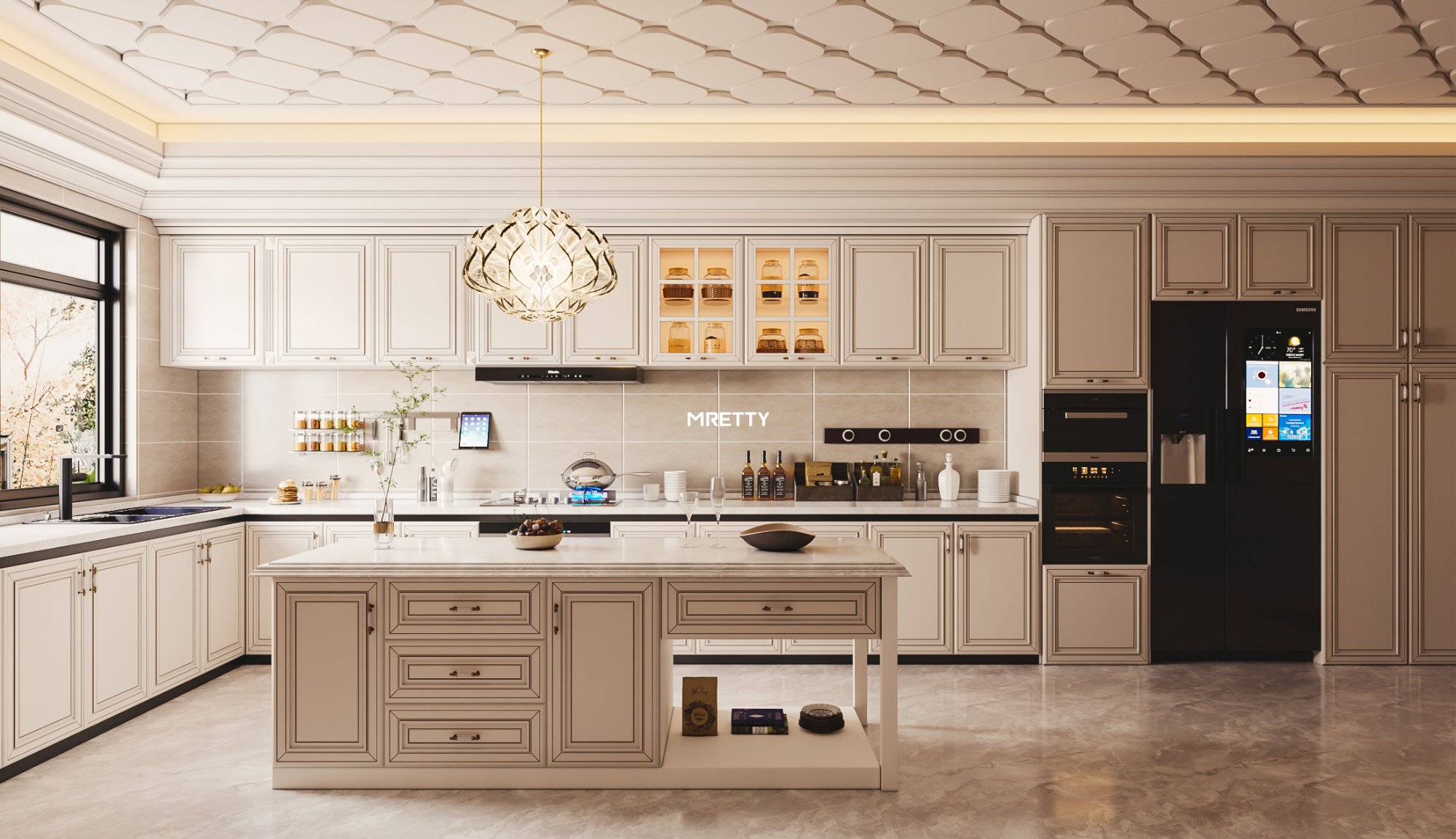
Best Kitchen Carpentry in Singapore: Homeowner Checklist
Finding the right team for your Singapore kitchen renovation comes down to separating true craftsmen from the rest. Here's a simple checklist.
What to Look For When Sourcing Kitchen Carpentry in Singapore
Recent Relevant Portfolio: Don't just look at 3D renders. Request photos of completed HDB or condo projects from the past 12 months. Check Singapore kitchen carpentry reviews on independent sites.
Material Expertise: A good carpenter must explain why they recommend a certain plywood. They should discuss moisture resistance and durability. If they can't explain the difference between MDF and high-moisture-resistant plywood — walk away.
Precision Manufacturing: Ask where cabinets are built. Local workshops can be decent, but a modern factory delivers unmatched precision. Our factory's auto-cutting and edge-banding create flawless, durable finishes handwork can't replicate.
Transparent Pricing: A trustworthy quote is itemised, listing every component. Vague terms like "solid-core plywood" or "premium hardware" are major red flags. To me, that's the biggest warning the contractor is either hiding something or doesn't know the specs themselves.
What's the Best Material for Integrated Cabinets in Singapore's Climate?
High-moisture-resistant plywood with quality laminate finish. That's the all-round best material for integrated cabinets in Singapore. It hits the ideal balance of durability, moisture resistance, and cost-efficiency — vastly outperforming MDF or particleboard.
Core material matters more than surface finish — non-negotiable.
Plywood: Gold standard. Multi-layer wood veneers cross-bonded — strong, warp-resistant. Always insist on multi-layer high-moisture-resistant plywood.
Laminate: Decorative surface bonded to plywood. Quality laminate finish is tough, easy-clean, and gives excellent moisture-sealing.
Countertop: Your kitchen workhorse. Quartz countertops* are Singapore's favourite for good reason — non-porous (resists coffee/wine stains), scratch-resistant, hygienic.
❌ Common Mistake: Choosing solid wood for that "premium" look. Solid wood expands/contracts with humidity — can warp doors in Singapore's climate.
✅ Better Approach: Use high-grade plywood for structure. Then choose quality woodgrain laminate or veneer for the look you want. You get the aesthetic without the maintenance headache.
What Is the Blum System and Is It Worth It?
The Blum system refers to high-end hinges and drawer slides by Austrian brand Blum. Absolutely worth it. The soft-close mechanism delivers smooth, silent operation and reduces wear. More importantly, durability is unmatched. Cheap hardware may fail in 3–5 years; Blum systems are engineered for 200,000 motion cycles — keeping your kitchen functioning perfectly for decades.
The MRETTY Standard: Integrating the Kitchen into a Whole-Home Bespoke System
The kitchen shouldn't be an afterthought. It should be the home's heart, visually and functionally connected to its surroundings. The MRETTY standard weaves kitchen design into a harmonious, unified whole-home aesthetic. We ensure materials, colours, and style flow seamlessly from kitchen through to living spaces.
This isn't just philosophy — it's a practice. When I kick off a kitchen project, the first questions I ask are about the living room: what's the TV console finish? What's the dining table style? Those answers dictate the kitchen's direction. This ensures your kitchen cabinet laminate doesn't clash with the living area's wood tone — delivering a harmonious, truly tailored home.
FAQ
How long does bespoke kitchen carpentry take?
From final design approval, factory production ~3–4 weeks; on-site installation typically 4–7 days.
Can I use my own interior designer?
Certainly. We frequently partner with IDs to execute their vision, contributing our manufacturing expertise and material knowledge.
What warranty do you provide?
All our bespoke carpentry carries warranty on workmanship and hardware. Specific terms — e.g. Blum mechanism lifetime warranty — detailed in your quote.
MRETTY: Premium Bespoke Kitchen & Cabinet Systems Provider in Singapore.
