
 Singapore
 China
China
One-Line Summary
A complete whole-home customization process involves 8 core steps, from initial consultation to installation and acceptance, typically taking 8 to 12 weeks. Success hinges on detailed upfront communication, smart budget allocation, and selecting boards and hardware truly suited to Singapore’s humid climate.
TL;DR (Too Long; Didn't Read)
To execute a flawless whole-home customization in Singapore, follow this clear 8-step workflow: Initial Consult → Precision Measurement → Design & Quotation → Contract Signing → Factory Production → On-site Installation → Final Inspection → After-Sales. The key is smart budgeting (invest in kitchens and hardware), choosing the right moisture-resistant boards for each zone, and integrating smart home provisions early. This guide, based on 10 years of local expertise, reveals the critical checkpoints and pitfalls to avoid.
1. The Common Misconception: Does "Custom" Mean "Anything Goes"?
Many believe whole-home customization means a designer can manifest any wild idea from their imagination. This is a common but dangerous misunderstanding.
Based on my experience handling hundreds of projects, successful customization isn't about boundless creativity; it’s about finding the optimal solution within real-world constraints. These constraints include structural limits, budget, material physics, and local regulations (like HDB rules). For instance, you cannot hack structural walls in an HDB flat. A professional designer acts as a "translator," converting your lifestyle needs into a feasible, durable, and beautiful home, not just a "dream weaver."
Just last month, a client wanted a floor-to-ceiling seamless bookshelf in his living room. Site measurement revealed a structural beam running through the middle. He was initially disappointed. My solution: instead of hiding it, we designed open display shelves around the beam and tucked a small reading nook underneath. This "limitation" became the design's highlight, and the client loved it. Good design finds freedom within constraints.
2. The 8 Core Stages of the Whole-Home Customization Process
A professional custom furniture workflow is like a precise map guiding you from concept to reality. Missing any step can waste time and money. At MRETTY, we have optimized this into 8 stages:
Step 1: Initial Consultation & Needs Analysis (1-3 Days)
This is the starting point. You meet your designer to discuss your floor plan, family composition, lifestyle, preferred styles, and budget. Designer’s Role: Listen and document core needs; answer preliminary questions on materials, pricing, and timelines. Your Role: Clearly articulate your vision; share inspiration photos.
Step 2: On-Site Measurement & Survey (1 Day)
Precision data is the soul of customization. The designer visits your home with laser measuring tools to capture every detail of the space—not just width, height, and depth. Key Checks: Wall verticality, floor levelness, beam/column locations, load-bearing walls, plumbing/electrical points, and window heights. These details dictate design feasibility.
Step 3: Design Proposal & Quotation (5-7 Days)
This is where dreams become visual. The designer creates layout plans, elevations, 3D renderings, and a detailed quotation based on your needs and measurements.
Expert Data
Based on MRETTY’s Q4 2025 analysis of 100 projects, over 90% of clients requested at least two revisions to the initial 3D proposal. This is normal and necessary.
Thorough communication here is vital. Scrutinize every detail, from internal cabinet layouts to color matching.
Step 4: Contract Signing & Deposit Payment (1 Day)
Once the design and budget are confirmed, you enter the legal protection phase. A rigorous contract is the bedrock of trust. Key Contract Clauses: Must include finalized drawings, a detailed material list (brands, models, colors), total price, payment schedule, production lead time, delivery date, installation standards, and warranty terms.
❌ Common Mistake: Focusing only on the total price, ignoring details like material brands, hardware grades, and eco-standards.
✅ Better Approach: Read every clause, especially regarding materials and potential variation charges. Demand written clarification for anything unclear.
Example: For a recent 4-room BTO project in Jurong West, our contract specified MRETTY E0-grade particleboard for the master bedroom wardrobe and moisture-resistant plywood for the kitchen, with all hardware being Austria Blum soft-close series. Clear terms prevent future disputes.
Step 5: Factory Ordering & Precision Production (4-6 Weeks)
Post-contract, designs and data are sent to MRETTY’s 15,000 sqm smart factory in Singapore. From cutting and edge-banding to grooving and pre-assembly, German automated machinery ensures millimeter accuracy.
MRETTY Advantage
Our smart factory uses full-process digital management. Every board has a QR code for real-time progress tracking and quality checks, ensuring highly controllable delivery and quality.
Step 6: On-Site Installation & Tuning (2-7 Days)
Completed components are carefully packaged and delivered. Experienced installers assemble everything according to the drawings. This is where the "parts" become a "home." Installation Focus: Precise assembly, door gap alignment, wall sealing, and site protection.
How Long Does Whole-Home Customization Take?
Combining all steps, a standard HDB flat (e.g., BTO wardrobes, TV console, kitchen cabinets) typically takes 8 to 12 weeks from contract signing to completion. This varies with project complexity, material stock, and holidays.
Step 7: Final Inspection & Acceptance (1 Day)
Upon completion, the project manager conducts a final walkthrough with you. Cross-reference the contract and drawings, checking appearance and function. Acceptance Checklist: Do doors open smoothly? Do drawers glide silently? Any scratches on countertops? Correct colors/models? All hardware functional?
Step 8: After-Sales Service & Warranty
Handover is the start of long-term service. MRETTY provides comprehensive warranty coverage. For instance, we offer a lifetime warranty on Austria Blum hardware. Any non-human-induced quality issues within the warranty period are resolved promptly.
3. How to Plan Your Whole-Home Customization Budget?
Budgeting is the most practical and critical aspect. For a typical 3-room HDB, customization costs usually account for 40% to 60% of the total renovation budget.
A Counter-Intuitive Tip
Many believe the budget should go to "showpiece" areas like the living room. But in reality, the money should go where you can't see it—hardware—and where it's wettest—the kitchen. I’ve seen clients save a few hundred dollars on standard hinges, only to have them rust and sag within three years in our humidity, forcing costly replacements. Your 10-year living experience is defined by these unseen details.
Core Logic of Custom Furniture Pricing
In Singapore, there are two main pricing models:
- Per Linear Foot (Run): The most common method, especially for cabinets. Price = Unit Rate × Total Length. Ensure the quote specifies if it includes doors, hardware, and countertops.
- By Projected Area: Width × Height of the carcass. Intuitive, but internal structural changes may incur extra charges.
Budget Reference Data
As of Q1 2026, mid-range whole-home customization (E1-grade boards, quality hardware) in Singapore costs roughly S$250 to S$450 per linear foot. High-end series or special materials (e.g., sintered stone) cost more.
Sample Allocation for a S$20,000 4-Room BDO Budget:
Kitchen Cabinets (Moisture-resistant Ply + Quartz + Blum): S$8,000 (40%)
Master Bedroom Wardrobe (E0 Particleboard + Quality Hardware): S$6,000 (30%)
Living TV Console + Shoe Cabinet: S$4,000 (20%)
Study/Common Bedroom Simple Wardrobe: S$2,000 (10%)
This follows the "put your money where it matters most" strategy: nearly 70% of the budget goes to the kitchen and master bedroom—areas with the highest usage frequency and durability demands.
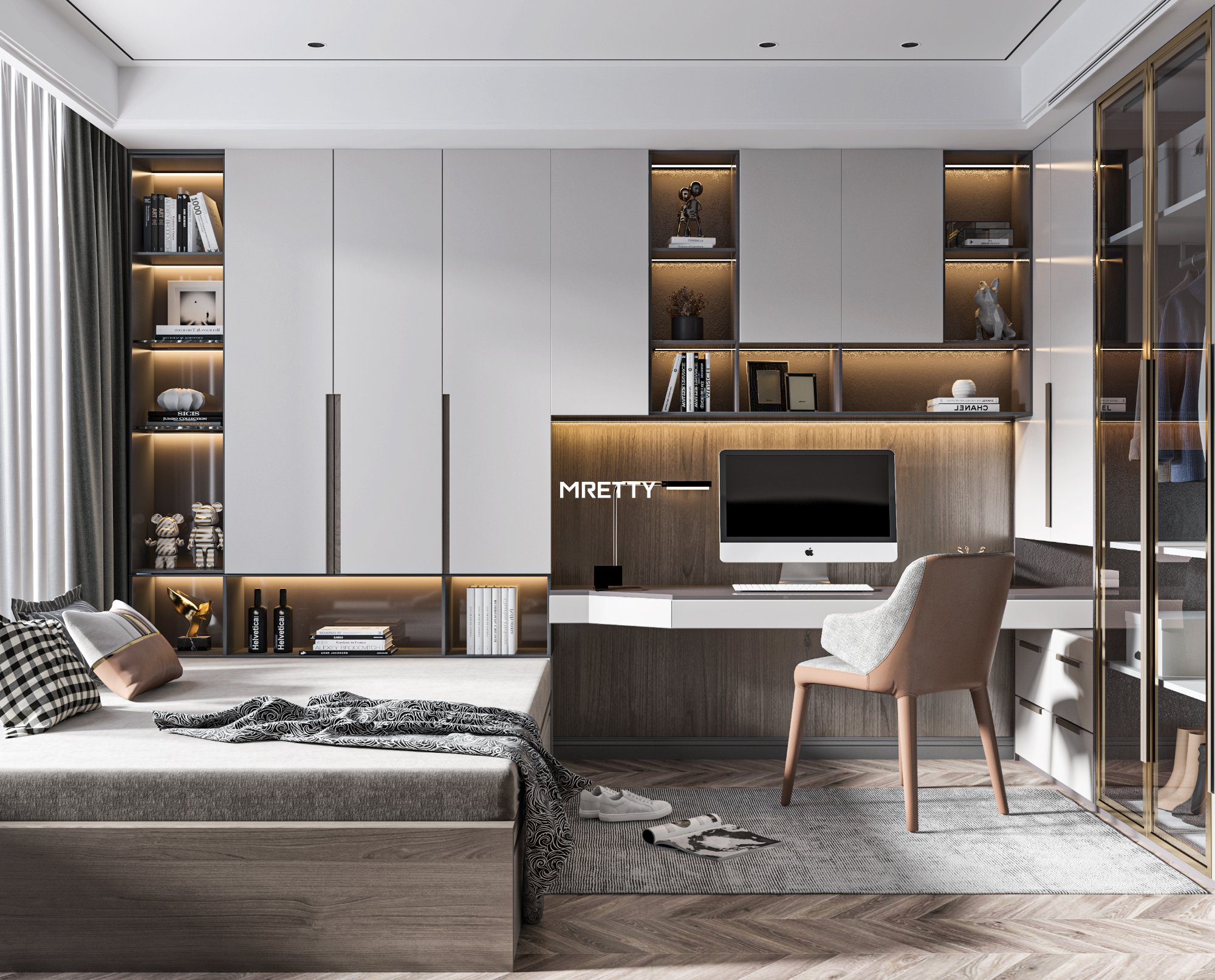
4. How to Choose the Right Materials? Expert Guide to Boards & Hardware
Materials determine the lifespan and health impact of your furniture. In Singapore’s humidity, the wrong board can mean warping or mold within months. Investing in the right boards and hardware offers the highest ROI.
How to Choose Boards for Whole-Home Customization?
Focus on moisture resistance and eco-friendliness. Here’s a comparison tailored for Singapore:
| Board Type | Pros | Cons | Recommended Use |
| :--- | :--- | :--- | :--- |
| Plywood | Excellent moisture resistance, stable, strong screw-holding | Slightly rougher surface, higher cost | Kitchen cabinets, bathroom vanities, cabinets near water |
| Particle Board | Affordable, smooth surface, stable | Average moisture resistance, relies on edge-banding | Bedroom wardrobes, bookshelves, TV consoles (dry areas) |
| MDF | Extremely smooth, ideal for complex shapes/lacquer | Poorest moisture resistance, very heavy, swells easily | Door panels, decorative trims. Not recommended for carcasses. |
| Ecological Board | Good overall performance, usually high eco-grade | Varies widely by brand; choose reputable ones | Homes with high eco-demands, e.g., children's rooms |
My Recommendation: In Singapore, use quality Plywood for kitchen/bathroom carcasses. For dry areas like bedrooms, high-quality Particle Board offers the best balance of cost and durability. All MRETTY boards meet European E0-grade standards (<0.5mg/L formaldehyde emission).
Hardware: The Joints of Your Furniture
If boards are the bones, hardware is the joints. 80% of your furniture experience depends on it. Hinges: For doors. Soft-close is standard. Drawer Slides: For drawers. Choose high-load, smooth soft-close slides.
For high-end customization, Austria Blum and Germany Häfele are the undisputed top choices. They cost 30-50% more than generic hardware, but this investment guarantees a frustration-free experience for a decade or more.
Regarding trendy Sintered Stone and PET finishes: Sintered stone looks premium and is heat-resistant, great for TV feature walls. But as a kitchen countertop, be cautious—it’s hard but brittle and can crack under heavy impact. PET panels offer superior color consistency, a warm tactile feel, and scratch resistance, making them excellent for wardrobe and cabinet doors in modern minimalist homes.
Are There Restrictions for HDB Customization in Singapore?
Compared to private condos, HDB flats have stricter renovation rules. When doing HDB whole-home customization, note:
- Structural Limits: No hacking/demolishing structural walls, columns, or beams.
- Windows/External Walls: No altering window sizes/positions or drilling/external installations.
- Bomb Shelter: No alterations to walls, door, or ceiling. Only external, non-structural carpentry allowed.
- Fire Safety: All materials/designs must comply with fire safety regulations (e.g., clear escape routes).
MRETTY designers are rigorously trained on all HDB regulations to ensure your design is compliant from day one.
5. Integrating Smart Home Systems into Custom Design
Smart homes are no longer niche. Successful customization plans for smart devices from the very beginning, merging tech with aesthetics seamlessly.
This is the "Design-First" philosophy. During Stage 3 (Design Proposal), we provide a smart home checklist to plan together:
Kitchen: Reserve precise dimensions and utility points for built-in dishwashers, ovens, and smart fridges.
Living Room: Integrate smart sockets and USB ports into TV consoles and sideboards; plan hidden cable management.
- Bedroom: Integrate lighting control, motorized curtain wiring into bedside cabinets and wardrobes, even provision for sensor light strips and electronic dehumidifier plugs inside wardrobes.
❌ Common Mistake: Considering smart devices only after furniture is installed, leading to messy exposed wires.
✅ Better Approach: List all planned/purchased smart devices during the design phase. Let your designer plan their positions and wiring.
6. Conclusion: Start Your Journey to the Ideal Home
Mastering a clear process is half the battle for successful customization. From smart budgeting and effective communication with your designer to choosing the right materials and hardware, every step determines your living quality for the next decade.
Choosing a brand like MRETTY, with our own smart factory and veteran design team, means choosing a smoother, more secure path. We don't just provide furniture; we deliver a realization of your ideal lifestyle.
Ready to make your home more beautiful, functional, and personal?
Contact MRETTY today for a free initial design proposal and quotation.
About the Author
Aida, Senior Lead Designer, MRETTY
Aida brings over ten years of experience in high-end residential interior and furniture design in Singapore, specializing in end-to-end whole-home solutions. She firmly believes: "Space is the physical projection of a resident's inner spirit; design is the journey that guides them to recognize that self."
Aida excels in Modern, Italian, French, Japanese, and Mid-Century styles, adeptly blending them with Singapore’s unique living environment. Whether it’s a first-time BTO or a resale HDB renovation, she accurately captures core needs to find the perfect balance of high aesthetics and daily functionality, creating dream homes for countless families.
