
 Singapore
 China
China
What is luxury whole-home customisation in Singapore? It is the art of crafting fully personalised, built-in furniture. Every piece is meticulously designed to fit your space and lifestyle perfectly. A recent report by Qanvast confirms this trend: the number of homeowners opting for custom solutions over retail ready-made furniture has grown by 15%. This approach elevates your home’s form and function through tailor-made joinery, premium materials, and masterful craftsmanship.
60-Second Core Takeaways
- True Luxury Lies in "Exclusivity." It is not about the price tag, but about solutions crafted for your unique spatial needs using exceptional materials and impeccable craftsmanship.
- Budget Varies by Property Type. Whole-home customisation ranges from S$30,000 for BTO flats to over S$150,000 for landed homes. Final cost depends on material selection and design complexity.
- Process Is Everything. A transparent, structured workflow is non-negotiable. It ensures your vision is delivered on time and within budget, avoiding common renovation nightmares.
First Questions to Ask About Luxury Custom Furniture
Before considering style samples, we need to clarify two things. Based on my experience, defining these points upfront saves clients countless hours and prevents costly misunderstandings.
What Qualifies as Luxury Custom Furniture in Singapore?
Luxury custom furniture in Singapore is far more than made-to-measure cabinets. It is custom joinery: a complete solution blending aesthetics, ergonomics, and intelligent spatial planning.
True luxury rests on four pillars:
- Personalised Design: It starts with you, not a catalogue. The design is co-created with you to match your daily habits, storage needs, and personal style. It is a vital component of a turnkey interior design solution.
- Premium Materials: This means using imported European boards, high-end laminates like Italian Fenix anti-fingerprint surfaces, and natural stone. It also demands high-performance hardware.
- Masterful Craftsmanship: Pursuing precision and seamless finishing. Edges should be perfectly sealed, joints invisible, and mechanical structures silky smooth. It is this quality assurance that makes MRETTY’s 15,000 sqm smart production facility the core of our process.
- Intelligent Functionality: Modern luxury incorporates smart home integration. Examples include wardrobes with motion-sensor lighting or kitchens designed around ergonomic workflows.
How Much Does Luxury Whole-Home Custom Furniture Cost in Singapore?
This is always the first question, and the answer truly varies. Based on my 14 years of experience, we can outline a realistic custom furniture cost breakdown for new BTO flats, condominiums, and landed homes.
| Property Type | Typical Scope | Estimated Budget Range (SGD) |
| :--- | :--- | :--- |
| HDB BTO (4/5-Room) | Wardrobes, kitchen cabinets, TV consoles, shoe cabinets | $30,000 – $60,000 |
| Condominium (3-Bedroom) | Floor-to-ceiling wardrobes, kitchen, feature walls, study | $50,000 – $90,000 |
| Landed Home | Whole-home customisation, walk-in wardrobes, wet & dry kitchens, entertainment rooms, custom stairs | $100,000 – $250,000+ |
Note: These are mid-2026 estimates. The final cost of a luxury whole-home furniture package in Singapore depends on materials and design complexity. A kitchen using premium Fenix surfaces and Blum hardware can easily cost 40% to 50% more than a standard configuration.
Just last month, I managed a project for a 4-room BTO flat in Punggol. The homeowner had a firm budget of S$45,000. We allocated the budget towards high-end Fenix finishes for the frequently used kitchen cabinet doors, while using cost-effective standard laminate for the internal wardrobe carcasses. This smart allocation gave them a luxury feel where it mattered most, without overspending.
What Does the Whole-Home Customisation Process Include?
Industry surveys show over 30% of renovation projects suffer budget overruns or delays. Why? These issues almost always stem from an unclear process. A professional whole-home custom joinery project in Singapore should be predictable and transparent.
Here is the refined, step-by-step process we follow at MRETTY to eliminate surprises:
- Step 1: Deep-Dive Consultation & Site Measurement (1–2 Weeks)
Content: We discuss your lifestyle, not just wall dimensions. Are you an avid cook? Do you own 50 pairs of sneakers? This is the true starting point for space planning in Singapore homes. We then conduct precise site measurements.
Importance: This is the foundation. Inaccurate measurements or weak understanding of needs leads to furniture that simply does not work.
- Step 2: Concept Design & 3D Visualisation (2–3 Weeks)
Content: Our designers translate your needs into concrete schemes. You receive detailed 3D renderings showing exactly how each piece will look. We review material samples and finalise layouts together.
Importance: Visualisation is key. It lets you see and confirm the final design before production starts, avoiding expensive changes later.
- Step 3: Technical Drawings & Factory Production (4–6 Weeks)
Content: Once designs are approved, our technical team creates precise production blueprints. These go directly into our 15,000 sqm smart factory, where automated equipment ensures sub-millimetre accuracy.
Importance: This is a major differentiator. MRETTY’s factory technology guarantees consistency and quality that manual joinery cannot match.
- Step 4: On-Site Installation & Quality Inspection (1–2 Weeks)
Content: Our in-house installation team handles assembly and adjustments. A project manager supervises throughout to ensure every detail aligns with the scheme.
Importance: Professional installation is as important as production. Our team knows exactly how the furniture is constructed and can perfectly handle any on-site adjustments.
- Step 5: Handover & After-Sales Service
Content: We walk you through every function. You receive care guides and warranty information. Our relationship does not end at handover; we are here for your future needs.
Importance: True luxury service means lasting peace of mind.
❌ Common Mistake: Relying on a contractor’s carpenter to work from rough sketches. This is a breeding ground for miscommunication and disappointment.
✅ Better Approach: Insist on detailed 3D renderings and a finalised material list, locked in as contractual quality benchmarks before production begins.
In a recent condominium project, the client insisted on a massive 3-metre-long kitchen island. On paper, it looked fine. But when we presented it in the 3D rendering, they immediately saw the problem: it blocked the walkway to the balcony. We adjusted it to 2.4 metres with tapered ends—retaining the grand feel while restoring critical living space. That would have been a permanent error.
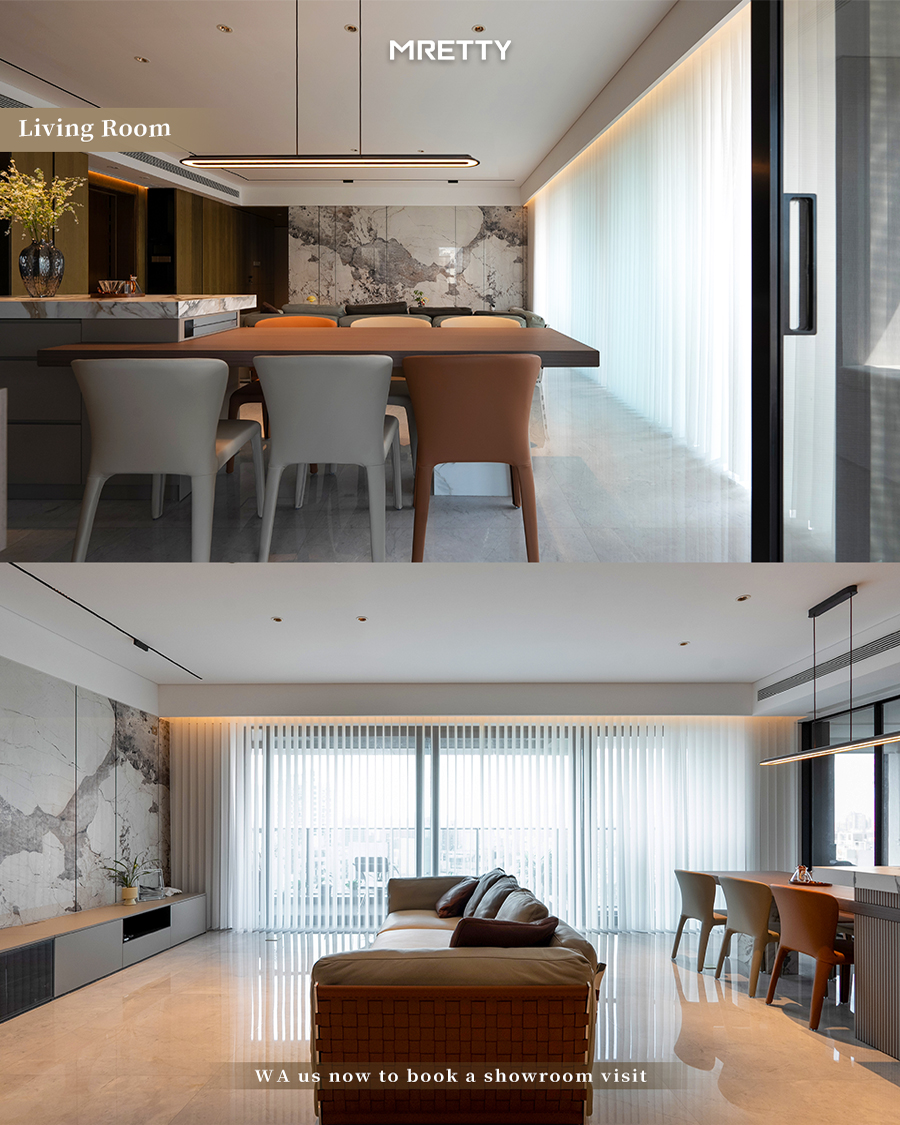
Planning Custom Furniture Budgets for Different Singapore Property Types
A luxury custom furniture price list in Singapore can be confusing. Price is not just about size; it relates to density, complexity, and material grade. As an interior designer with over 14 years of experience, I have guided hundreds of clients in budgeting—from high-end custom furniture for 5-room BTO flats to penthouses.
Here are the key cost drivers:
Material Selection (40% of Cost): Standard laminate is the baseline. Upgrading to premium options like Fenix, natural wood veneer, or sintered stone countertops increases price. An island with Italian sintered stone can cost three times more than one with quartz.
Design Complexity (30% of Cost): A simple flat-panel door wardrobe is cheaper than one with fluted details or curved doors. Complex custom joinery requires more skilled labour and machine hours.
Hardware & Mechanisms (20% of Cost): This is critical. Using top-tier Blum hardware with soft-close functionality costs more but drastically improves daily experience and durability. For luxury furniture, this is non-negotiable.
Labour & Installation (10% of Cost): Covers professional fees for designers, project managers, and installation teams.
Here is a practical comparison for a master bedroom wardrobe:
| Feature | Standard Configuration | Luxury Configuration (MRETTY Standard) |
| :--- | :--- | :--- |
| Carcass Material | Standard Particleboard | Moisture-Resistant, Low-Formaldehyde Board |
| Door Finish | Basic Laminate | Fenix Nanotech Material or Wood Veneer |
| Hardware | Generic Hinges & Slides | Blum Soft-Close Hinges & Drawer Systems |
| Internal Functionality | Basic Shelves & Hanging Rod | Integrated LED Sensors, Pull-Down Rails, Velvet Trays |
| Estimated Cost | S$350 – S$500 per linear foot | S$700 – S$1,200 per linear foot |
❌ Common Mistake: Accepting a "custom wardrobe" quote without specifying hardware brands or board types. Hidden costs and quality issues often originate here.
✅ Better Approach: Demand a fully itemised quotation. Exact materials must be listed, along with specific brands and models for all mechanical hardware.
This transparency is vital. It allows you to allocate your budget to what matters most to you, shifting the conversation from "How much?" to "What value do I get?"
Ready to Plan Your Dream Home?
Planning whole-home customisation can feel overwhelming. To simplify your journey, we have created a checklist based on experience from hundreds of Singapore homes.
Download our free New Condo/BTO Custom Furniture Planning Checklist. It covers everything from defining storage needs to the critical questions you must ask your designer.
Which Materials Truly Define Luxury Custom Joinery?
For luxury custom furniture in Singapore, materials are the main character. You see and touch them every day. Premium materials offer more than just looks; they provide durability, functionality, and a healthier living environment.
Most homeowners believe solid wood is the ultimate symbol of luxury. After all, it is a classic material.
But here is the counter-intuitive insight I have learned from 14 years designing in Singapore’s climate: for large built-in furniture (like wardrobes), high-quality engineered boards are often the superior choice.
Why? Stability is key. In our persistently humid environment, engineered boards are extremely resistant to warping or cracking. They provide an incredibly stable substrate for perfect, modern finishes—like anti-fingerprint Fenix or seamless lacquer—which define contemporary luxury. Solid wood moves with the environment; high-end engineered boards do not.
Here are the key points to focus on:
Core Boards: Top-tier companies use high-density, moisture-resistant boards with low formaldehyde emissions (E0 or E1 grade). This is crucial for high-end built-in furniture in condos and HDB flats.
Finishes: The new industry standard includes advanced surfaces like Italian Fenix® nanotech materials. It is anti-fingerprint, soft to the touch, and even has thermal healing properties.
- Hardware: This is the engine of the furniture. I often tell clients: never save money on hardware. Brands like Blum from Austria are the gold standard. Their hinges and drawers are tested for 200,000 cycles—equivalent to over 20 years of daily use.
MRETTY: Premium Bespoke Kitchen & Cabinet Systems Provider in Singapore
