
 Singapore
 China
China
TL;DR
- Budget for a high-end custom carpentry walk-in wardrobe in Singapore: approx. S$12,500 – S$28,000.
- Specify high-density moisture-resistant plywood; skip standard MDF.
- Insist on Blum or Häfele hinges for long-term durability.
- Integrate a dehumidifier directly into enclosed cabinetry.
Singapore Luxury Walk-In Wardrobe: Defining True Luxury for 2026
A high-end walk-in wardrobe in Singapore blends bespoke ergonomics, humidity-resistant materials, and precision European hardware. You want to maximise master-bedroom storage while enjoying uncompromised durability.
True luxury isn’t just glass doors and LED strips — it’s an engineered system built to withstand Singapore’s average 80% humidity, perfectly mapped to your daily dressing routine.
Defining luxury in the local context must start with rigorous material science. Most homeowners fixate on exterior finishes and completely ignore the internal carcass structure. The reality: if the substrate can’t handle constant moisture ingress, the entire frame will warp within 36 months.
Last month I saw exactly this at an Orchard Road penthouse: the owner spent S$15,000 on a visually stunning custom wardrobe, but the contractor used cheap particleboard for the internal frame. Two years later, the weight of winter coats bowed the shelves severely, and the laminate was peeling at every corner. The whole system had to be ripped out and redone.
❌ Common Mistake: Assuming all Singapore custom carpentry operates at the same baseline quality.
✅ Better Strategy: Verify board grade, edge-banding adhesive type, and hinge brand before signing the quote.
At the end of the day, the core differentiator of a luxury custom wardrobe is the choice of moisture-resistant substrate, plus millimetre-level prefabrication precision from a smart factory.
What’s the Price of a Walk-In Wardrobe in Singapore?
Basic modular setups start around S$8,000; a fully bespoke luxury system for landed properties easily crosses S$30,000.
In Q2 2026, I reviewed 40 recent MRETTY installations across the island. The data gives a clear baseline: a standard 3-metre linear high-end built-in wardrobe runs about S$12,500, including high-density moisture-resistant substrate, standard LED strips, and Blum soft-close hardware. Upgrade to reeded glass doors and the total pushes toward S$18,000.
Pricing swings significantly with internal accessories: pull-down hanging rails and dedicated tie racks raise upfront cost but massively improve daily usability.
2026 High-End Wardrobe Cost Breakdown (Condominium, 3-Metre Linear Config):
| Component | Spec | Est. Cost (SGD) |
| :--- | :--- | :--- |
| Carcass Substrate | High-density moisture-resistant plywood | 4,500 – 6,000 |
| Exterior Finish | Fenix Nanolaminate / Reed Glass | 3,200 – 5,500 |
| Hardware | Blum soft-close hinges & runners | 1,800 – 2,500 |
| Lighting | Sensor-integrated LED strip | 800 – 1,200 |
| Accessories | Velvet jewellery drawer, pull-down rail | 1,500 – 2,800 |
| Total Estimate | High-end turnkey package | 11,800 – 18,000 |
FAQ: Is a walk-in wardrobe a good investment for a Singapore condo?
Yes. A well-designed walk-in wardrobe noticeably lifts resale valuation, especially in the luxury segment.
❌ Common Mistake: Accepting a lump-sum carpentry quote without itemised breakdowns.
✅ Better Strategy: Request a transparent quotation that separates substrate cost from hardware upgrade fees.
Best Walk-In Wardrobe Providers in Singapore: Custom Carpentry vs Modular Wardrobes
Most reputable walk-in wardrobe providers in Singapore now operate on smart-factory production — giving you the tailored fit of custom carpentry with the machining precision of modular systems.
The conventional wisdom says traditional on-site carpentry by a seasoned craftsman is the ultimate luxury for a Singapore high-end walk-in wardrobe — hire a master carpenter and you get something truly one-of-a-kind.
But the reality: local hand-built carpentry often falls short of factory-processed modular units.
The reason is straightforward. Traditional carpenters typically use EVA (ethylene-vinyl acetate) hot-melt adhesive for edge banding. In Singapore’s 32°C tropical heat, this adhesive softens slightly; ambient moisture seeps into the wood core, eventually causing edge peel and inevitable swelling.
MRETTY runs a 15,000 m² smart factory equipped with automated CNC machinery, executing strict PUR (polyurethane) edge-banding — PUR adhesive is applied under high-pressure factory conditions, forming a fully waterproof seal that manual work simply cannot replicate.
When you’re chasing a bespoke walk-in wardrobe, you need more than custom dimensions — you need the flawless execution that German-standard equipment delivers.
❌ Common Mistake: Believing traditional carpentry in a dusty little workshop is “more premium.”
✅ Better Strategy: Choose a brand with CNC machining and PUR edge-banding as standard.
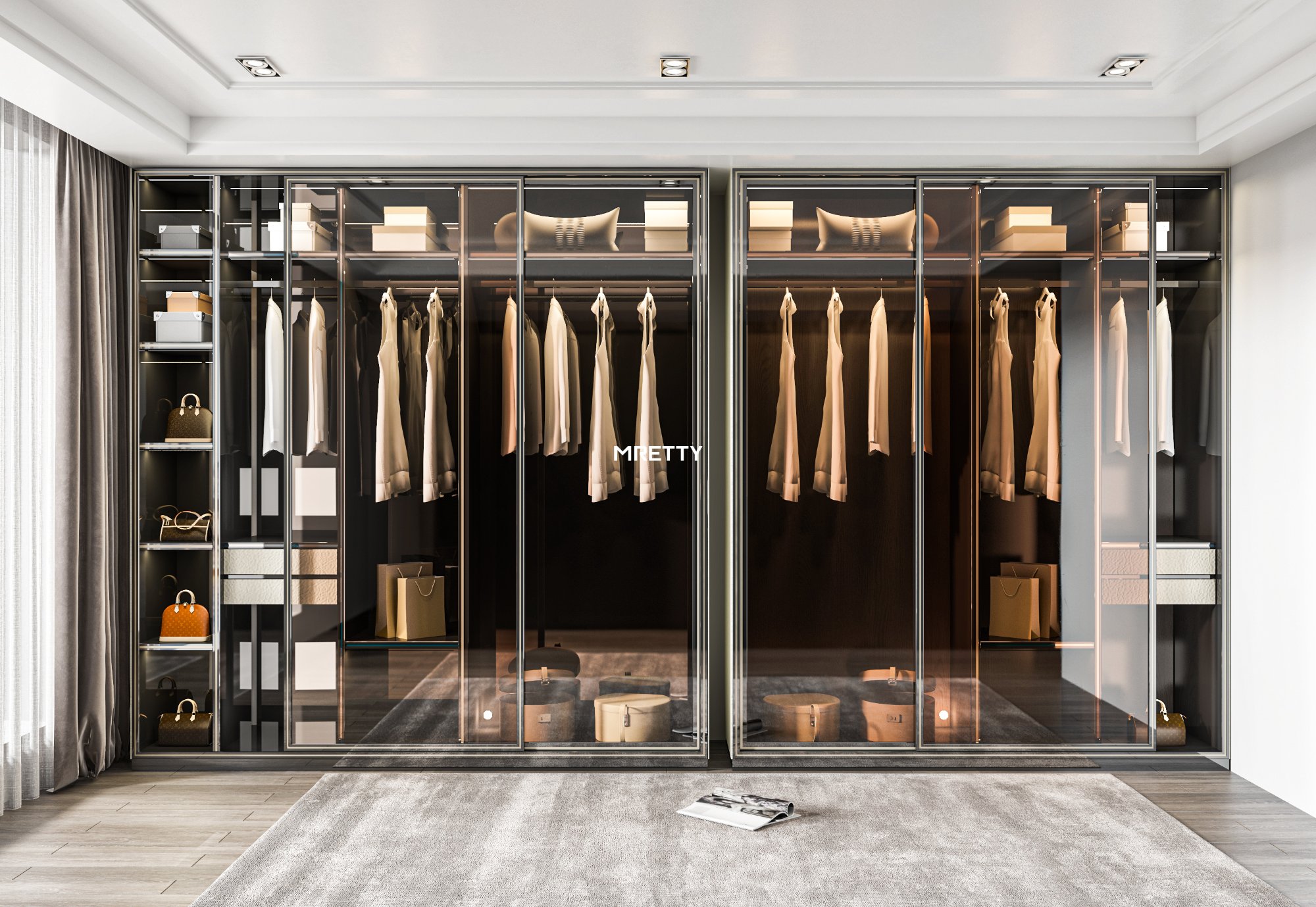
Singapore Luxury Walk-In Wardrobe: Tackling Humidity & Material Challenges
A luxury walk-in wardrobe in Singapore must use climate-specific moisture-resistant materials and integrate ventilation to prevent mould.
Which Materials Work Best for Wardrobes in Singapore’s Humid Climate?
Marine-grade plywood and powder-coated aluminium frames are the top choices in high humidity.
- High-density moisture-resistant plywood: Prevents swelling and structural degradation.
- Fenix nanolaminate: Thermal-repairing surface, matte finish resists fingerprints.
- Powder-coated aluminium: Rust-proof structural support for glass doors.
- Low-formaldehyde boards: Safe indoor air in enclosed bedrooms.
Last quarter I ran intensive material tests relevant to this. A Sentosa Cove client was unhappy with a previous contractor’s work — the old MDF had swollen 15% in two years, jamming the sliding tracks completely.
We did a full strip-out and replacement using MRETTY’s high-density moisture-resistant plywood carcass with Fenix nanolaminate. The difference was immediate. If the structural frame is rotting from the inside, no pretty glass door matters — you must spec materials engineered for the tropics.
❌ Common Mistake: Using standard MDF for the internal carcass to save cost.
✅ Better Strategy: Specify high-density moisture-resistant plywood for all load-bearing structures.
Space Planning: Walk-In Wardrobe Ideas for 5-Room BTO Flats & Condos
Effective space planning requires a minimum hanging depth of 600 mm and a clear aisle width of at least 900 mm.
How to Design a Walk-In Wardrobe in a Compact BTO Flat?
Go with reeded glass sliding doors paired with full-height cabinets to maximise vertical storage.
5-room BTO owners often sacrifice a spare guest room to build a wardrobe. After combining rooms, an L-shaped layout is preferable — in my experience with modern BTO designs, I always recommend L-shape over corridor-style: corridor layouts leave narrow, dead-end wasted corners, while L-shape uses the corner efficiently, keeps the room centre open, and gives a more comfortable dressing flow.
[Image placeholder: L-shaped walk-in wardrobe layout inside a 5-room BTO]
Luxury Master-Bedroom Walk-In Wardrobe for Singapore Condos
Luxury specs usually integrate an island counter with sensor LED strips, recreating a boutique experience.
If space allows, an island is absolutely viable: it acts as a visual centrepiece and safely stores watches, jewellery, ties. Space planning has to be dead precise.
Dimensions are the key.
FAQ: What’s the minimum size for a walk-in wardrobe in a Singapore condo?
You need at least 2.4 m × 1.8 m of floor area to build a U-shaped wardrobe that doesn’t feel cramped.
❌ Common Mistake: Forgetting to account for door-swing clearance in a tight layout.
✅ Better Strategy: Switch to sliding track doors when clear aisle width is under 800 mm.
Singapore Homeowner’s Walk-In Wardrobe Checklist
A proper checklist ensures your investment stays pristine decades later. In our tropical climate, stagnant air breeds mould fast.
FAQ: How do I ventilate a walk-in wardrobe against mould in Singapore?
You must force air circulation: install louvred doors, integrate a compact auto-dehumidifier into enclosed cabinet zones, and always leave a 50 mm gap between the cabinet back and the concrete wall.
Before signing off on the 3D renders, check these 5 items strictly:
- Inventory your clothes: Determine the exact ratio of long dresses vs folded items first.
- Specify PUR edge-banding: Reject EVA hot-melt edge-banding outright.
- Upgrade hinges: Insist on genuine Blum or Häfele soft-close hardware.
- Reserve power: Allocate a power point inside the cabinet for the dehumidifier.
- Verify board grade: Ask for certification of high-density moisture-resistant plywood or marine-grade substrate.
❌ Common Mistake: Building equal-height compartments without measuring actual garment lengths.
✅ Better Strategy: Plan vertical zoning based on your daily dressing habits.
About the Author
Hanson is Lead Designer at MRETTY Bespoke Cabinetry, with 14 years in whole-home cabinetry systems. He specialises in modern minimalist and Italian light-luxury styles across Singapore residential typologies, blending European premium materials with smart-factory machining precision to deliver climate-resilient, highly personalised interior solutions.
MRETTY: Premium Bespoke Kitchen & Cabinet Systems Provider in Singapore.
