
 Singapore
 China
China
Executive Summary
- Verify Factory Ownership: Prioritise Singapore kitchen cabinet manufacturers with their own factory — direct quality control, better cost efficiency.
- Materials Are Foundational: Singapore's high-humidity environment demands moisture-resistant materials — multi-layer plywood + low-formaldehyde E0 boards; skip standard particleboard.
- Break Down Costs: Insist on detailed itemised quotes; 2026 typical pricing is S$120–300+ per foot run depending on materials and hardware.
- Insist on Premium Hardware: Stick with reputable brands like Blum and Hettich — that's how you get durability and long-term smooth operation.
Assess Your Needs, Define Your Ideal Cabinet Project
Look at your kitchen — are the cabinet doors sagging? Has the veneer peeled from steam exposure? That's the reality of a poor renovation. Now picture drawers gliding silently, doors still aligned years later. That isn't luck; it's choosing the right manufacturer from day one.
Before searching "Singapore kitchen cabinet manufacturer," pin down your project scope — clarify your goals, style, and property type. This clarity is critical for getting an accurate quote. A 4-room HDB BTO project and a landed home full-renovation have completely different requirements. Many clients now want a cohesive theme, extending the kitchen design into a "whole-home custom furniture including kitchen" project.
Property type dictates design direction:
Compact HDB kitchens need smart space-saving solutions.
Spacious apartments or landed homes can fit a large island, going the "Singapore condo luxury kitchen design" route.
We find HDB BTO projects focus on squeezing storage out of a fixed layout, while resale HDB renovations often involve reorganising the entire layout. Matching your needs to a "Singapore kitchen cabinet maker" with relevant experience is the key first step.
Last year on a Tampines BTO project, the goal was purely functional: squeeze three generations' cookware into a narrow galley kitchen — we solved it with vertical pull-outs and corner carousel systems. On a Bukit Timah landed project, the kitchen was the family's social core; the main goal was a 4-metre marble island for hosting, with cabinetry designed more like fine furniture than pure storage — two completely different objectives.
❌ Common Mistake: Telling a manufacturer only "I want a nice-looking kitchen."
✅ Better Approach: Prepare a clear brief with property type (e.g. 4-room resale HDB), floor plan, and inspiration images so the manufacturer can quote accurately.
How to Choose a Singapore Kitchen Cabinet Manufacturer: 7-Step Checklist
Picking a reliable manufacturer takes systematic checking — verify the factory, drill into materials, check hardware, demand transparent pricing. Based on 14 years of experience, this process helps you avoid pitfalls and find a truly capable partner. It's also our core checklist for picking a kitchen carpenter.
Step-by-step process our project managers use:
- Verify Factory Ownership: Ask: "Do you have your own factory?" A true "Singapore direct-factory cabinet" provider like MRETTY controls quality, timeline, and cost end-to-end; interior design firms or contractors are just middlemen.
- Drill Into Material Quality: Don't be swayed by surface colour — ask for core-board specs. In Singapore's climate, cabinet carcasses must use high-density moisture-resistant plywood; avoid standard particleboard or MDF.
- Check Hardware Brands: Hardware determines how cabinets feel and how long they last. Look for European brands like Blum hinges or Hettich — lifetime warranty, soft-close mechanisms that last decades.
- Review Local Case Studies: Ask to see completed projects in similar properties, proving they know local layouts (HDB or condo both work). Study door alignment and joint finishing closely in photos.
- Demand Quote Transparency: A solid quote is fully broken down — price per foot run, material model, hardware model, add-ons like countertops all listed clearly.
- Clarify Warranty: How many years on carpentry structure vs hardware? Standard workmanship warranty is 1–2 years; premium hardware brands like Blum often carry lifetime warranty from the brand side.
- Evaluate Design & Technical Capability: Does the other party just take orders or actually propose solutions? A good partner will suggest workflow efficiency and material fit; detailed 3D renders before production are a hard indicator of professionalism.
Just last year, a potential client came to us — his kitchen started having issues after just one year. He'd picked a cheap quote, saving about S$1,500, but the contractor used off-brand hinges. Thirteen months later (just past warranty), they started rusting and sagging, doors wouldn't close properly, and fixing them meant replacing all hinges — the S$1,500 saved went straight out the window plus extra.
❌ Common Mistake: Picking a manufacturer solely on the lowest quote.
✅ Better Approach: Compare apples to apples — low quotes often mean inferior materials (particleboard instead of plywood) or low-grade hardware; they'll fail sooner or later.
The Factory Visit Myth: A Counter-Consensus View
Everyone says you must visit the factory — sounds reasonable. But the truth is, a polished factory tour guarantees nothing.
Conventional advice is to look at machinery and scale — a large modern facility like our 15,000 sq m one indicates capacity, but isn't the ultimate proof of craftsmanship. I've seen tiny messy workshops produce flawless work, and massive automated factories produce mediocre output.
Real proof is in the output, not the input. Instead of being dazzled by big machines, watch these three:
- Completed Project Photos: Dig into their portfolio; check if joints are tight and consistent, if door alignment is perfect.
- Material Samples: Ask for offcuts of the plywood core and laminate they're actually using; feel the density.
- Technical Drawings: Look at the 3D models and production drawings — are they detailed and accurate enough?
A strong manufacturer proves capability through finished work and technical precision, not just factory size.
Connect Direct-to-Factory, Optimise Custom Kitchen Carpentry Costs
Going "custom kitchen carpentry" direct-to-factory in Singapore typically saves 15–25%, bypassing the usual markups from contractors or interior design firms, so more of your budget goes into materials and hardware. We often see clients use the savings to upgrade from standard laminate to premium Fenix finishes, or from basic slide systems to Blum Legrabox drawer systems.
Going direct also gives you far more control — you talk directly to the team building the cabinets, reducing the communication drift most common with multiple layers of intermediaries.
Direct Manufacturer vs Interior Design Firm
| Dimension | Direct Manufacturer (e.g. MRETTY) | Interior Design Firm / Contractor |
| :--- | :--- | :--- |
| Cost | Lower (no 20–30% middleman markup) | Higher (includes coordination fee) |
| Quality Control | High (direct oversight at owned factory) | Variable (depends on subcontractor) |
| Communication | Direct with production team | Indirect, via designer |
| Flexibility | High (easy to adjust custom details) | Limited by subcontractor capability |
| Scope | Specialises in carpentry & cabinetry | Manages whole-home renovation |
❌ Common Mistake: Assuming an interior design firm has its own carpentry workshop — most just do project management; carpentry is outsourced.
✅ Better Approach: Ask your interior designer which factory they use and check that factory's work; or go direct to a direct manufacturer like MRETTY for carpentry, and hire a separate PM if needed.
How Much Do Custom Kitchen Cabinets Cost in Singapore?
2026 custom kitchen cabinets in Singapore run S$120–300+ per foot run; final price depends on materials and hardware. A "2026 HDB kitchen cabinet package" for a 4-room BTO typically falls between S$6,000–12,000.
Key cost drivers:
Carcass Material: Inside the cabinet — moisture-resistant plywood costs more than MDF but is critical for durability.
Finish Material: Outer surface — standard laminate is budget-friendly; premium options like Fenix, wood veneer, acrylic push the price up.
Hardware: Hinges and drawer systems — full Blum hinges + soft-close system costs S$1,000–3,000+ more than off-brand.
Countertop: Mid-high tier popular picks are Silestone, Caesarstone quartz; high-end goes to sintered stone and natural marble.
Complexity: More drawers, more pull-outs, curved elements = more labour hours = higher cost.
Singapore Custom vs Modular Kitchen Cabinets: Which Is Better?
For most Singapore households, custom cabinets are the better choice — unbeatable space optimisation, especially for non-standard HDB and condo sizes.
Modular installs fast, but fixed sizing leaves wasted space and ugly filler panels; custom carpentry is built to your kitchen's exact dimensions, no awkward gaps, every inch of storage accounted for.
Custom Cabinets
✅ Perfect fit to any wall length and ceiling height.
✅ Unlimited choice of materials, colours, finishes.
❌ Longer lead time (typically 4–8 weeks).
❌ Higher upfront investment.
Modular Cabinets
✅ Fast delivery and installation.
✅ Often lower upfront cost.
❌ Fixed sizes leave filler panels and wasted space.
❌ Limited design and material choices.
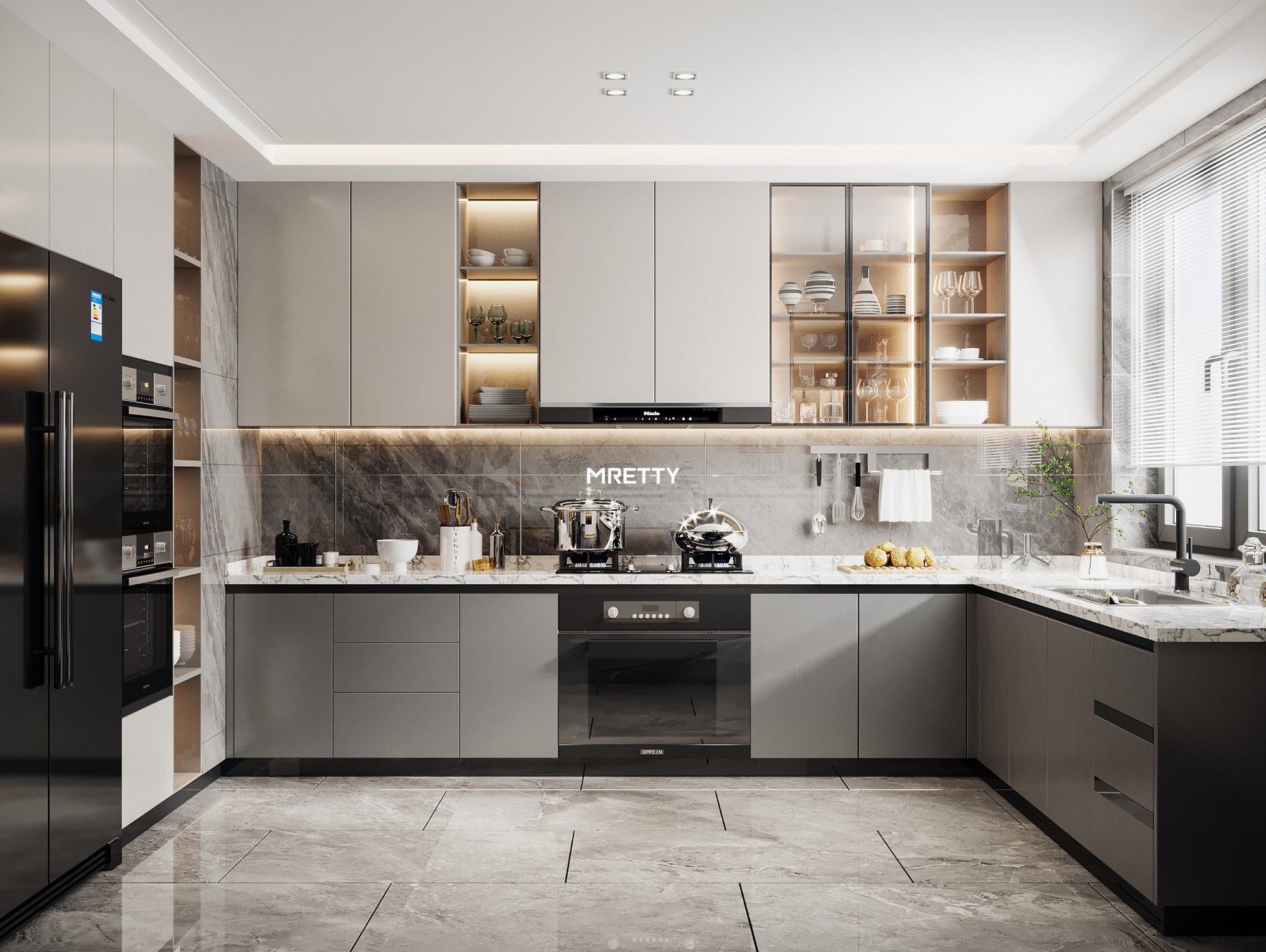
Choose the Right Materials for Long-Lasting Cabinets in Singapore's Climate
The best material for Singapore kitchen carcasses is moisture-resistant multi-layer plywood — the cross-grain structure blows MDF and particleboard out of the water for stability and warp resistance in humid air. MRETTY uses only high-density plywood + imported E0 boards across the line, ensuring cabinets last decades in the local climate.
Humidity is public enemy 1 for Singapore kitchen carpentry — it makes wood-composite materials swell, warp, delaminate, and encourages mould. Material choice is a technical question, not purely aesthetic.
MDF and particleboard act like sponges; compressed fine fibres absorb airborne moisture and irreversibly expand, causing permanent damage. Multi-layer plywood's cross-laminated grain structure resists this swelling and warping far better — that's why it's the pro choice for this climate.
❌ Common Mistake: Only focusing on laminate colour, ignoring the carcass core.
✅ Better Approach: Always ask "what's the carcass made of?" Ask for a raw sample and pinch the edge — the density and solidness of plywood vs particleboard are obvious once you feel them.
What's the Best Material for Kitchen Cabinets in Singapore's Climate?
For carcasses in high humidity, use multi-layer solid plywood with high-pressure laminate on the surface. Plywood wins on moisture resistance and strength. For health, choose "Singapore eco-friendly kitchen cabinet materials" like low-formaldehyde or E0 boards — formaldehyde emission below 0.5 mg/L, better for your family's indoor air than standard E1/E2 grades.
For finishes, laminate is durable, versatile, easy to wipe, with thousands of colours and textures available.
Verify Vendor Strength to Find the Best Cabinet Company in Singapore
Quotes and factory tours aren't enough — real skill hides in the execution details. When verifying vendor strength, I suggest watching four "invisible" dimensions:
1. Edge-Banding Process, Tested
Ask clearly: EVA hot-melt or PUR (polyurethane reactive) edge banding? In Singapore's humidity, EVA can start de-bonding and letting water in after 2–3 years; PUR is the long-term solution. Ask the vendor to show you an edge-banding cross-section — machine PUR banding gives a continuous, even cut; manual banding shows tiny breaks and glue-line bleed.
2. Hardware Spec Transparency
"Soft-close hinges" on a quote isn't enough — brand + series + warranty years must be written. Blum integrated soft-close hinges and Hettich soft-close slides are industry benchmarks; off-brand labelled "soft-close" often have dampers failing in six months. Demand hardware model numbers in the contract to avoid bait-and-switch.
3. Installation Team Affiliation
Ask: "Are the installers your employees or outsourced?" Outsourced crews are looser on precision — on-site cutting, gap-filling, door adjusting all depend on the worker's mood that day. MRETTY's installation team is dispatched straight from the factory, on the same tolerance standards as the production line — 0.1 mm cabinet precision can't be ruined by sloppy on-site installation.
4. After-Sales Response Speed
Clarify who comes during warranty and response time. Many contractors ghost after warranty expires; proper vendors keep a local after-sales contact. Our commitment to clients: hardware warranty per brand terms (Blum lifetime), carpentry structure 2 years, response within 48 hours.
Last month a client in a Bukit Batok resale HDB came to us — the contractor he used originally had sagging doors six months post-install. Called them up, got "the worker went back to Malaysia, back next month" — that kind of thing doesn't happen under an owned-factory + direct-dispatch installation model.
❌ Common Mistake: Only checking how the showroom sample feels during sales demo, not checking the QC process for actual production batches.
✅ Better Approach: Ask to see real-site handover photos (not polished marketing shots) of the same model order from that factory in the last three months — focus on corners, edge banding, and hinge alignment, the three points most likely to go wrong.
FAQ
Q: How long does custom kitchen cabinetry usually take in Singapore?
A: After design confirmation, factory production 3–5 weeks + installation 3–5 days, total 4–8 weeks. Direct-factory mode is typically 20% faster than outsourced models.
Q: Can I use particleboard for HDB kitchen cabinets?
A: Absolutely not for sink base and hob area — at Singapore's 80% humidity, particleboard swells within two years, and once the carcass goes the finish cracks. At minimum use moisture-resistant plywood in wet zones; full-house E0 is safer.
Q: How to choose between Blum and Hettich?
A: Both are tier-one. Blum's soft-close hinges and Legrabox drawer system are the benchmark; Hettich's carousel systems and slides each have strengths. You can mix — use Blum Aventos for lift-up doors, Hettich for heavy bottom draws; pick by function, no conflict.
Q: Does going direct-factory mean no design?
A: Not at all. The MRETTY model is "design + factory" integrated — designers and production line belong to one team, 3D render → production drawing → panel cutting is one chain, actually losing less in translation than "design outsourced + carpentry outsourced."
About the Author
Hanson
Besopke Home Design Specialist*
Hanson brings 14 years of design and project management experience, leading MRETTY's high-end kitchen and cabinetry system customisation across Singapore condos and landed homes, specialised in modern minimalist, Italian light-luxury, and French styles. Backed by MRETTY's 15,000 sq m smart factory, he weaves sub-millimetre precision, E0 eco-standards, and tropical-climate adaptation into every custom scheme, upgrading the kitchen from "storage room" to the home's core.
MRETTY: Premium Bespoke Kitchen & Cabinet Systems Provider in Singapore.
