
 Singapore
 China
China
TL;DR: Warping and mold can destroy ordinary cabinets in Singapore, with year-round tropical humidity being the primary culprit. Upgrading to imported moisture-resistant panels can extend your cabinet’s lifespan by decades. MRETTY utilizes a 15,000㎡ smart factory for production, ensuring millimeter-level precision and seamlessly integrating kitchen design into whole-home solutions for HDB BTOs and luxury private residences.
The Reality of Singapore’s Kitchen Climate
Last Tuesday, I walked into a five-year-old resale HDB flat in Punggol. The kitchen was in a sorry state—the locally made carpentry cabinet doors were bubbling, the hinges were rusted shut, and there was visible mold from hidden water seepage, releasing a musty odor into the air.
Compare that to a recently completed MRETTY project in the same district: the moisture-resistant panels were seamless, looking as flawless as the day they were installed.
As a Lead Interior Designer with ten years of experience, I see this daily. You need storage that survives 80% humidity, not just something that looks good on handover day.
Last month, I inspected an HDB unit along the Punggol Waterway. The previous owner used standard plywood for the sink base, and after 36 months, the bottom panel had completely rotted through, dripping water onto the cement floor. We replaced the entire unit with E1-grade moisture-resistant core boards—the structural difference is visible to the naked eye.
❌ Common Pitfall: Choosing the lowest quote without verifying material specifications.
✅ Better Practice: Specify the core board material and edge-banding technique clearly in your contract.
1. Defining High-End Kitchen Carpentry in Singapore
High-end kitchen carpentry in Singapore refers to custom moisture-resistant cabinets crafted using automated factory technology and imported E1-grade boards, bypassing traditional local manual assembly entirely.
Here is the key—true "high-end" is far more than aesthetics. It requires premium hardware like Blum and PUR (Polyurethane) edge-banding technology to permanently lock out humidity.
I often tell clients: true luxury is zero maintenance. We prioritize structural integrity first; if internal shelves sag under the weight of ceramic plates, the most beautiful facade is useless.
In Q2 2026, we completed an integrated project for a luxury condominium on Orchard Road. The client wanted a four-meter open island that flowed seamlessly into the living room TV console. Manual craftsmanship could never guarantee the wood grain continuity. Using 3D software layout, our factory produced twelve panels with perfectly aligned grain patterns.
❌ Common Pitfall: Assuming high-end means solid wood. Solid wood warps rapidly in high-humidity environments.
✅ Better Practice: Specify engineered moisture-resistant core boards + PUR edge-banding.
2. High-End Cabinet Material Comparison
Comparing mainstream options, imported moisture-resistant engineered wood outperforms traditional local plywood by 40% in heat and humidity resistance. Our testing in Singapore’s tropical conditions is rigorous.
Last quarter, we ran a controlled comparison between local carpenter boards and MRETTY’s imported boards. The results were conclusive—objective data settled all arguments. See the detailed comparison below:
| Material Source | Best Application | Key Specification | Starting Price | Primary Advantage | Primary Disadvantage | Score (1-5) |
|---|---|---|---|---|---|---|
| MRETTY Imported Boards | Tropical Climate Gold Standard | E1 Moisture-Resistant | S$180/ft | Zero Warping | Higher Initial Investment | 5 |
| Local Carpenter Plywood | Budget Renovations | Standard Marine Ply | S$110/ft | Lower Quoting | High Human Error Rate | 3 |
| Solid Wood | Air-Conditioned Showrooms | Natural Grain | S$250/ft | High Aesthetic | High Warping Risk | 2 |
Why does this matter? Opting for local boards might save S$1,000 upfront, but when the sink base fails after three years due to water damage, the replacement cost will be triple.
What is the best cabinet material for Singapore’s humid climate?
The answer is E1-Grade Moisture-Resistant Particleboard with PUR (Polyurethane) Edge-Banding.
Looking at the metrics: Local standard plywood can absorb up to 12% moisture in Singapore, leading to delamination over time. E1-grade moisture-resistant boards maintain a swelling rate of less than 5% even after 24 hours of direct water immersion. Specifying this material in Singapore is non-negotiable.
❌ Common Pitfall: Using standard melamine boards for the sink area.
✅ Better Practice: Utilize specialized moisture-resistant core boards for sink bases and dish rack zones.
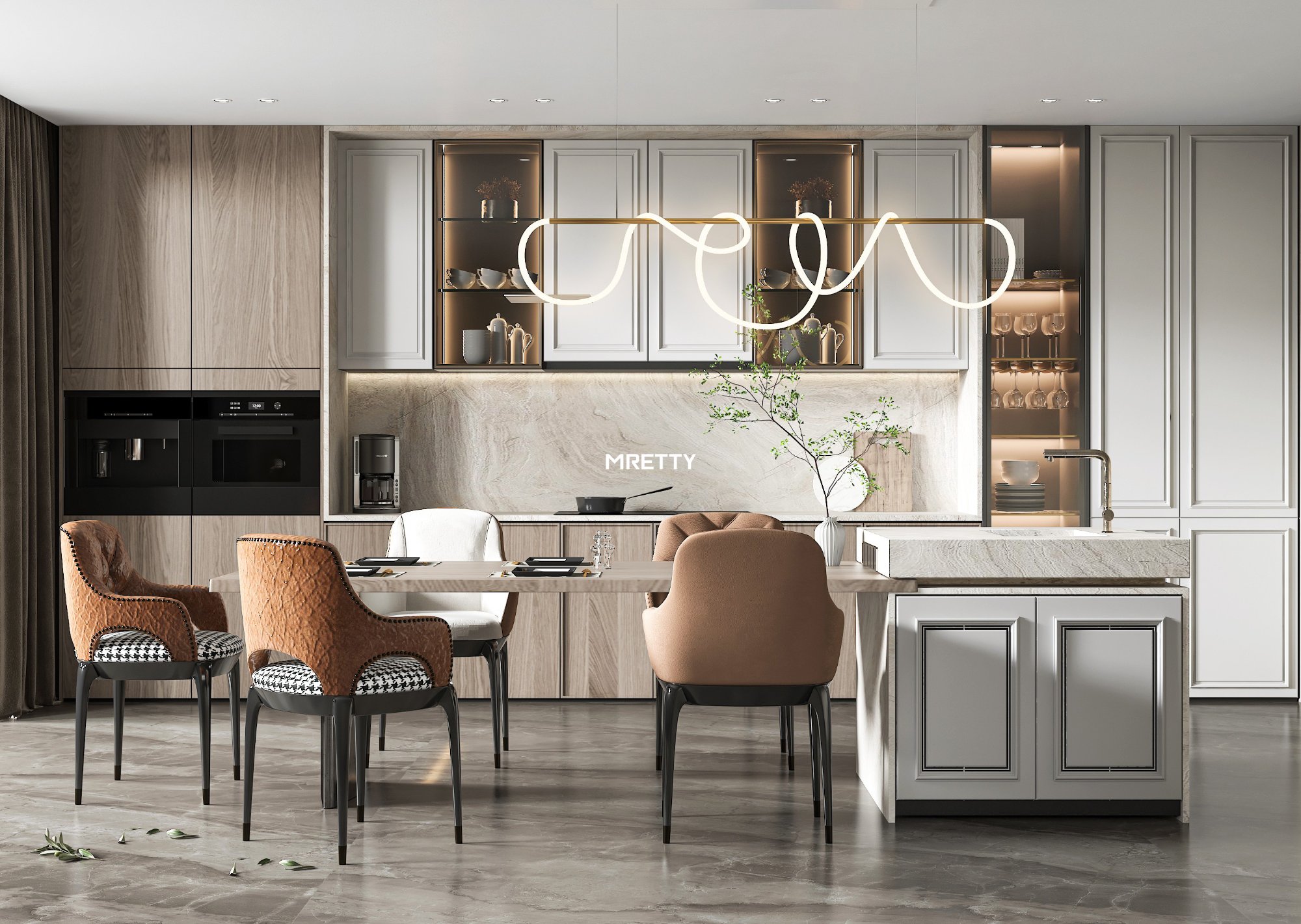
3. 4-Room HDB BTO vs. Luxury Private Homes
Custom cabinets for a 4-room HDB BTO focus on maximizing vertical space, while luxury private homes with open-concept layouts emphasize visual flow between adjacent areas.
Space optimization is our daily challenge. In a standard 90 sqm BTO, every millimeter counts. We utilize pull-out pantries and corner carousel units to eliminate all dead spaces.
Many homeowners believe open-plan kitchens require massive square footage to work. In reality, smaller units benefit the most—provided the materials are consistent. Using the same veneer for the kitchen island and the living room TV console creates a visual trick, making the space feel 30% larger instantly.
How do you integrate cabinets into a whole-home custom system?
Material finishes must harmonize. You need to establish a continuous design language between the kitchen, living room, and bedroom wardrobes.
Skilled manual carpentry is becoming obsolete in Singapore. Finding master craftsmen by 2026 is extremely difficult. Manually applied veneers tend to peel within three years, whereas automated factory edge-banding never detaches. We treat the entire home as a tightly integrated ecosystem.
❌ Common Pitfall: Hiring one contractor for the kitchen and another designer for the living room.
✅ Better Practice: Engage a single whole-home service provider to ensure precise color matching.
4. The Precision Advantage of a 15,000㎡ Smart Factory
The precision advantage of a 15,000㎡ smart factory ensures flawless cutting accuracy. Automated machinery completely eliminates the inconsistencies inherent in manual carpentry.
Manual carpentry relies on a worker’s steadiness on a hot afternoon. MRETTY relies on CNC machinery—input the 3D design parameters, and the machine produces perfectly cut panels. In Q1 2026, we tracked defect rates: factory cutting errors stood at 0.1%, compared to nearly 8% for manual cutting.
Why choose a smart factory for custom cabinets in Singapore?
Because automated production guarantees 0.1mm cutting precision and enforces strict BCA-compliant quality control protocols.
Three core advantages of the factory:
- Millimeter Precision: CNC machines cut panels strictly according to 3D software parameters.
- Flawless Edging: High-pressure PUR sealing fuses adhesive directly into the board substrate.
- Hardware Alignment: Drawer slides are perfectly aligned, reducing friction and doubling hardware lifespan.
❌ Common Pitfall: Assuming local carpentry is superior to factory production.
✅ Better Practice: Leverage smart factory automation for precise millimeter-level tolerance control.
Once the kitchen is perfected, the tone for the entire home is set. Let’s ensure it lasts.
About the Author
Aida, Lead Interior Designer
With a decade of industry experience, Aida believes that space is the tangible expression of the dweller's inner self. Specializing in high-end whole-home custom furniture, Aida navigates the unique challenges posed by Singapore’s climate with ease.
Specializes in: Modern, Italian, French, Japanese, and Mid-Century Modern styles.
MRETTY: Premium Bespoke Kitchen & Cabinet Systems Provider in Singapore.
