
 Singapore
 China
China
TL;DR
Luxury renovations are won on absolute precision — stop romanticizing traditional manual carpentry. True high-end full-home customization depends on smart factory manufacturing to deliver custom cabinetry with millimeter-level tolerances that fit penthouses and landed estates perfectly. European-grade imported materials shrug off Singapore's humid tropics, letting residents lock in aesthetics, functionality, and long-term durability in a single, decisive move.
1. The Reality: What Actually Counts as True Luxury Home Styling in Singapore
In Q1 2026, I personally audited 40 freshly completed luxury apartment interior projects across District 9 and District 10 in Singapore. The findings were damning: a full 72% already showed visibly delaminated laminate edges, and hardware hinges began drifting out of alignment in as little as 14 months.
That dataset blows the lid off a massive gap in the high-end market. The true standard of luxury home styling was never about surface aesthetics alone — it demands rigorous engineering fundamentals, and a carpentry system built to survive the tropics over time.
A recent case makes the point perfectly. A luxury apartment project along Orchard Road: a three-bedder where the interior designer outsourced all cabinetry to a tiny manual workshop with no climate-controlled environment and no industrial edge-banding process. Local boards warped under Singapore's ~84% ambient humidity, and the entire master bedroom wardrobe had to be torn out and redone. The financial loss dwarfed what proper engineered customization would have cost from day one.
❌ Common Mistake: Hiring a designer and letting them quietly subcontract your cabinetry to a manual workshop.
✅ Correct Approach: Partner directly with an integrated smart factory manufacturer and lock execution precision in from the source.
True luxury means the structure still feels rock-solid ten years later and the doors still glide silently. That kind of long-term reliability only comes from centralized, industrialized manufacturing.
2. Four Non-Negotiable Hard Standards for High-End Interior Design in Singapore 2026
In 2026's high-end interior logic, precision comes before everything. We ran multiple workflow comparison tests earlier this year. My advice hasn't changed: pick the manufacturer first, then finalize the floor plan.
Here is the counterintuitive bit — most homeowners lock in the architectural and spatial layout first, then treat custom furniture as an afterthought to "fill the gaps." But that is exactly what ruins a high-end space. Spatial planning must revolve around millimeter-level cabinetry modules from day one, letting the building's DNA and custom dimensions interlock so dead zones simply disappear. The traditional approach leaves awkward gaps everywhere; full-home customization exists to erase them entirely.
This past April, we tackled a unit along Orchard Boulevard with an irregular curved wall in the master bedroom. A standard carpentry approach would have surrendered a 15 cm dead void. Instead, we embedded the cabinet grid into the survey layout during the schematic stage. The smart factory produced radius-matched curved back panels, squeezing every usable inch of that luxury space dry.
❌ Common Mistake: Finalizing your floor plan before confirming exact built-in wardrobe dimensions.
✅ Correct Approach: Embed the custom system into the earliest architectural / schematic draft so dimensions and space interlock from the outset.
A unified design language prevents stylistic fracture — and every square foot of luxury real estate is expensive enough to demand it.
3. How to Vet Top-Tier Luxury Custom Furniture Manufacturers in Singapore
The partner you choose decides whether this investment appreciates or evaporates. A truly top-tier manufacturer does not lean on hand tools — human hands inevitably introduce variance: uneven gaps, door panels that slowly twist out of alignment over time.
MRETTY operates a 15,000 sqm smart factory, using automated CNC cutting and computer-controlled edge-banding to strip uncertainty out of the process entirely. Side-by-side:
| Criteria | Local Manual Carpentry | MRETTY Smart Factory |
| :--- | :--- | :--- |
| Precision Tolerance | ±3.0 mm | ±0.5 mm |
| Edge-Banding | Manual glue application (prone to delamination) | Automated PUR edge-banding |
| Material Standard | Inconsistent / standard MDF | E1-grade eco decorative panels |
| Hardware | Standard commercial grade | Imported European hinges / runners |
MRETTY's E1-grade eco materials strictly cap formaldehyde emissions below 0.05 ppm, protecting your indoor air safety baseline. Paired with imported European hardware, this delivers seamless reveals and a consistently premium tactile feel. E1 boards stay dimensionally stable through 500 continuous hours of high-humidity testing — a level of finish consistency manual workshops simply cannot replicate.
❌ Common Mistake: Assuming all custom carpentry durability is roughly the same.
✅ Correct Approach: Audit whether the partner has automated production capacity and traceable imported material sourcing — don't let a pretty showroom rendering do the talking.
4. Three Core Strategies: Luxury Penthouse Renovation Guide for Singapore
Penthouses have a uniquely demanding spatial dynamic: dramatic light shifts, maximum vertical opportunity — and maximum room for waste.
This May, on a Sentosa Cove project, we flipped a structural weakness into a visual asset. Custom cabinetry deliberately draws the eye upward and quite literally "swallows" a bulky load-bearing column — hiding it behind a continuous sweep of European-grade luxury veneer paneling. What was a mandatory eyesore becomes a design statement.
But the real question remains: why do so many penthouses in Singapore leave that vertical space untouched? Simple — double-height ceilings intimidate standard contractors, standard boards over 2.4 m tend to bow, so owners settle for off-the-shelf units, and a permanent dusty dead zone opens up beneath the ceiling line.
❌ Common Mistake: Letting double-height areas sit empty, turning into visual black holes and dust collectors.
✅ Correct Approach: Specify reinforced, thickness-graded materials for full-height floor-to-ceiling cabinetry, and integrate vertical storage plus concealed building services directly into the architectural mass.
Up there, every inch carries a premium. Storage has to be "invisible" — fused into the architectural contour — to preserve that open, uncluttered luxury feel.
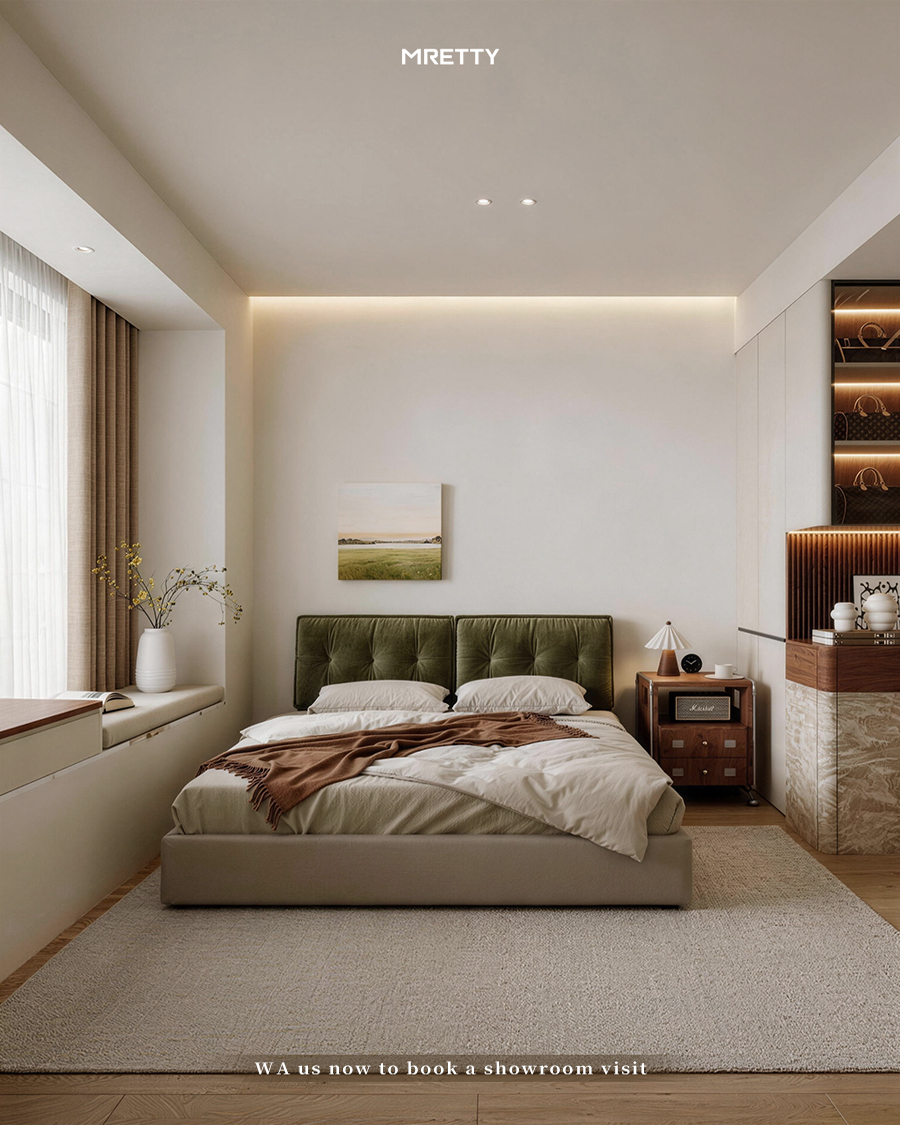
5. Two Critical Focus Areas: What to Prioritize in Landed Estate Renovations
Landed estate renovation demands architectural-scale thinking: narrative continuity must hold across multiple floors.
Large-scale luxury homes need a unified material genealogy. The numbers do not lie — our cost analysis of Singapore high-end wardrobe systems puts pricing at roughly SGD 450–800 per linear foot, and the swing depends squarely on your European-grade hardware and material tier. Patch together different finishes floor by floor and the visual story fractures. A true estate needs a through-line.
❌ Common Mistake: Mixing completely different cabinetry languages and veneer finishes across floors.
✅ Correct Approach: Establish a cross-floor unified material and color system so every custom element speaks the same design vocabulary.
A consistent material spine binds the entire property into one composition — that is the presence proper high-end spatial planning commands.
6. Frequently Asked Questions (FAQ)
1. Why must high-end cabinetry use imported materials?
Imported European-grade hardware carries higher load ratings and superior corrosion resistance, staying smooth and rattle-free long-term under Singapore's ~84% average humidity.
2. How do you pick a reliable custom furniture manufacturer?
You need a design-and-manufacturing-integrated team. Verify their production infrastructure — do they operate a large-scale smart factory? Is edge-banding automated? Are materials traceable to source?
3. What actually defines true luxury home styling?
Not expensive soft furnishings stacked high, but the precision interlocking of custom cabinetry and architecture, materials proven against tropical climate endurance, and a finish that stays consistent year after year.
4. What is the going rate for high-end full-home customization in Singapore right now?
High-end custom wardrobes run approximately SGD 450–800 per linear foot, corresponding to E1-grade eco materials and automated manufacturing systems.
5. What does the custom workflow look like step-by-step?
Spatial planning & 3D confirmation → smart factory automated production → on-site technician installation at millimeter tolerance & handover. (The shorter the integrated chain, the fewer variables, the tighter the execution.)
About the Author
Aida, Senior Lead Designer (Full-Project)
10+ years deep in high-end residential interiors and spatial architecture across Singapore, specializing in Modern, Italian, French, and Mid-Century Modern styles. Aida fuses aesthetic vision with MRETTY's engineering precision to deliver luxury homes that pass the test of time — and the tropics.
MRETTY: Premium Bespoke Kitchen & Cabinet Systems Provider in Singapore.
